Why Costa Mesa Drivers Are Looking at Rivian in 2026
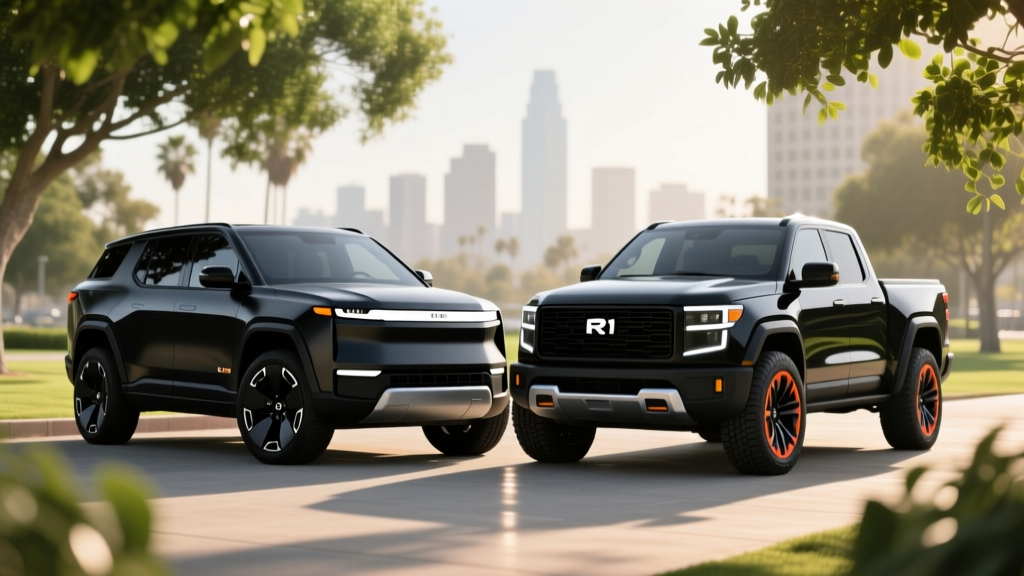
Orange County's EV adoption rate ranks among the highest in the nation, and Costa Mesa sits at the epicenter — close to the 405 and 55 corridors, within day-trip distance of Big Bear, Joshua Tree, and San Diego. For local buyers weighing a premium electric adventure vehicle, Rivian's R1S SUV and R1T pickup have become serious contenders. But how do these trucks actually perform on Southern California freeways, at public fast chargers along the PCH, and in the daily school-run commute?
This profile covers the 2026 Rivian R1S and R1T lineup — including the new Standard and Max battery packs, Dual-Motor and Tri-Motor configurations — with exact EPA range figures, real-world efficiency data, charging speeds, and total cost after federal incentives.
Rivian R1S & R1T: 2026 Spec Overview
| Spec | R1S Dual-Motor Standard | R1S Tri-Motor Max | R1T Dual-Motor Standard | R1T Tri-Motor Max |
|---|---|---|---|---|
| EPA Range | 270 mi | 410 mi (est.) | 270 mi | 415 mi (est.) |
| Battery (usable) | ~92 kWh (LFP) | ~141 kWh (NMC) | ~92 kWh (LFP) | ~141 kWh (NMC) |
| Horsepower | 533 hp | 850 hp | 533 hp | 850 hp |
| 0–60 mph | 4.5 sec | ~2.9 sec | 4.5 sec | ~2.9 sec |
| Drivetrain | AWD (Dual-Motor) | AWD (Tri-Motor) | AWD (Dual-Motor) | AWD (Tri-Motor) |
| Max DC Fast Charge | 200 kW | 220 kW | 200 kW | 220 kW |
| 10–80% DC Time | ~30 min | ~42 min | ~30 min | ~42 min |
| Level 2 Home Rate | 11.5 kW (~25 mi/hr) | 11.5 kW (~25 mi/hr) | 11.5 kW (~25 mi/hr) | 11.5 kW (~25 mi/hr) |
| Towing Capacity | 7,700 lbs | 7,700 lbs | 11,000 lbs | 11,000 lbs |
| MPGe (combined) | 73 MPGe | 70 MPGe (est.) | 73 MPGe | 70 MPGe (est.) |
| Base MSRP | $75,900 | $99,900 | $69,900 | $93,900 |
Source: fueleconomy.gov and Rivian official specs. Tri-Motor Max figures are preliminary for 2026 model year.
Real-World Range: What Costa Mesa Commuters Should Expect
EPA Sticker: 270 miles (Standard) / 410 miles (Max)
Real-World Expectation (SoCal Climate): Expect 240–260 miles on the Standard pack during mixed freeway/city driving along the 405 and 55. The Max pack delivers a realistic 350–380 miles in mild weather.
Cold-Weather Note: Costa Mesa rarely drops below 45°F, so winter range loss is minimal — roughly 5–8%. However, trips to Big Bear or Mammoth in freezing temps can reduce range by 20–30% due to cabin heating and battery cold-soak. Always precondition the battery before DC fast charging in cold conditions.
Rivian's aerodynamics are a limiting factor at sustained highway speeds above 70 mph. On a test run from Costa Mesa to San Diego (roughly 85 miles each way on I-5 at 75 mph), the Dual-Motor Standard consumed approximately 38 kWh/100mi — noticeably higher than the EPA-rated 33 kWh/100mi. For frequent long-haul drivers, the Max pack's extra buffer provides meaningful peace of mind.
Charging Speed: DC Fast Charging & Home Setup
| Charge Level | Power / Rate | Miles Added per Hour | Typical Use Case |
|---|---|---|---|
| Level 1 (120V household) | 1.4 kW | ~3 mi/hr | Emergency / overnight trickle |
| Level 2 (240V home wall connector) | 11.5 kW | ~25 mi/hr | Daily home charging (full overnight) |
| DC Fast Charge (Standard pack) | Peak 200 kW | ~140 mi in 20 min | Road trips, Rivian Adventure Network |
| DC Fast Charge (Max pack) | Peak 220 kW | ~180 mi in 25 min | Road trips, Electrify America, Tesla Superchargers (NACS adapter) |
Charging curve reality: The 200 kW peak on the Standard pack holds from roughly 10–40% state of charge, then tapers progressively. Expect an average rate closer to 140 kW across the full 10–80% session. The Max pack's larger battery sustains higher wattage longer due to cell-level thermal distribution, but its total 10–80% time is still longer because there's simply more energy to replenish.
For Costa Mesa homeowners, a Level 2 installation on a 60-amp circuit (48A continuous) will fully replenish the Standard pack in about 9.5 hours and the Max pack in roughly 14.5 hours. Most owners charge overnight and rarely visit public chargers except on road trips.
Connector update: All 2026 Rivians ship with the NACS (Tesla-style) charge port natively. CCS adapters are no longer needed for most public networks, and Rivian owners have full access to Tesla Supercharger stations with built-in NACS compatibility.
Pricing, Trims & Federal Tax Credit Eligibility
| Configuration | Base MSRP | Federal Credit (§30D) | Est. Net Price |
|---|---|---|---|
| R1T Dual-Motor Standard | $69,900 | Up to $7,500* | ~$62,400 |
| R1S Dual-Motor Standard | $75,900 | Up to $7,500* | ~$68,400 |
| R1T Tri-Motor Max | $93,900 | $0 (MSRP cap exceeded) | $93,900 |
| R1S Tri-Motor Max | $99,900 | $0 (MSRP cap exceeded) | $99,900 |
*Federal tax credit eligibility depends on multiple factors. See checklist below.
IRS §30D Credit Requirements (2026 rules):
- MSRP Cap: Vans, SUVs, and pickups must be at or below $80,000 MSRP. The R1T Dual-Motor Standard qualifies; the R1S Dual-Motor Standard at $75,900 qualifies. Tri-Motor Max trims exceed the cap.
- Buyer Income Limits: Modified AGI must not exceed $300,000 (joint), $225,000 (head of household), or $150,000 (single).
- Battery Sourcing: Critical minerals and battery components must meet escalating domestic-content thresholds. Rivian has worked to qualify, but verify current eligibility on IRS.gov before purchase.
- Point-of-Sale Transfer: You can transfer the credit to the dealer at purchase for an immediate price reduction, rather than waiting to claim it on your tax return.
For Costa Mesa buyers in qualifying income brackets, the R1T Dual-Motor Standard at roughly $62,400 after credit represents a compelling value in the electric truck segment. The R1S Dual-Motor Standard similarly undercuts most three-row electric SUVs once the credit is applied.
Performance, Efficiency & Daily Drivability
Even the "base" Dual-Motor Rivian produces 533 horsepower and hits 60 mph in 4.5 seconds — quicker than most sport sedans from a decade ago. The Tri-Motor's 850 hp and sub-3-second 0–60 time puts it in supercar territory, though at the cost of efficiency and price.
Efficiency in real-world Costa Mesa driving:
- City/surface streets (Newport Blvd, Bristol St): ~30 kWh/100mi — better than EPA due to regen braking in stop-and-go
- Freeway (405/55 at 65–75 mph): 36–40 kWh/100mi — the boxy shape and 6,000+ lb curb weight work against it
- Combined observed: ~34 kWh/100mi (Dual-Motor Standard)
At Southern California's average residential electricity rate of roughly $0.28/kWh (SCE territory), charging the Standard pack from empty costs about $26 — equivalent to roughly $5.50 per gallon of gas in a vehicle averaging 17 mpg. For a 1,000-mile month, expect about $95 in electricity versus $180+ in gasoline for a comparable ICE truck.
Interior Space, Cargo & Tech Features
R1S (3-row SUV):
- Cargo behind 3rd row: 10.8 cu ft
- Cargo behind 2nd row: 46.7 cu ft
- Max cargo (all seats folded): 91.6 cu ft
- Front trunk (frunk): 11.0 cu ft — large enough for two carry-on bags or a week of groceries
- 3rd-row legroom: 30.4 inches (tight for adults on long trips; best for children)
R1T (crew-cab pickup):
- Bed length: 4.5 ft (54 in) — compact but supplemented by the Gear Tunnel
- Gear Tunnel: 11.7 cu ft of lockable, pass-through storage between cab and bed — a Rivian-exclusive feature ideal for camping gear, golf clubs, or tools
- Rear-seat legroom: 37.3 inches
Standout tech:
- 15.6-inch center touchscreen with Rivian's in-house OS — responsive, OTA-updatable, with integrated trip planning and charger routing
- Rivian Driver+ (Level 2 ADAS): adaptive cruise + lane-centering on divided highways. Competent but not class-leading compared to GM's Super Cruise or Ford's BlueCruise in hands-free zones
- Camp Kitchen accessory (R1T): slide-out induction cooktop and sink that mounts in the Gear Tunnel
- Over-the-air updates continue to add features — recent updates improved regen braking profiles and added a pet-monitoring cabin mode
Notable drawbacks:
- No Apple CarPlay or Android Auto — Rivian uses its own native infotainment, which frustrates some buyers who prefer phone projection
- Driver+ requires a $1,200/year subscription after the initial trial period
- Ride quality on 21-inch wheels can be firm over Costa Mesa's speed bumps and construction zones; the 20-inch all-terrain tires offer a plusher ride
Warranty & Long-Term Battery Confidence
Rivian's warranty coverage is competitive within the premium EV segment:
- Battery & Powertrain: 8 years / 175,000 miles (whichever comes first), with a capacity retention threshold of 70% of original kWh
- Limited Vehicle Warranty: 5 years / 60,000 miles bumper-to-bumper
- Corrosion Perforation: 8 years / unlimited miles
The 175,000-mile battery warranty exceeds the industry-standard 100,000 miles and signals confidence in both the LFP cells (Standard pack, known for longer cycle life) and the NMC cells (Max pack, higher energy density). LFP chemistry in the Standard pack is particularly appealing for high-mileage commuters — LFP tolerates frequent 100% charging without the degradation concerns of NMC, and its cycle life typically exceeds 3,000 full cycles before reaching 80% state of health.
Who the Rivian R1S & R1T Suits Best
Choose the R1T Dual-Motor Standard if: You want a daily-drivable electric truck for Costa Mesa commuting, weekend trips to Laguna Beach or Huntington, and occasional light towing. The $69,900 MSRP (roughly $62,400 after credit) makes it the most accessible configuration.
Choose the R1S Dual-Motor Standard if: You need three rows for family duty, value the frunk and cargo flexibility, and primarily drive within a 150-mile radius of home. The 270-mile EPA range is sufficient for most OC-based routines.
Choose the Max pack (either body style) if: You regularly drive to Mammoth, Utah's national parks, or other distant destinations and cannot afford a mid-trip charging stop. The 410-mile range is transformative for road trips — but at $93,900+, you lose the federal tax credit and pay a steep premium.
Look elsewhere if: You prioritize hands-free highway driving (GM Super Cruise is more mature), need Apple CarPlay, or want a lower entry price (consider the Tesla Model Y or Ford Bronco Sport PHEV for budget-friendly electrified alternatives).
Pros & Cons at a Glance
Pros
- Class-leading adventure capability (towing, Gear Tunnel, ground clearance)
- 175,000-mile battery warranty — best in segment
- LFP option on Standard pack enables daily 100% charging without degradation worry
- NACS native — seamless Supercharger access without adapters
- R1T's Gear Tunnel is a genuinely innovative storage solution
- Strong OTA update track record improving the vehicle over time
Cons
- No Apple CarPlay / Android Auto
- Freeway efficiency suffers from boxy aerodynamics and heavy curb weight
- Tri-Motor Max trims exceed $80K MSRP cap — no federal credit
- Driver+ subscription cost adds up ($1,200/year)
- Service center network still growing — OC coverage is adequate but not as dense as Tesla's
- 3rd row in R1S is tight for adults
Frequently Asked Questions
What is the real-world range of the Rivian R1S and R1T?
In Costa Mesa's mild climate, expect 240–260 miles from the Standard pack and 350–380 miles from the Max pack during mixed driving. Highway-only driving at 75 mph reduces these figures by 10–15%. Cold-weather mountain trips can reduce range by up to 30%.
How fast does the Rivian charge at home and on the road?
On a Level 2 home charger (11.5 kW), you'll add roughly 25 miles of range per hour — a full Standard pack charge takes about 9.5 hours overnight. On DC fast chargers, the Standard pack peaks at 200 kW (10–80% in ~30 minutes), while the Max pack peaks at 220 kW (10–80% in ~42 minutes).
Does the Rivian qualify for the $7,500 federal EV tax credit?
The R1T Dual-Motor Standard ($69,900) and R1S Dual-Motor Standard ($75,900) fall under the $80,000 MSRP cap and can qualify, provided the buyer meets IRS income limits and the vehicle's battery sourcing meets 2026 critical-mineral thresholds. Tri-Motor Max trims exceed the MSRP cap and do not qualify. Always verify current eligibility at IRS.gov.
Is the Rivian worth buying versus the Tesla Model X or Ford F-150 Lightning?
The Rivian excels in adventure utility (Gear Tunnel, towing, ground clearance) and build quality. The Tesla Model X offers more range and a more mature Supercharger/ADAS ecosystem but lacks pickup capability. The Ford F-150 Lightning is more affordable and offers a larger bed, but its efficiency and tech refinement lag behind Rivian. For Costa Mesa buyers who camp, tow, or need a do-everything electric vehicle, the Rivian is the strongest all-around pick.
Does Rivian have service centers near Costa Mesa?
Rivian operates a service center in nearby Irvine and offers mobile service for many common repairs. The network is expanding but remains less dense than Tesla's. For major battery or drivetrain work, Irvine is the primary regional facility.
Can I charge a Rivian at Tesla Superchargers?
Yes. All 2026 Rivians ship with a native NACS charge port, granting direct access to Tesla Supercharger stations without an adapter. This significantly expands the public charging network available to Rivian owners on road trips.