Quick Verdict: The Family EV Benchmark Still Stands
The Tesla Model Y remains the default answer when someone asks, "Which EV should a family buy?" And for good reason: a 310-mile EPA range, a usable Supercharger network, and cargo volume that swallows two strollers without breaking a sweat. But as the 2026 model year arrives with refreshed styling, a revised interior, and new competition from the Hyundai Ioniq 5, Ford Mustang Mach-E, and Kia EV9, the Model Y's dominance is no longer a foregone conclusion. This review puts the family lens front and center — rear-seat space, car-seat compatibility, road-trip charging, and the real cost of ownership after incentives.
EPA sticker: 310 miles (Long Range AWD, 19-inch wheels).
Real-world expectation: 265–285 miles on a mixed highway trip at 70 mph; 220–240 miles in sub-30°F winter conditions. Add roughly 15 miles if you opt for the 20-inch Induction wheels at the cost of ride comfort.
Spec Table: 2026 Tesla Model Y Long Range AWD
| Spec | Value |
|---|---|
| EPA Range | 310 miles (Long Range AWD) |
| Battery (usable) | ~75 kWh usable / ~81 kWh gross, NMC (2170 cells) |
| Drivetrain | Dual-motor AWD |
| Horsepower | 384 hp (combined) |
| 0–60 mph | 4.8 seconds |
| Max DC Fast Charge | 250 kW peak |
| 10–80% DC Time | ~25 minutes |
| Level 2 Home Charge | 11.5 kW (~44 miles/hr) |
| EPA Efficiency | 122 MPGe combined / 28 kWh/100mi |
| Cargo (behind 2nd row) | 30.2 cu ft |
| Cargo (seats folded) | 72.1 cu ft |
| Rear Legroom | 38.4 inches |
| Frunk | 4.1 cu ft |
| Battery Warranty | 8 years / 120,000 miles (70% retention) |
| Base MSRP | $44,990 (Long Range AWD) |
| As-Tested (w/ FSD, 20" wheels) | ~$56,490 |
Range, Battery Chemistry, and What Families Actually See
The 2026 Model Y Long Range AWD uses a ~81 kWh gross nickel-manganese-cobalt (NMC) pack built from Tesla's 2170 cells. NMC delivers higher energy density than lithium iron phosphate (LFP), which is why the Long Range trim gets 310 miles while the RWD Standard Range (LFP-based, ~57 kWh usable) tops out at roughly 260 miles.
What this means for family life: NMC packs tolerate frequent DC fast charging well, but Tesla still recommends daily charging to 80% and 100% only for road trips. LFP packs, by contrast, can sit at 100% daily without accelerated degradation — a factor if your commute is short and you charge at home nightly. For a two-car household where the Model Y is the road-trip rig, NMC is the right call. For a single-car family doing 30-mile school runs, the Standard Range LFP variant is the lower-degradation play.
On a 68°F spring day with mixed suburban and highway driving, expect to see 290–300 miles from a full charge. Push 75–80 mph on the interstate with the climate running and that drops to 265–285. In 20°F weather with the heat pump active, plan for 220–240 miles. Tesla's heat pump is among the best in the industry, but physics still wins in deep cold.
Charging Speed: Home, Destination, and DC Fast
The Model Y's 250 kW peak DC fast-charge rate is no longer class-leading — the Hyundai Ioniq 5 peaks at 236 kW but sustains it longer thanks to its 800-volt architecture, and the Porsche Macan EV pushes past 270 kW. But Tesla's advantage is the Supercharger network: over 50,000 stalls globally, with Plug & Charge authentication that still beats any CCS network's reliability.
| Charging Level | Power | Miles Added per Hour | Typical Use Case |
|---|---|---|---|
| Level 1 (120V outlet) | ~1.4 kW | ~4–5 mi/hr | Overnight trickle, emergency top-off |
| Level 2 (240V, 48A Wall Connector) | 11.5 kW | ~44 mi/hr | Daily home charging, full charge in ~7 hours |
| Level 2 (public, 40A) | 9.6 kW | ~37 mi/hr | Destination charging, workplaces |
| DC Fast (Supercharger V3) | 250 kW peak | ~1,000 mi/hr at peak | Road trips; 10–80% in ~25 min |
| DC Fast (CCS adapter, EA/Ionity) | Up to 150–250 kW | Varies | Non-Tesla networks via NACS-to-CCS adapter |
Charging curve reality check: The Model Y hits 250 kW only below ~35% state of charge. By 60% SoC, you're down to roughly 110 kW. By 80%, it tapers to ~50 kW. That 10–80% time of 25 minutes assumes you arrive at a low SoC and the battery is preconditioned — which the navigation system handles automatically when you route to a Supercharger. Skip preconditioning on a cold day and that 10–80% time can stretch past 35 minutes.
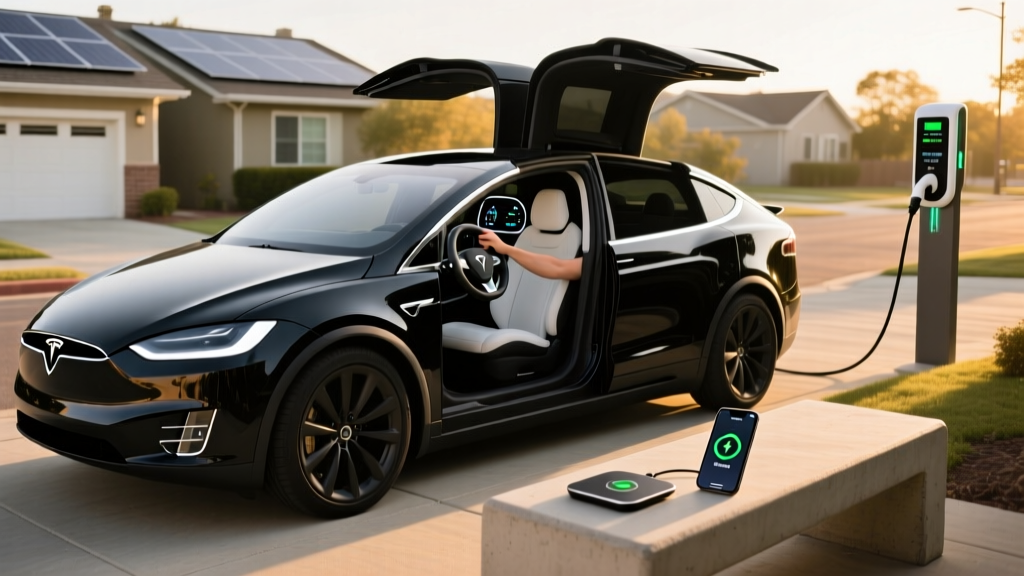
For home charging, Tesla's Wall Connector ($420) on a 60-amp circuit delivers the full 48A/11.5 kW. A typical electrician install runs $800–$2,500 depending on panel proximity and whether your home needs a service upgrade from 100A to 200A. Factor that into your first-year budget.
Family Practicality: Car Seats, Cargo, and the Optional Third Row
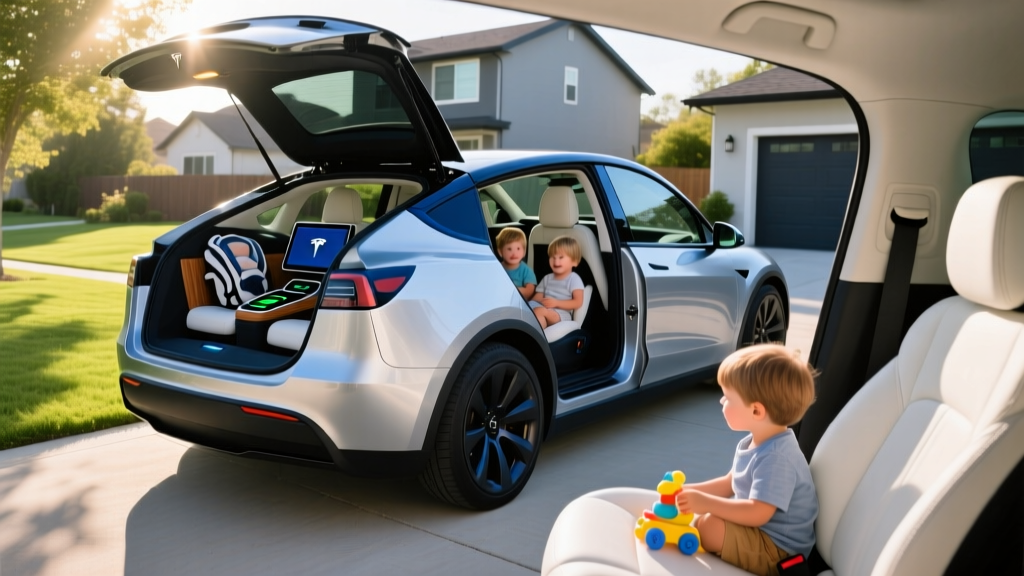
The Model Y's 38.4 inches of rear legroom is adequate for rear-facing car seats, though the sloping roofline cuts into headroom for taller passengers and makes loading a bulky forward-facing seat slightly more awkward than in a boxier SUV like the Kia EV9 (42.0 inches rear legroom). Two LATCH anchor sets are standard on the outboard rear seats; the center position uses a tether-only setup.
Cargo volume is where the Model Y punches above its class: 30.2 cu ft behind the second row beats the Ioniq 5 (27.2 cu ft) and the Mach-E (29.7 cu ft). Fold the 60/40 rear seats and you get 72.1 cu ft — enough for a week's family luggage or a Costco haul that would overwhelm most compact crossovers. The 4.1-cu-ft frunk handles charging cables, a diaper bag, or groceries you want separated from the main cargo area.
The third-row question: Tesla offers an optional third row for the Model Y, bringing seating to seven. Be realistic about this: the third row is viable only for children under about 5'4" and turns the cargo area into a token 10 cu ft. For families who regularly need to haul more than five people, the Kia EV9 or a minivan remains the honest answer. The Model Y's third row is a "sometimes" solution, not a daily one.
Tech, Safety, and Driver Assistance
The refreshed Model Y interior ditches the stalk-mounted turn signals and gear selector — everything is now on the 15.4-inch touchscreen and steering-wheel controls. This minimalist approach continues to polarize; families with a second driver who rotates between a traditional car and the Tesla should budget a week of adjustment.
Standard Autopilot includes Traffic-Aware Cruise Control and Autosteer (lane centering). Full Self-Driving (Supervised) adds automatic lane changes, traffic-light recognition, and city-street navigation for an additional $8,000 (or $99/month subscription as of 2026). Critical clarity: FSD Supervised is an SAE Level 2 system — the driver must remain attentive, hands on or near the wheel, and legally liable at all times. It is not autonomous driving. Families who expect a chauffeur will be disappointed; families who want highway fatigue reduction will find genuine value.
Safety ratings remain strong: the Model Y earned a 5-star overall rating from NHTSA and the IIHS Top Safety Pick+ designation (specific model-year testing applies). The low center of gravity from the floor-mounted battery makes rollover risk among the lowest in the SUV segment.
Pricing, Tax Credits, and 5-Year Ownership Cost
| Trim | Base MSRP | Federal §30D Credit | Effective Price (if eligible) |
|---|---|---|---|
| Standard Range RWD | $39,990 | Up to $7,500* | ~$32,490 |
| Long Range AWD | $44,990 | Up to $7,500* | ~$37,490 |
| Performance AWD | $48,990 | Up to $7,500* | ~$41,490 |
*Eligibility for the full $7,500 IRS §30D credit requires: buyer AGI below $150K single / $300K joint; vehicle MSRP under $80,000 (SUVs); battery critical-mineral and component sourcing thresholds met (rules tighten annually through 2032). As of 2026, the Model Y Long Range AWD qualifies for the full credit when purchased new, but always verify current sourcing compliance on the IRS qualified-vehicles list before signing. Point-of-sale transfer is available, reducing your dealer invoice directly.
On the cost-to-own side, the Model Y's 28 kWh/100mi efficiency translates to roughly $0.045/mile at the U.S. average residential electricity rate of $0.16/kWh. Compare that to a 25-MPG gas SUV at $3.40/gallon: $0.136/mile. Over 15,000 annual miles, that's a $1,365/year fuel savings — real money that offsets the higher insurance premiums Tesla owners typically face (expect $1,800–$2,800/year depending on state and driving record).
Tesla Model Y vs. the Family EV Competition
Against the Hyundai Ioniq 5: The Ioniq 5 offers 800V charging (10–80% in 18 min), a more conventional interior with physical buttons, and a starting price roughly $4,000 lower. It sacrifices ~40 miles of range and has a smaller CCS charging network. For families who prioritize charging speed over range and want a less screen-dependent cabin, the Ioniq 5 is a legitimate alternative.
Against the Kia EV9: The EV9 is the only mainstream three-row electric SUV under $60K. It's larger, boxier, and genuinely seats six or seven adults. If your family genuinely needs three rows daily, the EV9 is the answer. If you need it twice a year, the Model Y with its optional jump seat is the more efficient daily driver.
Against the Ford Mustang Mach-E: The Mach-E offers a more engaging driving feel and a physical key fob (yes, some families care). Range and efficiency are comparable. The gap is charging network reliability — Ford now accesses Superchargers via adapter, but the native Tesla experience remains smoother.
- 310-mile EPA range with best-in-class efficiency (122 MPGe)
- Supercharger network: still the most reliable DC fast-charge ecosystem
- Class-leading cargo volume (72.1 cu ft folded)
- Over-the-air updates continuously add features
- Strong safety ratings (NHTSA 5-star, IIHS TSP+)
- Optional third row for occasional 7-passenger needs
- Stalkless controls require adjustment period
- Rear headroom compromised by coupe-like roofline
- FSD Supervised is expensive and still Level 2, not autonomous
- Insurance premiums run 20–40% higher than segment average
- 250 kW peak charge rate now trails 800V competitors
- Third row only practical for small children
Who the Model Y Suits Best
Buy it if: You're a family of four (or five with small children) that takes 2–4 road trips a year, has home Level 2 charging access, and values the Supercharger network's reliability above all else. The Model Y's combination of range, efficiency, and cargo space remains unmatched in its price bracket.
Look elsewhere if: You need genuine three-row adult seating (Kia EV9), prefer physical controls and faster peak charging (Hyundai Ioniq 5), or want a more traditional SUV profile with easier car-seat loading.
Frequently Asked Questions
What is the real-world range of the Tesla Model Y Long Range?
EPA rates it at 310 miles. Expect 265–285 miles on a highway-dominant trip at 70–75 mph, and 220–240 miles in sub-freezing winter weather with the heat pump running. City driving with frequent regenerative braking can push you close to or slightly above the EPA number.
How fast does the Model Y charge at home and on the road?
At home on a 48A Level 2 Wall Connector, it charges at 11.5 kW, adding roughly 44 miles of range per hour — a full charge in about 7 hours. On a Tesla V3 Supercharger, it peaks at 250 kW and charges from 10–80% in approximately 25 minutes with battery preconditioning active.
Does the 2026 Tesla Model Y qualify for the $7,500 federal tax credit?
Yes, as of 2026 the Model Y Long Range AWD qualifies for the full $7,500 §30D credit, provided the buyer's AGI is under $150K (single) or $300K (joint) and the vehicle's battery meets the year's critical-mineral and component-sourcing thresholds. The credit can be transferred at the point of sale, reducing your purchase price directly. Always check the IRS qualified vehicles list before purchasing, as sourcing rules tighten annually.
Is the Model Y better than the Kia EV9 or Hyundai Ioniq 5 for families?
It depends on your family's size and habits. The Model Y wins on range, efficiency, and charging-network reliability. The EV9 wins on genuine three-row seating and cargo height. The Ioniq 5 wins on charging speed and a more conventional interior. For a family of four that road-trips regularly, the Model Y remains the strongest all-around pick.
How much does a Tesla home charger cost to install?
The Tesla Wall Connector costs $420. Professional installation on a 60A/240V circuit typically runs $800–$2,500 if your electrical panel has capacity. If your home needs a service upgrade from 100A to 200A, add $1,500–$3,500. Total first-year home-charging investment: $1,200–$6,400 depending on your panel.
What is the Model Y's battery warranty?
Tesla covers the Long Range battery and drive unit for 8 years or 120,000 miles, whichever comes first, with a guaranteed minimum 70% capacity retention. The Standard Range (LFP) variant carries an 8-year/100,000-mile warranty at the same 70% threshold.