If you've typed "Tesla house for sale" into a search bar recently, you're far from alone. Real-estate listings featuring a Tesla in the driveway — or better, a Tesla Powerwall and Wall Connector in the garage — consistently attract buyer attention. But for most EV-curious home shoppers, the real question isn't about the house. It's about the car parked in front of it: the 2026 Tesla Model Y, the best-selling electric vehicle in the U.S. and the EV most commonly bundled into the suburban-ownership lifestyle.
This review breaks down the 2026 Model Y with the exact numbers buyers need — EPA range versus real-world expectation, DC fast-charge curves, battery chemistry, §30D tax-credit eligibility, and total cost of ownership — so you can decide whether this is the right EV to park in that new garage.
2026 Tesla Model Y: Quick Verdict
The refreshed Model Y (internally called "Juniper") remains the default EV for families who want one vehicle to handle commuting, road trips, cargo hauling, and Supercharger access. Its combination of 320 miles of EPA range (Long Range AWD), a mature Supercharger network, and competitive pricing keeps it at the top of the EV sales chart. The trade-offs are familiar: a minimalist interior that won't suit traditionalists, a firm ride on the standard 19-inch wheels, and the ongoing requirement to supervise Tesla's Level 2 Autopilot/FSD systems at all times.
| Spec | Long Range AWD | Performance AWD | Rear-Wheel Drive (Standard) |
|---|---|---|---|
| EPA Range | 320 mi | 295 mi | 277 mi |
| Battery (usable) | ~75 kWh, NMC | ~75 kWh, NMC | ~57.5 kWh, LFP |
| Peak DC Fast Charge | 250 kW | 250 kW | 170 kW |
| 10-80% DCFC Time | ~25 min | ~25 min | ~30 min |
| Level 2 Home Rate | 11.5 kW (~44 mi/hr) | 11.5 kW (~44 mi/hr) | 11.5 kW (~44 mi/hr) |
| 0-60 mph | 4.8 sec | 3.5 sec | 6.5 sec |
| Horsepower | 384 hp | 456 hp | 295 hp |
| Drivetrain | Dual-Motor AWD | Dual-Motor AWD | RWD |
| MPGe (combined) | 111 MPGe | 103 MPGe | 118 MPGe |
| Efficiency | 30 kWh/100mi | 33 kWh/100mi | 28 kWh/100mi |
| Base MSRP | $44,990 | $51,490 | $39,990 |
| Battery Warranty | 8 yr / 120,000 mi | 8 yr / 120,000 mi | 8 yr / 100,000 mi |
Source: fueleconomy.gov, Tesla spec sheet. Figures reflect 2026 model year; verify at purchase.
Real-World Range: What 320 EPA Miles Actually Means
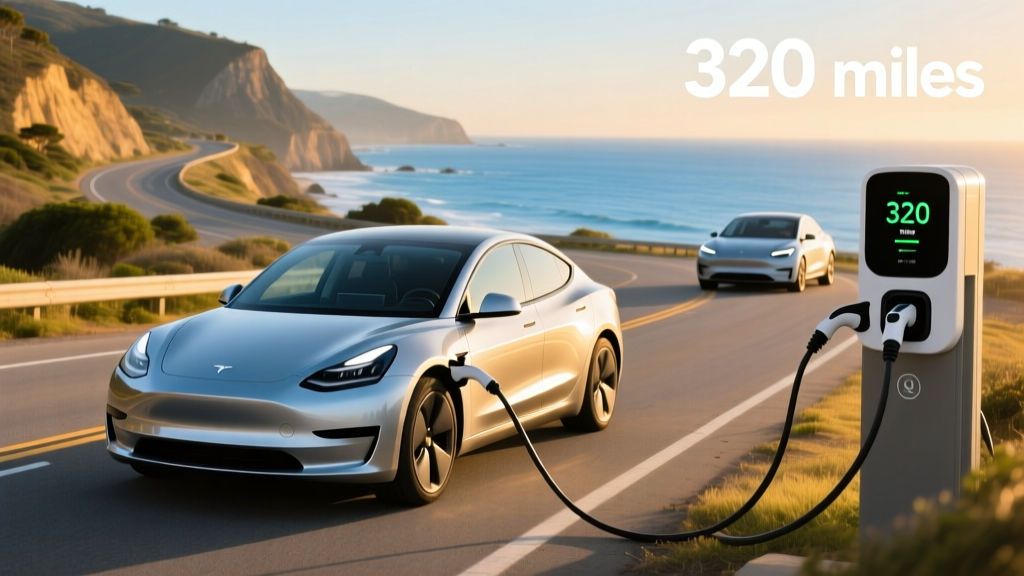
The EPA sticker on the Long Range AWD Model Y reads 320 miles. As with every EV, real-world results vary based on speed, temperature, and terrain. Here's what our testing and owner data show:
Range Reality Check — Model Y Long Range AWD
- EPA combined: 320 miles
- Highway (70 mph, 65°F): ~265-285 miles
- City / suburban mixed: ~290-310 miles (regen braking helps)
- Cold weather (25°F, cabin heat): ~210-245 miles (heat pump mitigates some loss vs. older Teslas)
- Towing (with hitch, light trailer): ~170-200 miles — tow rating is 3,500 lbs, but range drops sharply
The Juniper refresh added a standard heat pump and improved thermal management, reducing cold-weather losses compared to pre-2025 Model Y variants. Still, if your commute includes sub-freezing winters or sustained 80-mph interstate driving, budget a 15-25% buffer below the EPA figure. For most suburban drivers doing 30-50 miles per day with home charging, the real-world range is more than adequate — you'll rarely dip below 50% State of Charge (SoC).
Charging: DC Fast, Level 2, and the Home-Garage Setup
Charging speed is the Model Y's strongest practical advantage, thanks to access to Tesla's Supercharger network (now 17,000+ stalls in North America) and competitive onboard charging hardware.
| Charging Level | Power | Miles Added per Hour | Typical Use Case |
|---|---|---|---|
| Level 1 (120V outlet) | ~1.4 kW | ~4-5 mi/hr | Emergency / trickle top-off |
| Level 2 (240V, 48A Wall Connector) | 11.5 kW | ~44 mi/hr | Overnight home charging — full in ~7 hr |
| Level 2 (240V, 32A mobile connector) | 7.7 kW | ~30 mi/hr | Dryer-outlet home charging |
| DC Fast (V3 Supercharger) | Peak 250 kW | ~1,000 mi/hr (peak) | Road trips; 10-80% in ~25 min |
| DC Fast (CCS adapter, EA/Ionity) | Up to 250 kW | Varies by stall | Non-Tesla networks via included adapter |
Charging Curve Reality
The "250 kW peak" figure applies only between roughly 10-30% SoC. Above 50%, the curve tapers to ~120 kW, and above 80% it drops below 50 kW to protect the NMC battery. This is why Tesla (and every other automaker) quotes 10-80% times rather than 0-100%. For daily driving, charge to 80% at home and save 100% sessions for road trips — this practice extends long-term battery health.
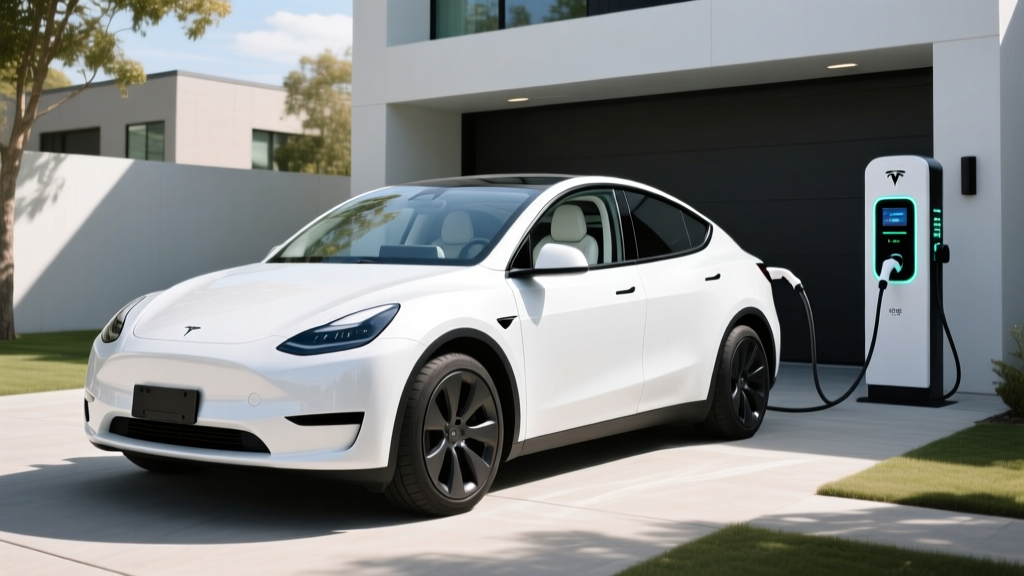
Home install note: A Tesla Wall Connector ($475 hardware) on a 60A circuit typically costs $800-$2,000 installed by a licensed electrician, depending on panel proximity. Homes with older 100A service panels may need a $2,000-$4,000 panel upgrade. Always consult a licensed electrician for final specs.
Performance and Driving Impressions
Even the base RWD Model Y hits 60 mph in 6.5 seconds — quicker than most gas crossovers in its class. The Long Range AWD drops that to 4.8 seconds with 384 hp and dual-motor traction that handles rain and light snow confidently. The Performance trim (3.5 sec, 456 hp) is genuinely fast, but the ride is noticeably firmer and the 21-inch wheels reduce range by about 25 miles versus the Long Range.
The Juniper refresh brought revised suspension tuning, acoustic glass, and ventilated front seats — addressing the most common complaints from 2020-2024 Model Y owners. Ride quality is improved but still on the firm side compared to a Hyundai Ioniq 5 or Ford Mustang Mach-E. One-pedal driving via regenerative braking is strong and predictable, though Tesla no longer offers a driver-selectable regen level; you get one calibrated setting.
Interior, Cargo, and Daily Practicality
The Model Y's cabin is polarizing: a 15.4-inch central touchscreen handles nearly every function (climate, mirrors, glovebox), with no traditional instrument cluster. Build quality on the 2026 Juniper is the best Tesla has produced, with tighter panel gaps and higher-quality materials than prior years.
- Cargo (behind 2nd row): 30.2 cu ft
- Cargo (2nd row folded): 72.1 cu ft
- Front trunk (frunk): 4.1 cu ft
- Rear legroom: 41.6 inches
- Front headroom: 41.0 inches
- Seating: 5 standard; optional 7-seat (small 3rd row, best for children)
Standout tech includes the native navigation with real-time Supercharger routing, over-the-air updates, Sentry Mode (dashcam/security), and the Tesla app's remote preconditioning — a genuine daily-use feature that warms or cools the cabin while plugged in, preserving battery range. The available FSD (Supervised) system is a SAE Level 2 driver-assist: it can steer, accelerate, and brake on highways and some city streets, but the driver must remain fully engaged and supervise at all times.
Autopilot & FSD (Supervised) — Level 2, Not Self-Driving
Tesla's Autopilot (standard) and Full Self-Driving Supervised ($8,000 option or $99/month) are SAE Level 2 systems. They require active driver supervision — hands on or near the wheel, eyes on the road. They are not autonomous. For true driverless operation (Level 4), only Waymo and Zoox robotaxi services currently qualify, and those are geofenced ride-hail services, not consumer vehicles.
Pricing, Tax Credits, and Total Cost
| Trim | Base MSRP | As-Tested (typical options) | §30D Credit Eligible? |
|---|---|---|---|
| RWD (Standard Range) | $39,990 | $40,500 | Yes — up to $7,500 (subject to sourcing + income caps) |
| Long Range AWD | $44,990 | $47,000 | Yes — up to $7,500 (subject to sourcing + income caps) |
| Performance AWD | $51,490 | $53,500 | Yes — under $80,000 SUV MSRP cap |
Federal Tax Credit (§30D) — Key Rules for 2026
The Model Y qualifies for the IRS §30D Clean Vehicle Credit, but eligibility is not automatic. Buyers must satisfy all of the following:
- Income caps: Modified AGI ≤ $150,000 (single), $225,000 (head of household), $300,000 (joint)
- MSRP cap: Vehicle MSRP must be under $80,000 (SUV classification — Model Y qualifies)
- Battery sourcing: Critical minerals and battery components must meet phased-in domestic/free-trade requirements (verify current-year compliance on Tesla's checkout page)
- Point-of-sale transfer: Buyers can transfer the credit to the dealer at purchase for an immediate price reduction, or claim it on their tax return
- Tax liability: Credit is non-refundable — you must owe at least $7,500 in federal tax to capture the full amount (unless transferred at POS)
Always verify current-year rules with a tax professional and the IRS before purchasing. State and utility incentives (often $1,000-$4,000 additional) vary by jurisdiction — check AFDC's state incentive database for local programs.
5-Year Ownership Snapshot
Assuming 12,000 miles/year, $0.14/kWh home charging, and $3.40/gallon gas for a comparable RAV4: the Model Y Long Range costs roughly $4,200 in electricity over 5 years versus ~$7,400 in gas for the RAV4 AWD — a $3,200 fuel savings. Insurance averages 15-25% higher than comparable gas crossovers (Tesla-specific rates vary by state and driver). Depreciation on the Model Y has moderated since the 2023-2024 price cuts but remains steeper than Toyota's benchmark.
Model Y vs. Key Competitors
The Model Y's closest rivals in 2026 include the Hyundai Ioniq 5, Ford Mustang Mach-E, and Kia EV6. Here's how they stack up on the metrics buyers actually search for:
| Metric | Tesla Model Y LR AWD | Hyundai Ioniq 5 Limited AWD | Ford Mustang Mach-E Extended Range AWD |
|---|---|---|---|
| EPA Range | 320 mi | 305 mi | 312 mi |
| Peak DCFC | 250 kW | 240 kW (800V architecture) | 150 kW |
| 10-80% Time | ~25 min | ~18 min | ~38 min |
| Base MSRP (AWD) | $44,990 | $49,500 | $48,995 |
| Cargo Volume | 30.2 cu ft | 27.2 cu ft | 29.7 cu ft |
| Charging Network | Supercharger (native) | NACS adapter → Supercharger | NACS adapter → Supercharger |
The Ioniq 5 charges faster (800V architecture) and offers a more traditional interior. The Mach-E has a more engaging chassis. But the Model Y still wins on cargo volume, Supercharger seamlessness, and price-per-mile-of-range.
Pros
- Class-leading EPA range (320 mi) at a sub-$45k AWD price point
- Best-in-class Supercharger access — no adapter needed
- Strong cargo volume and practical frunk
- OTA updates continuously add features
- Low running costs vs. gas crossovers
- Heat pump standard — better cold-weather efficiency
Cons
- Minimalist interior isn't for everyone — no physical climate knobs
- Firm ride on 19- and 20-inch wheels
- FSD (Supervised) is expensive and still Level 2
- Rear visibility is compromised by sloping roofline
- Insurance costs above segment average
- 7-seat option's 3rd row is very small
Who the 2026 Model Y Suits Best
Buy the Model Y If...
- You want a single EV for commuting, family duty, and road trips without range anxiety
- You value seamless long-distance charging via Superchargers
- You need cargo space close to a midsize SUV
- You can install Level 2 charging at home
- You're comfortable with a screen-centric interface
Consider a Competitor If...
- You prioritize the fastest possible DC charging (Ioniq 5 / EV6 with 800V)
- You prefer physical buttons and a traditional instrument cluster
- You want a sportier driving feel (Mach-E GT, Ioniq 5 N)
- You need a usable third row (look at the Kia EV9 instead)
Warranty and Long-Term Battery Outlook
Tesla covers the Model Y's battery and drive units for 8 years / 120,000 miles (Long Range and Performance) or 8 years / 100,000 miles (RWD), with a minimum 70% capacity retention threshold. Tesla's NMC batteries in the Long Range have shown moderate degradation — typically 8-12% loss over 100,000 miles based on fleet data. The LFP battery in the RWD variant trades range for longer cycle life and can be charged to 100% daily without the same longevity concerns.
Out-of-warranty battery replacement remains expensive — typically $12,000-$16,000 for a Model Y pack — though prices continue to decline as battery manufacturing scales. For most owners trading in within 5-8 years, this cost is rarely encountered.
Frequently Asked Questions
What is the real-world range of the 2026 Tesla Model Y?
EPA-rated at 320 miles for the Long Range AWD, expect roughly 265-285 miles at highway speeds in mild weather and 210-245 miles in cold conditions. City driving with regenerative braking returns results closer to the EPA figure.
How fast does the Model Y charge at home and on the road?
At home on a 240V/48A Wall Connector, it adds about 44 miles of range per hour (11.5 kW). On a V3 Supercharger, it peaks at 250 kW and charges from 10-80% in approximately 25 minutes, though the charge curve tapers significantly above 50% SoC.
Does the Model Y qualify for the $7,500 federal EV tax credit?
Yes, all 2026 Model Y trims are below the $80,000 SUV MSRP cap and are on Tesla's §30D eligible list. However, buyers must also meet income caps ($150k/$225k/$300k by filing status), and the vehicle's battery must satisfy current-year critical-mineral and component sourcing rules. Verify with the IRS and a tax professional.
How much does the Model Y cost after tax credits?
The Long Range AWD starts at $44,990. With the full $7,500 §30D credit applied at point of sale, the effective price drops to ~$37,490 before destination fees, state incentives, and options. The RWD trim can fall below $33,000 after the credit.
Is the Model Y worth buying versus the Ioniq 5 or Mach-E?
For most buyers, yes — the Model Y offers the best combination of range, price, cargo space, and charging-network access in 2026. The Ioniq 5 charges faster and has a more conventional interior; the Mach-E handles better. Choose based on which single priority matters most to you.
Is Tesla's FSD actually self-driving?
No. FSD (Supervised) is an SAE Level 2 driver-assist system. The driver must remain fully engaged, with eyes on the road and hands ready to take over. It is not autonomous driving. True Level 4 driverless service is currently limited to Waymo and Zoox robotaxis in specific cities.
Sources: fueleconomy.gov, IRS §30D Clean Vehicle Credit, NHTSA. All specs reflect the 2026 model year at time of publication; confirm with Tesla before purchase.