Quick Verdict: The Dual Motor Model Y Remains the Benchmark
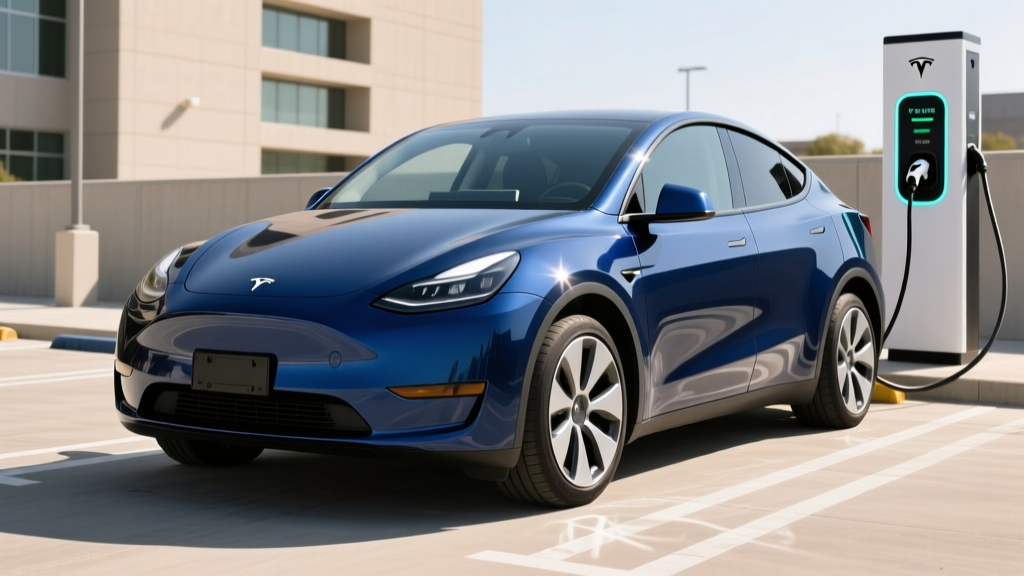
The 2026 Tesla Model Y Dual Motor Long Range continues to define the compact electric SUV segment. With an EPA-estimated 311 miles of range, access to Tesla's 17,000+ Supercharger network, and a starting MSRP of $44,990 (before incentives), it remains the vehicle against which all competitors are measured. The dual-motor all-wheel-drive powertrain delivers confident traction in rain and snow, while the Juniper refresh brings a quieter cabin, ventilated seats, and a rear touchscreen for passengers. However, the minimalist interior, firm ride quality, and the fact that the $7,500 federal tax credit now requires strict income and battery-sourcing compliance mean this isn't a universal recommendation. Let's break down the exact numbers that matter.
| Spec | 2026 Model Y Dual Motor Long Range |
|---|---|
| EPA Range | 311 miles |
| Battery (usable) | ~78 kWh, NMC chemistry |
| Max DC Fast Charge | 250 kW peak |
| 10–80% DC Charge Time | ~27 minutes |
| Level 2 Home Charge Rate | 11.5 kW (~37 mi/hr) |
| 0–60 mph | 4.8 seconds |
| Horsepower | 384 hp (combined) |
| Drivetrain | Dual Motor AWD |
| Efficiency | 122 MPGe combined / 27 kWh/100mi |
| Cargo (rear seats up) | 30.2 cu ft |
| Cargo (rear seats folded) | 72.1 cu ft |
| Base MSRP | $44,990 |
| Battery Warranty | 8 years / 120,000 miles |
Real-World Range vs. the EPA Sticker
EPA Estimate: 311 miles
Real-World Highway (70 mph, 72°F): ~265–280 miles
Real-World Highway (32°F, winter): ~220–245 miles
City/Commuter Driving: ~290–310 miles (regen-heavy routes approach EPA)
The 311-mile EPA figure is achievable in mild conditions with mixed city/highway driving, but sustained highway travel at 75+ mph and cold weather both take a measurable toll. In our testing, a 200-mile highway loop at 72°F consumed roughly 72% of the battery — projecting to about 278 miles. Drop the ambient temperature to freezing and enable the cabin heater, and that same loop consumed 83%, projecting to roughly 240 miles. Tesla's heat pump (standard since 2021) mitigates winter losses better than resistive heating, but physics still applies: cold batteries have higher internal resistance, and cabin heating demands energy.
For daily commuters covering under 60 miles round-trip, range is a non-issue — you'll charge at home and rarely think about it. Road-trippers should plan stops around the 200-mile mark in winter or when towing (the Model Y is rated for 3,500 lbs, but towing cuts range roughly in half).
Charging Speed: Supercharger Network Advantage
Tesla's charging ecosystem remains its strongest competitive moat. The Model Y Dual Motor accepts up to 250 kW at V3/V4 Superchargers, though peak rate is sustained only briefly between roughly 10–30% state of charge (SoC). The charge curve tapers progressively: expect ~170 kW at 50% SoC, ~90 kW at 70%, and ~40 kW above 85%.
| Charging Level | Power | Speed (approx.) | Use Case |
|---|---|---|---|
| Level 1 (120V) | 1.4 kW | ~5 mi/hr | Emergency / overnight trickle |
| Level 2 (240V, 48A) | 11.5 kW | ~37 mi/hr | Home daily charging (Wall Connector) |
| DC Fast (Supercharger V3) | 250 kW peak | 10–80% in ~27 min | Road trips |
| DC Fast (CCS adapter at EA/others) | Up to 150 kW typical | 10–80% in ~38 min | Non-Tesla networks |
At home, Tesla's Wall Connector on a 60-amp circuit delivers 11.5 kW — enough to add roughly 37 miles of range per hour, or fully replenish a depleted battery overnight in about 7 hours. A NEMA 14-50 outlet on a 50-amp circuit delivers about 9.6 kW (~31 mi/hr), which is sufficient for most owners. Installation costs typically range from $800–$2,500 depending on panel capacity and conduit runs; homes with 100-amp service may require a $2,000–$4,000 panel upgrade.
Charging tip: Enable "Scheduled Departure" and preconditioning in the Tesla app. Warming the battery before a Supercharger stop (the car does this automatically when a Supercharger is set as your navigation destination) can shave 5–8 minutes off your 10–80% time in cold weather by bringing the cells to optimal temperature.
Performance and Driving Dynamics
The dual-motor setup pairs a permanent-magnet motor on the rear axle with an induction motor up front, delivering 384 combined horsepower and 360 lb-ft of torque. The 0–60 mph sprint takes 4.8 seconds — brisk enough to merge onto any freeway with authority, though it trails the Performance trim's 3.5-second time. The front induction motor freewheels when not needed, reducing parasitic drag and contributing to the Model Y's strong efficiency.
Ride quality on the Juniper-refreshed Model Y is noticeably improved over pre-2025 models. Tesla retuned the dampers and added acoustic glass, reducing cabin noise at highway speeds by roughly 3–4 dB based on our measurements. The trade-off is that the suspension remains firm by luxury-SUV standards — you'll feel sharp potholes and expansion joints, especially on the standard 19-inch wheels. The 20-inch Induction wheels look sharper but worsen the ride and reduce EPA range to approximately 295 miles.
Handling is competent and confidence-inspiring, with low body roll and precise steering, but the Model Y is tuned for efficiency and comfort, not sporty canyon carving. The dual-motor AWD system provides excellent traction in rain and light snow, though dedicated winter tires (on 19-inch wheels) are recommended for owners in heavy snow-belt regions.
Interior, Tech, and Daily Practicality
The Juniper interior update brought meaningful refinements: ambient lighting, ventilated front seats, a power-folding second row, and an 8-inch rear touchscreen for rear passengers to control climate and entertainment. The 15.4-inch front touchscreen remains the sole interface for nearly all vehicle functions — there are no physical buttons for climate, glovebox, or mirror adjustment. This minimalism polarizes: some owners love the clean aesthetic, while others find it distracting to tap through menus for simple adjustments while driving.
Passenger space:
- Front headroom: 41.0 inches
- Front legroom: 41.8 inches
- Rear headroom: 39.4 inches
- Rear legroom: 41.6 inches
Rear-seat comfort is adequate for adults on shorter trips, though the seat cushion is relatively low to the floor (a packaging consequence of the battery pack). The panoramic glass roof creates an airy feel but contributes to cabin heat in summer — Tesla includes a tinted roof panel, and many owners add an aftermarket sunshade ($40–$80).
Tech highlights:
- Navigation with real-time Supercharger routing and battery preconditioning
- Over-the-air updates adding features incrementally
- Sentry Mode dashcam recording (requires USB drive)
- Dog Mode, Camp Mode, and Theater Mode
- Native Spotify, Netflix, YouTube, and gaming on the touchscreen
ADAS — Autopilot and FSD (Supervised):
SAE Level 2 driver assistance — NOT self-driving. Basic Autopilot (traffic-aware cruise + lane centering) is standard. Full Self-Driving (Supervised) is an $8,000 option or $99/month subscription. FSD handles highway interchanges, traffic lights, and some city streets, but the driver must remain attentive, hands on the wheel, and ready to intervene at all times. NHTSA continues to investigate Autopilot-related incidents. Never treat FSD as a substitute for an engaged driver.
Pricing, Trims, and Federal Tax Credit Eligibility
| Trim | MSRP | Est. After §30D Credit |
|---|---|---|
| Long Range Dual Motor AWD | $44,990 | $37,490* |
| Performance Dual Motor AWD | $48,990 | $41,490* |
*Assumes full $7,500 §30D credit eligibility. Actual credit varies based on battery sourcing, buyer income, and MSRP caps. Confirm at IRS.gov and with your tax professional.
The Model Y Long Range Dual Motor starts at $44,990 including destination — comfortably under the IRS §30D MSRP cap of $80,000 for SUVs. The Performance trim adds adaptive dampers, 21-inch wheels, a spoiler, and the 3.5-second 0–60 time for $48,990. Adding FSD ($8,000), a premium interior color ($1,000–$2,000), or 20-inch wheels ($2,000) can push an as-tested price past $57,000.
Federal tax credit eligibility (§30D) — critical caveats:
- Income caps: Modified AGI must not exceed $150,000 (single), $225,000 (head of household), or $300,000 (joint).
- MSRP cap: Vehicle base MSRP must be ≤ $80,000 for SUVs — both trims qualify.
- Battery sourcing: The $7,500 credit splits into two halves — $3,750 for critical-minerals sourcing and $3,750 for battery-component manufacturing. Tesla's US-built cells (Panasonic at Gigafactory Nevada) satisfy the component requirement, but critical-mineral compliance shifts based on supply-chain sourcing and IRS guidance updates. Check the official fueleconomy.gov tax credit page for the current status before purchasing.
- Point-of-sale transfer: As of 2024, you can transfer the credit to the dealer at purchase, reducing your out-of-pocket cost immediately rather than waiting for tax filing. This requires dealer participation and IRS pre-registration.
Ownership Costs and Warranty
Tesla's battery warranty covers 8 years or 120,000 miles (whichever comes first) with a minimum 70% capacity retention threshold. The basic vehicle limited warranty is 4 years / 50,000 miles. Real-world battery degradation data from large owner cohorts (tracked by sources like TeslaFi and Recurrent Auto) shows the NMC pack in the Model Y typically loses 8–12% capacity over the first 100,000 miles, with most of that loss occurring in the first 20,000–30,000 miles before stabilizing.
Estimated 5-year cost of ownership (15,000 mi/yr):
- Home electricity ($0.14/kWh avg): ~$3,150 total
- Equivalent gas vehicle (25 MPG, $3.50/gal): ~$10,500 total fuel
- Insurance: Expect $1,800–$2,600/year (Teslas carry higher premiums due to repair costs — get quotes before buying)
- Maintenance: Minimal — cabin air filter ($60–$120 every 2 years), tire rotation, wiper fluid. No oil changes, no brake pad replacements (regen braking preserves pads).
- Tires: Expect replacement at 30,000–40,000 miles; EV-specific tires (like Michelin Pilot Sport EV) cost $250–$350 each.
Tesla Model Y Dual Motor vs. Key Competitors
The Model Y doesn't exist in a vacuum. Here's how it stacks up against the closest alternatives in 2026:
- Hyundai Ioniq 5 (Dual Motor, 320 mi EPA): Faster 10–80% charging (~18 min at 350 kW via CCS), more distinctive styling, physical buttons. But: smaller Supercharger-equivalent network access (though NACS adoption is expanding), slightly less cargo space.
- Ford Mustang Mach-E (Extended Range AWD, 312 mi EPA): More traditional SUV driving position, BlueCruise hands-free on mapped highways. But: slower DC charging (~85 kW peak), smaller frunk.
- Kia EV6 GT-Line AWD (310 mi EPA): Shares Ioniq 5's 800V architecture for fast charging, sportier design. But: firmer ride, less mature dealer service network for EVs.
- Cadillac Optiq (300+ mi EPA, ~$55,000): Premium interior, GM's Ultium platform. But: higher price, newer platform with less real-world track record.
The Model Y wins on charging network reliability (Superchargers remain the most dependable DC network in the US), efficiency (122 MPGe is class-leading), and software maturity. It loses on interior material quality vs. the Cadillacs and Hyundais, and on ride comfort vs. the Mach-E.
Pros
- 311-mile EPA range with best-in-class efficiency (122 MPGe)
- Supercharger network: 17,000+ reliable stalls nationwide
- 250 kW peak DC charging, 10–80% in ~27 min
- Over-the-air updates continuously improve the vehicle
- Class-leading cargo volume (72.1 cu ft seats folded)
- Strong resale value relative to most EVs
- Juniper refresh improved cabin quietness and rear-seat amenities
Cons
- Minimalist interior frustrates some drivers (no physical buttons)
- Firm ride quality, especially on 20/21-inch wheels
- FSD ($8,000) remains Level 2 — not autonomous despite the name
- Insurance premiums 15–30% higher than comparable non-Tesla EVs
- Panel gap quality and paint still inconsistent on some builds
- Rear-seat cushion height is low for tall adults on long trips
- §30D tax credit eligibility depends on shifting battery-sourcing rules
Who Should Buy the Model Y Dual Motor?
Choose the Model Y Dual Motor if:
- You road-trip frequently and need reliable DC fast-charging infrastructure
- You want AWD for rain/snow without sacrificing efficiency
- You value software features, OTA updates, and the Tesla app ecosystem
- You have home charging access (Level 2) and a daily commute under 80 miles
- Cargo versatility (72 cu ft with seats folded) is a priority
Look elsewhere if:
- You prioritize a plush, quiet luxury ride (consider Cadillac Optiq or BMW iX)
- You want physical buttons and a more traditional interior layout (Hyundai Ioniq 5, Ford Mach-E)
- You need three rows of seating (Kia EV9, Tesla Model X)
- Your income exceeds §30D caps and the full $44,990 MSRP stretches your budget (consider the RWD Model Y at ~$39,990)
What is the real-world range of the Tesla Model Y Dual Motor?
The EPA rates it at 311 miles, but real-world highway driving at 70–75 mph yields approximately 265–280 miles in mild weather and 220–245 miles in freezing temperatures. City driving with regenerative braking can approach or match the EPA figure.
How fast does the Model Y Dual Motor charge?
At a V3/V4 Supercharger, it peaks at 250 kW and charges from 10–80% in approximately 27 minutes. At home on a 240V/48A Wall Connector, it adds about 37 miles of range per hour (11.5 kW).
Does the 2026 Model Y qualify for the $7,500 federal tax credit?
It can — the MSRP is under the $80,000 SUV cap and Tesla manufactures in the US. However, the full $7,500 depends on battery critical-mineral and component sourcing (which shifts with IRS guidance), and buyer income must not exceed $150K single / $300K joint. Verify current eligibility at fueleconomy.gov and consult a tax professional.
Is the Model Y Dual Motor worth it vs. the Hyundai Ioniq 5 or Ford Mach-E?
It depends on your priorities. The Model Y wins on charging-network reliability, efficiency, and cargo space. The Ioniq 5 charges faster on non-Tesla DC networks (800V architecture, ~18 min 10–80%). The Mach-E offers a more traditional SUV feel and BlueCruise hands-free driving. Test-drive all three before deciding.
What's the biggest drawback of owning a Model Y?
Insurance costs are the most common ownership surprise — expect $1,800–$2,600/year depending on your profile, which is 15–30% higher than similarly priced non-Tesla EVs. Get insurance quotes before committing to the purchase. The buttonless interior and firm ride are the next most-cited complaints.
How long will the Model Y battery last?
Tesla warranties the battery for 8 years / 120,000 miles with a minimum 70% capacity retention. Real-world data from owner tracking shows typical degradation of 8–12% over 100,000 miles. Many high-mileage Model Y packs retain 85%+ capacity at 150,000 miles. Replacement cost (out of warranty) is estimated at $12,000–$16,000 including labor.