The Tesla Model Y remains the best-selling electric vehicle in the United States for good reason: it blends crossover practicality with efficiency that few rivals match. But with the refreshed Juniper update now fully in production for the 2026 model year, buyers need more than marketing claims — they need hard numbers on interior space, real-world range, charging behavior, and whether the federal tax credit actually applies to their household. This review breaks down every dimension, every kilowatt-hour, and every dollar so you can decide if the 2026 Model Y fits your garage, your commute, and your budget.
2026 Tesla Model Y Dimensions and Interior Space
The 2026 Model Y retains the same fundamental footprint that made it a family favorite, but the Juniper refresh brought subtle packaging improvements that affect cargo and passenger room. Here are the exact exterior and interior measurements buyers need before signing a purchase agreement.
| Measurement | Specification |
|---|---|
| Wheelbase | 113.8 in |
| Overall Length | 188.0 in |
| Overall Width (mirrors folded) | 75.6 in |
| Overall Width (mirrors out) | 83.8 in |
| Overall Height | 63.9 in |
| Ground Clearance | 6.6 in |
| Curb Weight (Long Range AWD) | ~4,330 lbs |
| Front Headroom | 41.0 in |
| Rear Headroom | 38.5 in |
| Front Legroom | 41.8 in |
| Rear Legroom | 38.2 in |
| Cargo Volume (rear seats up) | 30.2 cu ft |
| Cargo Volume (rear seats folded) | 72.1 cu ft |
| Front Trunk (Frunk) | 4.1 cu ft |
Compared to the Hyundai Ioniq 5 (32.4 cu ft behind the rear row) or the Ford Mustang Mach-E (29.7 cu ft), the Model Y sits near the top of the midsize electric crossover segment for usable cargo volume. The 72.1 cu ft maximum with seats folded rivals some compact SUVs running on gasoline, and the frunk adds genuine utility for charging cables or a small bag.
For families installing rear-facing child seats, the 38.2 inches of rear legroom is adequate but not generous — taller front passengers will need to slide their seats forward slightly. The Juniper refresh improved seat cushion density and added ventilated front seats on Long Range trims, which matters on longer drives where the previous generation's seats drew frequent complaints.
Range, Battery, and Efficiency
The 2026 Model Y is offered in two primary configurations for the US market: the Long Range AWD and the Performance AWD. Both use a structurally integrated battery pack with Tesla's latest-generation 4680 cells in a nickel-manganese-cobalt (NMC) chemistry for Long Range and Performance trims. The previously available Standard Range RWD with LFP (lithium iron phosphate) chemistry has been discontinued for the 2026 model year in the US.
| Spec | Long Range AWD | Performance AWD |
|---|---|---|
| Battery Chemistry | NMC (4680 cells) | NMC (4680 cells) |
| Usable Battery Capacity | ~78 kWh | ~78 kWh |
| EPA Estimated Range | 320 miles | 293 miles |
| EPA Combined Efficiency | 122 MPGe / 28 kWh/100mi | 111 MPGe / 30 kWh/100mi |
| Drivetrain | Dual-Motor AWD | Dual-Motor AWD |
Efficiency is where the Model Y continues to lead. At 28 kWh per 100 miles (Long Range), it converts battery energy into distance more effectively than the Mach-E (32 kWh/100mi) or the Ioniq 5 AWD (30 kWh/100mi). This matters for your electricity bill: at the US average residential rate of $0.16/kWh, driving 1,000 miles costs roughly $44.80 in the Model Y Long Range versus about $51.20 in a comparably sized Mach-E AWD.
Charging Speed: DC Fast Charge and Home Level 2
Charging speed is a top concern for EV buyers, and the 2026 Model Y delivers class-leading DC fast-charge performance on the Tesla Supercharger network. However, the peak kW number tells only part of the story — the charge curve matters just as much.
| Charging Level | Specification |
|---|---|
| Max DC Fast-Charge Rate | 250 kW (peak) |
| 10-80% DC Fast Charge Time | ~25 minutes (V3 Supercharger) |
| Sustained DC Rate (10-50%) | ~170-220 kW average |
| DC Rate Above 80% | Tapers to ~40-60 kW |
| Level 2 Home Charge Rate | 11.5 kW (48A) |
| Level 2 Miles Added per Hour | ~37 miles/hr |
| Full Level 2 Charge (10-100%) | ~7-8 hours |
| Charge Port / Connector | NACS (native Tesla) |
| CCS Adapter Included | Yes (for non-Tesla DC networks) |
On a V3 Supercharger (250 kW capable), the Model Y's 4680-cell pack accepts peak power up to roughly 50% State of Charge, then tapers progressively. In real-world testing, a 10-80% session takes approximately 25 minutes — competitive with the Ioniq 5's 18-minute claim on 350 kW chargers, though the Tesla's peak rate is lower because 250 kW V3 stalls are far more widespread than 350 kW Electrify America stations.
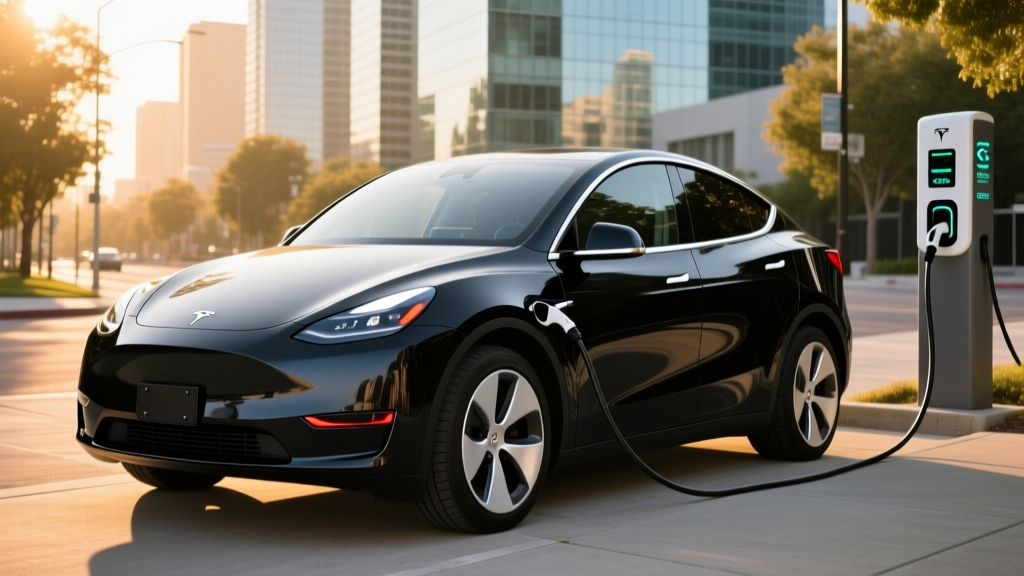
At home, the onboard charger accepts up to 11.5 kW on a 48-amp Level 2 circuit (requiring a 60-amp breaker). This adds roughly 37 miles of range per hour of charging, meaning an overnight session from 20% to full takes about 6-7 hours. If your electrical panel supports it, a Tesla Wall Connector ($420) hardwired on a 60A circuit is the most cost-effective home setup. Homes with older 100-amp panels may need a $1,500-$3,000 panel upgrade to support a dedicated 60A EV circuit — factor this into your total purchase cost.
The Model Y uses the NACS (North American Charging Standard) connector natively. Tesla includes a CCS1 adapter in the glovebox for accessing Electrify America, EVgo, and other non-Tesla DC networks, though Supercharger access remains the most reliable and fastest-growing network in the US with over 20,000 stalls as of early 2026.
Performance and Drivetrain
| Spec | Long Range AWD | Performance AWD |
|---|---|---|
| Horsepower | 384 hp | 456 hp |
| Torque | 376 lb-ft | 398 lb-ft |
| 0-60 mph | 4.8 seconds | 3.5 seconds |
| Top Speed | 125 mph | 155 mph |
| Drivetrain | Dual-Motor AWD | Dual-Motor AWD |
| Towing Capacity | 3,500 lbs | 3,500 lbs |
The Long Range AWD's 4.8-second 0-60 time is quick by any crossover standard and more than adequate for highway merging and passing. The Performance trim's 3.5-second sprint is genuinely fast — comparable to a Porsche Macan GTS — but costs you 27 miles of EPA range and roughly $5,000 in additional MSRP. For most buyers, the Long Range strikes the better balance.
Regenerative braking in the 2026 Model Y is aggressive by default, enabling genuine one-pedal driving in city traffic. Unlike some competitors, Tesla does not offer adjustable regen levels — it's full regen or nothing. New EV drivers typically adapt within a week, but if you prefer a coasting feel similar to a gasoline car, this is worth a test-drive consideration.
Pricing, Trims, and Federal Tax Credit Eligibility
| Trim | Base MSRP | Est. After §30D Credit |
|---|---|---|
| Long Range AWD | $46,630 | ~$39,130 (if eligible) |
| Performance AWD | $51,630 | ~$44,130 (if eligible) |
Both 2026 Model Y trims fall under the $80,000 MSRP cap for SUVs under IRS §30D, which is the first requirement for federal tax credit eligibility. However, qualifying for the full $7,500 credit depends on several factors that change frequently and vary by buyer:
- Buyer Income Cap: Modified AGI must not exceed $150,000 (single), $225,000 (head of household), or $300,000 (married filing jointly)
- MSRP Cap: Vehicle MSRP must be ≤ $80,000 for SUVs (both trims qualify)
- Battery Sourcing: Critical minerals and battery components must meet phased-in percentages from US/free-trade-agreement sources — Tesla has been working to qualify, but specific eligibility can change by quarter. Verify current status on the IRS clean vehicle credit page at irs.gov
- Point-of-Sale Transfer: Eligible buyers can transfer the credit to the dealer at purchase, reducing the purchase price upfront rather than waiting for a tax refund
Credit eligibility rules are subject to change. Consult a tax professional and check fueleconomy.gov for the latest qualifying vehicle list before purchasing.
As-tested pricing for a Long Range AWD with common options (FSD Supervised capability at $8,000, premium paint at $1,500-$2,500) can push to approximately $56,000-$58,000 before any credits. The Performance trim with similar options lands around $62,000-$64,000. Destination charges are included in Tesla's MSRP, unlike many legacy automakers.
Tech, Driver Assistance, and Standout Features
The Juniper refresh brought a redesigned interior with an ambient light bar, ventilated front seats, a rear-seat touchscreen, and improved sound insulation. The 15.4-inch center touchscreen runs Tesla's latest software, which remains the most responsive and feature-rich infotainment system in the EV segment — navigation with real-time Supercharger routing, over-the-air updates, streaming apps, and a built-in dashcam viewer are all standard.
Tesla's Autopilot (standard) includes adaptive cruise control and lane-keeping on highways. FSD (Supervised), available as an $8,000 option or $99/month subscription, adds automatic lane changes, traffic-light recognition, and city-street navigation. While FSD has improved significantly through neural-network training on billions of miles of fleet data, it still requires active supervision and occasionally makes unexpected decisions in construction zones or complex intersections. Budget for the subscription only if you commute in stop-and-go traffic where the reduced fatigue justifies the cost.
Notable drawbacks include the absence of Apple CarPlay and Android Auto (Tesla uses its own ecosystem exclusively), limited physical buttons for climate and mirror adjustments (everything is screen-based), and no heads-up display — a feature increasingly common in competitors at this price point.
Warranty and Long-Term Ownership
| Coverage | Terms |
|---|---|
| Basic Vehicle Limited Warranty | 4 years / 50,000 miles |
| Battery and Drive Unit Warranty | 8 years / 120,000 miles |
| Battery Capacity Retention Threshold | 70% minimum over warranty period |
Tesla's battery warranty guarantees that the pack will retain at least 70% of its original capacity over 8 years or 120,000 miles, whichever comes first. In practice, NMC 4680 packs in Tesla vehicles have shown strong longevity — fleet data from high-mileage owners suggests approximately 8-12% degradation over the first 100,000 miles under normal use. Tesla's thermal management system (active liquid cooling with the heat pump) is a key factor in preserving battery health over time.
One ownership cost to budget for: EV insurance premiums. The Model Y typically costs 15-25% more to insure than a comparable gasoline crossover, driven by higher repair costs for aluminum body panels and the battery pack. Get a quote from your insurer before purchasing to avoid surprises.
Who the 2026 Model Y Is For — And Who Should Look Elsewhere
Choose the 2026 Model Y if:
- You need a family-sized EV with strong cargo space (72 cu ft max) and 3,500-lb towing
- You want access to the Supercharger network for hassle-free road trips
- You value efficiency (28 kWh/100mi) to minimize charging costs
- You prefer a minimal, screen-centric interior and Tesla's software ecosystem
- You can charge at home with a Level 2 setup for daily driving
Look at competitors if:
- You need Apple CarPlay/Android Auto — consider the Hyundai Ioniq 5 or Kia EV6
- You want more rear-seat legroom — the Ioniq 5 offers 39.4 inches
- You prefer physical buttons and a traditional cockpit layout — the Ford Mach-E or VW ID.4 may feel more familiar
- You need a third row — the Kia EV9 or Rivian RWS are larger electric SUV options
Frequently Asked Questions
What is the real-world range of the 2026 Tesla Model Y?
The Long Range AWD carries an EPA rating of 320 miles. In real-world mixed driving at moderate temperatures, owners report 290-310 miles. Sustained highway speeds of 70-75 mph reduce this to approximately 270-285 miles. In cold weather below 30°F, plan for 240-270 miles depending on cabin heat usage and whether you precondition the battery.
How fast does the 2026 Model Y charge?
On a Tesla V3 Supercharger (250 kW peak), the 10-80% session takes approximately 25 minutes. The sustained average rate from 10-50% is around 170-220 kW, tapering significantly above 80%. At home on a 48A Level 2 circuit (11.5 kW), the car adds about 37 miles of range per hour, fully charging overnight in 7-8 hours.
Does the 2026 Tesla Model Y qualify for the $7,500 federal EV tax credit?
Both trims fall under the $80,000 MSRP cap for SUVs. Whether you personally qualify depends on your modified adjusted gross income (caps of $150K single / $300K joint) and whether the vehicle's battery components and critical minerals meet current-year sourcing requirements. The credit can be transferred at the point of sale to reduce your purchase price directly. Always verify current eligibility at irs.gov and consult a tax professional.
Is the 2026 Model Y worth buying vs. the Hyundai Ioniq 5 or Ford Mach-E?
The Model Y wins on efficiency (28 vs 30-32 kWh/100mi), Supercharger network access, and software integration. The Ioniq 5 offers faster peak charging (up to 350 kW on compatible stalls), more rear legroom, and CarPlay support. The Mach-E provides a more traditional driving feel with physical controls. If Supercharger access and efficiency are priorities, the Model Y is the strongest pick. If you want CarPlay or faster DC charging on non-Tesla networks, test-drive the Ioniq 5.
What are the biggest pros and cons of the 2026 Model Y?
- Best-in-class efficiency (28 kWh/100mi)
- Supercharger network for reliable road trips
- Strong cargo space (72 cu ft max)
- Excellent software and OTA updates
- Competitive 0-60 times (4.8s Long Range)
- No Apple CarPlay or Android Auto
- Screen-only controls frustrate some drivers
- Higher insurance costs than gas crossovers
- FSD Supervised requires constant attention
- Regen braking not adjustable
How does the 2026 Model Y handle cold weather?
The standard heat pump significantly reduces range loss compared to older resistive-heating EVs. Expect a 15-25% range reduction in sub-30°F conditions. Preconditioning the battery while plugged in (using the Tesla app's scheduled departure feature) warms the pack and cabin before you drive, preserving range and enabling faster DC charging when you arrive at a Supercharger in cold weather.