Quick Verdict: The Benchmark Compact EV SUV, Measured Inside and Out
The 2025 Tesla Model Y remains the most-purchased electric vehicle in the United States for good reason: it threads the needle between efficiency, interior volume, and charging infrastructure access that no rival has fully matched. But for buyers researching Tesla Model Y dimensions 2025 specs, the real questions go beyond the showroom brochure. How much cargo actually fits? What's the real-world highway range versus the EPA sticker? And does the Juniper refresh change the physical footprint enough to matter in your garage?
This profile dissects the 2025 Model Y (the Juniper-generation refresh that began deliveries in early 2025) with exact measurements, charging data, and ownership economics — the numbers Tesla's configurator doesn't always surface clearly.
Exterior and Interior Dimensions: Will It Fit Your Garage and Your Family?
The 2025 Juniper Model Y is slightly longer and marginally lower than its predecessor, with revised bumpers and a light bar that add roughly an inch to overall length. Here are the exact exterior measurements buyers need for garage planning and parking:
| Measurement | Specification |
|---|---|
| Overall Length | 188.6 inches |
| Overall Width (mirrors folded) | 77.9 inches |
| Overall Width (mirrors extended) | 83.8 inches |
| Overall Height | 63.9 inches |
| Wheelbase | 113.8 inches |
| Ground Clearance | 6.6 inches |
| Curb Weight (Long Range AWD) | ~4,330 lbs |
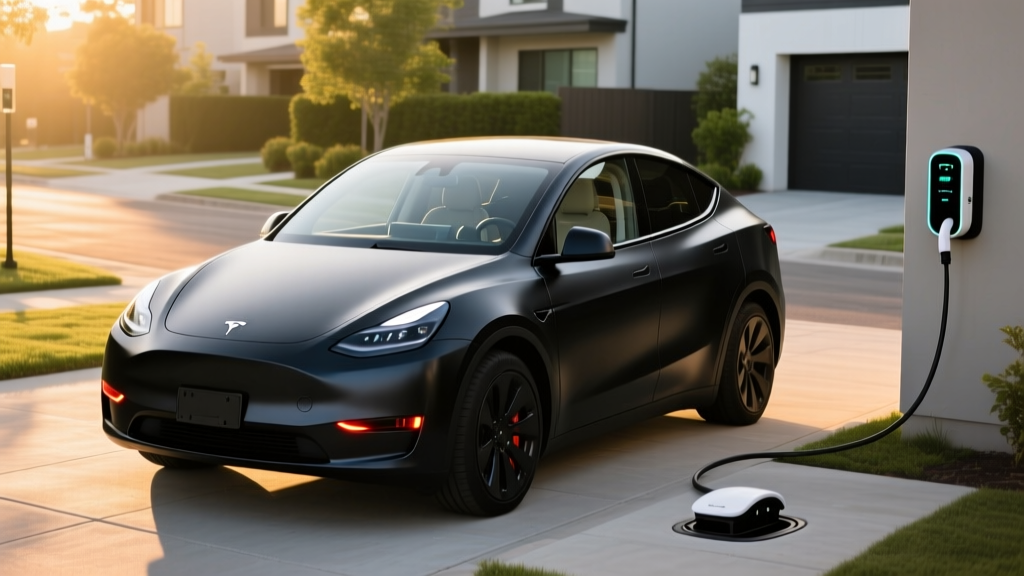
Garage fit note: A standard two-car garage (minimum 20 feet deep) accommodates the Model Y with roughly 18 inches to spare at the rear wall — enough for a wall-mounted Level 2 charger with the nose-in parking typical of home charging. If you're installing a Tesla Wall Connector or ChargePoint Home Flex, plan for at least 22 feet of depth to allow comfortable cable routing with the charge port on the driver-side rear quarter panel.
Passenger Space and Cargo Volume
Interior room is where the Model Y punches above its class weight. The Juniper refresh retains the same greenhouse but adds revised seat cushions and a rear-seat tablet for climate and media control.
| Measurement | Front | Rear |
|---|---|---|
| Headroom | 41.0 in | 38.5 in |
| Legroom | 41.8 in | 41.6 in |
| Shoulder Room | 58.4 in | 56.0 in |
| Hip Room | 53.8 in | 52.4 in |
Cargo volume (5-seat configuration): 30.2 cubic feet behind the second row, expanding to 72.1 cubic feet with the 60/40 rear seats folded. The front trunk (frunk) adds approximately 4.1 cubic feet — enough for a charging cable kit and a soft duffel. Total enclosed volume with all seats folded rivals midsize SUVs like the Honda Passport, though the sloping roofline limits stacking height for tall items.
Range, Battery, and Efficiency: The Real Numbers
The 2025 Model Y is offered in two primary configurations in the US market: Long Range AWD and Performance. The base Rear-Wheel-Drive variant was discontinued for 2025 as Tesla streamlined production around dual-motor builds.
Long Range AWD: EPA-estimated 320 miles. Real-world highway driving at 70-75 mph typically yields 270–290 miles in mild weather. In sub-30°F winter conditions, expect 220–250 miles due to cabin heating load and reduced battery chemistry efficiency. City driving with regenerative braking can approach or slightly exceed the EPA figure.
Performance: EPA-estimated 293 miles. Real-world highway: 250–270 miles mild weather; 210–230 miles cold weather.
| Spec | Long Range AWD | Performance |
|---|---|---|
| Battery Capacity (usable) | ~75 kWh | ~75 kWh |
| Battery Chemistry | NMC (Nickel Manganese Cobalt) | NMC |
| EPA Range | 320 miles | 293 miles |
| EPA Efficiency | 117 MPGe combined | 111 MPGe combined |
| Energy Consumption | 29 kWh/100 mi | 30 kWh/100 mi |
| Drivetrain | Dual-motor AWD | Dual-motor AWD |
| Horsepower | ~384 hp | ~456 hp |
| 0–60 mph | 4.8 seconds | 3.5 seconds |
Chemistry note: The 2025 Model Y uses NMC cells, not LFP (lithium iron phosphate). NMC offers higher energy density — critical for fitting 320 miles of range into the Model Y's footprint — but Tesla recommends daily charging to 80% for longevity, reserving 100% charges for road trips. If you're comparing to LFP-equipped vehicles like the base Model 3 RWD (which Tesla recommends charging to 100% regularly), the trade-off is usable daily range versus total pack capacity.
Charging Speeds: DC Fast, Level 2, and Level 1
Charging speed remains one of the Model Y's strongest competitive advantages, largely thanks to Tesla's Supercharger network and the vehicle's thermal management system that preconditions the battery for optimal charge acceptance.
| Charging Level | Power | Speed / Time |
|---|---|---|
| DC Fast Charge (Supercharger V4) | Peak 250 kW | 10–80% in ~25 minutes |
| DC Fast Charge (CCS adapter, third-party) | Peak 250 kW (varies by station) | 10–80% in ~25–30 minutes |
| Level 2 (Tesla Wall Connector, 48A) | 11.5 kW | ~37 miles per hour of charging |
| Level 2 (standard 240V/32A outlet) | 7.7 kW | ~25 miles per hour |
| Level 1 (120V household) | 1.4 kW | ~4 miles per hour |
Charging curve reality: The 250 kW peak is not sustained. The Model Y typically holds above 200 kW from roughly 10% to 35% State of Charge, then tapers progressively. From 80% to 100%, charging slows dramatically to protect the NMC cells — expect 40+ additional minutes for that final 20%. For road-trip planning, the practical strategy is charging from 10% to 80% and moving on, which the Tesla trip planner already optimizes.
Connector update: The 2025 Model Y ships with the NACS (North American Charging Standard) port natively. No adapter is needed at Tesla Superchargers. For Electrify America, EVgo, or other CCS networks, Tesla sells a CCS adapter (~$175) that enables access, though charging speeds on non-Tesla networks may be lower depending on station capability and handshake protocols.
Pricing, Trim Levels, and Federal Tax Credit Eligibility
| Trim | Base MSRP | Est. After §30D Credit* |
|---|---|---|
| Long Range AWD | $44,990 | $37,490 |
| Performance | $48,990 | $41,490 |
*Destination charge of ~$1,390 additional. Prices reflect Tesla's early-2025 configurator pricing and are subject to change.
- MSRP cap: SUVs must be under $80,000 — both trims qualify ✓
- Buyer income cap: AGI ≤ $150,000 (single) / $300,000 (joint) — verify on your tax return
- Battery sourcing: Must meet critical-mineral and battery-component requirements that phase in annually through 2029. Tesla has historically sourced to comply, but eligibility can change mid-year. Confirm current status at fueleconomy.gov before purchase.
- Point-of-sale transfer: As of 2024, the $7,500 credit can be transferred to the dealer at purchase, reducing your out-of-pocket cost immediately rather than waiting for tax filing. Tesla supports this through their checkout process.
- VIN verification: Always confirm the specific VIN's eligibility on the IRS clean vehicle credit portal before finalizing your order.
Source: IRS §30D Clean Vehicle Credit. Rules are subject to legislative change. Consult a tax professional for your specific situation.
Tech, Driver Assistance, and Safety
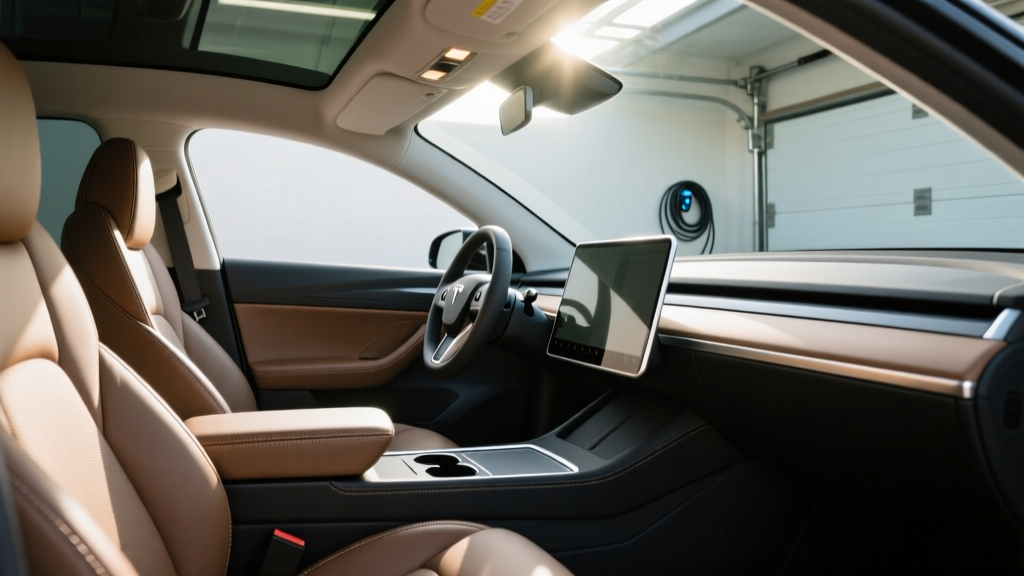
The Juniper Model Y ships with Tesla's current infotainment stack: a 15.4-inch front touchscreen, an 8-inch rear passenger tablet, and over-the-air update capability that has historically added meaningful features post-purchase (improved regen profiles, UI refinements, entertainment apps).
Driver assistance: Every Model Y includes Basic Autopilot (lane-centering and adaptive cruise). Enhanced Autopilot ($6,000) adds automatic lane changes, Navigate on Autopilot, and Smart Summon. Full Self-Driving (Supervised) at $8,000 adds traffic-light recognition and city-street autosteer.
All Tesla driver-assistance features — including FSD (Supervised) — are SAE Level 2 systems. The driver must remain fully attentive, keep hands available for steering input, and be prepared to take over immediately. This is not autonomous driving. Level 4 driverless operation (no human attention required) currently exists only in geofenced robotaxi services like Waymo, not in any consumer vehicle sold in the US.
Safety ratings: The Model Y has historically earned a 5-star overall rating from NHTSA and Top Safety Pick+ from IIHS in prior model years. The 2025 Juniper refresh had not been crash-tested by IIHS at the time of this writing — buyers should monitor for updated ratings as testing is completed.
Who the 2025 Model Y Is For — And Who Should Look Elsewhere
- You want maximum Supercharger network access for road trips
- You need 30+ cu ft of cargo with 5 seats in use
- You prioritize efficiency (117 MPGe) over luxury ride quality
- You want OTA updates that improve the car over time
- Your daily commute is under 200 miles round-trip
- You need 3-row seating (Kia EV9, Rivian R1S)
- You want a traditional instrument cluster or physical buttons (Hyundai Ioniq 5, BMW iX)
- You tow more than 3,500 lbs (Rivian R1S, Ford F-150 Lightning)
- You prefer a luxury ride with adaptive air suspension (Genesis GV70 Electrified, BMW iX)
- You lack home charging access and your area has limited Supercharger coverage
Warranty Coverage
| Coverage | Term |
|---|---|
| Basic Vehicle Limited Warranty | 4 years / 50,000 miles |
| Battery & Drive Unit (Long Range/Performance) | 8 years / 120,000 miles |
| Battery Capacity Retention Guarantee | Minimum 70% over warranty period |
Tesla's battery warranty is competitive with Hyundai/Kia (10yr/100k mi) slightly behind on years/miles but consistent with most legacy OEMs. The 70% retention threshold is standard — if your pack degrades below 70% capacity within 8 years/120,000 miles, Tesla replaces or refurbishes it at no cost. Real-world data from high-mileage Tesla owners suggests NMC packs typically retain 85–90% capacity at 100,000 miles when daily charging is kept to 80%.
Frequently Asked Questions
What is the real-world range of the 2025 Tesla Model Y?
The Long Range AWD carries a 320-mile EPA estimate. In practice, highway driving at 70+ mph yields 270–290 miles in mild weather and 220–250 miles in freezing temperatures. The Performance trim drops to roughly 250–270 real-world highway miles. These figures assume standard tire pressures and no roof cargo box.
How fast does the Model Y charge at home and on the road?
On a DC fast charger (Supercharger V4), the Model Y peaks at 250 kW and charges from 10–80% in approximately 25 minutes. At home on a Tesla Wall Connector (48 amps, 11.5 kW), you gain roughly 37 miles of range per hour — enough to fully replenish overnight from any daily commute. Level 1 (standard 120V outlet) adds only ~4 miles per hour and is only practical as emergency trickle charging.
Does the 2025 Model Y qualify for the $7,500 federal EV tax credit?
Both trims fall under the $80,000 SUV MSRP cap and have historically qualified. However, eligibility depends on your income (≤$150K single / ≤$300K joint), the battery's critical-mineral sourcing compliance for the current year, and taking delivery before any legislative changes. Always verify your specific VIN on the IRS clean vehicle portal and at fueleconomy.gov before purchase.
How does the 2025 Model Y compare to the Hyundai Ioniq 5 and Ford Mustang Mach-E?
The Ioniq 5 offers faster 800V charging architecture (10–80% in ~18 min at a 350 kW station) and a more conventional interior with physical buttons, but slightly less range (305 mi EPA for the Long Range AWD) and no front trunk. The Mach-E provides a sportier driving feel and BlueCruise hands-free highway driving, but trails on Supercharger-equivalent charging network access. The Model Y wins on cargo volume (72.1 cu ft vs. 59.3 for the Ioniq 5) and network convenience; rivals win on ride comfort and interior material quality.
Is the Juniper Model Y bigger than the previous generation?
Marginally. The 2025 refresh adds about one inch of length from revised bumper styling but retains the same 113.8-inch wheelbase and essentially identical interior volume. Garage fit and parking footprint are virtually unchanged from the 2024 model.
Can I charge a 2025 Model Y at non-Tesla charging stations?
Yes. The 2025 Model Y uses the NACS connector natively. For CCS-based networks (Electrify America, EVgo, many others), Tesla sells a CCS adapter that enables access. Note that some older CHAdeMO stations will not be compatible, and charging speeds on third-party networks depend on the station's maximum output and the vehicle's handshake with the charger.