The 2026 Tesla Model Y at a Glance
The Tesla Model Y remains one of the best-selling electric vehicles in the United States, but buyers in 2026 are asking a more nuanced question than "should I go electric?" — they want to know what happens to their money after they drive off the lot. Tesla Model Y depreciation has become a central concern as the EV market matures, used inventory swells, and competitors like the Hyundai Ioniq 5, Ford Mustang Mach-E, and Chevrolet Equinox EV push pricing lower.
This review covers the current 2026 Tesla Model Y lineup — its real-world range, charging behavior, battery chemistry implications, and the total cost of ownership picture including depreciation, incentives, and how it compares to the growing pack of rivals. If you're weighing whether a Model Y still makes financial sense, the numbers below should anchor your decision.
| Spec | Long Range RWD | Long Range AWD | Performance |
|---|---|---|---|
| EPA Range | 320 mi | 303 mi | 277 mi |
| Battery (usable) | ~75 kWh (NMC) | ~75 kWh (NMC) | ~75 kWh (NMC) |
| Peak DC Fast Charge | 250 kW | 250 kW | 250 kW |
| 10–80% DCFC Time | ~25 min | ~25 min | ~25 min |
| Level 2 Home Charge | 11.5 kW (~44 mi/hr) | 11.5 kW (~44 mi/hr) | 11.5 kW (~44 mi/hr) |
| 0–60 mph | 5.8 sec | 4.8 sec | 3.5 sec |
| Horsepower | ~346 hp | ~384 hp | ~456 hp |
| Drivetrain | RWD (single motor) | AWD (dual motor) | AWD (dual motor) |
| MPGe (combined) | 122 MPGe | 115 MPGe | 111 MPGe |
| Base MSRP | $44,990 | $47,990 | $52,490 |
Source: fueleconomy.gov and Tesla.com. Specs reflect 2026 model year. Verify exact figures at purchase, as Tesla occasionally adjusts trims mid-year.
Real-World Range: What the EPA Sticker Doesn't Tell You
The Long Range RWD's 320-mile EPA estimate is a combined city/highway figure. In sustained 75 mph highway driving at moderate temperatures, expect ~265–280 miles before needing to stop. In cold weather (below 32°F), cabin heating and battery conditioning can drop usable range by 15–25%, yielding roughly 210–240 miles on a full charge for highway-heavy trips.
Tesla's NMC (nickel manganese cobalt) battery chemistry offers strong energy density, which is why the Model Y achieves 320 miles from a relatively compact ~75 kWh usable pack. But NMC chemistry also means Tesla recommends daily charging to 80% for longevity, reserving 100% for road trips. That effectively gives you about 256 miles of daily usable range on the Long Range RWD — still excellent, but worth factoring into commute planning.
Efficiency on the Long Range AWD comes in at approximately 29 kWh/100 mi in mixed driving, which is competitive with the Hyundai Ioniq 5 (~30 kWh/100 mi) and slightly better than the Ford Mach-E Extended Range (~32 kWh/100 mi). Tesla's heat pump, standard across the lineup, mitigates cold-weather losses better than resistive heating systems, but physics still wins: sub-freezing range reduction is real and should be part of any buyer's calculation in northern states.
Charging Speed: DC Fast Charging and Home Setup
The Model Y's charging architecture peaks at 250 kW on DC fast chargers via the NACS (North American Charging Standard) connector — which Tesla pioneered and which most major automakers have now adopted for 2025+ models. On a V3 Tesla Supercharger or compatible NACS station, the Model Y's charge curve looks roughly like this:
- 10–30% SoC: Sustains near 250 kW (fastest segment)
- 30–60% SoC: Tapers to ~170–200 kW
- 60–80% SoC: Further taper to ~100–130 kW
- 80–100% SoC: Drops significantly below 50 kW (avoid unless needed)
The 10–80% charge takes approximately 25 minutes under optimal conditions (battery preconditioned, warm ambient temperature, V3 Supercharger). In cold weather without adequate preconditioning, expect this to stretch to 30–35 minutes. The Model Y's onboard navigation automatically routes through Superchargers and initiates battery preconditioning, which is one of Tesla's strongest practical advantages for road tripping.
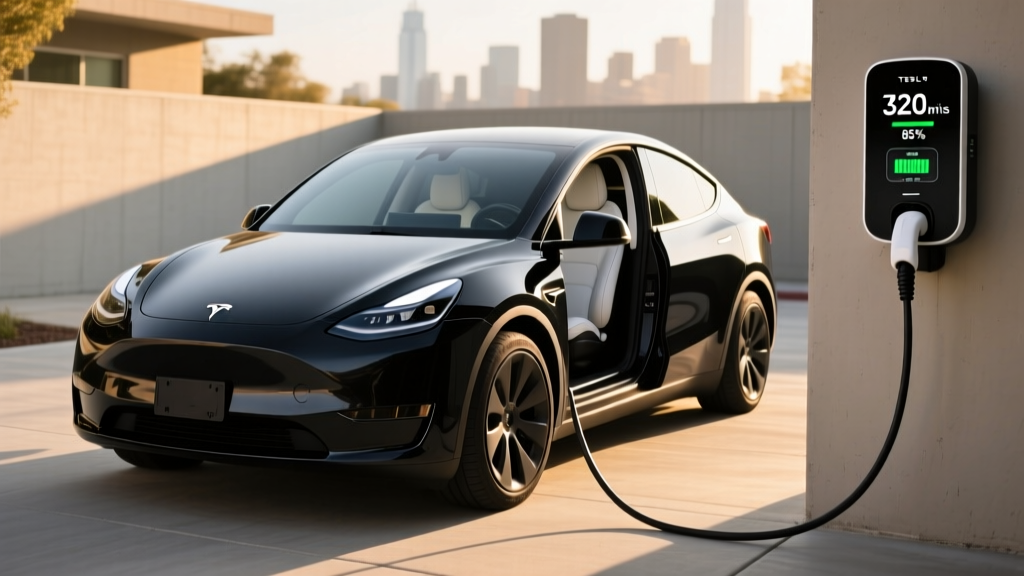
At home on a Level 2 Wall Connector (48-amp circuit, 60-amp breaker), the Model Y charges at 11.5 kW, adding roughly 44 miles of range per hour. An overnight session from 20% to 80% takes about 5 hours — easily handled while you sleep. Installation typically runs $800–$2,000 depending on panel proximity and local permitting, though a 200-amp panel upgrade can add $1,500–$3,000 if your home requires it.
Pricing, Tax Credits, and the Depreciation Question
Here's where the financial picture gets complex — and where Tesla Model Y depreciation becomes the central concern for buyers.
| Trim | Base MSRP | §30D Credit | Effective Price | Destination |
|---|---|---|---|---|
| Long Range RWD | $44,990 | Up to $7,500* | ~$37,490* | $1,390 |
| Long Range AWD | $47,990 | Up to $7,500* | ~$40,490* | $1,390 |
| Performance | $52,490 | Up to $7,500* | ~$44,990* | $1,390 |
*Federal §30D tax credit eligibility depends on multiple factors. See the IRS clean vehicle credits page for current rules. Key requirements for 2026:
- MSRP cap: SUVs/trucks must be ≤$80,000 (Model Y qualifies on all trims)
- Buyer income cap: AGI ≤$150,000 single / ≤$300,000 joint
- Battery sourcing: Critical minerals and battery components must meet phased-in domestic/Fta-country sourcing thresholds — verify current-year compliance at purchase
- Point-of-sale transfer: Eligible buyers can apply the credit as a down-payment reduction at the dealer rather than waiting for a tax refund
Understanding Tesla Model Y Depreciation
Tesla Model Y depreciation has been steeper than many legacy-brand EVs over the past two years, driven by three converging forces:
- Aggressive new-vehicle price cuts: Tesla has repeatedly lowered MSRP on the Model Y since 2023, which immediately compresses used values. A 2023 Model Y Long Range purchased at $52,990 saw its trade-in value undercut when Tesla dropped the new equivalent to the mid-$40K range.
- Market saturation: The Model Y was the best-selling vehicle globally in 2023. High volume means abundant used inventory by 2025–2026, increasing supply-side depreciation pressure.
- Competitor pricing: The Chevrolet Equinox EV starting under $35K and the Hyundai Ioniq 5 undercutting on price have compressed what buyers will pay for a used Model Y.
Based on current market data, a 2026 Model Y Long Range AWD at ~$47,990 (before credit) can expect to retain approximately 55–62% of its value after 3 years / 36,000 miles, depending on condition and regional demand. That translates to roughly $18,000–$21,500 in depreciation over three years. By comparison, a Toyota RAV4 Hybrid (non-plug-in) retains closer to 65–70% over the same period, while some competitors like the Mustang Mach-E depreciate similarly or slightly worse than the Model Y.
The key mitigation: if you qualify for the full $7,500 credit and purchase at the effective ~$40,490 price point, your depreciation basis is lower. Three years of 40% loss on $40,490 is ~$16,200 — a meaningfully different number than losing 40% on a $52,000 pre-cut Model Y.
Interior, Cargo, and Daily Practicality
The 2026 Model Y (refreshed with the "Juniper" update that rolled out for the 2025 model year) addresses several longstanding complaints. The cabin is noticeably quieter thanks to acoustic glass, the suspension tuning is more compliant over rough pavement, and the addition of ventilated front seats and a rear touchscreen improve passenger experience.
Cargo capacity remains a Model Y strength:
- Rear cargo (seats up): 30.2 cu ft
- Rear cargo (seats folded): 72.1 cu ft
- Front trunk (frunk): 4.1 cu ft
- Rear legroom: 41.6 inches
- Front headroom: 41.0 inches
The hatchback design with a wide liftgate makes loading bulky items straightforward — a clear advantage over sedan-format EVs. The optional third-row seat (available on some trims) adds two small rear-facing seats suitable only for children under about 5'2", and it eliminates the under-floor rear storage bin.
On the tech front, the 15.4-inch center touchscreen handles virtually all vehicle controls — there are no physical buttons for climate, mirrors, or glovebox. This minimalist approach continues to polarize: some owners love the clean aesthetic, while others find touchscreen-dependent HVAC adjustments distracting while driving. Tesla's infotainment system remains among the fastest and most responsive in the industry, with native streaming apps, a strong navigation system, and over-the-air updates that add features post-purchase.
Driver Assistance: Autopilot and FSD Supervised
Tesla Autopilot and Full Self-Driving (Supervised) are SAE Level 2 driver-assistance systems. They require continuous driver supervision — hands on or near the wheel, eyes on the road. They are not self-driving. The driver is legally and operationally responsible at all times.
Standard Autopilot includes Traffic-Aware Cruise Control and Autosteer (lane centering) on divided highways. The optional FSD (Supervised) package ($8,000 or $99/month subscription) adds Navigate on Autopilot (highway on/off-ramp handling), Auto Lane Change, Autopark, Summon, and traffic light/stop sign recognition.
In practice, FSD Supervised handles the majority of highway miles competently but still requires intervention in construction zones, unmapped intersections, and complex urban scenarios. City-street performance has improved substantially through 2025–2026 neural network updates, but it remains a supervision-heavy system — not a replacement for an attentive driver. Buyers should evaluate FSD as a convenience feature, not an autonomy solution.
- Drive without a licensed, attentive driver in the seat
- Handle all weather conditions (heavy rain, snow, fog degrade performance)
- Guarantee safe operation in construction zones or unmapped areas
- Replace the driver's legal responsibility for the vehicle
Warranty and Battery Longevity
Tesla's warranty structure for the 2026 Model Y:
- Basic vehicle: 4 years / 50,000 miles
- Battery & drive unit: 8 years / 120,000 miles (Long Range) — guaranteed to retain ≥70% capacity
- Roadside assistance: 4 years / 50,000 miles
The NMC battery in the Model Y has demonstrated strong longevity in fleet data. Tesla's 2024 Impact Report cited average battery degradation of approximately 12% at 200,000 miles across their fleet — though individual results vary based on charging habits, climate, and Supercharger frequency. Best practice for maximizing battery life: charge to 80% daily, avoid frequent 100% charges, minimize DC fast charging when Level 2 is available, and don't let the battery sit at very low SoC for extended periods.
Out-of-warranty battery replacement for a Model Y currently runs approximately $12,000–$16,000 at Tesla Service Centers, though this is rarely needed within the vehicle's typical ownership lifecycle. Most owners will sell or trade the vehicle long before the battery reaches its end-of-life threshold.
Who Should Buy the 2026 Model Y — and Who Shouldn't
- You need a practical family crossover with strong range and the most mature Supercharger network
- You value over-the-air updates, a responsive infotainment system, and hatchback versatility
- Your daily commute is under 150 miles round-trip and you can charge at home
- You road-trip regularly and want the most seamless long-distance charging experience
- You prefer physical buttons, traditional dealer service, or a more plush interior (consider Hyundai Ioniq 5 or BMW iX)
- Depreciation is your top financial concern and you'd prefer a segment leader in resale value (Toyota RAV4 Prime, though a PHEV)
- You need true LFP battery chemistry for 100% daily charging without degradation concerns (consider the Standard Range RWD variant, which uses LFP)
- You want the absolute lowest entry price in an electric crossover (Chevrolet Equinox EV starts ~$33K)
Pros
- Best-in-class Supercharger network for road trips
- Strong efficiency (29 kWh/100 mi) maximizes range per kWh
- Spacious hatchback cargo area (72 cu ft seats folded)
- Quick 250 kW DC fast charging, ~25 min 10–80%
- Continuous OTA improvements post-purchase
- Qualifies for full §30D credit on all trims (verify eligibility)
Cons
- Depreciation steeper than some legacy-brand competitors
- Touchscreen-only controls polarize and can distract
- NMC battery recommends 80% daily limit (reduces usable range)
- FSD costs $8,000 extra and remains Level 2 supervision-required
- No physical buttons; mirrors and glovebox adjusted via screen
- Tesla Service Center availability varies by region
Frequently Asked Questions
What is the real-world range of the 2026 Tesla Model Y?
The Long Range RWD is EPA-rated at 320 miles, but real-world highway driving at 75 mph yields approximately 265–280 miles. Cold weather (below freezing) can reduce that to 210–240 miles. The Long Range AWD delivers about 250–270 real-world highway miles from its 303-mile EPA rating.
How fast does the Model Y charge at home and on DC fast chargers?
On a DC fast charger (V3 Supercharger or NACS-compatible), the Model Y peaks at 250 kW and charges from 10–80% in approximately 25 minutes. At home on a Level 2 Wall Connector (11.5 kW), it adds about 44 miles of range per hour, with a 20–80% session taking roughly 5 hours.
Does the 2026 Tesla Model Y qualify for the $7,500 federal tax credit?
The Model Y qualifies as an SUV under the §30D MSRP cap of $80,000, and all current trims fall under that limit. However, buyer eligibility also depends on adjusted gross income (≤$150K single / ≤$300K joint) and battery component/critical mineral sourcing requirements that phase in annually. Verify eligibility at IRS.gov before purchasing. The credit can be transferred at point of sale as a price reduction.
How much will a Model Y depreciate over 3–5 years?
Current market data suggests a 2026 Model Y will retain approximately 55–62% of its value after 3 years/36,000 miles and roughly 42–50% after 5 years/60,000 miles. Depreciation is heavily influenced by Tesla's new-vehicle pricing changes — further price cuts on new models would compress used values further. Purchasing at the post-credit effective price (~$37,500–$45,000) reduces your absolute dollar depreciation.
Is the Model Y worth buying over the Hyundai Ioniq 5 or Ford Mach-E?
It depends on priorities. The Model Y leads in Supercharger network access, efficiency, and cargo space. The Ioniq 5 offers faster 800V charging (10–80% in ~18 min on 350 kW chargers), a more distinctive design, and physical climate controls. The Mach-E provides a more traditional crossover feel and competitive pricing. If road-trip charging convenience is your top priority, the Model Y still holds an edge. If interior design, charging speed, or price matter more, the alternatives deserve serious comparison.
Should I get the LFP or NMC battery in the Model Y?
If you choose the Standard Range RWD variant (where available), you'll get an LFP (lithium iron phosphate) battery that Tesla recommends charging to 100% daily — giving you full usable range every day with minimal degradation concerns. The trade-off is less total range (~260 miles EPA) and reduced cold-weather performance. The Long Range and Performance trims use NMC, which offers more range but recommends 80% daily charging for longevity.