The Real Story Behind Tesla Model Y Depreciation
If you bought a Tesla Model Y in 2022 or 2023, you've likely noticed the used market has softened. Price cuts, rising competition, and shifting tax-credit rules have compressed resale values across the EV segment — and the best-selling EV in America is no exception. But depreciation isn't just about the sticker price you paid versus what you'll get at trade-in. It's a function of battery health, software relevance, market saturation, and total cost of ownership.
This profile breaks down the 2026 Tesla Model Y with a depreciation lens: what you're buying, what it costs, how it holds value, and whether it still makes financial sense compared to key competitors.
2026 Tesla Model Y: Core Specs at a Glance
| Spec | Long Range AWD | Performance |
|---|---|---|
| Base MSRP | $44,990 | $49,990 |
| EPA Range | 320 miles | 285 miles |
| Usable Battery | ~75 kWh (NMC) | ~75 kWh (NMC) |
| Drivetrain | Dual-Motor AWD | Dual-Motor AWD |
| Horsepower | 384 hp | 456 hp |
| 0–60 mph | 4.8 sec | 3.5 sec |
| Efficiency | 122 MPGe (28 kWh/100mi) | 111 MPGe (30 kWh/100mi) |
| Cargo (rear seats up) | 30.2 cu ft | 30.2 cu ft |
| Cargo (rear seats folded) | 72.0 cu ft | 72.0 cu ft |
| Legroom (front/rear) | 41.8 / 37.7 in | 41.8 / 37.7 in |
| Battery Warranty | 8 years / 120,000 miles (≥70% retention) | |
| Basic Warranty | 4 years / 50,000 miles | |
Source: EPA fueleconomy.gov and Tesla's official 2026 order page. Specs reflect the Juniper-refreshed Model Y platform.
Range, Efficiency, and the Real-World Gap
Real-World Highway (70 mph, 72°F): ~265–280 miles
Real-World Cold Weather (32°F, mixed driving): ~220–245 miles
Why the gap? EPA tests include generous low-speed city cycles that favor EVs. Sustained highway speeds, cold battery chemistry, and cabin heating all draw more energy. The Model Y's heat pump helps in cold weather, but expect a 20–30% range reduction in freezing conditions.
The 2026 Model Y Long Range's 122 MPGe combined rating makes it one of the most efficient electric SUVs in its class. At the U.S. average electricity rate of ~$0.16/kWh, that translates to roughly $4.48 per 100 miles — compared to $12–$14 for a similarly sized gas crossover at 25 MPG and $3.50/gallon. This efficiency advantage is a key factor in total cost of ownership and, by extension, long-term value retention.
Charging Speed: DC Fast and Home Level 2
| Charging Level | Power / Rate | Time / Output |
|---|---|---|
| Level 1 (120V) | ~1.4 kW | ~3–4 miles per hour |
| Level 2 (240V, 48A) | 11.5 kW | ~37 miles per hour; full charge in ~8 hours |
| DC Fast Charge (peak) | 250 kW (CCS/NACS via Supercharger) | 10–80% in ~25 minutes |
| DC Fast Charge (sustained avg) | ~150–170 kW average | 10–80% realistic: ~28–30 min |
The Model Y peaks at 250 kW on V3 Superchargers, but like all EVs, it doesn't sustain that rate. The charge curve tapers significantly past 60% state of charge. On a road trip, expect realistic 10–80% stops around 28–30 minutes — fast enough for a bathroom-and-snack break, but plan for longer stops if you're charging past 80%.
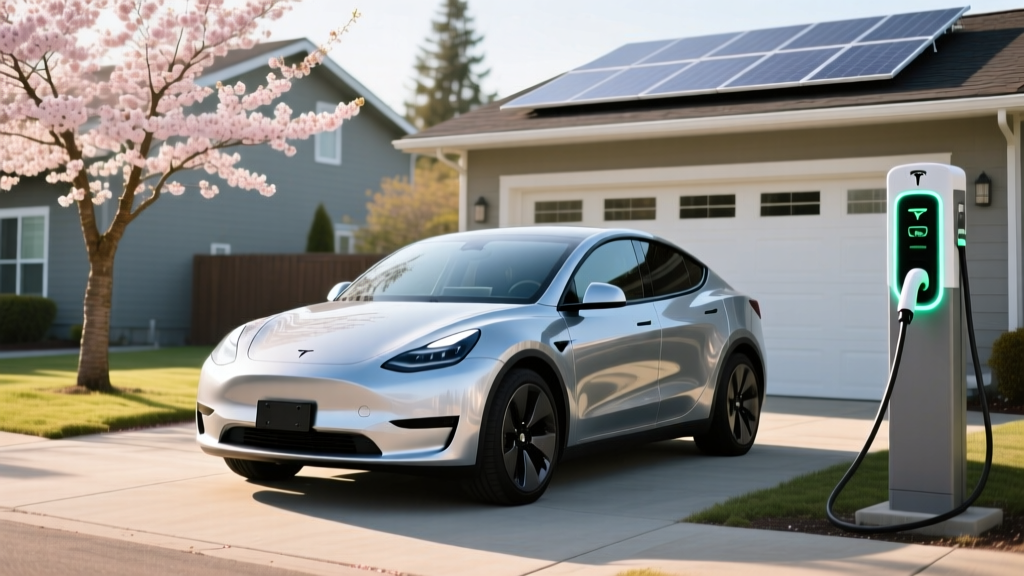
At home, a 48-amp Level 2 wall connector on a 60-amp circuit delivers 11.5 kW, adding ~37 miles per hour of charging. Most owners wake up to a full battery every morning, which is the single biggest quality-of-life advantage over gas vehicles. Installation typically costs $800–$2,000 depending on panel capacity and run length — factor this into your first-year budget.
Depreciation Drivers: Why the Model Y Loses Value
Tesla Model Y depreciation is shaped by several forces unique to the EV market:
1. Aggressive Price Cuts
Tesla has cut new-vehicle prices multiple times since 2022. When a new Long Range AWD drops from $65,990 (2022 pricing) to $44,990 (2026), every used Model Y on the market is instantly repriced downward. Early adopters who paid premium prices absorbed the steepest losses — some seeing 40–50% depreciation over three years, versus a typical 30–35% for mainstream gas SUVs over the same period.
2. Battery Degradation Perception
Tesla's NMC battery chemistry typically retains 90–95% capacity after 50,000 miles, based on fleet data. The 8-year/120,000-mile warranty (with a 70% capacity retention floor) provides a backstop. However, used-car buyers unfamiliar with EV battery longevity often over-discount older EVs — a perception gap that hurts resale.
3. Market Saturation
The Model Y is the best-selling EV in the U.S., which means high used-market supply. More trade-ins, more lease returns, and more fleet sales all increase inventory and suppress prices.
4. Rising Competition
The 2026 landscape includes strong alternatives: Hyundai Ioniq 5, Kia EV6, Ford Mustang Mach-E, and the refreshed Nissan Ariana. Each chips at the Model Y's monopoly on buyer attention, forcing used prices lower to remain competitive.
5. Tax Credit Shifts
The federal §30D credit can reduce a new Model Y's effective price by up to $7,500 — but only if the buyer meets income caps ($150K single / $300K joint), the vehicle stays under the $55,000 SUV MSRP cap, and battery sourcing requirements are satisfied. When new buyers get a $7,500 discount, used prices must fall to stay attractive. Check current eligibility at IRS.gov.
Pricing, Tax Credits, and True Cost
| Trim | MSRP | Est. §30D Credit | Effective Price |
|---|---|---|---|
| Long Range AWD | $44,990 | Up to $7,500* | ~$37,490 |
| Performance | $49,990 | Up to $7,500* | ~$42,490 |
*§30D credit eligibility depends on buyer AGI, battery critical-mineral sourcing, and MSRP caps. The Model Y qualifies as an SUV under the $80,000 MSRP cap for trucks/SUVs/vans. Point-of-sale transfer is available at participating dealers. Confirm your eligibility with a tax professional before relying on this figure.
For context, a 2026 Model Y Long Range at an effective ~$37,500 is now priced similarly to a well-equipped Toyota RAV4 Hybrid — but with far lower per-mile energy costs. Over five years and 75,000 miles, the fuel savings alone can exceed $6,000, partially offsetting depreciation.
5-Year Total Cost of Ownership Snapshot
Comparing a 2026 Model Y Long Range AWD to a 2026 Toyota RAV4 XLE AWD (gas), assuming 15,000 miles/year, $0.16/kWh electricity, and $3.50/gallon gas:
| Cost Factor | Model Y LR AWD | RAV4 XLE AWD |
|---|---|---|
| Purchase (after credit) | ~$37,490 | ~$33,500 |
| Fuel / Energy (5 yr) | ~$2,240 | ~$7,875 |
| Maintenance (5 yr) | ~$1,200 | ~$3,500 |
| Insurance (5 yr avg) | ~$9,500 | ~$7,200 |
| Est. Depreciation (5 yr) | ~$18,000 | ~$14,000 |
| 5-Year Total | ~$68,430 | ~$66,075 |
The Model Y costs slightly more over five years, primarily due to steeper depreciation and higher insurance premiums. But the gap is narrow — and if you charge primarily on home solar or off-peak rates, the energy savings widen significantly. Depreciation remains the single largest cost for both vehicles.
Standout Tech and Notable Drawbacks
Pros
- Supercharger Network: 50,000+ global stalls with unmatched reliability. NACS connector is now the industry standard, but Tesla's proprietary network remains the gold standard for road-trip charging.
- Over-the-Air Updates: Continuous feature additions and performance improvements keep the vehicle feeling current — a depreciation mitigator.
- Efficiency Leader: 122 MPGe combined beats nearly every electric SUV in its class.
- Minimalist Interior: 15.4-inch touchscreen handles nearly all controls; clean, spacious cabin with 72 cu ft of cargo room.
- Autopilot Standard: Basic Autopilot (SAE Level 2) includes adaptive cruise and lane-keeping. FSD (Supervised) available as a $8,000 option or $99/month subscription.
- Acceleration: 4.8-second 0–60 in the Long Range is genuinely quick for a family SUV.
Cons
- No Physical Controls: No turn-signal stalks, no speedometer cluster — everything routes through the touchscreen or steering-wheel buttons. Polarizing for new owners.
- Ride Quality: The Juniper refresh improved damping, but the Model Y still rides firmer than a Hyundai Ioniq 5 or Ford Mach-E on rough pavement.
- Insurance Costs: Tesla insurance averages 15–25% higher than comparable gas SUVs due to repair costs and parts pricing.
- Panel Gaps & Build Consistency: Improved since Fremont's early days, but fit-and-finish still trails Hyundai/Kia and legacy luxury brands.
- FSD Limitations: Full Self-Driving (Supervised) remains SAE Level 2 — the driver must monitor at all times. It is not autonomous driving.
Who Should Buy the Model Y in 2026?
Choose the Model Y if:
- You charge at home and want the lowest per-mile energy cost in a compact SUV.
- You road-trip frequently and value the Supercharger network's reliability.
- You want strong acceleration and a tech-forward cabin without luxury-brand pricing.
- You plan to keep the vehicle 5+ years, spreading out the depreciation hit.
Look elsewhere if:
- You need the softest ride quality — test-drive the Ioniq 5 or Mach-E first.
- You want physical buttons, a heads-up display, or a traditional instrument cluster.
- You plan to sell or trade in under 3 years — short ownership periods maximize depreciation pain.
- Your budget is under $35,000 — consider a used 2022–2023 Model Y, where the depreciation hit has already been absorbed by the first owner.
Is the Model Y Worth It vs. Key Competitors?
The 2026 compact electric SUV segment is crowded. Here's how the Model Y stacks up on the metrics that drive depreciation and ownership satisfaction:
- vs. Hyundai Ioniq 5: The Ioniq 5 charges faster (peak 350 kW, 10–80% in ~18 min on 800V architecture) and rides more comfortably. But it lacks Supercharger access (though NACS adapters are now available) and has slightly less range (305 mi EPA for the Long Range AWD). Depreciation is comparable.
- vs. Ford Mustang Mach-E: The Mach-E offers a more engaging drive and traditional controls, but its charging speed peaks at 150 kW and its efficiency trails the Model Y. Ford's dealer network provides easier service access.
- vs. Kia EV6: Shares the Ioniq 5's 800V fast-charging advantage. Slightly sportier styling but less cargo space. Pricing is competitive.
The Model Y's biggest competitive moat remains the Supercharger network and Tesla's software ecosystem. If those matter to you, the depreciation premium is arguably worth paying.
Frequently Asked Questions
How much does a Tesla Model Y depreciate in the first year?
Based on 2025–2026 market data, a new Model Y typically loses 15–22% of its value in the first 12 months — slightly higher than the segment average of 12–18% for gas compact SUVs. The primary driver is Tesla's frequent new-vehicle price adjustments, which reset used-market expectations.
Does the Model Y qualify for the $7,500 federal EV tax credit?
Yes — the 2026 Model Y qualifies under the §30D SUV MSRP cap of $80,000. However, buyer eligibility requires adjusted gross income under $150,000 (single) or $300,000 (joint), and the vehicle must meet battery critical-mineral and component sourcing thresholds. The credit can be transferred at the point of sale, reducing your purchase price directly. Verify current sourcing compliance at IRS.gov before purchasing.
Is a used Tesla Model Y a better deal than new?
Often, yes. A 2023–2024 Model Y Long Range with 20,000–40,000 miles can be found in the $28,000–$34,000 range, having already absorbed the steepest depreciation. Battery health is typically still above 92%, and the remaining powertrain warranty covers you to 120,000 miles. The trade-off is missing the full §30D credit (the used-EV credit under §25E caps at $4,000 and has stricter income and price limits).
How long will the Model Y battery last?
Tesla's NMC battery packs are designed for 1,500+ charge cycles. Real-world fleet data shows approximately 10–12% degradation at 100,000 miles for most owners. The 8-year/120,000-mile warranty guarantees at least 70% capacity retention. If the battery drops below that threshold within the warranty period, Tesla replaces or refurbishes it at no cost.
What's the real-world range in winter?
In sustained freezing temperatures (20–32°F), expect 220–245 miles from the Long Range AWD — a 23–31% reduction from the 320-mile EPA sticker. The Model Y's standard heat pump recovers waste heat from the drivetrain to warm the cabin, which is more efficient than resistive heating. Preconditioning the battery while plugged in before departure helps preserve range and enables faster DC charging.
How does Model Y depreciation compare to gas SUVs?
Gas compact SUVs like the Toyota RAV4 and Honda CR-V typically depreciate 30–38% over five years. The Model Y's 5-year depreciation currently sits around 40–48%, driven by the price-cut cycle and EV market maturation. However, as EV adoption normalizes and Tesla stabilizes pricing, this gap is expected to narrow. The fuel and maintenance savings over five years (~$5,600+ for the Model Y) partially offset the higher depreciation.