Why Tesla Model Y Demo Discounts Are Trending in 2026
Tesla periodically offers discounted demo and loaner vehicles directly through its inventory system, and the Model Y — America's best-selling EV — is frequently included. A "demo" in Tesla's parlance is a vehicle that has been used for test drives, service loaners, or internal company use, typically carrying between 1,000 and 6,000 miles. These units are sold at a markdown from MSRP, often ranging from $2,000 to $7,000 off depending on mileage, condition, and current demand.
For buyers who want a Model Y but bristle at the sticker price, demo inventory represents one of the few avenues to negotiate on a Tesla — a brand that famously doesn't haggle on new vehicles. In 2026, with the refreshed "Juniper" Model Y now fully in production and competing against an increasingly crowded midsize electric SUV segment, Tesla has used demo pricing more aggressively to move units.
This guide breaks down the full specs of the 2026 Model Y lineup, what to expect from real-world range and charging, how the §30D federal tax credit applies, and whether a demo unit is the smart play versus buying new or choosing a competitor.
2026 Tesla Model Y: Full Spec Breakdown
| Specification | Long Range RWD | Long Range AWD | Performance |
|---|---|---|---|
| EPA Range | 320 miles | 300 miles | 277 miles |
| Battery (usable) | ~75 kWh, NMC | ~75 kWh, NMC | ~75 kWh, NMC |
| Drivetrain | Rear-Wheel Drive | Dual Motor AWD | Dual Motor AWD |
| Horsepower | 346 hp | 384 hp | 510 hp |
| 0–60 mph | 5.8 sec | 4.8 sec | 3.5 sec |
| Peak DC Charge Rate | 250 kW | 250 kW | 250 kW |
| 10–80% DC Charge | ~27 min | ~27 min | ~27 min |
| Level 2 (11.5 kW) | ~44 mi/hr | ~44 mi/hr | ~44 mi/hr |
| MPGe (combined) | 122 MPGe | 116 MPGe | 111 MPGe |
| kWh/100 mi | 28 | 29 | 30 |
| Base MSRP | $44,990 | $47,990 | $52,490 |
Sources: EPA fueleconomy.gov, Tesla.com specifications. Pricing reflects 2026 model year before destination fees.
Real-World Range: What the EPA Sticker Doesn't Tell You
Expect ~270–290 miles on mixed highway/city driving at moderate temperatures. At sustained 75+ mph highway speeds, plan for ~240–260 miles. In freezing conditions (below 30°F), range drops 15–30%, yielding as low as ~200–220 miles without preconditioning.
The Juniper-generation Model Y benefits from improved aerodynamics (drag coefficient reportedly around 0.22 Cd) and a revised heat pump that reduces cold-weather cabin heating losses compared to the pre-2025 model. However, the physics of lithium-ion cells at low temperatures remain unchanged. NMC chemistry, which Tesla uses in the Long Range and Performance trims, is energy-dense but more sensitive to cold than LFP.
For buyers in the Sun Belt or those with garage parking and access to preconditioning via the Tesla app, the real-world delta from EPA is manageable. For cold-climate buyers in the Upper Midwest or Northeast, budgeting 200–220 miles of usable winter range is prudent — and one reason to prioritize a home Level 2 charger so you can depart at 100% SoC with a warm battery.
Charging Speed: Supercharger Network vs. Home Setup
| Charging Level | Power | Miles Added per Hour | Notes |
|---|---|---|---|
| Level 1 (120V) | ~1.4 kW | ~4–5 mi/hr | Emergency/trickle only |
| Level 2 (240V, 48A) | 11.5 kW | ~44 mi/hr | Home Wall Connector ideal |
| DC Fast (Supercharger V3/V4) | Up to 250 kW | Up to ~1,000 mi/hr (peak) | 10–80% in ~27 min |
Tesla's Supercharger network remains the gold standard for public DC fast charging in terms of reliability and plug-and-charge simplicity. The Model Y peaks at 250 kW on V3 and V4 Superchargers, though — as with all EVs — that peak is not sustained. The charge curve tapers significantly above 60% SoC, and above 80% it drops sharply to protect battery longevity. On a typical road trip stop (10–80%), expect about 27 minutes, which aligns with a restroom and snack break.
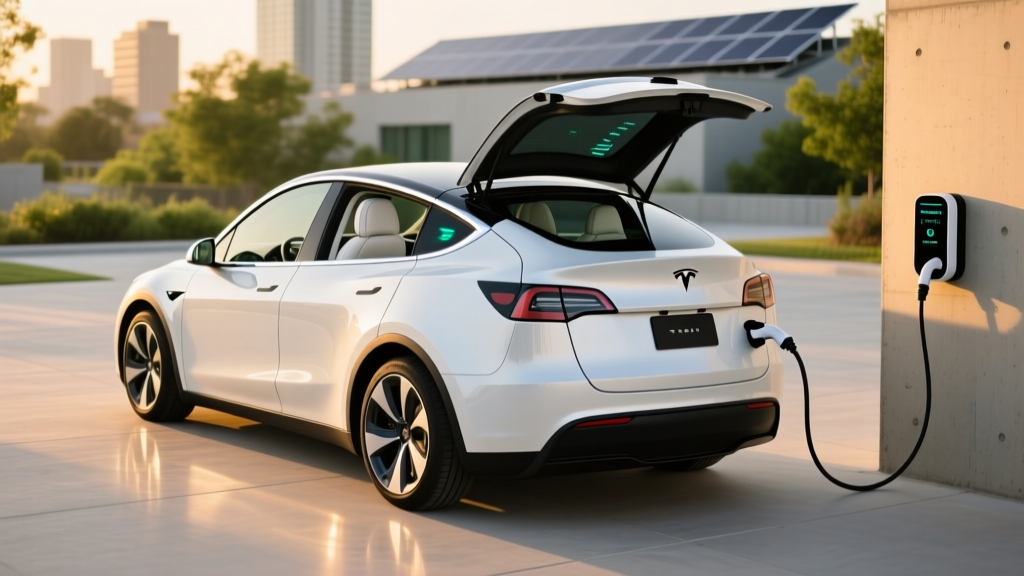
At home, a Tesla Wall Connector on a 60-amp circuit delivers 11.5 kW (48 amps continuous), adding roughly 44 miles of range per hour. An overnight charge from 20% to 80% takes about 4–5 hours — more than sufficient for daily driving. Installation costs for a Wall Connector typically run $800–$2,000 depending on panel proximity and whether a panel upgrade is needed.
One note for demo buyers: verify the vehicle's charge port door and connector are in good condition. High-traffic demo use means frequent plugging/unplugging, and while Tesla's charge port is robust, it's worth inspecting.
Pricing, Demo Discounts, and Federal Tax Credit Eligibility
| Trim | Base MSRP | Typical Demo Discount | Demo Price (est.) | §30D Credit (if eligible) | Effective Price |
|---|---|---|---|---|---|
| Long Range RWD | $44,990 | $3,000–$5,000 | $39,990–$41,990 | Up to $7,500 | ~$32,490–$34,490 |
| Long Range AWD | $47,990 | $3,000–$6,000 | $41,990–$44,990 | Up to $7,500 | ~$34,490–$37,490 |
| Performance | $52,490 | $2,000–$4,000 | $48,490–$50,490 | Up to $7,500 | ~$40,990–$42,990 |
§30D Federal Tax Credit Rules (2026): The IRS §30D Clean Vehicle Credit provides up to $7,500 for qualifying new EVs, and as of 2024+, this can be transferred to the dealer as a point-of-sale discount. However, eligibility hinges on several factors:
- MSRP cap: SUVs must be priced at or below $80,000 (all Model Y trims qualify).
- Buyer income cap: AGI must not exceed $150,000 (single), $225,000 (head of household), or $300,000 (joint).
- Battery sourcing: Critical minerals and battery components must meet phased-in percentages from US/free-trade-agreement partners. Tesla's US-built batteries with sourced materials have largely met these thresholds, but verify the specific VIN on the IRS eligible vehicle list.
- Demo vehicles: A demo sold with under ~7,500 miles and not previously titled to a retail owner generally qualifies as "new" for §30D purposes. Confirm with your tax professional and the Tesla delivery team.
The combination of a demo discount plus the full $7,500 credit can push a Long Range RWD Model Y into the low $30Ks — a price point that competes directly with well-equipped gas crossovers when you factor in fuel savings.
Interior, Cargo, and Technology
The Juniper Model Y interior received a significant overhaul: ventilated front seats, ambient lighting, a rear-seat touchscreen, power-folding second row, and improved sound insulation. The 15.4-inch front touchscreen runs Tesla's latest software with native navigation, streaming, and gaming.
Cargo volume: 30.2 cu ft behind the second row, expanding to 72.1 cu ft with seats folded. The rear trunk opening is wide and low, and the front trunk (frunk) adds roughly 4.1 cu ft — enough for a charging cable kit and a soft bag.
Passenger space: Front legroom is 41.8 inches; rear legroom is 40.5 inches — competitive with the Hyundai Ioniq 5 and Ford Mustang Mach-E, and noticeably more generous than the BMW iX3.
Driver assistance: Basic Autopilot (Traffic-Aware Cruise Control + Autosteer) is standard. Enhanced Autopilot ($6,000) adds Auto Lane Change, Autopark, Summon, and Navigate on Autopilot. Full Self-Driving (Supervised) remains a $8,000 add-on or $99/month subscription.
Warranty, Battery Longevity, and Ownership Costs
Tesla's warranty structure for the 2026 Model Y:
- Basic Vehicle: 4 years / 50,000 miles
- Battery & Drive Unit: 8 years / 120,000 miles (Long Range/Performance AWD), with a minimum 70% capacity retention guarantee over the warranty period
The NMC battery pack in the Long Range and Performance models has demonstrated strong longevity in fleet data. Real-world degradation studies from sources like Recurrent Auto show Tesla's NMC packs retaining approximately 90% capacity at 100,000 miles under normal use patterns. The active liquid thermal management system is a key contributor.
For demo buyers, the battery warranty clock starts from the original in-service date (when the car was first registered as a demo/loaner), not when you purchase it. Verify the exact warranty start date with Tesla before signing.
Pros and Cons: The Honest Take
Pros
- Supercharger network access — still the most reliable DC fast-charging ecosystem in North America
- Strong real-world efficiency (28–30 kWh/100mi) keeps charging costs low
- Best-in-class cargo volume for the segment at 72.1 cu ft max
- Demo pricing + §30D credit can yield a sub-$35K effective price
- OTA software updates continuously add features
- Excellent regenerative braking enables one-pedal driving
Cons
- No physical buttons — all climate, mirror, and glovebox controls are screen-based
- Ride quality is firm; some buyers find it less refined than Hyundai/Kia competitors
- FSD (Supervised) remains Level 2 despite the name and price
- Turn signal stalk removed in Juniper — steering-wheel-mounted buttons require adaptation
- Insurance premiums run 15–30% higher than comparable gas SUVs
- No Apple CarPlay or Android Auto integration
Model Y vs. Key Competitors: Is It Still the Default?
The 2026 Model Y faces serious competition. The Hyundai Ioniq 5 (310 miles EPA, 800V architecture for ~18-minute 10–80% charges on 350 kW chargers) offers faster peak charging and a more conventional interior. The Ford Mustang Mach-E (up to 312 miles EPA, BlueCruise hands-free highway driving) provides a more engaging driving experience. The Kia EV6 and Chevrolet Blazer EV round out strong alternatives.
Where the Model Y still wins: Supercharger reliability, over-the-air updates, cargo space, and the potential for aggressive demo pricing. Where it loses: interior material quality, charging port standardization (Tesla's NACS is now the industry standard, but adapter dynamics are still settling), and the polarizing minimalist interior.
If you prioritize charging infrastructure confidence and total cost of ownership, the Model Y remains the benchmark. If you value a more traditional cockpit layout, physical controls, or faster peak charging on third-party networks, test the Ioniq 5 or EV6 before committing.
Frequently Asked Questions
What is the real-world range of the 2026 Tesla Model Y?
The EPA rates the Long Range RWD at 320 miles. In mixed real-world driving, expect 270–290 miles. Sustained highway driving at 75+ mph reduces this to ~240–260 miles. In freezing weather without preconditioning, plan for 200–220 miles.
How fast does the Model Y charge at home and on the road?
On a home Level 2 Wall Connector (11.5 kW), you gain ~44 miles per hour — a full overnight charge covers most needs. On a V3/V4 Supercharger, the Model Y peaks at 250 kW, reaching 10–80% in approximately 27 minutes.
How much does a demo Model Y cost after tax credits?
A Long Range RWD demo typically runs $39,990–$41,990 after discount. With the full $7,500 §30D credit applied at point of sale, the effective price drops to roughly $32,490–$34,490. Verify your income eligibility and the vehicle's battery sourcing compliance on the IRS Clean Vehicle Credit page.
Does a Tesla demo qualify for the federal EV tax credit?
Generally yes — if the vehicle has not been previously titled to a retail owner and has low mileage (typically under 7,500 miles), it is considered "new" for §30D purposes. Always confirm with Tesla's delivery team and your tax professional before relying on the credit.
Is the Model Y worth buying vs. the Hyundai Ioniq 5 or Ford Mach-E?
Choose the Model Y if Supercharger network access, cargo volume, and OTA updates are your top priorities. Choose the Ioniq 5 if you want faster peak charging (800V architecture) and physical controls. Choose the Mach-E if you prefer hands-free highway driving (BlueCruise) and a more traditional driving feel. All three are excellent — test drive each before deciding.
What are the biggest drawbacks of the Model Y?
The screen-only interface, absence of Apple CarPlay/Android Auto, firm ride quality, and the removal of the turn signal stalk (replaced by steering-wheel buttons in the Juniper refresh) are the most common complaints. Insurance costs also run higher than segment average.
Who is the Tesla Model Y best suited for?
The Model Y is ideal for families and commuters who want a practical, efficient electric SUV with strong road-trip capability via the Supercharger network. It excels as a daily driver for households with home charging access and as a two-row family hauler with class-leading cargo space. It is less ideal for buyers who prioritize luxury interior materials or who lack reliable home charging options.