The Tesla Model Y remains America's best-selling electric vehicle for good reason: it threads the needle between range, space, charging speed, and price better than almost anything in the midsize electric crossover segment. But one spec that rarely gets the attention it deserves is Tesla Model Y curb weight — a number that directly shapes how this SUV accelerates, brakes, consumes energy on the highway, and wears through its tires over 50,000 miles.
In this deep-dive review, we're putting the 2026 Model Y on the scale — literally and figuratively. We'll cover how its curb weight compares to rivals, what it means for real-world range and efficiency, and whether the Juniper-refreshed Model Y still deserves its segment-leading reputation when you look past the spec sheet.
2026 Tesla Model Y Curb Weight by Trim
Curb weight — the vehicle's total mass with all standard equipment, fluids, and a full battery but no passengers or cargo — varies across the Model Y lineup depending on drivetrain and battery configuration. Here's how the 2026 trims stack up:
| Trim | Curb Weight (lbs) | Drivetrain | Battery (kWh usable) | Chemistry | EPA Range |
|---|---|---|---|---|---|
| Long Range RWD | 4,398 | Rear-Wheel Drive | ~75 kWh | NMC | 320 mi |
| Long Range AWD | 4,498 | Dual-Motor AWD | ~75 kWh | NMC | 310 mi |
| Performance AWD | 4,517 | Dual-Motor AWD | ~75 kWh | NMC | 298 mi |
For context, the Model Y's curb weight sits roughly 300–500 lbs lighter than direct competitors such as the Ford Mustang Mach-E Extended Range AWD (~4,800 lbs) and the Hyundai Ioniq 5 AWD (~4,890 lbs). That mass advantage, combined with Tesla's industry-leading drivetrain efficiency, is a primary reason the Model Y extracts more miles per kilowatt-hour than heavier rivals.
Range and Real-World Efficiency
The EPA posts one number on the window sticker, but real-world driving rarely cooperates with laboratory conditions. Here's what to actually expect from the 2026 Model Y:
- EPA Sticker: 310 miles
- Mixed real-world (55/45 city/highway): ~275–290 miles
- Sustained 75 mph highway: ~250–265 miles
- Cold weather (below 32°F, highway): ~210–235 miles (25–30% reduction)
The Model Y's heat pump — standard across all trims — helps mitigate winter range loss compared to EVs using resistive cabin heating. Preconditioning the battery while plugged in further preserves range in cold conditions.
Efficiency is where Tesla's weight advantage shows up clearly. The Long Range AWD achieves an EPA-rated 117 MPGe combined (29 kWh/100 mi). That translates to roughly 3.4–3.6 miles per kWh in mixed driving — among the best in the midsize electric SUV class. The lighter RWD trim pushes slightly higher at around 3.7 mi/kWh.
Weight matters here: every additional 100 lbs of vehicle mass demands more energy to accelerate and sustain speed, especially in stop-and-go traffic and on hilly terrain. The Model Y's relatively svelte curb weight (for a dual-motor, 75 kWh SUV) is a key reason it outperforms heavier rivals on efficiency despite offering comparable interior space.
Charging Speed and Infrastructure
Charging remains one of the Model Y's strongest competitive advantages, thanks to both its electrical architecture and access to Tesla's Supercharger network — now the largest and most reliable DC fast-charging ecosystem in North America.
| Charging Level | Power / Rate | Time / Range Added | Connector |
|---|---|---|---|
| Level 1 (120V household) | ~1.4 kW | ~3–4 mi/hr | NACS (J3400) |
| Level 2 (240V home/public) | 11.5 kW (48A) | ~37 mi/hr; full charge ~8 hrs | NACS (J3400) |
| DC Fast Charge (peak) | 250 kW | 10–80% in ~25 min | NACS (J3400) |
The Model Y uses the NACS connector (now standardized as SAE J3400) natively — no adapter needed at Tesla Superchargers. As of 2026, adapters are available for accessing CCS-equipped networks like Electrify America, though charging speeds on non-Tesla hardware may be limited by station protocols.
A note on the charge curve: the 250 kW peak rate is not sustained across the full session. The Model Y typically holds peak power from roughly 10% to 35% State of Charge (SoC), then progressively tapers. From 80% to 100%, charging slows dramatically — this is normal lithium-ion behavior to protect cell longevity. For road trips, plan your stops around the 10–80% window to minimize time at the charger.
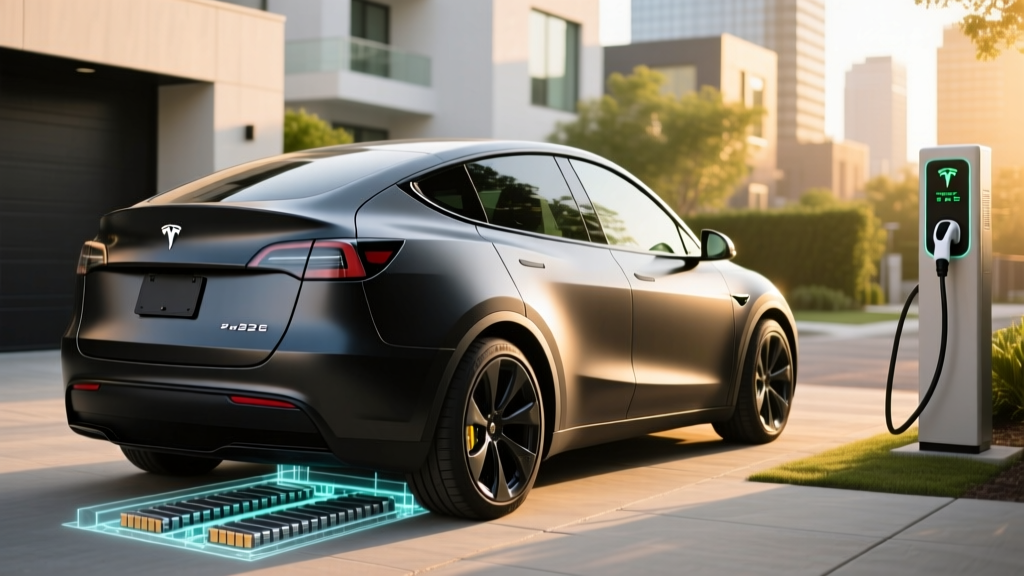
Home Level 2 charging at 11.5 kW (using a Tesla Wall Connector on a 60-amp circuit) adds approximately 37 miles of range per hour. Most owners who plug in overnight wake up to a full battery every morning without ever visiting a public charger. A typical home Level 2 installation runs $800–$2,000 including equipment and electrician labor, depending on panel proximity and local permitting.
Performance and Driving Dynamics
The Model Y's curb weight influences more than efficiency — it shapes how the vehicle accelerates, corners, and brakes. Here's the performance breakdown:
| Trim | 0–60 mph | Horsepower | Top Speed | Towing Capacity |
|---|---|---|---|---|
| Long Range RWD | 5.8 sec | ~346 hp | 125 mph | 3,500 lbs |
| Long Range AWD | 4.8 sec | ~384 hp | 135 mph | 3,500 lbs |
| Performance AWD | 3.5 sec | ~456 hp | 155 mph | 3,500 lbs |
Even at nearly 4,500 lbs, the Performance trim's instant electric torque and low center of gravity (battery pack mounted under the floor) deliver sports-sedan acceleration. The dual-motor AWD system provides precise torque vectoring that makes the weight largely imperceptible during spirited driving.
Regenerative braking is strong and predictable — in "Hold" mode, the Model Y enables true one-pedal driving in most conditions. This reduces brake wear significantly; many Tesla owners report original brake pads lasting 80,000+ miles because regen handles the majority of deceleration. That said, the vehicle's mass means you'll still feel the weight during hard emergency stops and on steep downhill grades, where sustained braking can generate heat.
Pricing, Tax Credits, and Ownership Cost
The 2026 Model Y lineup has been streamlined following the Juniper refresh. Here's where pricing stands before incentives:
| Trim | Base MSRP | Est. Federal Credit (§30D) | Effective Price |
|---|---|---|---|
| Long Range RWD | $44,990 | Up to $7,500* | ~$37,490* |
| Long Range AWD | $47,990 | Up to $7,500* | ~$40,490* |
| Performance AWD | $51,490 | Up to $7,500* | ~$43,990* |
*Federal tax credit eligibility is not automatic. Under IRS §30D rules, the $7,500 credit requires:
- MSRP cap: SUVs/vans must be ≤$80,000 (all Model Y trims qualify)
- Buyer income cap: Modified AGI ≤$150,000 (single), ≤$225,000 (head of household), ≤$300,000 (joint)
- Battery sourcing: Critical minerals and battery components must meet escalating North American/free-trade-partner thresholds — Tesla's battery supply chain has largely met these requirements for vehicles assembled at Giga Texas, but verify current-year compliance at fueleconomy.gov
- Point-of-sale transfer: As of 2024+, eligible buyers can transfer the credit to the dealer at purchase, reducing the upfront price directly
Consult a tax professional before relying on credit eligibility — rules change, and individual circumstances (tax liability, prior credit usage, lease vs. purchase) affect outcomes.
On total cost of ownership, the Model Y's efficiency translates to low fueling costs. At the national average residential electricity rate of ~$0.16/kWh, charging the 75 kWh battery from empty to full costs approximately $12. Compare that to $45–$55 for a tank of gas in a comparable crossover getting 25 MPG combined. Over 15,000 miles/year, the annual "fuel" savings versus gas can reach $1,200–$1,800 depending on local electricity and gas prices.
Interior Space, Cargo, and Daily Livability
The Juniper refresh brought meaningful interior improvements: updated materials, ventilated front seats, ambient lighting, rear-seat climate controls, and a significantly quieter cabin thanks to acoustic glass and additional sound deadening. The minimalist dashboard remains polarizing, but build quality has improved notably.
| Measurement | Value |
|---|---|
| Front headroom | 41.0 in |
| Rear headroom | 39.4 in |
| Front legroom | 41.8 in |
| Rear legroom | 41.6 in |
| Cargo (behind 2nd row) | 30.2 cu ft |
| Cargo (2nd row folded) | 72.1 cu ft |
| Front trunk (frunk) | 4.1 cu ft |
For a vehicle with a 4,498-lb curb weight, the Model Y offers remarkably practical cargo volume. The flat load floor and wide hatch opening make it easy to fit strollers, bicycles, or a week's worth of camping gear. The frunk is small but useful for charging cables and groceries.
One consequence of the vehicle's mass: tire wear. The Model Y's combination of weight, instant torque, and performance-oriented tire compounds means expect to replace tires every 25,000–35,000 miles under normal driving — faster than a comparable ICE crossover. Budget accordingly, especially on the Performance trim with its 21-inch wheels and low-profile rubber.
Tech, Safety, and Driver Assistance
The Model Y's 15.4-inch center touchscreen controls virtually everything — navigation, media, climate, vehicle settings, and even the glovebox release. The Juniper refresh added a rear 8-inch screen for passengers, along with improved voice recognition and a faster processor.
Tesla Autopilot comes standard and includes adaptive cruise control, lane centering, automatic emergency braking, and blind-spot monitoring. Full Self-Driving (Supervised) is a $8,000 add-on (or $99/month subscription) that adds automated lane changes, navigate-on-autopilot, and traffic light/stop sign recognition.
Both Autopilot and FSD (Supervised) are SAE Level 2 driver-assistance systems. The driver must remain fully engaged — hands on or near the wheel, eyes on the road — at all times. Tesla's cabin camera monitors driver attention. These systems are not self-driving. Level 4 driverless capability (like Waymo) is not available in any consumer Tesla vehicle.
Safety ratings remain excellent. The Model Y earned a 5-star overall rating from NHTSA and has consistently performed well in IIHS crash testing. The rigid battery pack structure contributes to a low rollover risk and strong side-impact protection.
Warranty Coverage
| Coverage Area | Term |
|---|---|
| Basic Vehicle Limited Warranty | 4 years / 50,000 miles |
| Battery & Drive Unit (Long Range/Perf) | 8 years / 120,000 miles |
| Battery Capacity Retention Guarantee | ≥70% retained capacity during warranty period |
Tesla's battery warranty is competitive with the industry standard. The 70% capacity retention threshold means if your battery degrades below that level within 8 years or 120,000 miles, Tesla will repair or replace it. Real-world data from high-mileage Tesla owners suggests NMC batteries in the Model Y typically retain 85–90% capacity at 100,000 miles under normal charging habits (avoiding frequent 100% charges and extreme heat exposure).
Pros and Cons
Pros
- Class-leading efficiency (117 MPGe combined) aided by favorable curb weight
- Access to Tesla Supercharger network — the most reliable DC fast-charging infrastructure
- Spacious interior with 72+ cu ft max cargo volume
- Strong 0–60 performance across all trims
- Over-the-air updates continuously add features
- Lower curb weight than key competitors means better tire wear and braking
Cons
- Minimalist interior not for everyone — no physical buttons or instrument cluster
- Ride quality on 21-inch wheels can be firm on rough roads
- FSD (Supervised) costs $8,000 extra and still requires full driver attention
- Tire replacement intervals shorter than ICE crossovers due to weight + torque
- Service center availability can be limited in rural areas
- Insurance premiums tend to run 15–25% higher than comparable gas vehicles
Who Should Buy the 2026 Tesla Model Y?
Choose the Model Y if: You want the most efficient electric SUV in its class, need reliable DC fast-charging access for road trips, value over-the-air feature updates, and have home Level 2 charging capability.
Look elsewhere if: You prefer traditional controls and a physical instrument cluster, need a third row (consider the Kia EV9), live in an area with sparse Tesla service infrastructure, or want a softer ride without sport-tuned suspension.
The Model Y Long Range AWD at ~$40,490 after the federal credit (if eligible) represents the sweet spot for most buyers: dual-motor traction for all-weather confidence, 310 miles of EPA range, and 250 kW DC fast-charging that makes road trips genuinely practical.
Frequently Asked Questions
What is the curb weight of the 2026 Tesla Model Y?
The 2026 Model Y curb weight ranges from 4,398 lbs (Long Range RWD) to 4,517 lbs (Performance AWD), depending on drivetrain and equipment. This is lighter than most competitors in the midsize electric SUV segment.
What is the real-world range of the Tesla Model Y?
The EPA rates the Long Range AWD at 310 miles. In real-world mixed driving, expect 275–290 miles. Sustained highway driving at 75 mph reduces that to 250–265 miles, and cold weather below freezing can drop range to 210–235 miles.
How fast does the Model Y charge at home and on the road?
At home on a Level 2 (240V, 48A) charger, the Model Y charges at 11.5 kW — adding about 37 miles of range per hour, or a full charge in roughly 8 hours. On a Tesla Supercharger (DC fast charge), it peaks at 250 kW and charges from 10–80% in approximately 25 minutes.
Does the 2026 Tesla Model Y qualify for the federal EV tax credit?
Yes, the Model Y qualifies for up to $7,500 under IRS §30D, provided the buyer meets income caps (≤$150K single / ≤$300K joint), the vehicle MSRP is under $80,000 (all trims qualify), and battery sourcing requirements are met. The credit can be transferred at point of sale. Always verify current-year eligibility at fueleconomy.gov and consult a tax professional.
Is the Tesla Model Y worth buying over the Ford Mach-E or Hyundai Ioniq 5?
The Model Y wins on efficiency, Supercharger network access, and cargo volume. The Mach-E offers a more traditional driving feel and the Ioniq 5 has faster 800V charging architecture (~18 min 10–80%). If charging infrastructure access and efficiency are your priorities, the Model Y's lighter curb weight and proven platform make it the strongest overall package in 2026.
How does curb weight affect the Model Y's efficiency and tire wear?
Lower curb weight directly improves energy efficiency (more miles per kWh) and reduces tire wear. The Model Y's ~4,400–4,500 lb curb weight is 300–500 lbs lighter than key rivals, contributing to its class-leading 117 MPGe. However, the combination of instant electric torque and vehicle mass still accelerates tire wear compared to gas crossovers — budget for tire replacement every 25,000–35,000 miles.