The Tesla Model Y remains one of the best-selling electric vehicles in the United States, and for 2026 it carries forward the Juniper refresh that debuted for the 2025 model year. Buyers researching this compact electric SUV almost universally ask one question first: how safe is it? Below, we dissect the Tesla Model Y crash test ratings from both the National Highway Traffic Safety Administration (NHTSA) and the Insurance Institute for Highway Safety (IIHS), then layer in the range, charging, pricing, and ownership data you need to make a purchase decision.
Tesla Model Y Crash Test Ratings: NHTSA and IIHS Results
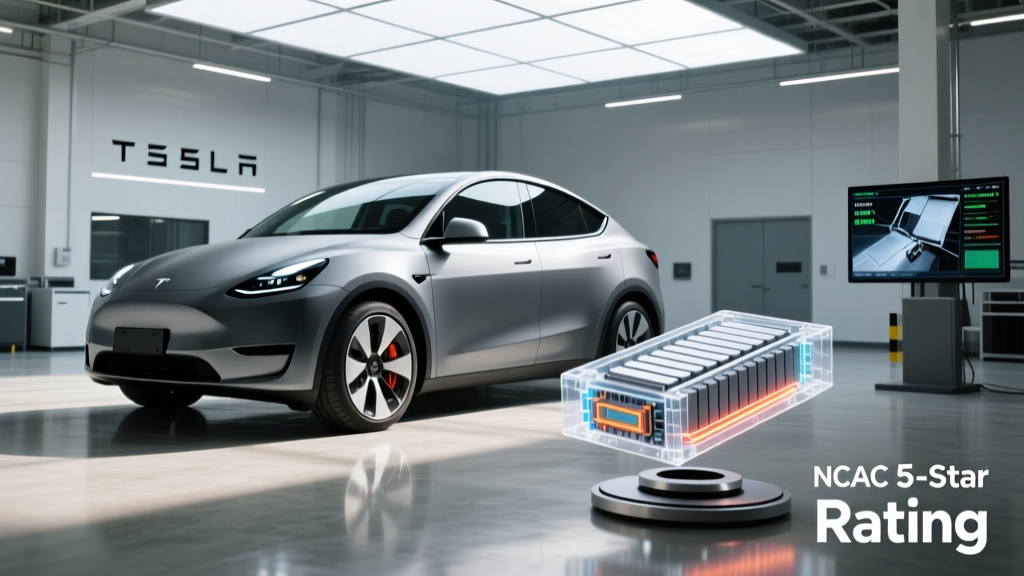
Safety is where the Model Y has historically excelled, and the current-generation Juniper model continues that trend. Here is a consolidated view of the latest available ratings:
| Test Agency | Test / Category | Rating |
|---|---|---|
| NHTSA | Overall | 5 Stars |
| NHTSA | Frontal Crash | 5 Stars |
| NHTSA | Side Crash | 5 Stars |
| NHTSA | Rollover | 5 Stars |
| IIHS | Moderate Overlap Front (Updated) | Good |
| IIHS | Side (Updated) | Good |
| IIHS | Headlights | Acceptable |
| IIHS | Vehicle-to-Pedestrian Front Crash Prevention | Superior |
The NHTSA five-star sweep is significant because it encompasses frontal, side, and rollover scenarios. The low center of gravity provided by the under-floor battery pack helps the Model Y achieve an exceptionally low rollover risk — around 7.9% according to NHTSA's vehicle listing.
On the IIHS side, the Model Y earns top marks in the updated moderate overlap front and updated side tests — two protocols that the institute made substantially more stringent in 2023–2024 to better capture rear-seat occupant protection and higher-energy side impacts. Headlights earn an Acceptable rating rather than Good, which is the single area keeping the Model Y from a clean IIHS Top Safety Pick+ sweep in some configurations. Check the latest status at IIHS.org.
Range, Battery, and Efficiency
For 2026, the Model Y lineup offers two primary battery and drivetrain configurations. Tesla does not publish exact usable kWh figures, but independent teardowns and EPA test data indicate the following:
| Trim | Drivetrain | Battery (est. usable) | Chemistry | EPA Range | MPGe (combined) | kWh/100 mi |
|---|---|---|---|---|---|---|
| Long Range RWD | Rear-Wheel Drive | ~75 kWh | NMC | 320 mi | 123 MPGe | 27 |
| Long Range AWD | Dual-Motor AWD | ~75 kWh | NMC | 305 mi | 117 MPGe | 29 |
| Performance AWD | Dual-Motor AWD | ~75 kWh | NMC | 285 mi | 111 MPGe | 30 |
The Model Y's efficiency — measured in kWh per 100 miles — remains among the best in its class. Tesla's heat pump, integrated thermal management, and aerodynamic refinement (the Juniper update lowered the drag coefficient to approximately 0.23 Cd) all contribute. For comparison, the Hyundai Ioniq 5 AWD achieves roughly 110 MPGe combined, and the Ford Mustang Mach-E Premium AWD sits around 101 MPGe.
Charging Speed: DC Fast Charging and Home Level 2
Charging speed is often the deciding factor for road-trip-capable EVs. Here is how the 2026 Model Y performs across charging levels:
| Charging Level | Connector | Max Rate | Speed / Time |
|---|---|---|---|
| Level 1 (120V) | NACS (native) | ~1.4 kW | ~4–5 mi/hr |
| Level 2 (240V home) | NACS / J1772 (adapter) | 11.5 kW (48A) | ~38–42 mi/hr |
| DC Fast Charge | NACS (Tesla Supercharger) | 250 kW peak | 10–80% in ~22 min |
Charging-curve reality: The 250 kW peak rate is just that — a peak. The Model Y sustains roughly 200–240 kW between approximately 10% and 35% state of charge, then tapers progressively. From 50% to 80%, expect rates closer to 80–120 kW. This is why the 10–80% time is approximately 22 minutes rather than the theoretical ~15 minutes a flat 250 kW rate would suggest. Above 80%, charging slows dramatically to protect battery longevity — plan your road-trip stops to charge to 80% and move on.
At home on a 48-amp Level 2 circuit (requiring a 60-amp breaker), the Model Y adds roughly 40 miles of range per hour of charging. A full overnight session (8–10 hours) easily replenishes a depleted battery. Tesla's Wall Connector costs approximately $450, and professional installation typically runs $500–$1,500 depending on panel proximity and local permitting. Total home charging setup: roughly $950–$1,950.
The Model Y uses the NACS (North American Charging Standard) connector natively. Tesla's Supercharger network — over 20,000 stalls in North America — remains the most reliable and widely available DC fast-charging infrastructure. Through adapters, the Model Y can also access CCS-equipped networks like Electrify America, though charge rates may be capped by adapter throughput.
Performance and Driving Dynamics
| Trim | 0–60 mph | Horsepower | Top Speed | Drivetrain |
|---|---|---|---|---|
| Long Range RWD | 5.8 sec | ~346 hp | 125 mph | Rear-Wheel Drive |
| Long Range AWD | 4.8 sec | ~384 hp | 135 mph | Dual-Motor AWD |
| Performance AWD | 3.5 sec | ~456 hp | 155 mph | Dual-Motor AWD |
The Long Range RWD trim provides more than adequate acceleration for daily driving and highway merging. The AWD variant adds traction confidence in rain and snow, along with a meaningful 0–60 improvement. The Performance trim delivers sports-car acceleration in a family SUV — 3.5 seconds to 60 mph is faster than most vehicles at twice its price.
Regenerative braking is aggressive in the Model Y. Tesla removed the user-adjustable regen setting in recent software updates, defaulting to strong one-pedal driving behavior. Most owners adapt quickly and appreciate the reduced brake-pad wear, but first-time EV drivers should expect a learning curve.
Pricing, Trims, and Federal Tax Credit Eligibility
| Trim | Base MSRP | Est. As-Tested* | §30D Credit Eligible? | Effective Price (with credit) |
|---|---|---|---|---|
| Long Range RWD | $44,990 | $46,500 | Yes — up to $7,500 | ~$37,490 |
| Long Range AWD | $47,990 | $49,900 | Yes — up to $7,500 | ~$40,490 |
| Performance AWD | $52,490 | $54,500 | Yes — up to $7,500 | ~$44,990 |
*As-tested includes destination fee and common add-ons (e.g., FSD capability, premium paint).
- MSRP Cap: SUVs must have an MSRP at or below $80,000 — all Model Y trims qualify.
- Income Cap: Modified adjusted gross income must not exceed $150,000 (single), $225,000 (head of household), or $300,000 (joint filers).
- Battery Sourcing: The full $7,500 credit requires meeting both critical-minerals and battery-component sourcing thresholds. Tesla's North American battery supply chain has progressively met these requirements, but eligibility can shift — verify current status at fueleconomy.gov and the IRS §30D page.
- Point-of-Sale Transfer: Buyers can elect to transfer the credit to the dealer at purchase, reducing the upfront cost rather than waiting for a tax refund.
Tax credit eligibility is subject to change based on IRS rulemaking and supply-chain compliance. Consult a tax professional for your specific situation.
Interior, Cargo, and Technology
The Juniper-refreshed Model Y interior is noticeably more refined than pre-2025 models. Tesla added ventilated front seats, ambient lighting, a rear-seat touchscreen, acoustic glass for improved cabin quietness, and revised materials throughout. The minimalist design language persists — there are no physical buttons, and virtually all controls live on the 15.4-inch center touchscreen.
| Measurement | Specification |
|---|---|
| Front Headroom | 41.0 in |
| Front Legroom | 41.8 in |
| Rear Headroom | 37.7 in |
| Rear Legroom | 37.4 in |
| Cargo (behind 2nd row) | 30.2 cu ft |
| Cargo (2nd row folded) | 72.1 cu ft |
| Front Trunk (Frunk) | 4.1 cu ft |
Cargo capacity is competitive with the class, though the Hyundai Ioniq 5 (behind-seat: 27.2 cu ft; folded: 59.3 cu ft) offers less total volume, while the Kia EV6 provides similar but slightly lower numbers. The Model Y's hatchback design and flat load floor make it practical for bulky items.
Standout tech features:
- 15.4-inch center touchscreen with integrated navigation, streaming, and gaming
- 8-camera vision system for Autopilot and available FSD (Supervised)
- Over-the-air software updates that add features post-purchase
- Phone-as-key with Bluetooth proximity unlock
- Sentry Mode dashcam recording with 360° coverage
- HEPA air filtration with Bioweapon Defense Mode
Notable drawbacks:
- No Apple CarPlay or Android Auto — Tesla's proprietary infotainment only
- No physical buttons or stalks (turn signals are on the steering wheel face)
- Rear-seat visibility is compromised by the sloping roofline
- Panel-gap consistency has improved but still draws occasional complaints
- FSD (Supervised) requires constant driver attention — it is SAE Level 2, not autonomous driving
Warranty and Long-Term Ownership
| Component | Coverage |
|---|---|
| Basic Vehicle | 4 years / 50,000 miles |
| Battery & Drive Unit | 8 years / 120,000 miles (Long Range) 8 years / 100,000 miles (Performance) |
| Battery Capacity Retention | Minimum 70% over warranty period |
Tesla's battery warranty guarantees that the pack will retain at least 70% of its original capacity over the warranty term. In practice, NMC batteries in Teslas have shown degradation curves that plateau after the first 20,000–30,000 miles, with many high-mileage examples retaining 85–90% capacity at 100,000 miles based on fleet data and owner surveys.
Out-of-warranty battery replacement remains expensive — approximately $12,000–$16,000 for a Model Y pack as of 2025–2026 service estimates. However, full replacements are rare; individual module repairs are often possible at lower cost.
Who Should Buy the Tesla Model Y?
- Choose the Model Y if: You want top-tier crash test ratings, access to the Supercharger network, strong efficiency, fast acceleration, and a proven EV platform with extensive OTA updates. Ideal for tech-savvy commuters, small-to-medium families, and frequent road-trippers who value charging infrastructure.
- Consider the Hyundai Ioniq 5 instead if: You prefer a more conventional interior layout with physical buttons, need 800V ultra-fast charging (10–80% in ~18 min at 350 kW chargers), or want Apple CarPlay/Android Auto integration.
- Consider the Ford Mustang Mach-E instead if: You want a more engaging driving feel with a traditional cockpit layout, or need slightly more rear-seat headroom for tall passengers.
- Consider a PHEV (e.g., Toyota RAV4 Prime) if: You lack reliable home charging access and need the flexibility of a gas engine for long rural trips without charging-infrastructure planning.
Pros and Cons at a Glance
Pros
- 5-star NHTSA and Good IIHS crash test ratings across the board
- Class-leading efficiency (27–30 kWh/100 mi)
- Access to Tesla Supercharger network — the most reliable DC fast-charging system
- Strong 0–60 acceleration even in base RWD trim
- Continuous OTA updates add new features post-purchase
- Generous cargo capacity with hatchback versatility
- Qualifies for up to $7,500 federal tax credit (subject to eligibility)
Cons
- No Apple CarPlay or Android Auto
- Touchscreen-only controls require eyes-off-road for basic adjustments
- Turn signals on steering wheel face are unintuitive for some drivers
- Peak DC charge rate of 250 kW trails 800V competitors (Ioniq 5: 350 kW)
- Rear-seat headroom limited by coupe-like roofline
- FSD (Supervised) is expensive ($8,000 or $99/mo) and still Level 2
- Insurance premiums tend to be higher than ICE compact SUVs
Frequently Asked Questions
What is the real-world range of the 2026 Tesla Model Y?
The EPA rates the Long Range RWD at 320 miles and the Long Range AWD at 305 miles. In real-world highway driving at 70–75 mph, expect 270–290 miles (RWD) and 250–270 miles (AWD). In sub-freezing temperatures, plan for a 20–30% reduction, bringing usable range to roughly 210–240 miles on a full charge. Preconditioning while plugged in helps recover some winter range.
How fast does the Model Y charge at home and on the road?
At home on a 240V Level 2 charger (48 amps), the Model Y charges at up to 11.5 kW, adding approximately 38–42 miles of range per hour — a full charge takes about 8–9 hours. On DC fast charging via Tesla Superchargers, the peak rate is 250 kW, achieving a 10–80% charge in approximately 22 minutes. Actual speed depends on battery temperature, state of charge, and charger availability.
Does the 2026 Tesla Model Y qualify for the $7,500 federal EV tax credit?
All Model Y trims fall under the $80,000 MSRP cap for SUVs and are currently listed as eligible on fueleconomy.gov. However, buyer income must not exceed $150,000 (single) / $300,000 (joint), and battery sourcing requirements under §30D must be met at the time of purchase. Tesla's North American supply chain has largely satisfied these thresholds, but rules can change — verify at the IRS and fueleconomy.gov before purchasing. The credit can be applied as a point-of-sale reduction.
Is the Tesla Model Y worth buying versus competitors in 2026?
The Model Y's combination of safety ratings, Supercharger network access, efficiency, and software ecosystem is difficult to match. If charging-infrastructure reliability and proven crash-test performance are your top priorities, the Model Y is the strongest choice in its segment. If you prioritize ultra-fast 800V charging, traditional infotainment integration (CarPlay/Android Auto), or a more button-heavy interior, the Hyundai Ioniq 5 or Kia EV6 are compelling alternatives at similar price points.
What are the Tesla Model Y's biggest strengths and weaknesses?
Strengths: five-star safety, top-tier efficiency, Supercharger access, strong performance, OTA updates, and practical cargo space. Weaknesses: no phone-mirroring integration, touchscreen-only controls, 250 kW peak charging that trails 800V rivals, and premium insurance costs.
How safe is the Tesla Model Y compared to gas-powered SUVs?
The Model Y's crash test ratings are equal to or better than most gas-powered compact SUVs. The battery pack's low placement gives it a rollover risk of under 8%, far below typical crossovers. Standard automatic emergency braking, side-impact protection, and the rigid battery-structure integration all contribute to consistent top marks from both NHTSA and IIHS.