Tesla Model Y Crash Rating: How It Scores Across NHTSA and IIHS
For many EV shoppers, safety is the make-or-break factor — and the Tesla Model Y has built a reputation as one of the safest crossovers on the road. But what do the actual crash-test numbers say? This review dissects the Tesla crash rating data from both the National Highway Traffic Safety Administration (NHTSA) and the Insurance Institute for Highway Safety (IIHS), then pairs that safety profile with everything else you need to know: real-world range, charging speeds, pricing, and 2026 federal tax credit eligibility.
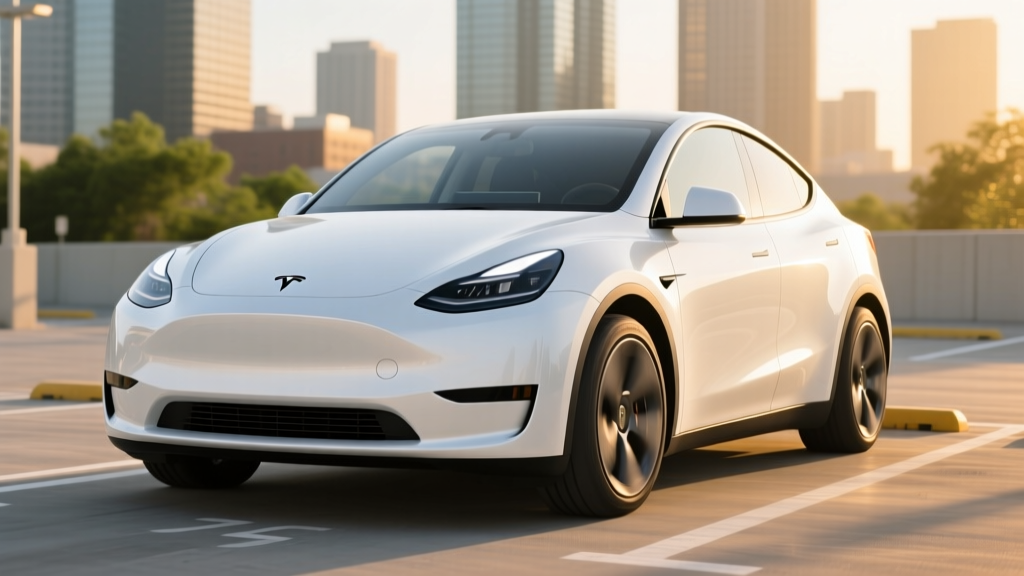
The 2026 Tesla Model Y (refreshed "Juniper" generation) carries forward the structural advantages that earned its predecessor top marks, while adding updated restraint systems and revised crumple-zone engineering. Let's look at exactly what the crash-test labs found.
| Spec | Long Range AWD | Performance AWD | RWD (Standard) |
|---|---|---|---|
| EPA Range | 320 mi | 295 mi | 290 mi |
| Battery (usable) | ~75 kWh (NMC) | ~75 kWh (NMC) | ~60 kWh (LFP) |
| Drivetrain | Dual-Motor AWD | Dual-Motor AWD | Rear-Wheel Drive |
| Horsepower | 384 hp | 456 hp | 295 hp |
| 0–60 mph | 4.8 sec | 3.5 sec | 6.6 sec |
| Max DC Fast Charge | 250 kW | 250 kW | 170 kW |
| 10–80% DC Time | ~24 min | ~24 min | ~28 min |
| Level 2 Home Charge | 11.5 kW (~44 mi/hr) | 11.5 kW (~44 mi/hr) | 11.5 kW (~44 mi/hr) |
| MPGe (combined) | 122 MPGe | 111 MPGe | 130 MPGe |
| Base MSRP | $44,990 | $51,490 | $38,990 |
| Battery Warranty | 8 yr / 120,000 mi | 8 yr / 120,000 mi | 8 yr / 100,000 mi |
NHTSA 5-Star Results: The Federal Crash Test Breakdown
NHTSA subjects vehicles to a frontal barrier crash at 35 mph, a side barrier test, a side pole test, and a rollover resistance evaluation. The Model Y has consistently earned a 5-star overall safety rating from NHTSA — the highest possible score. According to NHTSA's ratings database, the Model Y achieved 5 stars in every individual subcategory:
- Frontal crash: 5 stars (driver and passenger)
- Side crash: 5 stars (barrier and pole)
- Rollover risk: 5 stars (~9.3% risk of rollover — among the lowest for any SUV, thanks to the low-slung battery pack)
The physics behind these scores are straightforward: the Model Y's skateboard platform places the heaviest component — the battery pack — along the floor, creating an extremely low center of gravity. This dramatically reduces rollover propensity compared to ICE crossovers with top-heavy engine bays. Additionally, the absence of a front engine block allows Tesla to engineer a longer, more progressive front crumple zone that absorbs crash energy before it reaches the occupant cell.
IIHS Testing: Top Safety Pick Status and Where the Model Y Falls Short
The Insurance Institute for Highway Safety applies more granular tests than NHTSA, including the updated moderate overlap front test (which now evaluates rear-seat occupant protection) and the side crash test updated in 2023 to use a heavier barrier at higher speed. The refreshed Model Y has earned strong marks in most IIHS evaluations, but there are nuances worth understanding.
In the original side test, the Model Y scored "Good" across all measurements. The updated side test — which better simulates being struck by a large SUV or truck — has proven more challenging for many vehicles, and Tesla has made structural revisions to the Juniper-generation B-pillars and door reinforcement to address this. As of early 2026, the Model Y has not yet received a full IIHS Top Safety Pick+ designation, largely due to headlight ratings on certain trims and the rear-seat moderate overlap test. Check the IIHS Model Y page for the most current evaluation cycle.
Real-World Range vs. EPA Estimates: What Owners Actually See
Real-world highway (70 mph, moderate climate): ~265–285 miles
Real-world cold weather (below 30°F, mixed driving): ~220–250 miles
City/commuter driving with regen: ~290–310 miles
The EPA combined figure of 320 miles for the Long Range AWD is achievable in mild conditions at moderate speeds, but highway driving at 75+ mph and cold-weather operation both take a measurable toll. Lithium-ion batteries lose efficiency in cold temperatures because the electrolyte becomes more viscous, increasing internal resistance. Tesla's heat pump (standard on all 2026 Model Y trims) mitigates cabin-heating energy draw significantly compared to resistive heaters, but the battery itself still suffers cold-weather capacity reduction of roughly 15–25% in sub-freezing conditions.
For the RWD trim with its smaller LFP (lithium iron phosphate) battery, the 290-mile EPA rating is similarly optimistic under highway loads. Expect roughly 240–260 miles on a road trip. The LFP chemistry trades energy density for longevity and thermal stability — more on that below.
Charging Speed: DC Fast Charging and Home Level 2
Charging speed is where the Model Y's Supercharger ecosystem advantage shows. On a V3 Supercharger (250 kW peak), the Long Range and Performance trims can add up to 200 miles of range in about 15 minutes under ideal conditions. However, the charge curve tapers significantly above 80% State of Charge (SoC) to protect battery health.
| Charging Level | Power (kW) | Miles Added per Hour | 10–80% Time |
|---|---|---|---|
| Level 1 (120V household) | ~1.4 kW | ~5 mi/hr | Not practical for full charge |
| Level 2 (240V, 48A Wall Connector) | 11.5 kW | ~44 mi/hr | ~6–7 hours (full) |
| DC Fast Charge (Long Range/Perf) | 250 kW peak | ~800 mi/hr (peak) | ~24 min (10–80%) |
| DC Fast Charge (RWD) | 170 kW peak | ~550 mi/hr (peak) | ~28 min (10–80%) |
kW vs. kWh refresher: kW (kilowatts) measures the rate of energy delivery — like water flow from a hose. kWh (kilowatt-hours) measures the total energy stored in the battery — like the size of the bucket. A 250 kW charger fills a 75 kWh battery fast, but only while the battery can accept that peak rate. The charge curve tapers above 50–60% SoC, so the average rate over a 10–80% session is closer to 120–140 kW for the Long Range.
The Model Y uses the NACS (North American Charging Standard) connector natively. With the broader industry adopting NACS through 2025–2026, the Model Y now accesses not only Tesla Superchargers but also an expanding number of third-party networks that have added NACS cables — a significant advantage over the CCS-only vehicles of prior years.
Pricing, Trim Levels, and Federal Tax Credit Eligibility
The 2026 Model Y lineup is streamlined into three trims. Here's how pricing and potential tax-credit-adjusted costs break down:
| Trim | Base MSRP | Max §30D Credit | Effective Price (if eligible) |
|---|---|---|---|
| RWD (Standard) | $38,990 | Up to $7,500 | ~$31,490 |
| Long Range AWD | $44,990 | Up to $7,500 | ~$37,490 |
| Performance AWD | $51,490 | Up to $7,500 | ~$43,990 |
Critical §30D eligibility caveats (2026 rules): The federal EV tax credit under IRS §30D is not guaranteed for every buyer or every configuration. Eligibility depends on:
- MSRP cap: SUVs/crossovers must have an MSRP at or below $80,000 — all Model Y trims qualify.
- Buyer income cap: Modified adjusted gross income must not exceed $150,000 (single), $225,000 (head of household), or $300,000 (joint filers).
- Battery sourcing requirements: The $7,500 credit splits into two halves — $3,750 for critical minerals sourcing and $3,750 for battery component manufacturing. Vehicles that meet only one requirement receive $3,750. Tesla's supply chain has been shifting toward North American and FTA-partner sourcing, but exact eligibility can change by production batch. Verify at the point of sale.
- Point-of-sale transfer: As of 2024, you can transfer the credit to the dealer at purchase, receiving it as an upfront price reduction rather than waiting to claim it on your tax return.
Always confirm current eligibility on the IRS Clean Vehicle Credit page and with your tax professional before relying on the credit in your budget.
Interior, Cargo, and Technology: Daily Ownership Practicality
The Juniper-refreshed Model Y interior addresses many of the prior generation's criticisms. Tesla has added ventilated front seats, ambient lighting, a rear-seat touchscreen, and improved sound deadening. The minimalist single-screen dashboard remains — love it or not — but build quality has noticeably improved.
Cargo and passenger dimensions:
- Cargo (rear seats up): 30.2 cu ft
- Cargo (rear seats folded): 72.1 cu ft
- Front trunk (frunk): 4.1 cu ft
- Rear legroom: 41.6 inches
- Front headroom: 41.0 inches
These numbers make the Model Y one of the most practical vehicles in its class — the flat floor and hatchback design swallow bulky items more easily than sedan competitors. The frunk, while smaller than some rivals, still fits a charging cable kit and a soft-sided bag.
Standout technology:
- 15.4-inch center touchscreen with fast, responsive UI
- Sentry Mode (360° security camera recording while parked)
- Over-the-air updates that add features post-purchase
- Tesla Supercharger network access (17,000+ stalls in North America)
- Dog Mode, Camp Mode, and theater-style media streaming while parked
Notable drawbacks:
- No traditional instrument cluster — all info routes through the center screen
- Turn-signal stalks removed in the Juniper refresh (steering-wheel-mounted buttons instead — a polarizing change)
- No Apple CarPlay or Android Auto — Tesla's proprietary system only
- Panel-gap inconsistency still appears on some delivery vehicles
- Insurance premiums run 15–30% higher than comparable ICE crossovers
Pros, Cons, and Who the Model Y Suits Best
Pros
- 5-star NHTSA crash rating across all subcategories
- Class-leading Supercharger network access
- 320-mile EPA range (Long Range) handles most road trips with one stop
- Excellent cargo versatility with hatchback + frunk
- Strong OTA update pipeline keeps the vehicle improving
- Low rollover risk due to skateboard battery architecture
Cons
- IIHS Top Safety Pick+ not yet secured for 2026 refresh
- RWD trim's LFP battery means reduced cold-weather range (~220 mi)
- No CarPlay/Android Auto — proprietary ecosystem lock-in
- Higher insurance costs than segment average
- Steering-wheel turn-signal buttons take significant adaptation
- Service center wait times can stretch weeks in some markets
Who Should Buy the Tesla Model Y?
Choose the Model Y Long Range AWD if: You need a family crossover with top crash-test scores, road-trip capability (320 mi EPA + Supercharger access), and you regularly drive in variable weather where AWD and a heat pump matter.
Choose the Model Y RWD if: You're primarily a commuter in a mild climate, want the lowest entry price (~$31,490 after potential credit), and can charge at home nightly. LFP battery longevity is a plus for high-mileage drivers who charge to 100% regularly.
Consider a competitor (Hyundai Ioniq 5, Ford Mustang Mach-E) if: You want Apple CarPlay, prefer a more conventional interior layout, or live in an area with limited Tesla Service Center access.
Frequently Asked Questions
What is the real-world range of the Tesla Model Y?
The EPA rates the Long Range AWD at 320 miles combined. In real-world highway driving at 70–75 mph, expect 265–285 miles. In cold weather below 30°F, range can drop to 220–250 miles due to battery chemistry limitations and increased cabin heating demand. The RWD trim (290 mi EPA) typically delivers 240–260 miles on highway trips.
How fast does the Model Y charge at home and on the road?
At home on a 240V Level 2 Tesla Wall Connector (48A), the Model Y charges at 11.5 kW, adding roughly 44 miles of range per hour — a full overnight charge from 20% to 100% takes about 7 hours. On a 250 kW V3 Supercharger, the Long Range and Performance trims charge from 10% to 80% in approximately 24 minutes. The RWD trim peaks at 170 kW, taking roughly 28 minutes for the same session.
Does the Tesla Model Y qualify for the $7,500 federal EV tax credit?
It can, but eligibility depends on your income, the vehicle's MSRP (all trims are under the $80,000 SUV cap), and battery-sourcing compliance at the time of manufacture. Under current IRS §30D rules, income must not exceed $150K (single) / $300K (joint). Battery critical-mineral and component-sourcing rules may reduce the credit to $3,750 for certain production batches. Verify at purchase and consult a tax professional. The credit can be transferred at point of sale for an immediate price reduction.
Is the Tesla Model Y worth buying vs. the Hyundai Ioniq 5 or Ford Mustang Mach-E?
The Model Y wins on charging network access (Superchargers), NHTSA 5-star crash ratings, and software ecosystem. The Ioniq 5 offers faster peak charging (up to 350 kW on 800V architecture), Apple CarPlay, and a more distinctive design. The Mach-E provides a more traditional crossover feel and competitive range. If Supercharger reliability and Tesla's safety scores are your top priorities, the Model Y remains the benchmark. If you want CarPlay or faster DC charging on non-Tesla networks, cross-shop the Ioniq 5.
What are the biggest pros and cons of the 2026 Model Y?
Top pros: 5-star NHTSA crash safety, 320-mile range (Long Range), best-in-class Supercharger access, spacious hatchback cargo area, and continuous OTA improvements. Top cons: IIHS Top Safety Pick+ not yet earned for the Juniper refresh, no smartphone mirroring (CarPlay/Android Auto), higher-than-average insurance premiums, polarizing steering-wheel turn-signal buttons, and potential service-center wait times.
How long will the Model Y battery last?
Tesla warranties the Long Range and Performance battery for 8 years or 120,000 miles (whichever comes first), guaranteeing at least 70% capacity retention. The RWD's LFP battery is warranted for 8 years or 100,000 miles. Real-world data from Tesla's fleet suggests NMC batteries retain roughly 85–90% capacity at 100,000 miles under normal use. LFP batteries degrade more slowly and can be regularly charged to 100% without significant harm, making them well-suited for high-mileage commuters.
The Tesla Model Y's crash-test credentials — anchored by a 5-star NHTSA rating and strong structural performance — remain a core reason families choose it over competitors. Pair that safety profile with 320 miles of EPA range, the most reliable DC fast-charging network in North America, and a starting price that can dip below $32,000 after federal incentives, and the Model Y's position as the best-selling EV in its class makes practical sense. Just go in with realistic expectations about cold-weather range, insurance costs, and the proprietary tech ecosystem.