2026 Tesla Model Y Color Lineup: What Changed This Year
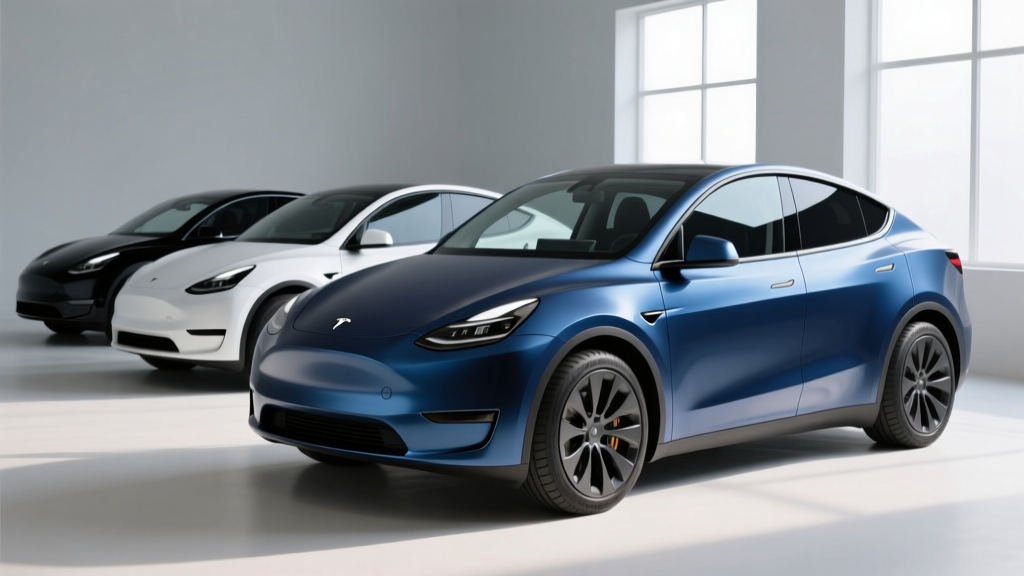
If you have been tracking the Tesla Model Y color palette, the 2026 refresh (internally dubbed "Juniper") brought more than a restyled front fascia and light bar — it expanded the paint menu and reshuffled which hues cost extra. Tesla now offers five standard exterior colors on the Model Y, plus one premium multi-coat option. The base color is no longer Pearl White Multi-Coat as it was for years; Solid Black is now the included no-cost color on most trims, while Ultra Red and the new Quicksilver command a $2,000 premium, and Deep Blue Metallic sits at $1,000.
Color choice may seem cosmetic, but it affects resale value, thermal management in hot climates, and even paint durability. Darker colors like Solid Black and Deep Blue Metallic show swirl marks more readily, while Ultra Red's multi-layer candy-coat finish requires careful washing to avoid hologramming. Quicksilver, a liquid-metal tone introduced alongside the Juniper update, has quickly become the most requested premium color based on Tesla's configurator analytics shared in Q4 2025 earnings.
Spec Table: 2026 Tesla Model Y by Trim
| Spec | Long Range RWD | Long Range AWD | Performance |
|---|---|---|---|
| EPA Range | 320 mi | 292 mi | 277 mi |
| Battery (usable) | 75 kWh (NMC) | 75 kWh (NMC) | 75 kWh (NMC) |
| Drivetrain | RWD, single motor | Dual-motor AWD | Dual-motor AWD |
| Horsepower | 295 hp | 384 hp | 456 hp |
| 0–60 mph | 5.8 sec | 4.1 sec | 3.3 sec |
| Max DC Charge | 250 kW | 250 kW | 250 kW |
| 10–80% DC Time | ~25 min | ~25 min | ~25 min |
| Level 2 Rate | 11.5 kW (~44 mi/hr) | 11.5 kW (~44 mi/hr) | 11.5 kW (~44 mi/hr) |
| Efficiency | 123 MPGe / 27 kWh/100mi | 117 MPGe / 29 kWh/100mi | 111 MPGe / 30 kWh/100mi |
| Base MSRP | $44,990 | $47,990 | $51,490 |
| Destination Fee | $1,390 | $1,390 | $1,390 |
| Battery Warranty | 8 yr / 120,000 mi | 8 yr / 120,000 mi | 8 yr / 120,000 mi |
Source: fueleconomy.gov and Tesla's official configurator, accessed January 2026.
Real-World Range: What the EPA Sticker Doesn't Tell You
EPA Estimated: 320 miles (Long Range RWD) / 292 miles (Long Range AWD) / 277 miles (Performance)
Real-World Expectation: On a 70-mph highway drive in mild weather (65°F), expect roughly 260–280 miles from the Long Range RWD before needing to stop. In freezing temperatures (below 30°F), range can drop 20–30%, meaning a realistic winter highway figure of 195–220 miles. City driving with frequent regenerative braking recovers energy and often exceeds the EPA combined estimate.
The Juniper Model Y improved its drag coefficient to approximately 0.23 Cd, which helps highway efficiency compared to the pre-2025 model. However, the 75 kWh usable battery (NMC chemistry, supplied by LG Energy Solution and Panasonic depending on build week) means there is less buffer for cold-weather loss than larger-pack competitors like the Hyundai Ioniq 5's 77.4 kWh pack or the Ford Mustang Mach-E Extended Range's 91 kWh pack.
Preconditioning the battery — which the Model Y does automatically when you navigate to a Supercharger — is critical for achieving peak charge speeds in cold weather. Without it, expect the charge curve to peak closer to 150 kW instead of the rated 250 kW, adding 10+ minutes to a 10–80% session.
Charging Speed: Supercharger Network Advantage
| Charging Level | Power | Speed (mi/hr) | Notes |
|---|---|---|---|
| Level 1 (120V) | ~1.4 kW | ~4–5 mi/hr | Emergency/trickle only |
| Level 2 (240V, 48A) | 11.5 kW | ~44 mi/hr | Home Wall Connector; full charge in ~7 hr |
| DC Fast (Supercharger V3) | 250 kW peak | ~1,000 mi/hr at peak | 10–80% in ~25 min; tapers sharply above 80% |
| DC Fast (Supercharger V4) | Up to 350 kW (future) | TBD | Model Y currently capped at 250 kW by vehicle-side architecture |
The Model Y's 400-volt architecture limits it to a 250 kW peak, meaning it cannot take advantage of newer 350 kW+ chargers the way 800-volt vehicles like the Hyundai Ioniq 5 or Porsche Macan Electric can. On a V3 Supercharger, the charge curve peaks at 250 kW between roughly 10–25% SoC, then steps down to ~175 kW through 50%, and further to ~100 kW by 70%. Plan your road-trip stops around 10–80% sessions to avoid the painful taper above 80%, where speeds can drop below 50 kW.
With the native NACS port, Model Y owners access the Tesla Supercharger network directly — now exceeding 22,000 stalls in North America — without an adapter. Non-Tesla chargers using CCS1 require a third-party adapter, though Tesla includes a CCS adapter in some markets.
Performance, Interior Space, and Tech Highlights
The 2026 Model Y Performance trim delivers 456 hp and a 3.3-second 0–60 mph time, making it one of the quickest compact electric SUVs available. Even the Long Range RWD at 295 hp feels brisk in daily driving, with instant torque providing strong merging acceleration. The dual-motor AWD trims add a front induction motor for all-weather traction and torque-vectoring capability.
Cargo and Passenger Dimensions
- Cargo (rear seats up): 30.2 cu ft
- Cargo (rear seats folded): 72.1 cu ft
- Front trunk (frunk): 4.1 cu ft
- Rear legroom: 40.5 inches (improved 1.3 in over pre-Juniper)
- Front headroom: 40.8 inches
- Towing capacity: 3,500 lbs (AWD/Performance trims)
The Juniper interior redesign added ventilated front seats, ambient lighting, a rear-seat touchscreen for climate and media control, and improved sound insulation. The 15.4-inch center display now runs a faster processor, reducing map-rendering lag. However, Tesla's continued reliance on a screen-only interface (no physical stalks for turn signals on the refreshed model — they are now capacitive buttons on the yoke or steering wheel rim) remains a polarizing choice that some buyers find distracting.
Driver Assistance: Autopilot and FSD Supervised
SAE Level 2 — Driver Supervision Required. Tesla's Autopilot (included) and Full Self-Driving Supervised ($8,000 option or $99/mo subscription) are not self-driving systems. You must keep your hands on the wheel and eyes on the road at all times. FSD Supervised can navigate highway interchanges, handle traffic lights, and perform parking maneuvers, but it makes errors and requires active monitoring. Only Level 4 services like Waymo operate without a driver in the loop.
For 2026, Tesla has transitioned FSD to a vision-only architecture (no radar or ultrasonic sensors) and claims improved intersection handling. Real-world reliability varies significantly by geography and weather — heavy rain, construction zones, and faded lane markings still cause disengagements.
Pricing, Color Upcharges, and Federal Tax Credit Eligibility
| Trim | Base MSRP | With $2,000 Color | Est. After §30D Credit | Monthly (72-mo, 5.5% APR) |
|---|---|---|---|---|
| Long Range RWD | $44,990 | $46,990 | ~$37,490–$39,490 | ~$598–$630 |
| Long Range AWD | $47,990 | $49,990 | ~$40,490–$42,490 | ~$646–$678 |
| Performance | $51,490 | $53,490 | ~$43,990–$45,990 | ~$702–$734 |
2026 Tesla Model Y Color Pricing
- Solid Black: No charge (base color)
- Pearl White Multi-Coat: $1,000
- Deep Blue Metallic: $1,000
- Ultra Red: $2,000
- Quicksilver: $2,000
Federal Tax Credit: IRS §30D Eligibility Checklist
- Vehicle MSRP cap: SUVs must be ≤ $80,000 — all Model Y trims qualify.
- Buyer income cap: AGI ≤ $150,000 (single), $225,000 (head of household), $300,000 (joint).
- Battery sourcing: For 2026, 100% of critical minerals must be sourced from the U.S. or FTA partners, and 100% of battery components must be manufactured or assembled in North America. Tesla's Panasonic-built cells in Nevada generally satisfy this, but confirm at IRS.gov before purchasing, as sourcing rules tighten annually.
- Point-of-sale transfer: You can transfer the credit to the dealer for an immediate price reduction rather than waiting to claim it on your tax return.
- One vehicle per SSN per year: You cannot claim the credit for multiple EVs in the same tax year.
Always verify current eligibility on the IRS qualified vehicles list before signing a purchase agreement — battery sourcing compliance can change mid-year.
Pros and Cons: The Honest Assessment
Pros
- Access to the Supercharger network — still the most reliable DC fast-charging ecosystem in North America
- Strong efficiency (27–30 kWh/100mi) translates to lower per-mile charging costs
- Over-the-air updates continuously add features without dealer visits
- Class-leading cargo space (72.1 cu ft folded) for the compact SUV segment
- Strong resale value relative to most EV competitors
- Juniper interior upgrades address prior noise and comfort complaints
Cons
- 400V architecture caps DC charging at 250 kW — outpaced by 800V competitors
- No physical turn-signal stalk; capacitive buttons are a learning curve and safety concern for some
- Ride quality still firm on 20-inch Performance wheels over rough pavement
- FSD Supervised at $8,000 is expensive for a Level 2 system that requires full driver attention
- Paint quality inconsistencies remain a common owner complaint — inspect delivery carefully
- No Apple CarPlay or Android Auto — Tesla's proprietary ecosystem only
How the 2026 Model Y Compares to Key Rivals
The compact electric SUV segment is crowded. Here is how the Model Y Long Range AWD stacks up against three benchmark competitors:
| Attribute | Tesla Model Y LR AWD | Hyundai Ioniq 5 Limited AWD | Ford Mach-E Premium AWD ER | VW ID.4 AWD Pro S |
|---|---|---|---|---|
| EPA Range | 292 mi | 290 mi | 290 mi | 263 mi |
| Battery | 75 kWh (NMC) | 77.4 kWh (NMC) | 91 kWh (NMC) | 82 kWh (NMC) |
| Max DC Charge | 250 kW | 350 kW (800V) | 150 kW | 175 kW |
| 10–80% DC | ~25 min | ~18 min | ~38 min | ~29 min |
| 0–60 mph | 4.1 sec | 4.5 sec | 5.1 sec | 5.7 sec |
| Base MSRP | $47,990 | $53,500 | $48,995 | $47,290 |
The Model Y's edge is the Supercharger network and software ecosystem. The Ioniq 5 charges faster thanks to 800V architecture, and the Mach-E offers a more traditional interior with physical controls. The ID.4 is the comfort-oriented choice but trails in performance and charging speed. If road-trip charging reliability is your top priority, the Model Y still wins. If fastest possible DC charging matters, the Ioniq 5 is the benchmark.
Who Should Buy the 2026 Tesla Model Y?
Choose the Model Y Long Range RWD if: You commute 30–60 miles daily, have home Level 2 charging, rarely road-trip in winter, and want the lowest entry price with maximum range (320 mi EPA). The RWD trim also avoids the AWD premium and is the most efficient Model Y available.
Choose the Model Y Long Range AWD if: You live in a region with snow or rain where dual-motor traction matters, take regular road trips and value the 3,500-lb towing capacity, or need the extra 89 hp for highway merging confidence.
Choose the Model Y Performance if: Acceleration thrills matter (3.3 sec 0–60), you want the track-driving mode and upgraded brakes, and you accept the 15-mile range penalty and firmer ride that come with the 21-inch wheels.
Look elsewhere if: You want the absolute fastest DC charging (Ioniq 5), a traditional interior with physical buttons (Mach-E), or a third-row seat for larger families (Kia EV9).
Frequently Asked Questions
What is the real-world range of the 2026 Tesla Model Y?
The EPA rates the Long Range RWD at 320 miles, the Long Range AWD at 292 miles, and the Performance at 277 miles. In real-world highway driving at 70 mph in moderate temperatures, expect 260–280 miles from the Long Range RWD. In freezing weather, that drops to 195–220 miles due to battery resistance and cabin heating demands. City driving with regenerative braking often matches or slightly exceeds EPA estimates.
How fast does the Model Y charge at home and on the road?
On a Level 2 home charger (Tesla Wall Connector at 48A/11.5 kW), the Model Y gains approximately 44 miles of range per hour, with a full 0–100% charge taking roughly 7 hours. On a V3 Supercharger, it peaks at 250 kW and charges from 10–80% in about 25 minutes. Above 80%, the charge rate tapers significantly — plan to unplug at 80% on road trips to avoid wasting time.
How much does the Model Y cost after the federal tax credit?
If you qualify for the full $7,500 §30D credit (income within caps, vehicle meets battery-sourcing rules), the Long Range RWD drops from $44,990 to approximately $37,490 before destination. The Long Range AWD falls to roughly $40,490 and the Performance to about $43,990. The credit can be transferred at point-of-sale for an immediate price reduction. Always verify eligibility at IRS.gov before purchasing.
Does the 2026 Model Y qualify for the federal EV tax credit?
As of early 2026, the Model Y qualifies for the full $7,500 credit under IRS §30D, provided the buyer meets income limits ($150K single / $300K joint AGI) and the vehicle's battery components and critical minerals satisfy North American sourcing thresholds. Tesla's Panasonic cells built in Nevada currently meet these requirements, but the IRS updates its qualified-vehicle list periodically — confirm before signing.
Is the Tesla Model Y worth buying over competitors in 2026?
The Model Y remains the segment benchmark for charging-network access, software, and efficiency. If you prioritize Supercharger reliability, OTA updates, and strong resale value, it is the strongest pick. If you want faster DC charging, the Hyundai Ioniq 5's 800V system charges 10–80% in 18 minutes vs. 25 minutes. If you prefer physical controls and a more conventional cabin, the Ford Mach-E is compelling. Test-drive at least two competitors before committing.
What are the biggest pros and cons of the 2026 Model Y?
Top pros: Supercharger network access, strong efficiency, spacious cargo area (72.1 cu ft), OTA updates, solid resale value. Top cons: 400V charging capped at 250 kW, no physical turn-signal stalk, firm ride on large wheels, no Apple CarPlay/Android Auto, FSD Supervised is expensive for a Level 2 system, and paint quality can be inconsistent at delivery.
Which Tesla Model Y color holds its value best?
Historically, Pearl White Multi-Coat and Solid Black have shown the strongest resale demand in the used Model Y market. Quicksilver, as a newer premium color, may command a resale premium due to limited supply in the used market, but long-term data is not yet available. Ultra Red's multi-coat finish is striking but shows chips and scratches more readily, which can affect trade-in appraisal.