The Quick Verdict: Tesla's Winter Arsenal
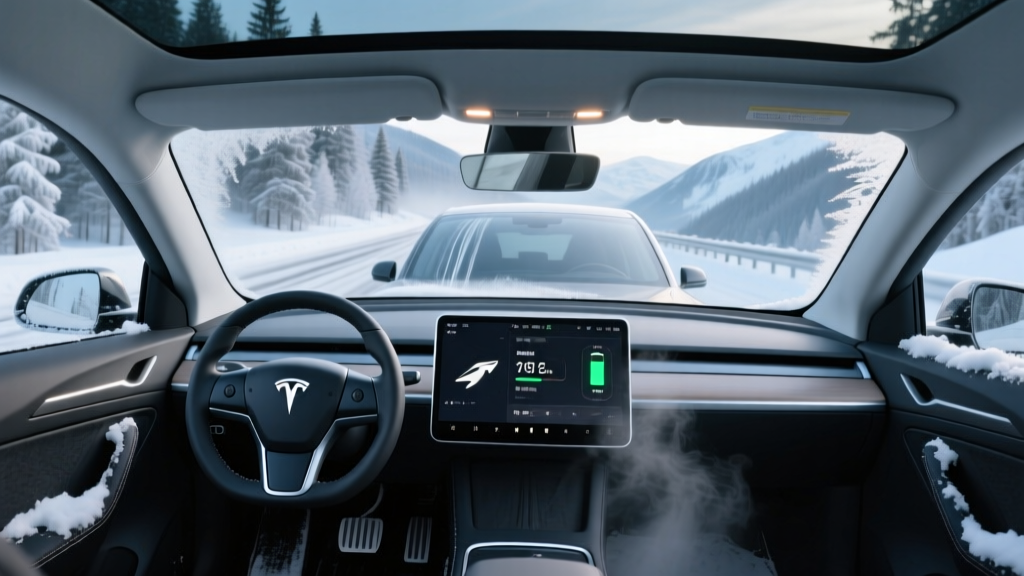
If you live above the 40th parallel, you've probably wondered whether a Tesla can handle a real winter. The short answer: yes — but with caveats that every prospective buyer should understand before signing a purchase agreement. The 2026 Tesla Model Y Long Range AWD remains one of the most cold-weather-capable EVs on the market, thanks largely to its standard heat pump, sophisticated battery thermal management, and software features designed specifically for freezing conditions. But physics still applies, and no EV escapes winter range loss entirely.
This review focuses on the 2026 Model Y Long Range AWD — Tesla's highest-volume vehicle and the one most likely to serve as a daily driver in snow-belt states. We'll break down every cold weather feature Tesla offers, quantify the real-world range impact, and tell you exactly what to expect when the thermometer drops below freezing.
| Spec | 2026 Model Y Long Range AWD |
|---|---|
| EPA Range | 320 miles |
| Battery (usable) | ~75 kWh, NMC chemistry |
| Peak DC Fast Charge | 250 kW (Supercharger V3/V4) |
| 10-80% DC Charge Time | ~25 minutes |
| Level 2 Home Charging | 11.5 kW (~44 mi/hr) |
| 0-60 mph | 4.8 seconds |
| Horsepower | 384 hp (dual motor) |
| Drivetrain | AWD (dual motor) |
| MPGe (combined) | 111 MPGe |
| Efficiency | 28 kWh/100 mi |
| Cargo Volume | 72 cu ft (rear seats folded) |
| Rear Legroom | 40.5 in |
| Battery Warranty | 8 years / 120,000 miles |
| Base MSRP | $48,990 (before incentives) |
Every Cold Weather Feature Tesla Builds Into the Model Y
Tesla has invested more engineering into cold-climate performance than most legacy automakers, largely because their home market includes harsh-winter regions like Norway, Canada, and the northern United States. Here's the full inventory of cold weather features on the 2026 Model Y:
1. Octovalve Heat Pump (Standard)
The single most important cold weather feature Tesla includes is the heat pump — specifically, Tesla's proprietary "Octovalve" system introduced with the Model Y platform. Unlike resistive cabin heaters (which draw directly from the battery at a 1:1 energy ratio), a heat pump moves thermal energy from the ambient air, powertrain, and battery into the cabin at roughly 3:1 to 4:1 efficiency. In practical terms, heating the cabin at 30°F uses roughly 1-2 kW with the heat pump versus 4-6 kW with a resistive heater.
The Octovalve integrates eight coolant flow paths into a single manifold, scavenging waste heat from the drive motors and battery to warm the cabin. This means even when ambient temperatures are too low for an air-source heat pump to work efficiently, the system can still pull thermal energy from the powertrain. According to Tesla's engineering disclosures, this system reduces winter energy consumption for cabin heating by roughly 30% compared to the resistive PTC heaters used in older Model 3 variants.
2. Battery Preconditioning
When you set a Supercharger as your navigation destination, the Model Y automatically begins warming the battery pack to its optimal charging temperature — typically around 95-104°F (35-40°C). This preconditioning process can take 15-45 minutes depending on starting temperature and ambient conditions. Without it, a cold battery (below 50°F) will accept charge at a fraction of its peak rate, sometimes limiting DC fast charging to under 50 kW until the pack warms up.
This feature is critical for winter road trips. A preconditioned battery at a Supercharger will hit its 250 kW peak within minutes; a cold-soaked battery may take 15-20 minutes of slow charging before ramping up, adding significant time to your stops.
3. Scheduled Departure & Cabin Preheating
Through the Tesla app or the vehicle's touchscreen, owners can schedule a departure time. The Model Y will begin warming the cabin, defrosting windows, and preconditioning the battery while still plugged in to your home charger. This means you leave with a warm cabin, clear glass, and a battery at optimal temperature — all powered by grid electricity rather than your battery's stored energy.
4. Heated Seats and Steering Wheel
All four outboard seats and the steering wheel are heated on the 2026 Model Y Long Range. Heated seats are dramatically more energy-efficient than heating the entire cabin air volume — a heated seat draws roughly 50-100 watts, while cabin air heating (even with a heat pump) draws 1,000-3,000 watts. Tesla's software lets you prioritize seat/steering wheel heat and reduce cabin air temperature to maximize range on cold commutes.
5. Heated Side Mirrors and Camera Defrost
The side mirrors include integrated heating elements, and the rearview camera has a small defroster. Tesla removed ultrasonic sensors in favor of Tesla Vision (camera-only), so keeping those cameras clear of ice and frost is essential. The vehicle's "Defrost" mode activates mirror heaters, window defoggers, and camera warmers simultaneously.
6. Traction Control and AWD Winter Tuning
The dual-motor AWD system provides independent torque vectoring to front and rear axles with millisecond response. Unlike mechanical AWD systems with a center differential or clutch pack, Tesla's electronic system can shift torque distribution from 0:100 to 100:0 front-to-rear virtually instantaneously. Combined with traction control tuned for low-friction surfaces, this gives the Model Y confident acceleration on snow and ice — though winter tires remain essential for braking and cornering grip.
7. Cabin Overheat/Freeze Protection
Even when parked, the Model Y can maintain a minimum cabin temperature to prevent interior components from freezing and to keep the cabin comfortable if you return to the vehicle. "Keep Climate On" and "Dog Mode" can maintain temperature indefinitely (as long as battery remains above 20%), which is useful during winter errands.
EPA Sticker: 320 miles
Expected Highway (70°F, 70 mph): ~280-295 miles
Expected City/Mixed (40-50°F): ~260-285 miles
Expected Cold Highway (20°F, 70 mph, heater on): ~210-240 miles
Expected Extreme Cold (0°F, short trips, frequent cabin reheating): ~180-210 miles
Cold weather range loss of 20-35% is normal for all EVs. The Model Y's heat pump keeps it toward the better end of that spectrum compared to EVs using resistive heating, which can lose 40%+ in extreme cold. Data from fueleconomy.gov confirms the 111 MPGe combined rating.
Charging in Cold Weather: What Changes
Cold temperatures affect not just range but charging speed. Here's the full charging profile for the 2026 Model Y Long Range AWD:
| Charging Level | Power (kW) | Miles Added per Hour | Notes |
|---|---|---|---|
| Level 1 (120V, 12A) | ~1.4 kW | ~3-4 mi/hr | Emergency/trickle only |
| Level 2 (240V, 48A Wall Connector) | 11.5 kW | ~44 mi/hr | Full charge in ~7.5 hours |
| DC Fast (Supercharger V3, preconditioned) | Peak 250 kW | ~1,000 mi/hr (peak) | 10-80% in ~25 min |
| DC Fast (cold battery, no precondition) | ~50-90 kW | ~200-350 mi/hr | Ramps up as battery warms |
The charging curve matters enormously in winter. A preconditioned Model Y at a V3 Supercharger will sustain 250 kW up to roughly 45-50% state of charge, then taper through 150 kW, 100 kW, and finally under 50 kW above 85%. Total 10-80% time averages 25 minutes when the battery is preconditioned. Without preconditioning in sub-freezing weather, that same session could stretch to 45-60 minutes as the battery warms itself using the incoming charge energy.
For home charging, Tesla's Gen 2 Wall Connector at 48 amps (11.5 kW) will fully replenish the ~75 kWh usable battery overnight. In winter, we recommend scheduling departure preconditioning so the vehicle uses grid power — not battery energy — to warm up each morning.
Pricing, Tax Credits, and Total Winter Cost
| Trim | MSRP | Est. Federal Credit (§30D) | Effective Price |
|---|---|---|---|
| Model Y Long Range AWD | $48,990 | Up to $7,500* | ~$41,490* |
| Model Y Performance AWD | $53,490 | Up to $7,500* | ~$45,990* |
*Federal tax credit eligibility under IRS §30D depends on buyer income caps ($150K single / $300K joint MAGI), vehicle MSRP cap ($55,000 for SUVs — both trims qualify), and battery critical-mineral/component sourcing requirements that change annually. The credit can now be transferred to the dealer as a point-of-sale discount. Verify current-year eligibility at irs.gov and consult a tax professional.
Both 2026 Model Y trims fall under the $55,000 SUV MSRP cap for §30D. The Long Range AWD at $48,990 qualifies on price. The Performance at $53,490 also clears the cap. However, battery sourcing requirements under the Inflation Reduction Act have tightened annually — critical minerals and battery components must meet escalating domestic/free-trade-agreement thresholds. Tesla's shift toward LFP batteries from CATL for some Standard Range variants has complicated credit eligibility for those trims, but the Long Range AWD continues to use NMC cells with supply chains that have historically met §30D requirements. Always confirm at the point of sale.
Who Should Buy the Model Y for Cold-Weather Driving?
- Best-in-class heat pump system reduces winter range loss vs. competitors with resistive heating
- Extensive Supercharger network with reliable preconditioning integration
- OTA updates continuously improve thermal management algorithms
- Scheduled departure preconditioning from grid power is seamless
- Dual-motor AWD with instant torque vectoring for snow traction
- 72 cu ft cargo space handles winter gear, skis, and groceries
- Strong resale value relative to EV segment average
- 20-35% range loss in extreme cold is unavoidable — plan accordingly
- Camera-only Tesla Vision can struggle with lens ice/snow buildup (no ultrasonic backup)
- Regenerative braking is significantly reduced when battery is cold below 30% SoC
- Frameless windows can freeze shut in ice storms (a Tesla-specific annoyance)
- No spare tire — only a tire inflation kit (problematic in remote winter areas)
- Insurance premiums 15-25% above segment average in many states
- Minimalist interior lacks physical buttons for climate — touchscreen-only adjustment while driving
Best for: Commuters in cold-climate metro areas with home charging access, families who need cargo versatility for winter sports gear, and road-trippers who primarily travel along Supercharger-equipped corridors. The Model Y's heat pump and thermal management make it one of the most winter-efficient EVs available.
Think twice if: You regularly drive 250+ miles in sub-zero rural areas with limited charging infrastructure, you depend on consistent regenerative braking for mountain descents in cold weather, or you need a full-size spare tire for remote winter travel.
How the Model Y Compares to Key Winter Competitors
The Model Y doesn't exist in a vacuum. Here's how its cold weather feature Tesla engineering compares to other popular AWD EVs:
- Hyundai Ioniq 5 AWD: Also uses a heat pump (standard on AWD trims). EPA range 290 miles. Charges faster at peak (up to 350 kW on 800V architecture, 10-80% in ~18 min). Slightly less range in cold due to smaller 77.4 kWh battery and less aggressive thermal scavenging. MSRP ~$52,000.
- Ford Mustang Mach-E AWD Extended Range: Heat pump added for 2025+ models. EPA range ~312 miles. DC fast charging peaks at 150 kW (slower than Model Y). More traditional interior with physical climate controls — an advantage for gloved winter driving. MSRP ~$52,000.
- Rivian R1S Dual-Motor: Heat pump standard. EPA range ~352 miles (Max Pack). Excellent ground clearance for snow. Far heavier, so winter efficiency drops more sharply. DC charging peaks at 220 kW. MSRP ~$75,900+ — different price bracket entirely.
The Model Y's combination of range, charging speed, heat pump efficiency, and Supercharger network access makes it the default cold-weather EV benchmark at its price point. The Ioniq 5 charges faster but has slightly less range; the Mach-E offers a more conventional interior but charges slower.
Owner Tips: Maximizing Winter Range and Comfort
After multiple winters with Tesla vehicles, here are the practical strategies that make the biggest difference:
- Always precondition while plugged in. Even 15 minutes of preconditioning before departure — drawing power from your Level 2 charger, not the battery — can recover 15-25 miles of range that would otherwise be consumed warming the pack and cabin on the road.
- Use seat heaters as primary warmth. Set cabin temperature to 65°F and seat heaters to medium. This combination uses significantly less energy than maintaining a 72°F cabin air temperature.
- Navigate to every Supercharger. Even if you know the route, entering the Supercharger as a destination triggers battery preconditioning. Skipping this step in winter can double your charging time.
- Charge to 80-90% in winter (not 100%). NMC batteries perform better with a buffer. Charging to 90% and preconditioning before departure gives you more usable range than charging to 100% and leaving the car cold-soaked overnight.
- Install winter tires. Tesla's all-season tires are adequate for light snow, but dedicated winter tires (Michelin X-Ice, Nokian Hakkapeliitta) transform braking and cornering performance on ice. The AWD system helps you accelerate, but tires are what stop you.
- Carry de-icer spray for cameras and door handles. Tesla Vision depends on clear cameras. A small bottle of de-icer in the glovebox prevents frustrating "camera blocked" warnings.
Frequently Asked Questions
What is the real-world winter range of the Tesla Model Y?
The EPA rates the 2026 Model Y Long Range AWD at 320 miles. In real-world cold-weather driving (20-35°F, highway speeds, heat pump active), expect 210-240 miles. In extreme cold (below 10°F) with frequent short trips and cabin reheating, plan for 180-210 miles. The heat pump keeps the Model Y toward the better end of EV winter efficiency.
How fast does the Model Y charge in winter?
At a Tesla Supercharger V3 with a preconditioned battery, peak rate is 250 kW with a 10-80% time of approximately 25 minutes. Without preconditioning in freezing temperatures, expect 45-60 minutes for the same session as the battery warms itself. Home Level 2 charging at 11.5 kW adds ~44 miles per hour regardless of temperature.
Does the 2026 Model Y qualify for the federal EV tax credit?
Both the Long Range AWD ($48,990) and Performance ($53,490) fall under the §30D SUV MSRP cap of $55,000. Buyer income must not exceed $150,000 (single) or $300,000 (joint). Battery sourcing requirements must also be met — verify current-year compliance at irs.gov. The credit can be applied as a point-of-sale discount through participating dealers.
Is the Tesla Model Y worth buying vs. competitors for cold climates?
For cold-climate buyers prioritizing range retention, charging infrastructure, and thermal management sophistication, the Model Y remains the benchmark. The Ioniq 5 charges faster but offers less range; the Mach-E has a more traditional interior but slower DC charging. The Supercharger network's reliability in winter (redundant stalls, preconditioning integration) is a significant practical advantage over CCS-only vehicles dependent on third-party networks.
Does regenerative braking work in cold weather?
Partially. When the battery is cold (below roughly 50°F) and at high state of charge (above 85%), regenerative braking is software-limited to protect the cells. You'll see a dotted line on the energy graph indicating reduced regen. The Model Y will use friction brakes to compensate, but the transition can feel abrupt. Preconditioning the battery before driving restores full regen capability.
Do I need winter tires on the Model Y?
Strongly recommended if you regularly drive on snow or ice. The dual-motor AWD system provides excellent traction for acceleration, but braking and cornering grip depend entirely on your tires. Tesla sells a Winter Tire & Wheel package through its shop, or you can source compatible winter tires (255/45R19 or 255/40R20 depending on wheel option) from any tire retailer.