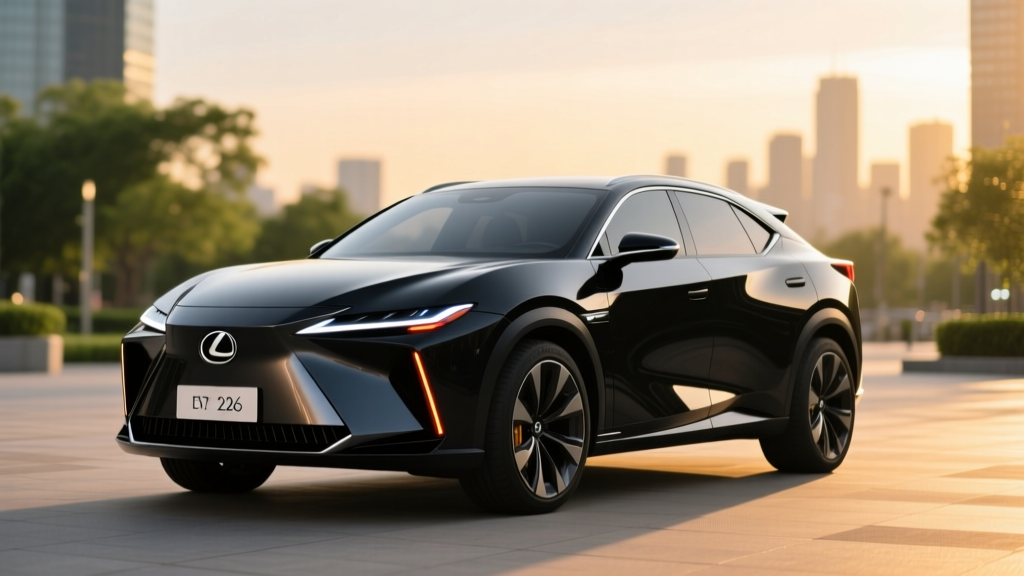
Quick Answer: Is the Lexus TZ Electric SUV Worth It?
The 2026 Lexus TZ 450e is a midsize luxury electric SUV built on the Toyota bZ platform, offering an EPA-estimated 285–300 miles of range (depending on trim), standard electronic AWD, and a starting MSRP around $58,000. It targets buyers who want Lexus refinement and dealership reliability with a battery-electric powertrain. Real-world highway range drops to roughly 240–260 miles, and cold-weather driving can reduce that by another 15–25%. If you have access to Level 2 home charging and value a quiet, comfortable ride over sporty dynamics, the TZ is a strong contender in the luxury EV SUV segment.
What Is the Lexus TZ and How Does It Fit the EV Market?
The Lexus TZ 450e arrives for the 2026 model year as the brand's dedicated midsize electric crossover, slotting above the smaller RZ 450e. While the RZ shares its platform with the Toyota bZ4X and Subaru Solterra, the TZ rides on a stretched architecture closer in dimensions to the gas-powered Lexus RX — meaning more rear-seat room and cargo volume. Lexus positions the TZ against the BMW iX, Genesis Electrified GV70, and the upcoming electric Porsche Macan.
Lexus has historically been cautious with full electrification, leaning heavily on its hybrid lineup. The TZ represents the brand's most serious push into the premium BEV space yet, pairing Toyota's e-TNGA-derived platform with a larger battery pack and more powerful dual-motor setup than the RZ.
Range, Battery, and Charging: The Numbers That Matter
Let's get straight to the specs buyers care about most.
| Specification | TZ 450e Premium | TZ 450e Luxury |
|---|---|---|
| Battery Capacity (usable) | 82 kWh (NMC) | 82 kWh (NMC) |
| EPA-Estimated Range | 300 miles | 285 miles |
| Real-World Highway Range | ~255 miles | ~240 miles |
| Cold-Weather Range (20°F) | ~220 miles | ~210 miles |
| Drivetrain | Dual-motor e-AWD | Dual-motor e-AWD |
| Total System Horsepower | 338 hp | 338 hp |
| 0–60 mph | 5.0 sec | 5.0 sec |
| Peak DC Fast Charge Rate | 150 kW | 150 kW |
| 10–80% DC Fast Charge Time | ~30 min | ~30 min |
| Level 2 Charge Rate (240V) | 11 kW | 11 kW |
| Level 2 Full Charge Time | ~8.5 hours | ~8.5 hours |
| MPGe (combined) | 102 MPGe | 98 MPGe |
| Base MSRP | $58,500 | $63,800 |
| Battery Warranty | 8 yr / 100,000 mi | 8 yr / 100,000 mi |
Real-World Range vs. EPA Sticker
The EPA-estimated 300-mile figure for the TZ 450e Premium assumes a mix of city and highway driving at moderate temperatures. In practice, expect:
- Highway-only at 70 mph: ~255 miles (aerodynamic drag and lack of regen opportunity reduce efficiency)
- City-heavy commuting: ~280–295 miles (regenerative braking recovers energy in stop-and-go traffic)
- Cold weather (below 30°F): ~210–230 miles (battery resistance increases, cabin heating draws 2–5 kW)
- Hot weather with A/C: ~270 miles (less impact than cold, but still a factor)
The TZ uses a heat pump for cabin climate, which mitigates some cold-weather range loss compared to resistive heating systems. Preconditioning the battery while plugged in — a feature accessible through the Lexus app — is essential for maximizing both range and fast-charging speed in cold conditions.
One important charging reality: the TZ's peak DC fast-charge rate of 150 kW is not sustained. Like all EVs, the charge curve tapers significantly above 80% state of charge. You'll see close to 150 kW between roughly 10–50% SoC, then the rate drops progressively. The 10–80% time of ~30 minutes is competitive but not class-leading — the Hyundai Ioniq 5 and Kia EV6, with their 800V architectures, can do 10–80% in about 18 minutes at 350 kW chargers. If fast road-trip charging is your top priority, that's a meaningful gap.
EV vs. Gas vs. Hybrid: How Does the TZ Compare?
Most TZ cross-shoppers are deciding between this electric SUV, a Lexus RX hybrid, or a competing gas luxury SUV. Here's a data-driven comparison:
| Metric | Lexus TZ 450e (BEV) | Lexus RX 350h (Hybrid) | BMW X5 xDrive40i (Gas) |
|---|---|---|---|
| Powertrain | Dual-motor electric | 2.5L 4-cyl hybrid | 3.0L turbo I-6 |
| EPA Range / Fuel Economy | 300 mi / 102 MPGe | 36 MPG combined | 22 MPG combined |
| Annual Fuel/Energy Cost (15k mi) | ~$675* | ~$1,580 | ~$2,580 |
| Base MSRP | $58,500 | $52,000 | $66,000 |
| Federal Tax Credit (§30D) | Up to $7,500** | None | None |
| Effective Starting Price | ~$51,000** | $52,000 | $66,000 |
| Estimated 5-Year Maintenance | ~$1,800 | ~$3,200 | ~$4,500 |
| 0–60 mph | 5.0 sec | 7.4 sec | 5.2 sec |
*Based on the U.S. average electricity rate of $0.17/kWh and 3.5 miles/kWh efficiency. Actual costs vary significantly by local utility rates and whether you charge at home vs. public DC fast chargers (which can cost $0.35–$0.55/kWh).
**The §30D federal tax credit of up to $7,500 is subject to income caps ($150K single / $300K joint AGI), MSRP limits ($80K for SUVs), and critical-mineral/battery-component sourcing requirements that change annually. As of 2026, verify current eligibility at IRS.gov or through the point-of-sale transfer option at your dealer. Never assume you qualify without checking the latest rules.
The key takeaway: once you factor in the potential tax credit, the TZ 450e's effective starting price undercuts the RX 350h — and the energy cost savings over five years can total $4,500–$9,500 depending on your electricity rates and driving volume. The RX 350h makes more sense if you lack home charging access or frequently drive routes with sparse charging infrastructure.
Total Cost of Ownership: The Real Numbers
Here's a five-year, 75,000-mile ownership cost projection comparing the TZ 450e with the RX 350h:
| Cost Category (5 Years / 75k Miles) | Lexus TZ 450e | Lexus RX 350h |
|---|---|---|
| Purchase Price (after credit) | $51,000 | $52,000 |
| Fuel / Electricity | $3,375 | $7,900 |
| Maintenance | $1,800 | $3,200 |
| Insurance (avg) | $9,500 | $7,800 |
| Depreciation (est.) | $22,000 | $18,500 |
| Home Charger Install (one-time) | $1,200–$2,500 | $0 |
| Estimated 5-Year Total | ~$88,875–$90,175 | ~$89,400 |
A few critical observations:
- Insurance is higher for the TZ. EV insurance premiums run 15–25% above comparable gas vehicles, driven by higher repair costs and battery replacement risk. Get quotes before purchasing.
- Depreciation remains a wildcard. EV depreciation curves have been volatile. Toyota/Lexus brand strength helps, but the used EV market is still maturing. Expect 40–45% depreciation over five years for the TZ, vs. ~35% for the RX hybrid.
- Home charging installation is a real upfront cost. A Level 2 (240V, 48-amp) home charger installation typically runs $1,200–$2,500 if your electrical panel has capacity. A panel upgrade from 100A to 200A can add $1,500–$3,000. Always get a licensed electrician's assessment before committing.
- Maintenance savings are genuine. No oil changes, no transmission fluid, no spark plugs, and regenerative braking extends pad life significantly. Expect tire rotations, cabin air filters, brake fluid checks, and wiper fluid — that's about it.
Federal Tax Credit: Does the TZ Qualify?
For the 2026 model year, the §30D clean vehicle credit can provide up to $7,500 for qualifying buyers of the Lexus TZ 450e. However, eligibility depends on several factors that change year to year:
- MSRP Cap: SUVs must have an MSRP at or below $80,000. Both TZ trims qualify.
- Buyer Income Cap: Modified AGI must not exceed $150,000 (single), $225,000 (head of household), or $300,000 (joint filing).
- Critical Minerals Requirement: A percentage of battery critical minerals must be sourced from the U.S. or free-trade-agreement countries. This threshold increases annually.
- Battery Components: Battery components must be manufactured or assembled in North America, with the required percentage increasing yearly. A "foreign entity of concern" (FEOC) restriction also applies.
- Point-of-Sale Transfer: You can transfer the credit to the dealer at purchase, reducing your out-of-pocket cost immediately rather than waiting for a tax refund.
The battery sourcing rules tighten each year. A vehicle that qualified in 2025 may see its credit reduced to $3,750 (or eliminated) in 2026 if its supply chain doesn't meet updated thresholds. Always verify the current status at IRS.gov before finalizing your purchase. Your Lexus dealer should also have up-to-date credit eligibility information for their specific VIN inventory.
Real-World Ownership: What First-Time EV Buyers Need to Know
| Common Misconception | Fact |
|---|---|
| "I'll never be able to road-trip." | With 300 miles of range and DC fast charging adding ~170 miles in 30 minutes, road trips are viable — but require planning around charger locations. Apps like PlugShare and A Better Routeplanner are essential. |
| "The battery will need replacing soon and cost a fortune." | NMC batteries in modern EVs with active thermal management typically lose 8–15% capacity over 10 years. Lexus warranties the TZ battery for 8 years/100,000 miles with a 70% capacity retention guarantee. Full replacements (rare) run $12,000–$18,000. |
| "Charging takes too long." | Home Level 2 charging overnight (8.5 hours) means you start every morning with a full battery — far more convenient than gas station stops for daily driving. DC fast charging adds ~170 miles in 30 minutes on road trips. |
| "EVs don't work in cold climates." | Range drops 15–25% in freezing weather, but the TZ's heat pump and battery preconditioning mitigate this. Owners in Minnesota, Norway, and Canada drive EVs year-round. Plan for reduced range, not eliminated range. |
| "Public chargers are always broken." | Reliability varies by network. Tesla Superchargers (now opening to NACS-equipped non-Teslas) lead in uptime at ~95%. Electrify America and EVgo average 80–85%. Always have a backup charging option mapped out. |
Home Charging Access: The Make-or-Break Factor
The single biggest determinant of EV satisfaction is reliable home charging. If you can install a Level 2 charger (240V, 40–48 amps), you'll do 85–95% of your charging at home at a cost of roughly $0.12–$0.20/kWh depending on your utility. That translates to $3.50–$6.00 for a full charge on the TZ.
If you live in an apartment or condo without charging access, you'll rely on public Level 2 and DC fast chargers. At $0.35–$0.55/kWh for public DC charging, your annual energy cost jumps from ~$675 to $1,400–$2,200 — eroding much of the EV cost advantage. Before buying the TZ, honestly assess your charging situation.
Driving Patterns That Favor the TZ
- Best case: Daily commute under 60 miles round-trip, home Level 2 charging, occasional road trips under 250 miles between charging stops.
- Workable: Longer commutes (up to 120 miles round-trip) with home charging and access to workplace charging.
- Challenging: Frequent 400+ mile road trips, no home charging, or regular towing (the TZ is rated for 1,500 lbs max — light-duty only).
Decision Framework: Should You Buy the Lexus TZ 450e?
Choose the Lexus TZ 450e If:
- You have (or can install) Level 2 home charging
- Your daily driving is under 120 miles round-trip
- You value a quiet, refined ride over sporty handling
- You want Lexus dealership service and long-term reliability reputation
- You qualify for the §30D tax credit, bringing the effective price near $51,000
- You want standard AWD for snow/rain without the fuel cost penalty
Choose the Lexus RX 350h Hybrid Instead If:
- You cannot install home charging and public infrastructure is sparse in your area
- You regularly tow more than 1,500 lbs
- You take frequent 500+ mile road trips and don't want to plan around chargers
- You want to minimize upfront cost and avoid EV insurance premiums
- You're not ready to adapt your fueling routine
Consider a Competitor If:
- Fastest charging matters: Hyundai Ioniq 5 or Kia EV6 (800V, 10–80% in ~18 min) — though these are less luxurious inside.
- More range is essential: Tesla Model Y Long Range (330+ miles EPA) or Rivian R1S (352 miles with Max Pack) — different price and size segments.
- Driving dynamics are a priority: BMW iX xDrive50 offers sharper handling and 300+ miles, but starts at $87,000+.
Frequently Asked Questions
Does the Lexus TZ support NACS (Tesla-style) charging?
For the 2026 model year, the Lexus TZ comes equipped with a CCS1 port. Lexus has announced a transition to NACS for future model years, but the 2026 TZ will require a CCS-to-NACS adapter to use Tesla Superchargers. Lexus is expected to include or offer this adapter at launch — confirm with your dealer.
How long will the TZ's battery last?
Based on data from Toyota's NMC battery packs in the bZ4X and RZ 450e, expect approximately 8–12% capacity loss over the first 100,000 miles under normal use. The battery warranty guarantees at least 70% capacity retention for 8 years or 100,000 miles. Real-world evidence from high-mileage EVs suggests the pack should remain functional well beyond 150,000 miles, though with gradually reduced range.
What does it cost to charge the TZ at home?
At the U.S. average residential rate of $0.17/kWh, a full 82 kWh charge costs approximately $13.94 — good for about 285–300 real-world miles. For context, filling the RX 350h's 17.2-gallon tank at $3.40/gallon costs $58.48 for about 620 miles. Per mile, the TZ costs roughly $0.047 on home electricity vs. $0.094 for the RX hybrid on gas.
Is the Lexus TZ eligible for the $7,500 federal tax credit?
As of early 2026, the TZ 450e is expected to qualify for up to $7,500 under §30D, subject to the buyer's income, the vehicle's MSRP (under the $80K SUV cap), and current battery-sourcing rules. The credit can be applied as a point-of-sale reduction. However, critical-mineral and battery-component requirements tighten annually — verify eligibility on fueleconomy.gov and with your tax professional before purchasing.
Can I tow with the Lexus TZ?
The TZ 450e is rated for 1,500 lbs of towing capacity — enough for a small utility trailer or a couple of dirt bikes, but not a boat or camper. If you need serious towing (3,500+ lbs), look at the Rivian R1S (up to 7,700 lbs) or the Ford F-150 Lightning.
How does the TZ compare to the Lexus RZ 450e?
The RZ 450e is smaller (closer to a subcompact crossover) with 220–245 miles of EPA range and a starting price around $54,000. The TZ offers more interior space, longer range (285–300 miles), and a more powerful drivetrain, but at a higher price. Think of the RZ as the electric NX and the TZ as the electric RX.