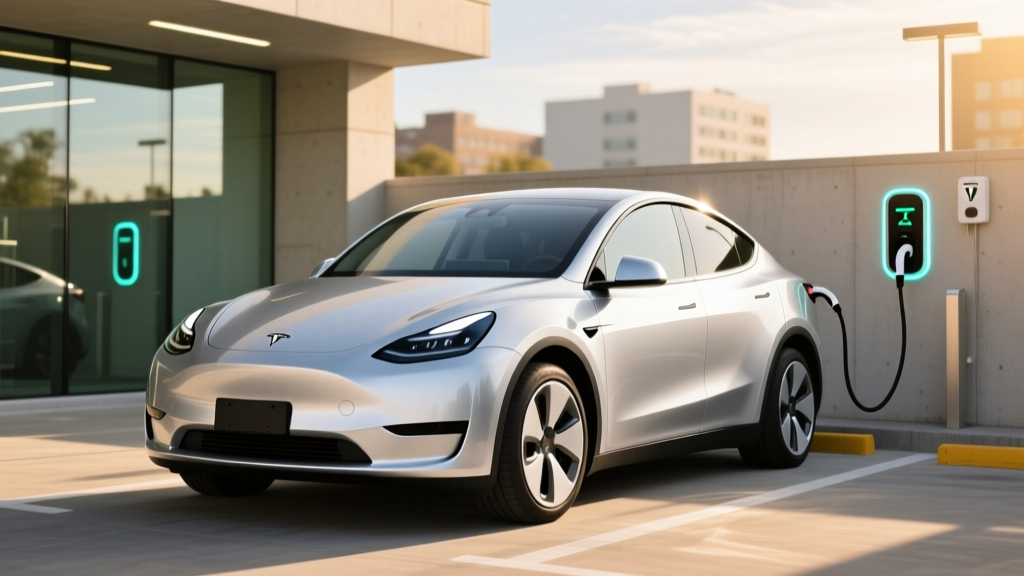
The Tesla Model Y has long been the default answer for buyers wanting a practical, long-range electric SUV without paying luxury prices. But with aggressive price cuts, refreshed styling, and shifting federal incentive rules, the question on many shoppers' minds is straightforward: is the Tesla Model Y cheaper now than it has ever been, and does that make it the smartest EV buy in 2026?
After spending time with the latest Model Y Long Range AWD and tracking Tesla's pricing trajectory over the past two years, the answer is nuanced. The base MSRP has dropped significantly from its 2022-2023 peaks, and the federal tax credit can slash the effective price further — but only if you meet specific IRS requirements. Below, we break down every number that matters: real-world range, charging speeds, ownership costs, and whether the Model Y still earns its reputation against a growing field of rivals.
2026 Tesla Model Y: Quick Spec Overview
| Spec | Value |
|---|---|
| Base MSRP (Long Range AWD) | $44,990 |
| EPA Estimated Range | 320 miles |
| Battery Capacity (usable) | ~75 kWh (NMC chemistry) |
| Efficiency | 122 MPGe / 28 kWh/100 mi |
| Max DC Fast Charge | 250 kW (peak) |
| 10–80% DC Fast Charge | ~25 minutes |
| Level 2 Home Charging | 11.5 kW (~44 mi/hr) |
| 0–60 mph | 4.8 seconds |
| Horsepower | 384 hp (dual motor) |
| Drivetrain | Dual-motor AWD |
| Cargo Volume (rear seats up) | 30.2 cu ft |
| Cargo Volume (rear seats folded) | 72.0 cu ft |
| Battery Warranty | 8 years / 120,000 miles |
| Federal Tax Credit (§30D) | Up to $7,500 (eligibility varies) |
Range and Efficiency: EPA vs. the Real World
The 2026 Model Y Long Range AWD carries an EPA-estimated 320 miles of range. That figure positions it near the top of the compact electric SUV segment, trailing only the most efficiency-focused rivals and edging out competitors like the Ford Mustang Mach-E Extended Range (312 miles EPA) and Hyundai Ioniq 5 Long Range (303 miles EPA).
EPA estimates assume a mix of city and highway driving at moderate temperatures. In our experience and consistent with third-party highway tests, expect ~265–285 miles on a sustained 70 mph highway trip in fair weather. In cold conditions (below 30°F), that number can drop to 220–245 miles due to battery resistance and cabin heating demands, even with the Model Y's standard heat pump. City driving with frequent regenerative braking opportunities tends to match or slightly exceed the EPA sticker.
Efficiency is rated at 122 MPGe combined (28 kWh per 100 miles), which is excellent for a dual-motor AWD crossover. Tesla's thermal management system and aerodynamic refinement continue to give it an edge — the Model Y sips electrons where heavier, less-slippery competitors gulp them.
Charging Speed: DC Fast, Level 2, and the Supercharger Advantage
Charging remains one of Tesla's strongest differentiators, and not just because of the hardware on the car. The Supercharger network's reliability and density still outperform third-party networks in most U.S. corridors, though the adoption of NACS by Ford, GM, Rivian, and others is narrowing that gap as of 2026.
| Charging Level | Power / Rate | Speed (Miles Added) | Notes |
|---|---|---|---|
| Level 1 (120V household) | ~1.4 kW | ~3–5 mi/hr | Emergency/trickle only |
| Level 2 (240V home, 48A) | 11.5 kW | ~44 mi/hr | Full charge in ~7–8 hours |
| DC Fast (Supercharger V3) | 250 kW peak | ~175 mi in 15 min | 10–80% in ~25 min; tapers above 80% |
| DC Fast (CCS adapter, third-party) | Up to 250 kW peak | Varies by station | Tesla now includes CCS adapter; NACS native port |
A critical ownership note: Tesla's DC fast-charging curve peaks at 250 kW only at low states of charge (roughly 10–30% SoC). Sustained rates average closer to 150–170 kW through the 10–80% window, which is why the full 10–80% session takes about 25 minutes rather than the theoretical minimum. This is normal for NMC chemistry at this capacity — but buyers accustomed to "peak kW" marketing should understand the taper.
At home on a Level 2 Wall Connector (48 amps, 11.5 kW), the Model Y recovers roughly 44 miles of range per hour of charging. An overnight session from 20% to full takes about 6–7 hours, making daily home charging effortless for most commuters.
Performance, Drivetrain, and Daily Drivability
The Long Range AWD uses a dual-motor setup producing 384 combined horsepower. The 0–60 mph sprint takes 4.8 seconds — quick enough to merge onto any freeway with confidence, though the Performance trim (not covered here) drops that to 3.5 seconds at a higher price.
Ride quality in the post-refresh Model Y has improved noticeably. Tesla retuned the suspension and added acoustic glass, reducing the harshness that plagued earlier builds. The steering remains precise if artificially weighted, and the low center of gravity keeps body roll in check through corners.
Interior space is a genuine strength. With 30.2 cubic feet behind the second row and 72.0 cubic feet with seats folded, the Model Y swallows groceries, luggage, and dog crates with ease. Rear legroom measures 41.6 inches — enough for adults on longer trips. The optional third row is best reserved for small children on short errands.
Pricing Breakdown: Is the Model Y Actually Cheaper?
This is where the "tesla model y cheaper" question gets concrete. Tesla has cut Model Y pricing multiple times since early 2023. Here's where the 2026 lineup stands:
| Trim | Base MSRP | Est. Federal Credit (§30D) | Effective Price* |
|---|---|---|---|
| Long Range AWD | $44,990 | Up to $7,500 | ~$37,490 |
| Long Range AWD (7-seat) | $46,990 | Up to $7,500 | ~$39,490 |
| Performance AWD | $48,990 | Up to $7,500 | ~$41,490 |
*Effective price assumes full $7,500 §30D credit eligibility. Actual credit depends on battery sourcing, buyer income, and MSRP caps. See tax credit section below.
Destination fees ($1,390), paint upgrades ($1,000–$2,500), FSD capability ($8,000 one-time or $99/month), and Enhanced Autopilot ($6,000) can push as-tested prices well above $55,000. A reasonably equipped Long Range AWD with a common paint color and no FSD typically lands around $46,500–$47,500 before incentives.
Compared to its 2023 MSRP of roughly $52,990 for the Long Range, the current pricing represents a genuine drop of $8,000+ at the base level — making the Model Y meaningfully cheaper before incentives even enter the equation.
Federal Tax Credit: Do You Qualify for the Full $7,500?
The IRS §30D Clean Vehicle Credit can reduce your federal tax liability by up to $7,500 — and as of 2024, this credit can be transferred to the dealer at the point of sale, effectively reducing your purchase price on day one. But eligibility is not automatic. Here's what the IRS requires for 2026:
- MSRP Cap: The vehicle's MSRP must not exceed $80,000 for SUVs (the Model Y qualifies).
- Buyer Income Limits: Modified adjusted gross income must not exceed $150,000 (single), $225,000 (head of household), or $300,000 (joint filers).
- Battery Component Sourcing: A percentage of battery components must be manufactured or assembled in North America (threshold increases annually).
- Critical Minerals: A percentage of critical minerals must be sourced from the U.S. or a free-trade-agreement country (threshold increases annually).
- Final Assembly: Vehicle must undergo final assembly in North America (the Model Y is assembled in Fremont, CA, and Austin, TX).
The $7,500 credit splits into two halves: $3,750 for meeting the battery-component requirement and $3,750 for meeting the critical-minerals requirement. Depending on Tesla's supply-chain shifts in 2026, the Model Y may qualify for the full amount or only half. Always verify current eligibility on fueleconomy.gov before purchasing, and consult a tax professional for your specific situation.
Tech, Driver Assistance, and the Software Moat
The Model Y's 15-inch center touchscreen controls nearly every vehicle function — climate, mirrors, glovebox, and driving settings. There is no instrument cluster; speed and navigation appear in the upper-left corner of the main display. This minimalism is polarizing: some owners love it, others find it distracting.
Standard Autopilot includes adaptive cruise control and lane-centering — a competent SAE Level 2 driver-assist system. It is not self-driving. You must keep your hands on the wheel and eyes on the road at all times. The optional Full Self-Driving (Supervised) capability adds automatic lane changes, navigate-on-Autopilot, and traffic-light recognition, but it remains a Level 2 system requiring active driver supervision despite the ambitious name.
Tesla Autopilot and FSD (Supervised) are SAE Level 2 driver-assistance systems. The driver is always responsible for vehicle control. Only fully driverless services like Waymo operate at Level 4. No Tesla vehicle sold today is "self-driving."
Other tech highlights include over-the-air software updates that periodically add features, Sentry Mode dashcam recording, a built-in trip planner with charging stops, and an expanding Tesla app ecosystem. The 2026 refresh also brings ventilated front seats and ambient lighting — addressing common complaints from earlier builds.
Model Y vs. the Competition: Which EV SUV Wins?
| Spec | Tesla Model Y LR AWD | Ford Mustang Mach-E ER AWD | Hyundai Ioniq 5 LR AWD |
|---|---|---|---|
| Base MSRP | $44,990 | $48,995 | $49,850 |
| EPA Range | 320 mi | 312 mi | 290 mi |
| Max DC Charge | 250 kW | 150 kW | 240 kW (350 kW capable) |
| 10–80% DC Time | ~25 min | ~38 min | ~18 min |
| 0–60 mph | 4.8 sec | 5.1 sec | 5.1 sec |
| Cargo (seats up) | 30.2 cu ft | 29.7 cu ft | 27.2 cu ft |
| Battery Warranty | 8 yr / 120k mi | 8 yr / 100k mi | 10 yr / 100k mi |
The Model Y's combination of lower MSRP, longer EPA range, and Supercharger access still gives it the strongest overall value proposition. The Ioniq 5 charges faster (18 minutes 10–80% on a 350 kW station) and offers a superior 10-year battery warranty. The Mach-E provides a more traditional driving feel and a physical instrument cluster. But on pure cost-per-mile-of-range, the Model Y remains hard to beat.
Ownership Costs, Warranty, and Long-Term Value
Tesla's battery and drive-unit warranty covers 8 years or 120,000 miles (whichever comes first) with a minimum 70% capacity retention guarantee. The basic vehicle limited warranty is 4 years / 50,000 miles. These terms are competitive but not class-leading — Hyundai's 10-year powertrain warranty is more generous.
Insurance premiums for the Model Y tend to run 15–30% higher than comparable gas crossovers, reflecting repair costs and parts pricing. Get quotes before committing. On the savings side, electricity at the national average of ~$0.16/kWh costs roughly $4.50 per 100 miles, versus $12–$14 per 100 miles for a 25-MPG gas SUV at $3.50/gallon.
Maintenance is minimal: no oil changes, no spark plugs, cabin air filter replacement every 2 years, tire rotation every 6,250 miles, and occasional brake-fluid checks. Tesla's mobile service and expanding service-center network handle most issues, though body-shop wait times after collisions can stretch into weeks in some markets.
Pros
- Lowest base MSRP in its segment after recent price cuts
- 320-mile EPA range with strong real-world efficiency
- Supercharger network reliability still leads third-party options
- Excellent cargo space and practical crossover packaging
- Continuous OTA updates add features post-purchase
- Point-of-sale tax credit transfer reduces upfront cost
Cons
- No instrument cluster; all info on center screen
- FSD is expensive and still Level 2, not autonomous
- Insurance premiums above segment average
- Build quality improving but still inconsistent vs. legacy brands
- Ride firmness noticeable on rough pavement
- Third-row seat is impractical for anyone but small children
Who Should Buy the 2026 Tesla Model Y?
Choose the Model Y if: You want the most range per dollar in an electric SUV, rely on road-trip charging infrastructure, prefer minimal maintenance, and are comfortable with touchscreen-centric controls.
Look elsewhere if: You want a traditional instrument cluster and physical buttons (Mach-E, Ioniq 5), need the longest battery warranty (Hyundai/Kia), require serious towing capacity (Rivian R1S, Ford F-150 Lightning), or want a luxury interior (BMW iX, Genesis GV60).
The 2026 Model Y is best suited for daily commuters and small families who can charge at home and want a practical, efficient EV with strong road-trip capability. Its price reductions make it accessible to a wider audience than ever, and the tax credit can push the effective price below $38,000 for eligible buyers — a compelling entry point for a 320-mile AWD electric SUV.
Frequently Asked Questions
What is the real-world range of the Tesla Model Y?
The EPA estimates 320 miles for the Long Range AWD. Real-world highway driving at 70 mph typically yields 265–285 miles in mild weather and 220–245 miles in freezing conditions. City driving with regenerative braking often matches or slightly exceeds the EPA figure.
How fast does the Model Y charge at home and on the road?
On a Level 2 home charger (11.5 kW / 48A), the Model Y adds about 44 miles per hour and fully charges overnight. On a V3 Supercharger, it peaks at 250 kW and charges from 10–80% in approximately 25 minutes, though sustained rates average 150–170 kW due to the charging curve taper.
How much does the Tesla Model Y cost after tax credits?
The Long Range AWD starts at $44,990. Eligible buyers can receive up to $7,500 via the IRS §30D federal tax credit (transferable at point of sale), bringing the effective price to approximately $37,490. Eligibility depends on buyer income, battery sourcing, and MSRP caps — verify on fueleconomy.gov before purchase.
Does the Tesla Model Y qualify for the $7,500 federal EV tax credit?
The Model Y qualifies on MSRP (under the $80,000 SUV cap) and final assembly (U.S.-built). Whether you receive the full $7,500, a partial $3,750, or nothing depends on your income, the battery's critical-mineral and component sourcing in the current tax year, and your tax liability. Consult a tax professional and check the latest IRS guidance.
Is the Model Y worth buying vs. the Mach-E or Ioniq 5?
If lowest price, longest range, and Supercharger access are your priorities, yes. If you prefer faster DC charging, a longer warranty, or physical controls, the Ioniq 5 or Mach-E are strong alternatives. Test-drive all three before deciding.
Is Tesla Autopilot self-driving?
No. Autopilot and FSD (Supervised) are SAE Level 2 driver-assistance systems. You must remain fully engaged, keep hands on the wheel, and monitor the road at all times. No Tesla vehicle sold today drives itself without human supervision.