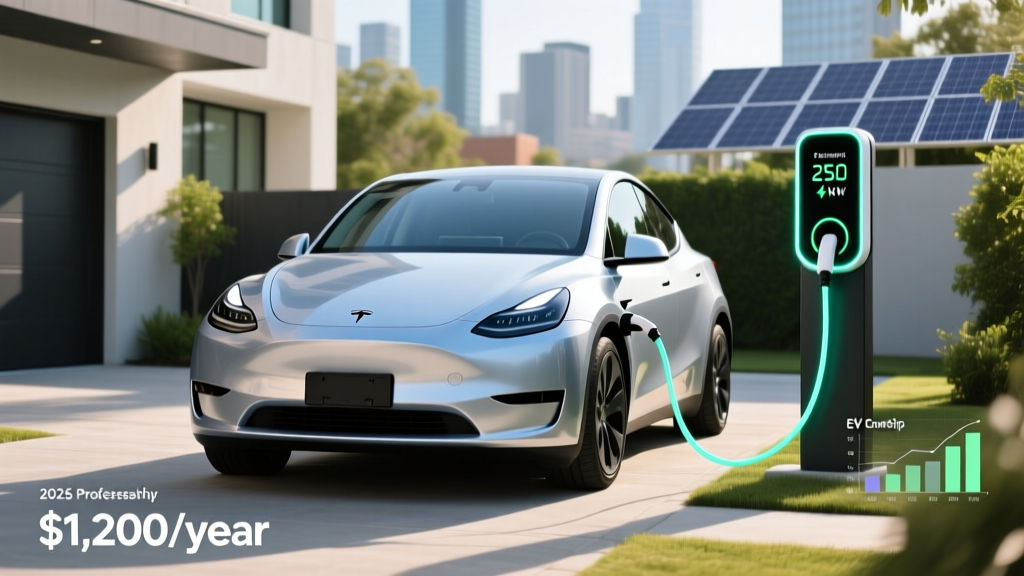
If you are shopping for an electric SUV and keep asking how fast can a Tesla charge, the 2026 Tesla Model Y is the most relevant case study on the market. It is the best-selling EV in the United States for a reason: it pairs broad Supercharger network access with competitive DC fast-charging speeds, usable daily range, and a starting price that lands inside the federal tax credit window. But Tesla's marketing materials emphasize peak numbers, and peak is not the same as practical. This review breaks down the Model Y's actual charging curve, real-world range, ownership economics, and where it stacks up against the Hyundai Ioniq 5 and Ford Mustang Mach-E in 2026.
2026 Tesla Model Y: Quick Verdict
The 2026 Model Y (refreshed for the 2025 model year and carried forward) remains the default electric crossover for buyers who prioritize charging network reliability and software integration. The Long Range AWD delivers an EPA-estimated 320 miles, peaks at roughly 250 kW on V3 Superchargers, and starts at $44,990 before incentives. It is not the fastest-charging EV in its class — the Ioniq 5's 800V architecture still beats it on 10-80% time — but Tesla's Supercharger network uptime and seamless plug-and-charge experience close the gap in real-world usability. For commuters with home Level 2 access and road-trippers who want minimal charging friction, the Model Y is still the benchmark.
Spec Sheet: 2026 Tesla Model Y Long Range AWD
| Spec | Value |
|---|---|
| EPA Range | 320 miles |
| Battery (usable) | ~75 kWh, NMC (nickel manganese cobalt) |
| Max DC Fast Charge | 250 kW peak (V3 Supercharger) |
| 10–80% DC Fast Charge | ~27 minutes |
| Level 2 Home Charge | 11.5 kW (44 miles/hour) |
| Level 1 (120V) Charge | ~1 kW (~3–4 miles/hour) |
| Drivetrain | Dual Motor AWD |
| Horsepower | 384 hp |
| 0–60 mph | 4.8 seconds |
| Efficiency | 122 MPGe combined / 28 kWh/100 mi |
| Cargo (rear seats up) | 30.2 cu ft |
| Cargo (rear seats folded) | 72.0 cu ft |
| Base MSRP | $44,990 |
| Battery Warranty | 8 years / 120,000 miles |
Real-World Range: What the EPA Sticker Doesn't Tell You
Real-World Expectation: 270–290 miles highway (70–75 mph); 240–260 miles in freezing temperatures; 300+ miles city/suburban driving with regen braking.
The EPA combined cycle blends city and highway driving at moderate temperatures. In practice, the Model Y's efficiency is heavily influenced by speed, ambient temperature, and elevation. At sustained 75 mph on a flat interstate, expect roughly 270–290 miles before the buffer warning. In winter conditions (below 30°F), battery resistance increases and cabin heating draws significant power — plan for 20–25% range loss, bringing usable range to roughly 240–260 miles. The Model Y uses a heat pump (standard since 2021), which mitigates cold-weather losses compared to resistive heaters, but physics still applies.
City driving is where the Model Y shines: regenerative braking recovers kinetic energy, and stop-and-go traffic keeps speeds in the efficiency sweet spot. Commuters with short-to-medium daily drives will routinely see 300+ miles of practical range. For road trips, plan charging stops at roughly 200-mile intervals to stay in the 10–80% state-of-charge (SoC) window where charging is fastest.
How Fast Can a Tesla Charge? The Full Breakdown
The question how fast can a Tesla charge has three answers depending on where you plug in. Understanding the difference between kW (power, or charge rate) and kWh (energy, or battery capacity) is essential. Think of kW as the speed of water flowing into a tank, and kWh as the size of the tank itself.
| Charging Level | Power (kW) | Speed (miles/hour) | Typical Use Case |
|---|---|---|---|
| Level 1 (120V household) | ~1 kW | 3–4 mi/hr | Emergency / overnight trickle |
| Level 2 (240V home Wall Connector) | 11.5 kW | 44 mi/hr | Daily home charging |
| Level 2 (public J1772/NACS) | 7.2–19.2 kW | 25–70 mi/hr | Destination / workplace |
| DC Fast (V3 Supercharger) | 250 kW peak | ~1,000 mi/hr (peak) | Road trips |
| DC Fast (V4 Supercharger) | Up to 250 kW* | Similar to V3 | Road trips (newer stations) |
*V4 Supercharger cabinets support higher power, but the Model Y's onboard architecture caps intake at approximately 250 kW.
DC Fast Charging: The Real Charge Curve
Tesla advertises "up to 250 kW" and "up to 200 miles in 15 minutes." Both statements are technically accurate but represent peak conditions, not sustained rates. Here is what actually happens at a V3 Supercharger:
- 10–30% SoC: The battery accepts close to peak 250 kW, adding roughly 4–5 miles per minute.
- 30–60% SoC: Power tapers to approximately 175–200 kW as battery temperature and cell voltage rise.
- 60–80% SoC: Further taper to 100–130 kW. This is where the "charging curve" matters most.
- Above 80%: Dramatic taper to protect battery health. Charging from 80–100% can take as long as 10–80%.
The practical result: a 10–80% charge takes approximately 27 minutes under ideal conditions (battery preconditioned, warm ambient temperature, V3 stall not shared with another vehicle). On a cold battery without preconditioning, expect 35–40 minutes. Always navigate to a Supercharger using the car's built-in navigation — this triggers automatic battery preconditioning, warming the pack to optimal charging temperature before you arrive.
Home Level 2 Charging: The Daily Reality
Most Model Y owners do the vast majority of their charging at home. With the Tesla Wall Connector on a 60-amp circuit (48-amp continuous draw), the Model Y accepts 11.5 kW, recovering approximately 44 miles of range per hour. A full overnight session (8–10 hours) easily replenishes 300+ miles — more than enough for any daily commute. Installation typically requires a NEMA 14-50 outlet or hardwired connection; budget $500–$1,500 for a licensed electrician depending on panel proximity and local permit requirements, per Tesla's home charging guide.
Performance, Efficiency, and Daily Usability
The 2026 Model Y Long Range AWD produces 384 horsepower from its dual-motor setup, hitting 0–60 mph in 4.8 seconds. That is brisk for a family crossover and more than adequate for highway merging and passing. The Performance trim drops that to 3.5 seconds for $52,490, but most buyers will find the Long Range's acceleration plenty quick.
Efficiency is rated at 122 MPGe combined (28 kWh per 100 miles) by fueleconomy.gov. That translates to roughly $0.04–$0.06 per mile on home electricity (at $0.13–$0.18/kWh national average) versus $0.12–$0.15 per mile for a comparable gas crossover at 25 MPG and $3.50/gallon. Supercharging costs more — typically $0.25–$0.35/kWh depending on location — but is still cheaper than gas on a per-mile basis in most markets.
Cargo, Passenger Space, and Interior
The Model Y offers 30.2 cubic feet of cargo space behind the second row and 72.0 cubic feet with the rear seats folded — competitive with the Toyota RAV4 and Honda CR-V. Rear legroom measures 41.6 inches, which is generous for the segment. The front trunk (frunk) adds 4.1 cubic feet for charging cables or a soft bag. The cabin is minimalist: a single 15.4-inch touchscreen controls everything from climate to mirrors, which some buyers love and others find frustrating. Build quality on the refreshed Model Y has improved noticeably, with tighter panel gaps and updated interior materials.
Pricing, Trims, and Federal Tax Credit Eligibility
| Trim | MSRP | Est. After §30D Credit | Drivetrain |
|---|---|---|---|
| Long Range AWD | $44,990 | ~$37,490* | Dual Motor AWD |
| Performance | $52,490 | ~$44,990* | Dual Motor AWD |
*Estimated after $7,500 federal tax credit. Eligibility is not universal — see rules below.
Does the Model Y Qualify for the Federal EV Tax Credit?
The 2026 Model Y Long Range and Performance trims are assembled at Tesla's Fremont, California factory and Austin Gigafactory, and as of early 2026, both trims qualify for the full $7,500 §30D federal tax credit — but only if you meet IRS requirements. Per IRS guidelines, eligibility depends on:
- Buyer income caps: Modified adjusted gross income (MAGI) must not exceed $300,000 (joint filers), $225,000 (head of household), or $150,000 (single filers).
- MSRP cap: The vehicle's MSRP must not exceed $80,000 for SUVs/pickups/vans (both Model Y trims clear this easily).
- Battery sourcing: Critical minerals and battery components must meet phased-in percentages from US or free-trade-agreement countries. Tesla has restructured supply chains to maintain compliance, but always verify current eligibility on the IRS qualified vehicles list before purchasing.
- Point-of-sale transfer: As of 2024, buyers can transfer the credit to the dealer at purchase, reducing the upfront cost by $7,500 rather than waiting for a tax refund. This effectively lowers the Model Y Long Range's out-of-pocket cost to approximately $37,490.
Always consult a tax professional and check the latest IRS qualified vehicle list before finalizing your purchase. Rules and sourcing compliance can shift mid-year.
How the Model Y Compares: Key Competitors
| Spec | Tesla Model Y LR AWD | Hyundai Ioniq 5 AWD | Ford Mach-E ER AWD |
|---|---|---|---|
| EPA Range | 320 mi | 290 mi | 305 mi |
| Battery | ~75 kWh NMC | 84 kWh NMC | 91 kWh NMC |
| Max DC Charge | 250 kW | 240 kW (800V) | 150 kW |
| 10–80% Time | ~27 min | ~18 min | ~36 min |
| 0–60 mph | 4.8 sec | 5.1 sec | 5.1 sec |
| Base MSRP | $44,990 | $48,450 | $48,995 |
| Charging Network | Tesla Supercharger | NACS (Supercharger access) | NACS (Supercharger access) |
The Hyundai Ioniq 5 charges noticeably faster thanks to its 800V architecture — 18 minutes 10–80% versus the Model Y's 27 minutes. However, the Ioniq 5 has less EPA range (290 vs. 320 miles) and a higher starting price. The Ford Mach-E charges significantly slower at 150 kW peak, which matters on road trips. All three now have NACS charge ports, granting access to Tesla's Supercharger network, which remains the most reliable and geographically comprehensive DC fast-charging network in the US. The Model Y's advantage in 2026 is less about raw specs and more about the integrated ecosystem: Supercharger plug-and-charge, over-the-air updates, and a mature service network.
Pros, Cons, and Who Should Buy the Model Y
Pros
- 320 miles EPA range — among the best in the electric SUV segment
- Access to Tesla Supercharger network (most reliable DC charging in the US)
- 44 mi/hr Level 2 home charging is fast enough for any daily routine
- Class-leading software, OTA updates, and app integration
- Qualifies for full $7,500 federal tax credit (subject to eligibility)
- Spacious cargo area (72 cu ft) and comfortable rear seat
Cons
- DC fast charging slower than Ioniq 5 (27 min vs 18 min, 10–80%)
- Minimalist interior lacks physical controls — polarizing for some buyers
- No Apple CarPlay or Android Auto
- FSD (Supervised) is expensive ($8,000) and remains SAE Level 2 — requires full driver attention
- Insurance costs tend to be higher than non-Tesla competitors
- Ride quality firm on larger wheel options (20" Induction wheels)
Who the Model Y Suits Best
Commuters: Ideal. Home Level 2 charging means you start every day with a full battery. At 28 kWh/100 mi, operating costs are roughly one-third of a gas equivalent.
Families: Strong choice. The cargo space, rear-seat room, and safety ratings (5-star NHTSA overall) make it a practical family hauler. The frunk adds bonus storage.
Road trippers: The Supercharger network is the Model Y's killer app. While 27-minute stops are not as fast as the Ioniq 5, the reliability and coverage of Tesla's network means less time troubleshooting broken chargers and more time driving.
Towing: Rated for 3,500 lbs — adequate for a small trailer or a couple of dirt bikes, but not for a large boat or camper. If you tow frequently, consider the Ford F-150 Lightning instead.
Warranty and Long-Term Ownership
Tesla covers the Model Y's battery and drive unit for 8 years or 120,000 miles (whichever comes first), with a minimum 70% capacity retention threshold. The limited vehicle warranty is 4 years or 50,000 miles. In practice, Tesla's NMC batteries have demonstrated strong longevity — data from fleet analytics suggests average degradation of approximately 10–12% over 150,000 miles, well within the warranty threshold. To maximize battery life, Tesla recommends daily charging to 80–90% for NMC packs and reserving 100% charges for road trips.
Frequently Asked Questions
How fast can a Tesla charge at a Supercharger?
The 2026 Model Y peaks at 250 kW on V3 and V4 Superchargers, achieving a 10–80% charge in approximately 27 minutes under ideal conditions (preconditioned battery, warm weather). Real-world stops average 25–35 minutes depending on state of charge and ambient temperature. The charge curve tapers significantly above 60% SoC, which is why Tesla recommends charging only to 80% on road trips for fastest overall travel time.
How long does it take to charge a Tesla Model Y at home?
With a Tesla Wall Connector on a 60-amp circuit (11.5 kW), the Model Y gains approximately 44 miles of range per hour. A full charge from 10% to 100% takes roughly 7–8 hours — easily accomplished overnight. On a standard 240V/40-amp outlet (NEMA 14-50), expect about 32 miles per hour (7.6 kW).
What is the real-world range of the Tesla Model Y?
The EPA rates the 2026 Model Y Long Range AWD at 320 miles. In real-world highway driving at 70–75 mph, expect 270–290 miles. In freezing weather, plan for 240–260 miles. City driving with regenerative braking can exceed 300 miles. These figures assume standard driving habits — aggressive acceleration and high HVAC use will reduce range further.
Does the 2026 Tesla Model Y qualify for the $7,500 tax credit?
Yes, both the Long Range and Performance trims qualify for the full $7,500 §30D federal tax credit as of early 2026, provided the buyer meets IRS income caps ($300K joint / $150K single), the vehicle MSRP is under $80,000 (both trims qualify), and battery sourcing requirements are met. The credit can be transferred at point of sale, reducing the purchase price directly. Always verify on the IRS qualified vehicle list before purchasing.
Is the Tesla Model Y worth buying over the Ioniq 5 or Mach-E?
Choose the Model Y if you prioritize maximum range (320 mi), Supercharger network reliability, and Tesla's software ecosystem. Choose the Hyundai Ioniq 5 if faster DC charging (18-minute 10–80%) matters more to you and you can accept 30 fewer miles of range. Choose the Ford Mach-E if you prefer a more traditional interior with physical controls and Apple CarPlay, and don't mind slower 150 kW charging. All three now access Tesla's Supercharger network via NACS, so the charging-infrastructure gap has narrowed significantly in 2026.
Is Tesla's Full Self-Driving actually self-driving?
No. Tesla's FSD (Supervised) is an SAE Level 2 driver-assistance system. It can handle steering, acceleration, and braking on highways and some city streets, but the driver must remain fully engaged and ready to take over at any moment. It is not autonomous driving. Only Level 4 services like Waymo operate without a driver. FSD costs $8,000 (or $99/month) and is not necessary for the vast majority of Model Y buyers — standard Autopilot provides excellent highway lane-keeping and adaptive cruise control at no extra cost.