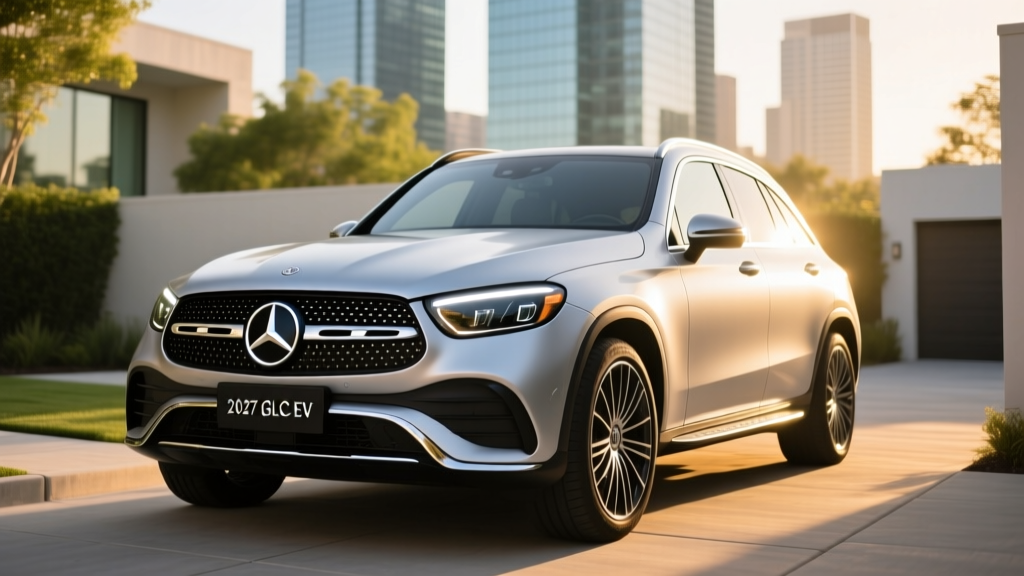
The Short Answer on the 2027 Mercedes-Benz GLC EV
The 2027 Mercedes-Benz GLC EV is an upcoming all-electric compact luxury SUV built on Mercedes' new MB.EA (Mercedes-Benz Electric Architecture) platform. While final U.S. EPA figures won't be published until closer to launch, Mercedes has confirmed a dual-motor all-wheel-drive layout, an estimated WLTP range exceeding 370 miles (translating to roughly 310–330 miles EPA), and 800-volt architecture enabling DC fast charging peaks above 250 kW. Expect a starting MSRP near $62,000–$65,000 before destination. The GLC EV will compete directly with the BMW iX3, Audi Q6 e-tron, and Tesla Model Y, targeting buyers who want luxury refinement without the EQE SUV's size or price.
Note: The 2027 GLC EV has been announced but is not yet on sale. All specifications below are preliminary estimates based on Mercedes-Benz press disclosures, MB.EA platform data, and comparable models. Final U.S. EPA certification and pricing will be confirmed at launch.
What We Know: Platform, Battery, and Powertrain
The GLC EV rides on the dedicated MB.EA platform, purpose-built for battery-electric vehicles rather than adapted from an internal-combustion chassis. This matters for packaging: a flat skateboard battery allows a lower floor, more interior volume, and optimized crash structure compared to the outgoing EQC (which shared architecture with the gas GLC).
| Spec | Estimated / Confirmed |
|---|---|
| Platform | MB.EA (Mercedes-Benz Electric Architecture) |
| Battery Capacity (usable) | ~85–92 kWh (NMC chemistry expected) |
| System Voltage | 800V architecture |
| Drivetrain | Dual-motor AWD (4MATIC) |
| Horsepower | ~375–410 hp (est.) |
| 0–60 mph | ~4.8–5.2 seconds (est.) |
| EPA Range | ~310–330 miles (est.; WLTP >370 mi confirmed) |
| Peak DC Fast Charge | >250 kW |
| 10–80% DC Charge Time | ~22–27 minutes (est.) |
| Level 2 AC Charge Rate | Up to 22 kW (optional); 11 kW standard |
| Starting MSRP (est.) | $62,000–$65,000 |
| Battery Warranty | 8 years / 100,000 miles (Mercedes EV standard) |
The 800-volt system is a significant upgrade from the 400V architecture used in the older EQC and current EQB. Higher voltage allows faster charging at compatible DC stations without requiring excessive current, which reduces heat and cable weight. In real-world terms, this means the GLC EV should sustain higher charge rates deeper into the session — expect the curve to hold above 150 kW through roughly 60% State of Charge before tapering, rather than dropping off a cliff after 40%.
Mercedes has not confirmed battery chemistry for the U.S. market. The likely choice is NMC (nickel manganese cobalt) given the energy-density requirements for a 310+ mile EPA target in a compact SUV footprint. LFP (lithium iron phosphate) offers longer cycle life and lower cost but sacrifices roughly 15–20% energy density — a trade-off that would push battery weight higher and range lower in this segment.
Real-World Range Expectations
EPA estimate: ~310–330 miles
Highway driving (70–75 mph): expect ~260–285 miles
Cold weather (below 32°F): expect ~230–265 miles (15–25% reduction)
Mixed suburban/commute: ~290–320 miles
Mercedes' heat pump (expected standard) will help mitigate winter losses, but physics governs all EVs in freezing temperatures. Preconditioning the battery while plugged in recovers significant range.
Charging Speed and Infrastructure Reality
The GLC EV's 800V architecture positions it among the faster-charging luxury SUVs, rivaling the Hyundai Ioniq 5 and Kia EV6 (both 800V) and outpacing 400V competitors like the BMW iX3.
| Charging Level | Power | Miles Added Per Hour |
|---|---|---|
| Level 1 (120V household) | ~1.4 kW | ~4–5 mi/hr |
| Level 2 (240V, 48A home charger) | ~11.5 kW | ~35–40 mi/hr |
| Level 2 (240V, 80A / wallbox) | ~19.2 kW | ~58–65 mi/hr |
| DC Fast Charge (peak) | >250 kW | ~180+ mi in 10 min (peak) |
For daily ownership, Level 2 home charging is the backbone. An overnight session of 8 hours at 11.5 kW replenishes roughly 280–320 miles — effectively a full battery. If your daily commute is 40 miles round-trip, a home Level 2 charger means you'll rarely, if ever, visit a public DC fast charger outside of road trips.
On the public network side, the GLC EV will ship with a NACS (North American Charging Standard) port, giving it native access to Tesla Supercharger stalls alongside Electrify America, EVgo, and other networks. Mercedes-Benz has also partnered with charging providers to build its own "Mercedes-Benz High-Power Charging" network at select U.S. locations, with stalls rated up to 400 kW.
Charge-curve reality check: The advertised ">250 kW" peak is just that — a peak. Real-world DC sessions average considerably less due to taper. Based on 800V comparables, expect an average rate of roughly 170–190 kW over a 10–80% session, yielding a 22–27 minute charge time. That's competitive with the best in class but not instantaneous.
GLC EV vs. Gas GLC: Cost and Efficiency Comparison
The natural cross-shop for most buyers is the gas-powered GLC 300 4MATIC, which starts around $48,250. Let's run the numbers over five years and 75,000 miles.
| Category | 2027 GLC EV (est.) | 2026 GLC 300 4MATIC |
|---|---|---|
| Base MSRP | $63,500 | $48,250 |
| Federal Tax Credit (§30D) | Up to $7,500 (see eligibility) | $0 |
| Effective Purchase Price | ~$56,000 | $48,250 |
| Fuel/Energy Cost (75k mi) | ~$3,400 (home L2 at $0.14/kWh) | ~$9,200 (26 MPG combined, $3.20/gal) |
| Maintenance (5 yr) | ~$1,200 | ~$3,800 |
| Insurance (5 yr avg.) | ~$11,500 | ~$9,800 |
| Estimated Depreciation | ~$24,000 | ~$22,000 |
| Total 5-Year Cost | ~$96,100 | ~$93,050 |
The math is close. The GLC EV costs more upfront but saves roughly $5,800 on fuel and $2,600 on maintenance over five years. Insurance runs higher for EVs (typically 10–20% more due to repair costs and parts pricing), which partially offsets those savings. Whether the EV wins on total cost depends heavily on your local electricity rate, whether you qualify for the full federal credit, and how long you hold the vehicle.
If you charge primarily at home on a standard residential rate, the per-mile energy cost is roughly $0.045/mile (based on 3.0 mi/kWh efficiency and $0.14/kWh). If you rely heavily on public DC fast chargers at $0.35–$0.50/kWh, that jumps to $0.12–$0.17/mile — still below gasoline but no longer a bargain.
Federal Tax Credit: What You Actually Qualify For
The §30D federal EV tax credit offers up to $7,500, but eligibility for the 2027 GLC EV depends on several factors that change year to year. Here's the current framework:
- MSRP cap: SUVs must be priced at or below $80,000. The GLC EV's expected $62K–$75K range (depending on trim) should clear this.
- Buyer income cap: Modified adjusted gross income (MAGI) must not exceed $150,000 (single), $225,000 (head of household), or $300,000 (married filing jointly).
- Battery sourcing: The credit splits into two $3,750 halves — one for critical minerals and one for battery components. Sourcing requirements tighten annually. Mercedes has not yet disclosed whether the GLC EV's battery meets 2027 thresholds.
- Point-of-sale transfer: Eligible buyers can transfer the credit to the dealer at purchase, reducing the out-of-pocket price immediately rather than waiting for a tax refund.
Check current rules at IRS.gov before making purchase decisions. A tax professional can confirm your specific eligibility. Do not assume the full $7,500 applies — battery sourcing compliance is the variable most likely to reduce or eliminate the credit for European-manufactured vehicles.
Who Should Buy the GLC EV — and Who Shouldn't
Decision Framework
Choose the 2027 GLC EV if:
- You have reliable Level 2 home charging (garage or driveway with 240V access)
- Your daily driving is under 80 miles and you take road trips 3–5 times per year
- You value cabin quietness, one-pedal driving, and instant torque over traditional luxury cues
- You're cross-shopping the Audi Q6 e-tron, BMW iX3, or Tesla Model Y and want Mercedes' interior quality
- You qualify for some or all of the §30D credit
Stick with the gas GLC or consider a PHEV if:
- You live in an apartment or condo without charging access and rely on street parking
- You regularly drive 300+ miles in a single day through areas with sparse DC fast-charging infrastructure
- You live in an extremely cold climate (consistent sub-zero winters) and lack a garage for preconditioning
- Your budget is firm below $50,000 and you can't absorb the EV premium even after credits
- You plan to keep the vehicle 10+ years and are concerned about long-term battery replacement costs ($12,000–$18,000 out of warranty)
Common Misconceptions About Luxury EVs Like the GLC
| Myth | Fact |
|---|---|
| "The battery will need replacing in 5 years" | Mercedes warranties the battery for 8 years/100,000 miles with a 70% capacity retention threshold. NMC batteries in modern thermal-managed packs typically retain 85–92% capacity at 100K miles based on fleet data from comparable platforms. |
| "EVs are worse in the cold" | Range drops 15–25% in freezing weather — a real loss. But EVs start instantly, don't idle for warm-up, and with preconditioning (heating the battery while plugged in), much of the loss is recoverable. A gas GLC also loses efficiency in cold weather, just less visibly. |
| "Public charging is always unreliable" | Network reliability varies widely. Tesla Superchargers consistently deliver 95%+ uptime. Electrify America and EVgo have improved significantly since 2023. The GLC EV's NACS port opens the Supercharger network, dramatically expanding reliable options. |
| "I'll save a fortune on fuel" | Savings depend on your electricity source. Home charging at residential rates saves $5,000–$7,000 over 5 years vs. premium gasoline. Exclusive reliance on public DC fast charging cuts savings to $1,000–$2,000 over the same period. |
| "It qualifies for the full $7,500 credit automatically" | Credit eligibility depends on your income, the vehicle's battery sourcing, and MSRP caps. European-built EVs face the steepest sourcing hurdles. Always verify before purchase. |
First-Time EV Buyer Checklist for the GLC EV
If this is your first electric vehicle, the transition involves more planning than switching between gas models. Here's what to prepare before taking delivery:
- Home charging assessment: Have a licensed electrician evaluate your panel capacity. A Level 2 charger on a 60-amp circuit (48A continuous) requires a panel with at least 100A spare capacity. Panel upgrades add $1,500–$3,500 to installation costs. Budget $800–$2,000 for the charger unit and $600–$2,500 for electrician labor and permits.
- Utility rate plan: Many utilities offer time-of-use (TOU) plans with off-peak rates as low as $0.06–$0.09/kWh overnight. Setting your GLC EV to charge between midnight and 5 AM can cut your fuel cost nearly in half versus standard rates.
- Charging apps: Download PlugShare, A Better Routeplanner (ABRP), and your vehicle's native app before your first road trip. Plan DC fast-charger stops around 20–25% remaining battery to avoid range stress and charge-curve taper.
- Insurance quotes: Get quotes before purchasing. Luxury EVs carry 10–20% higher premiums on average. Some insurers offer EV-specific discounts — shop around.
- Maintenance expectations: EVs eliminate oil changes, spark plugs, and transmission fluid. Expect tire rotations, cabin air filter replacement, brake fluid checks (regen braking preserves pads), and software updates. Budget ~$200–$300/year for scheduled maintenance.
Frequently Asked Questions
When will the 2027 Mercedes-Benz GLC EV be available in the U.S.?
Mercedes has confirmed the GLC EV for the 2027 model year. U.S. deliveries are expected to begin in late 2026 or early 2027. Final EPA certification and pricing will be published closer to the on-sale date.
Will the GLC EV use a NACS or CCS charging port?
The GLC EV will use a NACS (North American Charging Standard) port, consistent with Mercedes' commitment to NACS for all new U.S. EVs starting in the 2025+ timeframe. This provides native Tesla Supercharger access without an adapter.
How does the GLC EV compare to the EQE SUV?
The GLC EV slots below the EQE SUV in size and price. The EQE SUV starts around $78,000, rides on the larger EVA2 platform, and offers more rear-seat space. The GLC EV targets a more accessible price point (~$63K) with similar technology but in a compact SUV footprint closer to the traditional gas GLC.
Can I tow with the GLC EV?
Mercedes has not published a towing rating for the GLC EV yet. Comparable MB.EA and EVA2-platform vehicles (like the EQE SUV) are rated for 3,500–4,000 pounds. Expect a similar figure, but note that towing reduces range by 30–50% depending on trailer weight and speed.
Is the GLC EV eligible for the full $7,500 federal tax credit?
Eligibility depends on battery sourcing compliance with §30D requirements, your income, and MSRP caps. As a European-manufactured vehicle, battery component and critical-mineral sourcing is the key variable. Mercedes has not yet confirmed credit eligibility for the GLC EV. Verify at IRS.gov closer to purchase.
What's the battery replacement cost out of warranty?
Based on current Mercedes EQ-platform battery pricing, a full pack replacement runs $12,000–$18,000 including labor. However, module-level repair (replacing individual degraded sections) can cost $2,000–$5,000. Battery degradation data from similar NMC packs suggests most owners will retain 85%+ capacity at 100,000 miles, making full replacement uncommon within the warranty period.