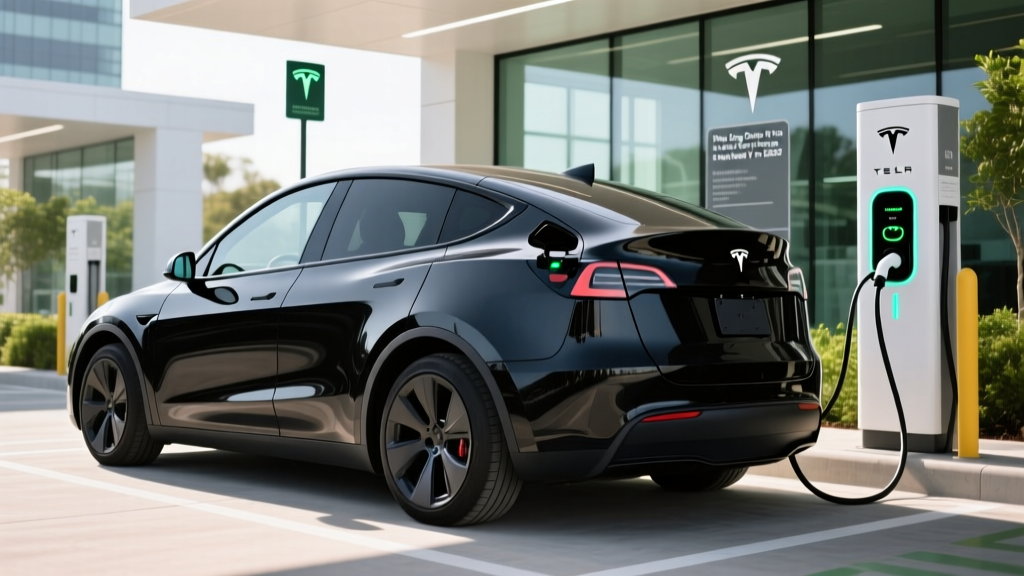
If you are shopping for a Tesla Model Y in 2026 and searching for a straight answer on charge times, you have landed in the right place. The Tesla Model Y remains the best-selling electric vehicle in the United States, and for good reason: it pairs a practical crossover form factor with access to Tesla's Supercharger network. But "how long does it take to fully charge a Tesla" is not a single-number question. The answer depends entirely on how you charge — from a standard wall outlet to a V4 Supercharger — and which Model Y trim you drive.
In this review, we break down every charging scenario for the 2026 Tesla Model Y, pair those numbers with real-world range expectations, and evaluate whether this EV still earns its market-leading position against rising competitors like the Hyundai Ioniq 5, Ford Mustang Mach-E, and Chevrolet Equinox EV.
2026 Tesla Model Y: Core Specs at a Glance
| Specification | Long Range AWD | Performance AWD | Rear-Wheel Drive (Standard) |
|---|---|---|---|
| EPA Range | 320 miles | 295 miles | 280 miles |
| Battery Capacity (usable) | ~75 kWh (NMC) | ~75 kWh (NMC) | ~57.5 kWh (LFP) |
| Max DC Fast Charge | 250 kW | 250 kW | 175 kW |
| 10–80% DC Fast Charge | ~25 min | ~25 min | ~30 min |
| Level 2 Home Charge Rate | 11.5 kW (~44 mi/hr) | 11.5 kW (~44 mi/hr) | 11.5 kW (~44 mi/hr) |
| Level 1 (120V) Charge Rate | ~1.4 kW (~5 mi/hr) | ~1.4 kW (~5 mi/hr) | ~1.4 kW (~5 mi/hr) |
| 0–60 mph | 4.8 sec | 3.5 sec | 6.5 sec |
| Horsepower | 384 hp | 510 hp | 295 hp |
| Drivetrain | Dual-Motor AWD | Dual-Motor AWD | RWD |
| Efficiency (MPGe) | 122 MPGe combined | 111 MPGe combined | 129 MPGe combined |
| Base MSRP | $47,990 | $52,990 | $39,990 |
Note: Specs reflect the refreshed Model Y platform. Tesla periodically adjusts pricing and range estimates; verify current figures at fueleconomy.gov.
How Long Does It Take to Fully Charge a Tesla Model Y? Every Scenario Explained
The question "how long does it take to fully charge a Tesla" really splits into three distinct charging scenarios. Understanding the difference between kW (power, or how fast energy flows) and kWh (energy, or how much the battery holds) is essential here. Think of kW as the width of a hose and kWh as the size of the bucket.
| Charging Method | Power (kW) | Miles of Range per Hour | 0–100% Time (Long Range) | Best Use Case |
|---|---|---|---|---|
| Level 1 (Standard 120V Outlet) | ~1.4 kW | ~5 mi/hr | ~50+ hours | Emergency top-ups, overnight trickle |
| Level 2 (240V Home Charger / Wall Connector) | 11.5 kW | ~44 mi/hr | ~7–8 hours | Daily home charging, overnight |
| DC Fast Charge (Tesla V3/V4 Supercharger) | Up to 250 kW | ~1,000+ mi/hr (peak) | 10–80% in ~25 min | Road trips, rapid top-ups |
The Charging Curve Reality: Why 10–80% Matters More Than 0–100%
Here is what most first-time EV buyers miss: DC fast charging does not sustain peak speed from empty to full. The Model Y Long Range peaks at 250 kW only when the battery is at a low state of charge (roughly 5–25%). As the battery fills, the charge rate tapers to protect cell longevity. By 80%, you might be pulling only 40–60 kW. That last 20% (from 80–100%) can take as long as the first 80%.
This is why the industry standard metric is 10–80% charge time. For the 2026 Model Y Long Range, that is approximately 25 minutes at a V3 Supercharger — enough to add roughly 200 miles of range. The 0–100% figure is mostly academic unless you are charging overnight at home on Level 2, where time is irrelevant because you are sleeping.
Level 2 Home Charging: The Daily Reality
Most Tesla owners do the vast majority of their charging at home. The Tesla Wall Connector, installed on a 60-amp circuit (48-amp continuous), delivers up to 11.5 kW. At that rate, a fully depleted Long Range battery refills in roughly 7 to 8 hours — easily overnight. If your home has a 50-amp circuit (40-amp continuous), expect about 9.6 kW and slightly longer charge times.
Installation cost note: A Level 2 home charger installation typically runs $500–$2,000 depending on your electrical panel's capacity, the distance from the panel to your garage, and local permit requirements. Homes with older 100-amp panels may need a $1,500–$3,000 panel upgrade to support a dedicated 60-amp circuit. Always get a quote from a licensed electrician before committing.
Real-World Range vs. EPA Sticker: What to Actually Expect
EPA Estimated Range (Long Range AWD): 320 miles
Real-World Expectations:
- City/mixed driving (moderate temps): 290–320 miles — regenerative braking recovers energy in stop-and-go traffic
- Highway driving (70–80 mph, moderate temps): 260–290 miles — sustained high speeds increase aerodynamic drag significantly
- Cold weather (below 32°F, highway): 210–250 miles — battery chemistry slows, cabin heating draws power. Preconditioning helps but does not eliminate the loss.
- Towing (if equipped): 160–200 miles — towing a small trailer near the 3,500-lb limit can cut range nearly in half
The Model Y's LFP-equipped RWD variant (280 mi EPA) holds up slightly better in repeated charge cycles but still sees similar cold-weather and highway reductions proportionally.
Battery Chemistry: LFP vs. NMC in the Model Y Lineup
Tesla uses two distinct battery chemistries across the 2026 Model Y range, and the choice affects more than just range:
| Attribute | LFP (Lithium Iron Phosphate) | NMC (Nickel Manganese Cobalt) |
|---|---|---|
| Trims | Rear-Wheel Drive (Standard Range) | Long Range, Performance |
| Energy Density | Lower (heavier per kWh) | Higher (lighter, more range) |
| Cycle Life | 3,000+ cycles (excellent longevity) | 1,500–2,000 cycles |
| Daily Charging to 100% | Recommended by Tesla | Not recommended; 80% daily limit advised |
| Cold-Weather Performance | Slightly worse in extreme cold | Better low-temperature output |
| Max DC Charge Speed | 175 kW | 250 kW |
If you plan to charge at home every night and rarely road-trip, the LFP RWD model offers outstanding battery longevity and a lower purchase price. If you regularly take long highway trips or live in a cold climate, the NMC Long Range variant's faster charging, higher energy density, and better cold-weather behavior justify the premium.
Performance, Efficiency, and Daily Practicality
The Model Y's efficiency is a standout in the EV crossover segment. The RWD variant achieves 129 MPGe combined (26 kWh/100 mi), making it one of the most energy-efficient vehicles in its class according to EPA data. The Long Range AWD drops slightly to 122 MPGe, and the Performance trim to 111 MPGe — still excellent for a dual-motor, all-wheel-drive crossover.
In terms of acceleration, even the base RWD model hits 60 mph in 6.5 seconds — quicker than most gas-powered compact SUVs. The Long Range drops that to 4.8 seconds, and the Performance variant rockets to 60 in 3.5 seconds, which is sports-car territory in a five-passenger family hauler.
Cargo and Passenger Space
- Cargo volume (behind rear seats): 30.2 cu ft
- Cargo volume (rear seats folded): 72.1 cu ft
- Front trunk (frunk): 4.1 cu ft
- Rear legroom: 41.6 inches
- Front headroom: 41.0 inches
- Seating: 5 passengers standard; 7-seat option available on Long Range (third row best suited for small children)
The cargo area is generous for the segment, though the sloping roofline cuts into vertical space compared to boxier competitors like the Hyundai Ioniq 5. The optional third row is tight — think occasional use for kids, not adults.
Pricing, Trims, and Federal Tax Credit Eligibility
The 2026 Tesla Model Y lineup starts at $39,990 for the RWD and climbs to $52,990 for the Performance trim. Options like paint colors, larger wheels, and Enhanced Autopilot or Full Self-Driving (Supervised) can push the as-tested price $5,000–$10,000 higher.
| Trim | Base MSRP | Est. Destination | Federal Credit (if eligible) | Effective Price |
|---|---|---|---|---|
| Rear-Wheel Drive | $39,990 | $1,390 | Up to $7,500 | ~$33,880 |
| Long Range AWD | $47,990 | $1,390 | Up to $7,500 | ~$41,880 |
| Performance AWD | $52,990 | $1,390 | Up to $7,500 | ~$46,880 |
Federal EV Tax Credit (§30D) Eligibility Checklist
The IRS §30D credit can reduce your effective price by up to $7,500, but eligibility is not universal. You must meet all of the following:
- MSRP cap: Vehicle MSRP must not exceed $80,000 for SUVs (all Model Y trims qualify)
- Buyer income cap: Modified AGI must not exceed $150,000 (single), $225,000 (head of household), or $300,000 (joint)
- Battery sourcing: Critical minerals and battery components must meet phased-in domestic-content thresholds (Tesla's North American supply chain has largely met these requirements for the Model Y, but verify current-year compliance)
- Point-of-sale transfer: As of 2024+, you can transfer the credit to the dealer at purchase for an immediate price reduction, rather than waiting for tax filing
- Assembly: Vehicle must undergo final assembly in North America (the Model Y is assembled in Fremont, CA and Austin, TX)
Consult a tax professional to confirm your personal eligibility. Rules are subject to legislative change.
Tech, Driver Assistance, and What Sets the Model Y Apart
The Model Y's 15.4-inch center touchscreen remains the nerve center of the vehicle — there are virtually no physical buttons. Climate, mirrors, glovebox, and driving settings are all screen-controlled, which some buyers love and others find distracting. The infotainment system is fast, supports over-the-air updates, and includes streaming, gaming, and navigation with real-time Supercharger routing.
Tesla Autopilot comes standard and includes adaptive cruise control and lane centering. Enhanced Autopilot ($6,000) adds automatic lane changes, Navigate on Autopilot, and Smart Summon. Full Self-Driving (Supervised) ($8,000 or $99/month) adds traffic-light recognition and city-street navigation.
Important: All Tesla driver-assistance features — including FSD (Supervised) — are SAE Level 2 systems. This means the driver must remain fully attentive, keep hands on the wheel, and be prepared to take over at any moment. These are not self-driving systems. True driverless (Level 4) operation is currently limited to geofenced robotaxi services like Waymo.
Notable Drawbacks
- Ride quality: The Model Y's suspension is firm. Road imperfections are more noticeable than in the Hyundai Ioniq 5 or Kia EV6, especially on larger optional wheels.
- Touchscreen dependency: The lack of physical climate and volume controls frustrates some drivers, particularly in winter when gloves are involved.
- No Apple CarPlay / Android Auto: Tesla uses its proprietary infotainment. If you rely on phone projection, this is a dealbreaker.
- Visibility: The thick rear pillars and sloping roofline create blind spots. The backup camera is essential.
- Insurance costs: Tesla insurance premiums tend to run 15–30% higher than comparable non-Tesla EVs due to repair costs and parts pricing.
Warranty Coverage and Battery Longevity
Tesla's warranty structure is competitive with the broader EV market:
- Basic vehicle warranty: 4 years / 50,000 miles
- Battery and drive unit warranty: 8 years / 100,000 miles (RWD) or 8 years / 120,000 miles (Long Range and Performance)
- Battery capacity threshold: Tesla guarantees at least 70% capacity retention during the warranty period
In practice, Tesla's NMC batteries have shown roughly 10–12% degradation over 100,000 miles based on aggregated fleet data. LFP batteries in the RWD variant are expected to degrade even less, given the chemistry's superior cycle life. Out-of-warranty battery replacement currently costs approximately $12,000–$16,000 depending on the pack, though prices continue to decline as battery manufacturing scales.
Is the 2026 Tesla Model Y Worth It vs. the Competition?
Pros
- Access to the Tesla Supercharger network — still the most reliable and widespread DC fast-charging network in the U.S.
- Class-leading efficiency and real-world range
- Strong acceleration across all trims
- Over-the-air updates continuously add features
- Excellent cargo capacity with available 7-seat configuration
- LFP battery option for maximum longevity
Cons
- Firm ride quality, especially on 20-inch wheels
- No Apple CarPlay or Android Auto
- Touchscreen-only controls can be distracting
- Higher insurance premiums than rivals
- FSD (Supervised) remains expensive and is still Level 2
- Competition is catching up fast in charging speed and interior quality
Who Should Buy the 2026 Tesla Model Y?
Choose the Model Y if: You want the most reliable public charging network, value over-the-air software updates, need a practical family crossover with strong range, and prefer the simplicity of a single-screen interface.
Consider alternatives if: You prioritize ride comfort (Hyundai Ioniq 5), want physical buttons and Apple CarPlay (Ford Mustang Mach-E, Kia EV6), or need the absolute lowest starting price in an electric SUV (Chevrolet Equinox EV).
Frequently Asked Questions
How long does it take to fully charge a Tesla Model Y at home?
On a Level 2 home charger (11.5 kW / 48-amp), a full 0–100% charge takes approximately 7–8 hours for the Long Range AWD and about 5–6 hours for the RWD variant with its smaller LFP battery. Most owners plug in overnight and wake up to a full charge every morning, making "full charge time" largely irrelevant for daily use.
Can I charge a Tesla Model Y on a regular household outlet?
Yes, using the included Mobile Connector on a standard 120V outlet (Level 1). However, this adds only about 5 miles of range per hour of charging. A full charge from empty would take over 50 hours. Level 1 is suitable for emergency top-ups or very low daily mileage, but a Level 2 installation is strongly recommended for regular ownership.
Does the Tesla Model Y qualify for the $7,500 federal tax credit?
The Model Y qualifies for the federal §30D tax credit (up to $7,500) as long as the buyer meets income caps ($150K single / $300K joint MAGI) and the vehicle meets battery-sourcing requirements. All Model Y trims fall under the $80,000 SUV MSRP cap. The credit can be transferred to the dealer at the point of sale for an immediate price reduction. Verify current-year sourcing compliance with your dealer and consult a tax professional.
How does Supercharger speed compare to other networks?
Tesla V3 Superchargers deliver up to 250 kW, while newer V4 stations can deliver up to 350 kW (though the Model Y currently caps at 250 kW). The key advantage is not just peak speed but reliability — Tesla's network consistently delivers advertised speeds with minimal downtime. Competing networks like Electrify America and EVgo have improved but still report higher failure rates in independent surveys.
What is the real-world highway range of the Model Y Long Range?
Expect approximately 260–290 miles at highway speeds (70–80 mph) in moderate temperatures. In cold weather (below freezing), highway range can drop to 210–250 miles. Preconditioning the battery while plugged in and using seat heaters instead of cabin heat can help mitigate losses.
How long will the Tesla Model Y battery last before needing replacement?
Based on fleet data, Tesla NMC batteries retain approximately 88–90% capacity at 100,000 miles. The LFP battery in the RWD variant is expected to retain even more. At typical degradation rates, the battery should remain functional well beyond 200,000 miles before dropping below 70% capacity. The 8-year/100,000–120,000-mile warranty provides a safety net.