Tesla Model Y at a Glance: Why Cargo Space Matters in 2026
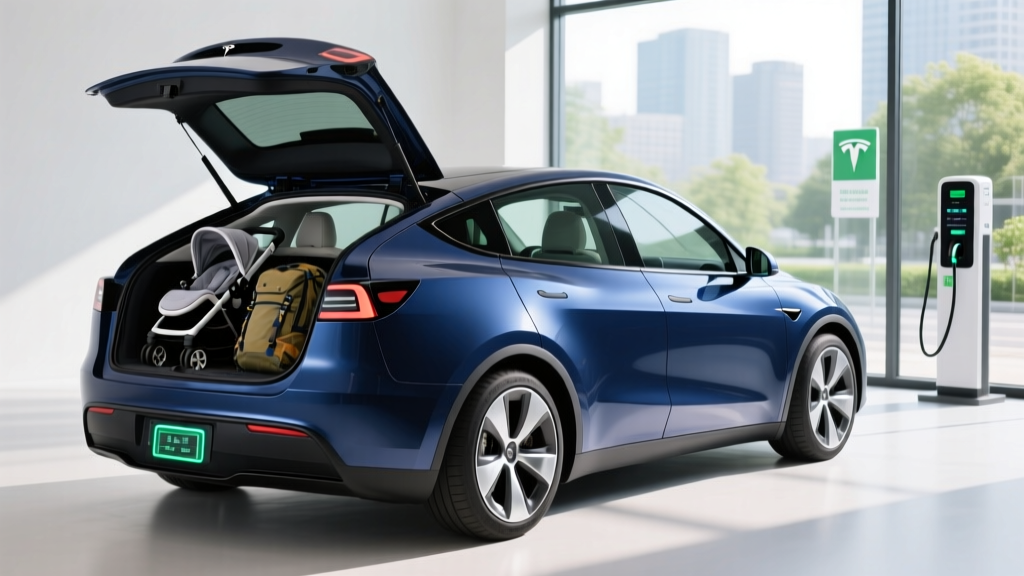
The Tesla Model Y remains one of the most practical electric crossovers on the market, and for 2026, it continues to draw buyers who need a balance of range, efficiency, and everyday utility. But beyond the headline EPA range and 0-60 times, one of the most searched topics is Tesla Model Y cargo dimensions — and for good reason. This is the EV that families, road-trippers, and gear-haulers actually live with daily. Whether you're fitting strollers, camping equipment, or weekly groceries, the Model Y's cargo architecture is a key part of the ownership equation.
This review covers everything you need to know about the 2026 Tesla Model Y: exact cargo measurements, real-world range, charging speeds, battery chemistry, pricing after federal tax credits, and how it stacks up against rivals like the Hyundai Ioniq 5 and Ford Mustang Mach-E.
Tesla Model Y Cargo Dimensions and Interior Space
The Model Y's hatchback crossover design gives it a significant practicality edge over sedan-shaped EVs. Here are the exact cargo and passenger measurements for the current Model Y:
| Measurement | Specification |
|---|---|
| Cargo volume (behind 2nd row) | 30.2 cu ft |
| Cargo volume (2nd row folded) | 72.1 cu ft |
| Front trunk (frunk) | 4.1 cu ft |
| Total max cargo | 76.2 cu ft |
| Cargo floor length (behind 2nd row) | ~38 inches |
| Cargo floor length (seats folded) | ~73 inches |
| Cargo opening width | ~45 inches |
| Front headroom | 41.0 inches |
| Rear headroom | 39.4 inches |
| Front legroom | 41.8 inches |
| Rear legroom | 39.1 inches |
| Seating capacity | 5 (optional 7-seat config on select trims) |
The 30.2 cu ft behind the second row is competitive with gas-powered compact SUVs like the Honda CR-V and Toyota RAV4. Fold the 60/40 split rear seats, and the 72.1 cu ft flat-load floor can swallow a full-size bicycle without removing the front wheel, or multiple large suitcases for airport runs. The 4.1 cu ft frunk is best used for charging cables, a small bag, or groceries you want separated from the main cargo area.
One practical note: the optional third-row seat (available on Long Range trims) reduces behind-row-two cargo space significantly and is best suited for small children. Most buyers are better served by the standard five-seat layout for cargo flexibility.
Range, Battery, and Real-World Efficiency
For 2026, the Tesla Model Y is offered in two primary configurations, each with distinct battery and range profiles:
| Spec | Long Range AWD | Performance AWD |
|---|---|---|
| EPA Range | 320 miles | 285 miles |
| Battery (usable) | ~75 kWh (NMC) | ~75 kWh (NMC) |
| Drivetrain | Dual-Motor AWD | Dual-Motor AWD |
| Horsepower | ~384 hp | ~456 hp |
| 0-60 mph | 4.8 seconds | 3.5 seconds |
| Top Speed | 125 mph | 155 mph |
| MPGe (combined) | 122 MPGe | 111 MPGe |
| Efficiency | 28 kWh/100 mi | 30 kWh/100 mi |
| Towing Capacity | 3,500 lbs | 3,500 lbs |
The EPA rates the Long Range AWD at 320 miles, but real-world conditions tell a more nuanced story. In mixed highway driving at 70-75 mph, expect approximately 270-290 miles before needing to charge. In cold weather (below 32°F), range can drop 15-25% depending on cabin heating demand and battery preconditioning habits — putting realistic winter range closer to 240-270 miles. City driving with frequent regenerative braking opportunities can push efficiency closer to or even slightly above the EPA sticker. The Model Y's heat pump, standard on all current trims, helps mitigate cold-weather losses compared to older resistive-heater EVs, but physics still applies.
The Model Y Long Range uses an NMC (nickel manganese cobalt) lithium-ion battery pack, which offers higher energy density than LFP chemistry. This means more range in a lighter package, though NMC batteries generally benefit from daily charging limits around 80-90% for longevity, unlike LFP packs that tolerate regular 100% charges. Tesla's battery management system is among the most sophisticated in the industry, and long-term degradation data from fueleconomy.gov and owner surveys shows most Model Y packs retain 90%+ capacity after 100,000 miles.
Charging Speeds: DC Fast, Level 2, and Level 1
Charging speed is where the Model Y continues to leverage Tesla's Supercharger network advantage. Here's the full breakdown:
| Charging Level | Power / Rate | Speed (Miles Added) | Notes |
|---|---|---|---|
| DC Fast Charge (peak) | 250 kW (max) | ~162 miles in 15 min | Peak rate; tapers above 50% SoC |
| DC 10-80% time | — | ~25-28 minutes | With battery preconditioning |
| Level 2 (home/wall connector) | 11.5 kW (48A) | ~44 miles per hour | Requires 60A circuit |
| Level 2 (standard 240V/32A) | 7.7 kW | ~30 miles per hour | Common NEMA 14-50 setup |
| Level 1 (120V household) | ~1.2 kW | ~3-4 miles per hour | Emergency/trickle only |
Charging curve reality: The 250 kW peak is not sustained across the entire session. The Model Y's charge curve peaks around 250 kW at low state of charge (10-20%), then progressively tapers. By 50% SoC, you're typically seeing 120-150 kW, and above 80%, speeds drop sharply to protect the battery — often below 50 kW. This is why the 10-80% metric matters more than peak kW claims. Always navigate to a Supercharger using the car's built-in navigation to trigger battery preconditioning; arriving cold can add 5-10 minutes to your session.
The Model Y uses the NACS (North American Charging Standard) connector natively — the Tesla plug. With Tesla opening its Supercharger network to non-Tesla EVs and most automakers adopting NACS by 2025-2026, this connector is now the de facto North American standard, giving Model Y owners the broadest fast-charging access in the country.
Pricing, Trims, and Federal Tax Credit Eligibility
Here's what the 2026 Model Y lineup looks like at the dealership (or rather, on Tesla's website, since Tesla sells direct):
| Trim | Base MSRP | Est. After §30D Credit* | Destination |
|---|---|---|---|
| Long Range AWD | $44,990 | $37,490 | $1,390 |
| Performance AWD | $48,990 | $41,490 | $1,390 |
*Federal tax credit amount shown is the maximum $7,500 under IRS §30D. Actual eligibility depends on multiple factors — see checklist below.
- MSRP Cap: Vehicle must be under $80,000 for SUVs/crossovers — Model Y qualifies ✓
- Buyer Income Cap: Modified AGI must not exceed $150,000 (single), $225,000 (head of household), or $300,000 (joint filers)
- Battery Sourcing: Critical minerals and battery components must meet escalating domestic/free-trade-agreement sourcing thresholds — Tesla has worked to qualify, but verify current-year status on IRS.gov
- Point-of-Sale Transfer: The $7,500 credit can now be applied at purchase as a down-payment reduction, rather than waiting for tax filing — ask Tesla at delivery
- Assembly: Vehicle must undergo final assembly in North America — Model Y (Fremont/Austin built) qualifies ✓
Tax credit rules are subject to change. Consult a tax professional and check the IRS before purchasing.
Tech, Driver Assistance, and Ownership Experience
The Model Y's interior is defined by its minimalist approach: a single 15-inch center touchscreen handles infotainment, climate, navigation, and vehicle settings. There is no instrument cluster — speed and driving info appear on the left side of the main display. This polarizes some buyers but is second nature to existing Tesla owners.
Standard tech includes:
- Tesla Autopilot (adaptive cruise + lane centering) — SAE Level 2 driver assist
- Over-the-air software updates
- 15-speaker premium audio
- Heated front and rear seats, heated steering wheel
- Power liftgate
- Sentry Mode dashcam/surveillance
- Dog Mode and Camp Mode climate settings
Tesla's Autopilot and optional Full Self-Driving (Supervised) are SAE Level 2 driver-assistance systems. They require continuous driver attention, hands on the wheel, and eyes on the road. The driver is legally responsible for the vehicle at all times. No consumer Tesla vehicle is autonomous. True driverless operation (Level 4) is currently limited to commercial robotaxi services like Waymo in select geofenced cities.
FSD (Supervised) remains a $8,000 add-on or $99/month subscription as of 2026. It adds city-street navigation, traffic light/stop sign recognition, and autosteer on local roads, but performance varies significantly by geography and road complexity. Most buyers are better served by the included Autopilot for highway commuting.
Notable drawbacks: The minimalist interior lacks physical buttons for climate and mirror adjustment (all screen-based). The glass roof, while expansive, can create cabin heat in direct summer sun — Tesla includes a UV-reflective coating but some owners add aftermarket shades. Panel gap quality has improved significantly since early production years but still varies by factory and batch.
How the Model Y Compares to Key Rivals
| Spec | Tesla Model Y LR | Hyundai Ioniq 5 LR AWD | Ford Mustang Mach-E ER AWD |
|---|---|---|---|
| EPA Range | 320 mi | 305 mi | 305 mi |
| Cargo (behind 2nd row) | 30.2 cu ft | 27.2 cu ft | 29.7 cu ft |
| Max Cargo | 72.1 cu ft | 59.3 cu ft | 59.7 cu ft |
| DC Fast Charge (peak) | 250 kW | 238 kW | 150 kW |
| 10-80% DC Time | ~25 min | ~18 min | ~38 min |
| 0-60 mph | 4.8 sec | 5.1 sec | 5.1 sec |
| Starting MSRP | $44,990 | $49,400 | $45,995 |
| Charging Network | NACS (Supercharger) | NACS (adapter/2026+) | NACS (adapter/2026+) |
The Model Y's advantages remain clear: the largest cargo area in its class, the most mature Supercharger network, strong range, and competitive pricing. The Ioniq 5 charges faster from 10-80% thanks to its 800V architecture (versus the Model Y's ~400V system), and the Mach-E offers a more conventional interior with physical controls. But for total cargo utility and charging infrastructure confidence, the Model Y holds its position.
✓ Pros
- Class-leading 76.2 cu ft total cargo volume
- 320-mile EPA range (Long Range)
- Supercharger network — most reliable DC fast-charging in North America
- Strong efficiency at 122 MPGe combined
- Over-the-air updates keep the vehicle current
- 3,500-lb towing for a compact EV crossover
- Qualifies for up to $7,500 federal tax credit
✗ Cons
- No physical buttons — all controls via touchscreen
- ~400V architecture means slower 10-80% charge than 800V rivals
- Optional third row is cramped and reduces cargo
- FSD ($8,000) remains Level 2 — expensive for what it delivers
- Insurance premiums tend to be above class average
- Glass roof can increase cabin heat in summer
- Service center availability varies by region
Who Should Buy the 2026 Tesla Model Y?
Best for: Families needing maximum cargo flexibility in an EV, daily commuters with home Level 2 charging, road-trippers who value Supercharger network coverage, and tech-forward buyers who prefer a minimalist, software-driven vehicle.
Consider alternatives if: You prefer physical buttons and a traditional cockpit layout, you need the fastest possible DC charging sessions (look at 800V platforms like the Ioniq 5 or Kia EV6), or you regularly need more than five seats with usable cargo space (consider the Kia EV9 or a three-row PHEV).
Frequently Asked Questions
What is the real-world range of the Tesla Model Y?
The EPA rates the Long Range AWD at 320 miles, but expect 270-290 miles in real-world highway driving and as low as 240-270 miles in freezing temperatures. City driving with regenerative braking can match or slightly exceed the EPA figure.
How fast does the Model Y charge at home and on the road?
On a Tesla Wall Connector (11.5 kW / 48A), you'll add about 44 miles per hour — a full overnight session easily replenishes daily driving. At a V3 Supercharger, the 10-80% session takes approximately 25-28 minutes with proper battery preconditioning, though the charge curve tapers significantly above 50% SoC.
Does the Tesla Model Y qualify for the federal EV tax credit?
The Model Y qualifies for up to $7,500 under IRS §30D, provided the buyer meets income caps ($150K single / $300K joint), the vehicle MSRP is under $80,000 (it is), and battery sourcing requirements are met for the current model year. The credit can be transferred at point of sale as a price reduction. Always verify current eligibility on IRS.gov.
How much cargo can the Model Y actually hold?
30.2 cu ft behind the second row and 72.1 cu ft with seats folded, plus a 4.1 cu ft frunk. That's enough for a double stroller plus groceries behind the rear seats, or a full load of camping gear and luggage with seats flat. It's the largest cargo area in the compact electric crossover segment.
Is the Model Y worth buying vs. the Ioniq 5 or Mach-E?
If cargo space and charging infrastructure are your top priorities, the Model Y wins on both counts — 72.1 cu ft max cargo and the Supercharger network. If you value faster peak DC charging (18-minute 10-80%), a more traditional interior, or a lower starting price on certain trims, the Ioniq 5 and Mach-E are strong alternatives. Test-drive all three before deciding.
What is the battery warranty on the Model Y?
Tesla covers the Model Y battery and drive unit for 8 years or 120,000 miles (whichever comes first), with a guaranteed minimum 70% capacity retention over that period. This is competitive with the industry standard for EV battery warranties.