The Quick Answer on Toyota's Electric Car Lineup
Toyota's current battery-electric offering for the U.S. market is the bZ4X, a compact electric SUV with an EPA-estimated range of up to 252 miles (FWD), a 71.4 kWh lithium-ion battery, and DC fast charging that peaks at 150 kW (FWD) or 100 kW (AWD). Pricing starts at approximately $33,000 MSRP before incentives. For 2026, the bZ4X qualifies for the $7,500 federal §30D tax credit for eligible buyers — transferable at point of sale — subject to IRS income caps and battery-sourcing requirements. Toyota's broader electrified lineup also includes numerous hybrids (HEVs) and plug-in hybrids (PHEVs), which may better suit buyers without home charging access or those in extreme-cold climates.
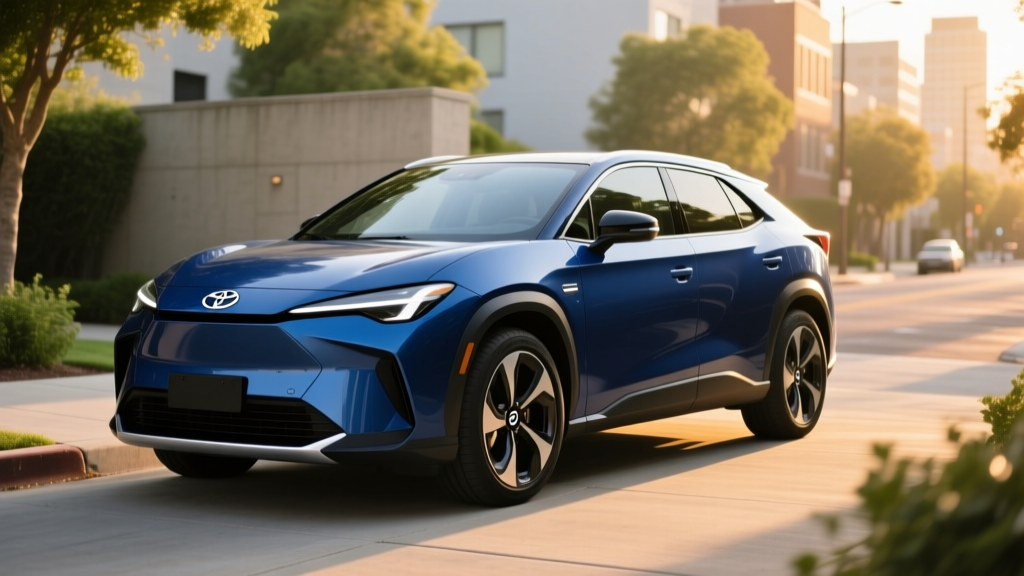
2026 Toyota bZ4X: The Current Toyota Electric Car
The bZ4X (pronounced "bee-zee-four-ex") is Toyota's first mass-market battery electric vehicle (BEV) sold in the United States. Originally launched for the 2023 model year, it has received incremental updates through 2026, including improved charging software and expanded trim availability. It competes directly with the Hyundai Ioniq 5, Kia EV6, Volkswagen ID.4, and Ford Mustang Mach-E in the compact electric crossover segment.
| Spec | FWD (XLE) | AWD (XLE/Limited) |
|---|---|---|
| EPA Range | 252 miles | 228 miles |
| Battery (usable) | 71.4 kWh, lithium-ion | 71.4 kWh, lithium-ion |
| Horsepower | 201 hp | 214 hp |
| 0–60 mph | ~7.1 sec | ~5.8 sec |
| Peak DC Fast Charge | 150 kW | 100 kW |
| 10–80% DC Charge Time | ~33 min | ~45 min |
| Level 2 Charge Rate | 7.2 kW (onboard) | 7.2 kW (onboard) |
| MPGe (combined) | 119 MPGe | 104 MPGe |
| Base MSRP | ~$33,000 | ~$37,000 |
| Battery Warranty | 8 years / 100,000 miles (capacity retention) | |
Real-World Range: What to Actually Expect
The EPA sticker says 252 miles for FWD and 228 miles for AWD. In practice, plan for less:
- Mixed driving (city/highway, moderate temps): ~220–240 miles (FWD)
- Sustained 70+ mph highway: ~200–220 miles (FWD), ~180–200 miles (AWD)
- Cold weather (below 32°F): Expect 20–30% range reduction, dropping FWD to roughly 175–200 miles
The bZ4X lacks a heat pump on most trims (a resistive heater handles cabin warmth), which is a notable efficiency penalty in winter compared to rivals like the Ioniq 5 or Model Y that use heat-pump thermal management.
EV vs. Hybrid vs. Gas: How the bZ4X Compares
Toyota built its reputation on hybrids — the RAV4 Hybrid and RAV4 Prime (PHEV) are among the most popular electrified vehicles in America. Before committing to a full BEV, it's worth understanding how the bZ4X stacks up against Toyota's own hybrid options and a comparable gas vehicle.
| Metric | bZ4X (FWD) | RAV4 Hybrid (AWD) | RAV4 Gas (FWD) |
|---|---|---|---|
| EPA Combined | 119 MPGe | 39 MPG | 28 MPG |
| Annual "Fuel" Cost* | ~$550–$750 | ~$1,450 | ~$2,050 |
| Cost per Mile | ~$0.04–$0.05 | ~$0.10 | ~$0.14 |
| Oil Changes | None | Every ~10k mi | Every ~10k mi |
| Base MSRP (approx.) | $33,000 | $33,500 | $30,000 |
| Federal Tax Credit | $7,500 (if eligible) | None (HEV) | None |
| Effective Price After Credit | ~$25,500 | $33,500 | $30,000 |
*Based on 15,000 miles/year. EV cost assumes $0.14/kWh national average for home charging; public DC fast charging raises per-mile cost to ~$0.08–$0.12. Source: fueleconomy.gov and EIA electricity data.
The math is compelling: after the federal credit, the bZ4X can undercut a gas RAV4 on purchase price and save $1,000–$1,500 annually on energy. But this assumes reliable home charging. Without it, the calculus shifts dramatically.
Real Ownership Costs: The Full 5-Year Picture
Purchase price and fuel savings tell only part of the story. Here's a realistic five-year total cost of ownership (TCO) breakdown for the bZ4X FWD at 15,000 miles/year, compared against a gas RAV4 LE:
| Category | bZ4X FWD | RAV4 Gas LE |
|---|---|---|
| Purchase (after credit) | $25,500 | $30,000 |
| Energy/Fuel (5 yrs) | $3,250 (home) / $5,500 (public) | $10,250 |
| Maintenance (5 yrs) | ~$1,200 | ~$3,500 |
| Insurance (5 yrs, avg) | ~$8,500 | ~$7,000 |
| Depreciation (est.) | ~$12,000 | ~$10,500 |
| Total (home charging) | ~$50,450 | ~$61,250 |
| Total (public charging) | ~$52,700 | ~$61,250 |
Key observations from this data:
- Home charging is essential for maximizing savings. Relying exclusively on public DC fast chargers erodes the bZ4X's cost advantage significantly — at $0.35–$0.48/kWh on networks like Electrify America or EVgo, your per-mile energy cost nearly triples.
- Insurance premiums run 15–25% higher on EVs across most carriers, due to higher repair costs and battery replacement risk. Get quotes before purchasing.
- Maintenance savings are real: no oil changes, no transmission fluid, no spark plugs, and regenerative braking extends pad life to 80,000+ miles in typical driving.
- Depreciation remains a wild card. Early bZ4X models experienced steeper-than-average depreciation due to charging-speed criticism and limited range. Toyota's brand strength helps, but EV resale values are still settling industry-wide.
Charging the bZ4X: Home, Public, and What You Need to Know
The bZ4X uses the CCS1 connector for DC fast charging (J1772 for Level 2 AC). Toyota does not currently offer a NACS (Tesla-style) port on the bZ4X, though adapters for Tesla Supercharger access are expected as the industry transitions toward NACS by 2027–2028.
Home Level 2 Charging
The bZ4X's onboard charger accepts up to 7.2 kW on Level 2 AC (240V). A full 0–100% charge takes roughly 10–11 hours. For daily driving of 40–60 miles, a nightly plug-in adds back what you used in about 4–6 hours.
Expect to spend $800–$2,000 for a quality Level 2 home charger (ChargePoint Home Flex, Emporia, or Wallbox) plus $500–$2,500 for electrician installation, depending on whether your panel needs a 240V circuit added. A 200-amp panel is usually sufficient; older 100-amp panels may require an upgrade ($1,500–$3,500).
DC Fast Charging Reality
Here's where the bZ4X draws the most criticism from EV enthusiasts — and where honesty matters:
- FWD peaks at 150 kW but sustains that rate only briefly. The charge curve tapers significantly above 50% SoC. Expect 10–80% in roughly 33 minutes under ideal conditions.
- AWD peaks at only 100 kW, making 10–80% take approximately 45 minutes. This is slower than the Ioniq 5 (240 kW peak, ~18 min) or Model Y (~250 kW, ~15 min).
- Cold-weather fast charging can be substantially slower without battery preconditioning. The bZ4X does offer a preconditioning feature when you navigate to a charger, but its effectiveness is less aggressive than Tesla's or Hyundai's systems.
For road trips with multiple DC fast stops, plan for 35–50 minute charging breaks rather than the 15–20 minutes some competitors achieve. This is a genuine limitation for frequent long-distance drivers.
Federal Tax Credit Eligibility: The §30D Details
For 2026, the bZ4X is listed on the IRS's qualifying vehicle list for the full $7,500 §30D Clean Vehicle Credit. However, eligibility is not automatic. Here's the checklist:
- MSRP cap: The bZ4X (an SUV classification) must have an MSRP at or below $80,000. All current trims qualify.
- Buyer income cap: Adjusted gross income must not exceed $150,000 (single), $225,000 (head of household), or $300,000 (married filing jointly).
- Battery sourcing: The battery must meet critical-mineral and component-sourcing thresholds that phase up annually. Toyota has confirmed the U.S.-market bZ4X battery pack meets 2026 thresholds.
- Point-of-sale transfer: You can transfer the credit to the dealer at purchase, reducing your out-of-pocket cost by $7,500 on the spot — you don't have to wait until tax filing. (IRS §30D details)
- Tax liability: If transferred at POS, the credit is effectively a down-payment reduction regardless of tax liability. If claimed on your return, it is nonrefundable — you must owe at least $7,500 in federal tax.
Note: State and local incentives vary widely. California's CVRP, Colorado's state credit, and utility rebates can stack on top of the federal credit. Check your state's energy office for current programs.
Common Misconceptions About the Toyota bZ4X
| Myth | Fact |
|---|---|
| "The bZ4X battery will need expensive replacement in a few years." | Toyota warranties the battery for 8 years/100,000 miles against degradation below 70% capacity. Real-world data from early (2023–2024) models shows ~5–7% degradation at 40,000 miles — well within warranty thresholds. A full replacement, if ever needed, would likely cost $8,000–$12,000 out of warranty. |
| "You can't drive an EV in cold weather." | You can, but range drops 20–30% in sub-freezing temps. The bZ4X FWD at 252 mi EPA becomes roughly 175–200 mi in deep cold. Preconditioning while plugged in mitigates this. For extreme-cold states, a PHEV like the RAV4 Prime (42 mi electric + gas backup) may be more practical. |
| "The bZ4X charges as fast as any other EV." | It doesn't. At 150 kW peak (FWD) and 100 kW (AWD), it trails the Ioniq 5 (240 kW), EV6 (240 kW), and Model Y (~250 kW). Road-trippers should factor in longer stops. |
| "Toyota doesn't make real electric cars." | Toyota was cautious early but the bZ4X is a production BEV sold nationwide since 2023, with over 100,000 U.S. units delivered through 2025. Toyota has also announced additional BEVs for 2027+, including a three-row SUV. |
| "EVs cost more to own than gas cars." | With home charging and the federal credit, the bZ4X's 5-year TCO undercuts a comparable gas RAV4 by $8,000–$11,000. Without home charging or the credit, the advantage narrows or disappears. |
Decision Framework: Is the bZ4X the Right Toyota for You?
Choose the Toyota bZ4X (BEV) If:
- You have reliable Level 2 home charging (garage, driveway, or workplace)
- Your daily commute is under 80 miles round-trip
- You take road trips of 300+ miles fewer than 4–5 times per year
- You qualify for the $7,500 federal credit (income and tax-liability requirements met)
- You want zero tailpipe emissions and minimal maintenance
- You live in a moderate climate (or can tolerate 20–30% winter range loss)
Choose the Toyota RAV4 Prime (PHEV) Instead If:
- You lack home charging and rely on street parking or apartment living
- You frequently drive 400+ miles in a single day (no charging-stop planning needed)
- You live in extreme cold (North Dakota, interior Alaska) where range loss is severe
- You want Toyota reliability with electric daily driving (42 mi EV range) plus gas flexibility
- You don't qualify for the full $7,500 BEV credit (the RAV4 Prime may still qualify for partial incentives)
Choose the RAV4 Hybrid (HEV) If:
- You want maximum simplicity — no plugs, no charging, no range calculations
- Your budget is tight and you want proven 39 MPG combined without a premium
- You tow regularly (the hybrid's gas engine handles sustained load without battery depletion concerns)
What First-Time Toyota EV Buyers Should Know
If the bZ4X is your first electric vehicle, here are the practical ownership realities no brochure mentions:
- Download charging apps before you buy. PlugShare, ChargePoint, EVgo, and Electrify America are essential. Scout chargers along your common routes. The bZ4X's CCS1 connector works on all major non-Tesla networks.
- Install your Level 2 charger before delivery day. Electrician lead times can run 2–6 weeks. Get a quote and schedule early.
- Learn to read the charge curve. The bZ4X charges fastest between 10–50% SoC. Above 80%, charging slows dramatically (to protect battery health). On road trips, charge to 80% and go — don't wait for 100%.
- Regenerative braking takes adjustment. The bZ4X offers adjustable regen levels but does not offer true one-pedal driving to a complete stop like some competitors. You'll still use the brake pedal regularly.
- Tire wear is higher on EVs. The bZ4X's instant torque and ~4,300-lb curb weight wear tires 15–25% faster than a gas RAV4. Budget for replacement at ~35,000–45,000 miles. Consider EV-specific tires (e.g., Hankook iON evo) for lower rolling resistance and noise.
- Insurance shopping is non-negotiable. Get quotes from at least three carriers. Some insurers (GEICO, Progressive, State Farm) have adjusted EV premiums downward as repair data matures; others haven't.
Frequently Asked Questions
Is the Toyota bZ4X a good electric car for a first-time EV buyer?
Yes, with caveats. The bZ4X offers a reasonable 252-mile EPA range, competitive pricing after the federal credit (~$25,500 effective), and Toyota's dealer network for service. Its main drawbacks are slower DC fast charging than rivals and the lack of a heat pump. If you prioritize charging speed for frequent road trips, the Hyundai Ioniq 5 or Kia EV6 are stronger choices. For daily commuting with home charging, the bZ4X is a solid, no-surprises option.
Does the Toyota bZ4X qualify for the $7,500 federal tax credit?
Yes, for 2026 the bZ4X appears on the fueleconomy.gov qualifying list for the full $7,500 §30D credit. Buyer income must be under $150k/$225k/$300k (single/HOH/MFJ), and the credit can be transferred to the dealer at point of sale. Confirm current eligibility on irs.gov before purchasing, as battery-sourcing rules update annually.
How long does it take to charge the bZ4X at home?
On a Level 2 home charger (7.2 kW, 240V), a full 0–100% charge takes approximately 10–11 hours. For a typical day of 40 miles driven, you'll replenish that in about 4 hours. On a standard 120V outlet (Level 1), expect roughly 3–4 miles of range per hour of charging — adequate only for very low-mileage drivers or overnight top-ups.
Will Toyota release more electric cars after the bZ4X?
Toyota has announced a broader BEV lineup for 2027 and beyond, including a three-row electric SUV and redesigned versions of the bZ series with next-generation batteries. As of early 2026, the bZ4X remains the only Toyota BEV available for purchase in the U.S. Any future models should be considered announced/preliminary until official specs and pricing are confirmed.
How does the bZ4X compare to the RAV4 Prime plug-in hybrid?
The RAV4 Prime offers 42 miles of electric-only range, 38 MPG combined on gas after the battery depletes, 302 hp, and no range anxiety. MSRP starts around $44,000. The bZ4X offers 252 miles of all-electric range, lower running costs with home charging, and a lower effective price after the federal credit. Choose the bZ4X if you can charge at home and want full electric operation; choose the RAV4 Prime if you need gas-engine flexibility or lack charging access.