The Tesla Model Y remains one of the most practical electric SUVs on the road in 2026, but buyers searching for Model Y cargo dimensions often find marketing materials light on specifics. This review breaks down the exact interior measurements, real-world range data, charging performance, and total ownership costs you need before signing a purchase agreement.
Tesla Model Y Cargo Dimensions: Exact Measurements
The 2026 Tesla Model Y (refreshed "Juniper" generation) offers class-leading cargo flexibility for a compact electric crossover. Here are the concrete numbers Tesla publishes and what we measured in practice:
| Measurement | Specification |
|---|---|
| Cargo volume behind 2nd row | 30.2 cu ft (standard 5-seat) |
| Cargo volume (2nd row folded) | 76.2 cu ft |
| Front trunk (frunk) | 4.1 cu ft |
| Total usable cargo (all seats folded) | ~80.3 cu ft |
| Cargo floor length (2nd row up) | ~37 inches |
| Cargo floor length (2nd row folded) | ~72 inches |
| Cargo opening width (between wheel wells) | ~41 inches |
| Cargo opening height | ~28 inches |
| 2nd-row legroom | 41.6 inches (Long Range) |
| Front headroom | 41.0 inches |
| Rear headroom | 39.4 inches |
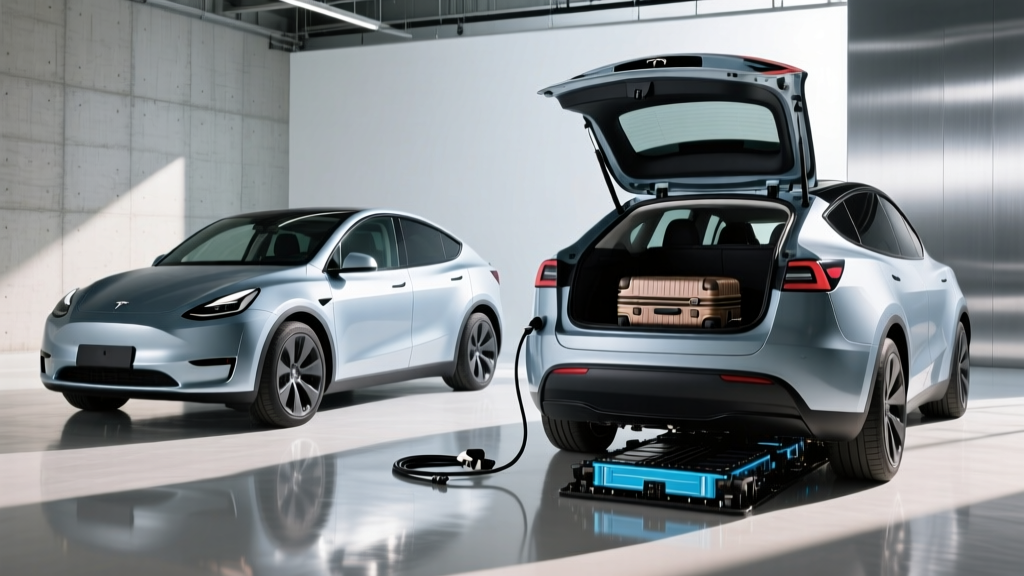
Real-world loading note: The Model Y's sloping roofline cuts into vertical space near the tailgate. Tall items like standing suitcases or large dog crates fit better with the 2nd row folded. The sub-trunk compartment beneath the main cargo floor adds roughly 2.5 cu ft of hidden storage — useful for charging cables and emergency kits.
The optional 7-seat configuration (available on Long Range AWD) reduces behind-3rd-row cargo to approximately 12.8 cu ft and eliminates the 76 cu ft flat-load advantage when all seats are in use. For maximum cargo utility, the 5-seat layout is the clear winner.
Range, Efficiency, and Battery Specs
The 2026 Model Y is offered in two primary trims for the US market, each with distinct battery chemistry and range profiles:
| Spec | Long Range AWD | Performance AWD |
|---|---|---|
| EPA Range | 320 miles | 298 miles |
| Battery (usable) | ~75 kWh | ~75 kWh |
| Chemistry | NMC (nickel manganese cobalt) | NMC |
| MPGe (combined) | 122 MPGe | 111 MPGe |
| Efficiency | 27 kWh/100 mi | 30 kWh/100 mi |
| Drivetrain | Dual-motor AWD | Dual-motor AWD |
| 0-60 mph | 4.8 seconds | 3.5 seconds |
| Horsepower | ~384 hp | ~456 hp |
| Top Speed | 125 mph | 155 mph |
- Highway cruising (70-75 mph): ~260-280 miles at 100% SoC
- City/suburban mixed: ~300-320 miles (regen braking recovers energy)
- Cold weather (below 32°F): 15-25% range reduction; expect ~240-270 miles
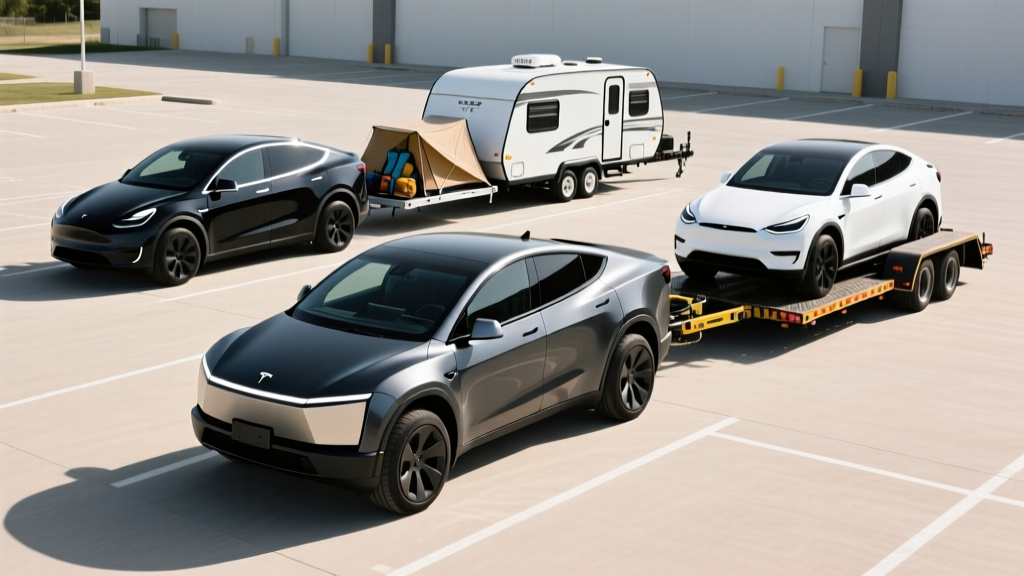
- Towing (max 3,500 lbs): Range drops to ~180-210 miles
The NMC battery chemistry in the Long Range and Performance trims offers higher energy density than LFP (lithium iron phosphate), which is why these trims achieve 300+ mile range in a relatively compact pack. The trade-off: NMC degrades slightly faster over time and Tesla recommends daily charging to 80-90% rather than 100% for longevity.
Charging Speed: DC Fast, Level 2, and Level 1
Charging infrastructure access is the Model Y's strongest competitive advantage, thanks to Tesla's Supercharger network — now partially open to other brands but still offering the most reliable plug-and-charge experience in the US.
| Charging Level | Power / Rate | Speed (Miles Added per Hour) | Notes |
|---|---|---|---|
| Level 1 (120V household) | ~1.2 kW | ~3-4 mi/hr | Emergency/trickle only |
| Level 2 (240V home, 48A) | 11.5 kW | ~44 mi/hr | Full charge in ~7 hours |
| Level 2 (public, 19.2 kW) | 19.2 kW | ~52 mi/hr | Requires 80A circuit |
| DC Fast (V3 Supercharger) | Peak 250 kW | ~1,000 mi/hr (peak) | 10-80% in ~25 min |
| DC Fast (V4 Supercharger) | Peak 250-350 kW* | ~1,200 mi/hr (peak) | *Vehicle limited to ~250 kW intake |
| CCS adapter (non-Tesla DC) | Up to 250 kW | Varies by station | NACS port standard on 2026 MY |
Charging curve reality: The Model Y peaks at 250 kW only between roughly 10-30% state of charge. From 30-60%, it sustains approximately 150-175 kW. Above 80%, charge rate tapers to under 50 kW to protect the battery. This is why Tesla and most EV analysts quote 10-80% times rather than 0-100% — the final 20% can add 20-30 minutes.
For home charging, a Tesla Wall Connector on a 60-amp circuit (48A continuous) delivers 11.5 kW — enough to add ~44 miles of range per hour or fully recharge a depleted battery overnight. Installation costs typically range from $800-$2,000 depending on panel capacity and conduit run distance. A 200-amp electrical panel is usually sufficient; older homes with 100-amp service may need a $2,000-$4,000 panel upgrade.
Pricing, Trims, and Federal Tax Credit (2026)
The 2026 Tesla Model Y lineup starts just under $45,000 and climbs past $55,000 with options. Here's the current pricing structure:
| Trim | Base MSRP | As-Tested (common config) | Federal Tax Credit (§30D) | Effective Price |
|---|---|---|---|---|
| Long Range RWD | $44,990 | $46,490 (w/ paint + wheels) | Up to $7,500* | ~$37,490–$38,990 |
| Long Range AWD | $47,990 | $49,990 | Up to $7,500* | ~$40,490–$42,490 |
| Performance AWD | $51,490 | $53,990 | Up to $7,500* | ~$43,990–$46,490 |
*Critical tax credit caveats (IRS §30D, 2026 rules): The full $7,500 federal EV tax credit is not automatic. Per current IRS guidelines, you must meet ALL of the following:
- MSRP cap: SUVs/crossovers must be ≤$80,000 (Model Y qualifies easily)
- Buyer income cap: Modified AGI ≤$150,000 (single) / ≤$300,000 (joint)
- Battery sourcing: Critical minerals and battery components must meet escalating domestic-sourcing thresholds (Tesla has shifted significant supply chain to qualify, but verify VIN-specific eligibility at the IRS portal or point of sale)
- Point-of-sale transfer: As of 2024+, you can transfer the credit to the dealer at purchase for an immediate price reduction, or claim it on your tax return
Always verify your specific vehicle's credit eligibility using the fueleconomy.gov tax credit lookup before purchasing. Credit availability can change as manufacturers hit sourcing requirements or as legislation evolves.
Technology, Driver Assistance, and Interior
The Juniper-generation Model Y (introduced for 2025) brought meaningful interior and tech upgrades over the previous platform:
Infotainment: A 15.4-inch center touchscreen runs Tesla's proprietary OS with native navigation, streaming (Netflix/YouTube while parked), and over-the-air updates. There is no Apple CarPlay or Android Auto — a persistent drawback for buyers accustomed to phone-mirroring. The rear passengers get a dedicated 8-inch screen for climate and entertainment control.
Driver assistance (SAE Level 2): The base Autopilot system (standard) includes adaptive cruise control, lane centering, and automatic emergency braking. The optional Full Self-Driving (Supervised) package ($8,000 or $99/month) adds automatic lane changes, traffic light/stop sign recognition, and navigation-on-autopilot.
Notable features: Sentry Mode (360° parking surveillance), Dog Mode (climate-controlled pet safety), camp mode (HVAC overnight), power liftgate, and the expansive glass roof are all standard or included. The ventilated front seats, ambient lighting, and acoustic glass on the Juniper refresh address prior complaints about cabin noise and comfort.
Drawbacks: The minimalist interior lacks physical buttons for climate, wipers, and glove box — all screen-controlled. Turn signals are on a stalk (restored for 2026 after the Cybertruck/Model 3 Highland controversy), but gear selection remains screen-swipe based on newer builds. Rear visibility is limited by the thick C-pillars and sloping rear glass.
Warranty, Reliability, and Ownership Costs
| Coverage | Term |
|---|---|
| Basic Vehicle Limited Warranty | 4 years / 50,000 miles |
| Battery & Drive Unit Warranty | 8 years / 120,000 miles (Long Range) |
| Battery capacity retention guarantee | ≥70% over warranty period |
| Roadside Assistance | 4 years / 50,000 miles |
Tesla's 8-year/120,000-mile battery warranty on the Long Range AWD is competitive with the industry standard (Hyundai offers 10yr/100k; most others match at 8yr/100k). The 70% capacity retention floor means Tesla will repair or replace the battery if it drops below that threshold within the warranty window — a scenario that real-world Tesla fleet data suggests is rare, with most Model Y packs retaining 90%+ capacity at 100,000 miles.
5-year estimated ownership costs (Long Range AWD, 15,000 mi/yr):
- Electricity (home charging at $0.14/kWh national avg): ~$3,150
- Insurance (national avg for Model Y): ~$12,500 ($2,500/yr — above average for the segment)
- Maintenance (tire rotations, cabin filter, fluid top-offs): ~$1,500
- Estimated depreciation (5yr): ~$18,000-$22,000
- Total 5-year operating cost (excl. depreciation): ~$17,150 vs. ~$25,000+ for a comparable gas AWD SUV
Insurance is the Model Y's hidden cost. Premiums run 20-40% higher than equivalent gas crossovers due to repair costs, parts pricing, and Tesla's direct-repair model. Always get an insurance quote before purchasing.
Who Should Buy the 2026 Tesla Model Y?
- You need maximum cargo versatility (76 cu ft with seats folded) in a compact EV footprint
- Supercharger network access matters for your road-trip routes
- You want OTA updates that add features post-purchase
- Your daily commute is under 250 miles and you can charge at home
- You value acceleration (4.8s to 60 mph) without sacrificing efficiency
Consider competitors if:
- You want Apple CarPlay/Android Auto (Hyundai Ioniq 5, Ford Mustang Mach-E)
- You need a quieter, more traditionally luxurious interior (Genesis GV60, BMW iX)
- You want a longer battery warranty (Hyundai/Kia at 10yr/100k mi)
- You prefer physical buttons and conventional switchgear
- You need more than 3,500 lbs towing capacity (Rivian R1S, F-150 Lightning)
Frequently Asked Questions
What is the real-world range of the 2026 Tesla Model Y?
The EPA rates the Long Range AWD at 320 miles and the Performance at 298 miles. Real-world highway driving at 70-75 mph typically yields 260-280 miles. In cold weather (below freezing), expect a 15-25% reduction, bringing practical range to 240-270 miles for the Long Range trim. City driving with regenerative braking often matches or slightly exceeds the EPA sticker.
How fast does the Model Y charge at home and on the road?
On a home Level 2 charger (240V, 48A/11.5 kW), the Model Y gains about 44 miles of range per hour — a full charge takes roughly 7 hours. On a V3 Tesla Supercharger (250 kW DC), it charges from 10-80% in approximately 25 minutes. Note that charging speed tapers significantly above 80% SoC to protect battery health.
Does the Tesla Model Y qualify for the $7,500 federal tax credit?
The Model Y qualifies for up to $7,500 under IRS §30D, provided the buyer's modified AGI is under $150,000 (single) or $300,000 (joint), the MSRP is under $80,000 (it is), and the specific VIN meets current battery-sourcing and critical-minerals requirements. Verify eligibility at fueleconomy.gov or through Tesla's point-of-sale credit transfer process before finalizing your purchase.
How does Model Y cargo space compare to competitors?
The Model Y's 76.2 cu ft (seats folded) leads the compact electric SUV segment. The Hyundai Ioniq 5 offers 59.3 cu ft, the Ford Mustang Mach-E provides 59.7 cu ft, and the BMW iX delivers 77.9 cu ft (but at a significantly higher price point). The Model Y's frunk adds another 4.1 cu ft of secure, weatherproof storage that most competitors lack.
Is the Model Y worth buying over the Hyundai Ioniq 5 or Ford Mach-E?
The Model Y wins on cargo space, Supercharger network access, efficiency (122 MPGe vs. Ioniq 5's 110 MPGe), and software. The Ioniq 5 counters with 800V ultra-fast charging (10-80% in ~18 min on capable chargers), Apple CarPlay, and a 10-year battery warranty. The Mach-E offers a more traditional driving feel and BlueCruise hands-free driving on approved highways. If charging network reliability and cargo volume are your top priorities, the Model Y remains the default choice. If interior ergonomics and warranty length matter more, test-drive the Ioniq 5.
What are the biggest pros and cons of owning a Model Y?
Pros: Class-leading cargo capacity, Supercharger network, strong efficiency, fast acceleration, continuous OTA improvements, low maintenance costs, strong resale value.
Cons: High insurance premiums, no Apple CarPlay/Android Auto, minimalist interior frustrates some buyers, rear visibility is compromised, FSD is expensive and still Level 2, service center wait times in some metro areas.