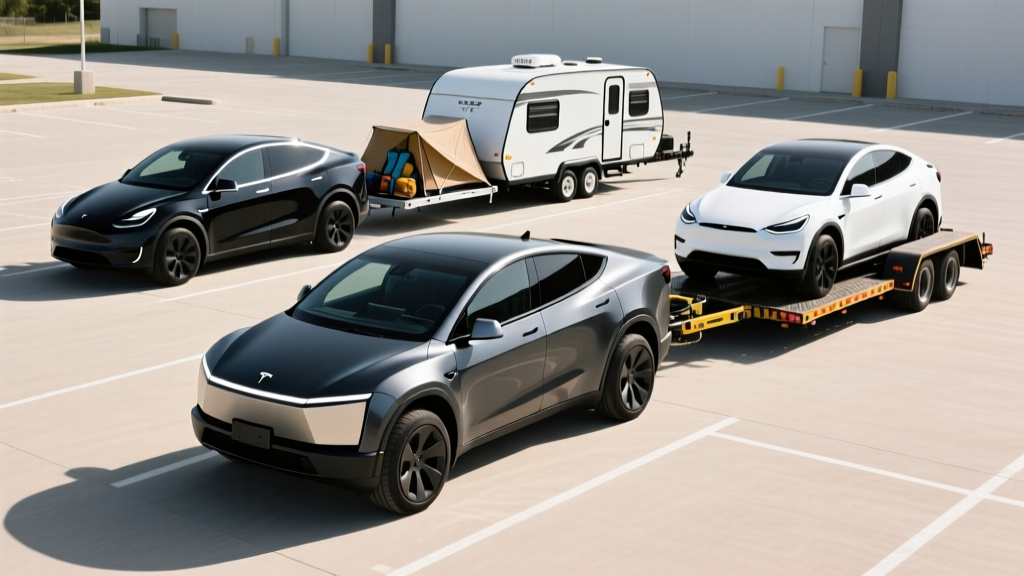
Electric vehicles have come a long way in terms of range and performance, but towing remains one of the most demanding tests an EV can face. Tesla offers three models with legitimate towing capability — the Model Y, Model X, and Cybertruck — each targeting different hauling needs. This guide breaks down every Tesla's towing capacity with exact numbers, the real-world range penalty you'll face while pulling a trailer, charging logistics on the road, and whether the 2026 federal tax credit applies.
Tesla Towing Capacity at a Glance
| Model (2025–2026) | Max Towing Capacity | Hitch Type | Drivetrain | EPA Range (Unloaded) | Starting MSRP |
|---|---|---|---|---|---|
| Model Y Long Range AWD | 3,500 lbs | 1.25" receiver (factory option) | Dual-Motor AWD | 320 mi | $44,990 |
| Model X Long Range | 5,000 lbs | 2" receiver (factory-installed) | Dual-Motor AWD | 325 mi | $74,990 |
| Cybertruck AWD | 7,500 lbs | 2" receiver (factory-installed) | Dual-Motor AWD | 340 mi | $59,990 |
| Cybertruck Cyberbeast | 7,500 lbs | 2" receiver (factory-installed) | Tri-Motor AWD | 320 mi | $99,990 |
For context, the Model 3 is not rated for towing in the United States. European Model 3 variants carry a 1,000 kg (2,205 lb) braked towing rating, but Tesla does not offer a factory hitch or towing rating for the US-market Model 3 as of 2026. The Model S also has no towing rating.
Model Y Towing: The Practical Light-Haul Option
The Model Y Long Range AWD can tow up to 3,500 pounds when equipped with the factory tow hitch option ($1,000 at time of order). This covers small utility trailers, a pair of jet skis, or a lightweight teardrop camper. The hitch uses a 1.25-inch receiver, which limits you to lighter ball-mount accessories — if you need a 2-inch receiver for bike racks or heavier cargo carriers, you'll need an adapter or aftermarket solution.
| Spec | Model Y Long Range AWD (2025) |
|---|---|
| Battery Capacity | 75 kWh usable (NMC chemistry) |
| EPA Range | 320 miles |
| Efficiency | 28 kWh/100 mi (120 MPGe combined) |
| 0–60 mph | 4.8 seconds |
| Horsepower | 384 hp |
| Max DC Fast Charge | 250 kW peak (Supercharger V3) |
| 10–80% DC Charge Time | ~25 minutes |
| Level 2 Home Charge | 11.5 kW (~44 mi/hr) |
| Cargo Volume | 76.2 cu ft (rear seats folded) |
| Towing Capacity | 3,500 lbs (with factory hitch) |
| Battery/Powertrain Warranty | 8 years / 120,000 miles |
The Model Y's NMC (nickel manganese cobalt) battery chemistry offers higher energy density than LFP, which helps with range, but it's worth noting that frequent towing at maximum capacity will accelerate battery wear over time due to sustained high-current discharge. Tesla's thermal management system is robust, but plan for more frequent Supercharger stops on any road trip with a trailer in tow.
Model X Towing: The Family Hauler With Real Capability
The Model X Long Range steps up to 5,000 pounds of towing capacity with a factory-installed 2-inch receiver hitch. This opens up mid-size travel trailers, small boat trailers, and larger cargo trailers. The Model X comes standard with the tow package — no separate hitch order required.
| Spec | Model X Long Range (2025) |
|---|---|
| Battery Capacity | 95 kWh usable (NMC chemistry) |
| EPA Range | 325 miles |
| Efficiency | 34 kWh/100 mi (100 MPGe combined) |
| 0–60 mph | 3.8 seconds |
| Horsepower | 670 hp |
| Max DC Fast Charge | 250 kW peak (Supercharger V3) |
| 10–80% DC Charge Time | ~30 minutes |
| Level 2 Home Charge | 11.5 kW (~34 mi/hr) |
| Cargo Volume | 88.1 cu ft (rear seats folded) |
| Seating | 5, 6, or 7 passengers |
| Towing Capacity | 5,000 lbs (2" receiver) |
| Battery/Powertrain Warranty | 8 years / 150,000 miles |
With the larger 95 kWh battery, the Model X handles towing duties with more reserve than the Model Y. However, the vehicle's heavier curb weight (~5,183 lbs) and less aerodynamic profile (despite the low 0.24 Cd) mean efficiency drops sharply under load.
Cybertruck Towing: The Serious Work Machine
The Cybertruck is Tesla's most capable tow vehicle, rated at 7,500 pounds across both the Dual-Motor AWD and tri-motor Cyberbeast trims. This puts it in the same class as many half-ton pickups from legacy automakers. The 2-inch receiver comes standard, and the truck's stainless-steel exoskeleton and air suspension (with up to 16 inches of ground clearance) are built for rugged use.
| Spec | Cybertruck AWD | Cybertruck Cyberbeast |
|---|---|---|
| Battery Capacity | ~112 kWh usable (NMC) | ~112 kWh usable (NMC) |
| EPA Range | 340 miles | 320 miles |
| Efficiency | ~42 kWh/100 mi | ~46 kWh/100 mi |
| 0–60 mph | 4.1 seconds | 2.6 seconds |
| Horsepower | 600 hp | 845 hp |
| Max DC Fast Charge | 250 kW peak | 250 kW peak |
| 10–80% DC Charge Time | ~30 minutes | ~30 minutes |
| Level 2 Home Charge | 11.5 kW (~28 mi/hr) | 11.5 kW (~28 mi/hr) |
| Bed Length | 6 ft (vault) | 6 ft (vault) |
| Payload Capacity | 2,500 lbs | 2,500 lbs |
| Towing Capacity | 7,500 lbs | 7,500 lbs |
| Battery/Powertrain Warranty | 8 years / 120,000 miles | 8 years / 120,000 miles |
The Cybertruck's angular stainless-steel body creates significant aerodynamic drag compared to more streamlined trucks, which is the primary reason for the steep range loss under tow. The truck does support V2L (vehicle-to-load) through its bed outlets (up to 2.4 kW), which is useful for powering tools or campsite equipment — but it cannot power your home (V2H) as of 2026.
Charging Logistics When Towing
Towing is where EV ownership diverges most sharply from gas trucks. Here's what you need to know about charging with a trailer attached:
| Charging Level | Power (kW) | Model Y Miles/Hr | Model X Miles/Hr | Cybertruck Miles/Hr |
|---|---|---|---|---|
| Level 1 (120V outlet) | 1.4 kW | ~5 mi/hr | ~4 mi/hr | ~3 mi/hr |
| Level 2 (240V, 48A) | 11.5 kW | ~44 mi/hr | ~34 mi/hr | ~28 mi/hr |
| DC Fast (Supercharger V3) | Up to 250 kW | 10–80% in ~25 min | 10–80% in ~30 min | 10–80% in ~30 min |
Key towing-charge reality: Most Supercharger stalls are designed for pull-through access, but many older stations require you to unhitch or park awkwardly. Tesla has been adding pull-through Supercharger stalls at travel centers and truck stops, but availability varies by region. Plan your route using Tesla's built-in navigation, which factors in trailer mode and adjusts range estimates accordingly.
On a road trip towing at max capacity, expect to stop every 90–120 minutes at highway speeds for a 25–35 minute charge session. This is significantly more frequent than a gas truck, which might refuel once every 4–5 hours while towing. Factor this into any trip planning.
Pricing and Federal Tax Credit Eligibility
Tesla's towing-capable models span a wide price range. Here's the breakdown with 2026 federal tax credit considerations:
| Model | Base MSRP | As-Tested (Typical Config) | §30D Federal Credit | Effective Price |
|---|---|---|---|---|
| Model Y Long Range AWD | $44,990 | $48,990 (w/ hitch, FSD) | Up to $7,500 (if eligible) | ~$37,490–$41,490 |
| Model X Long Range | $74,990 | $82,990 (w/ 6-seat, FSD) | $0 (exceeds MSRP cap) | $74,990–$82,990 |
| Cybertruck AWD | $59,990 | $65,990 (w/ FSD, tonneau) | Up to $7,500 (if eligible) | ~$52,490–$58,490 |
| Cybertruck Cyberbeast | $99,990 | $105,990 | $0 (exceeds MSRP cap) | $99,990–$105,990 |
- MSRP Cap: Vans, SUVs, and pickup trucks must have an MSRP ≤ $80,000 to qualify. The Model X and Cybertruck Cyberbeast exceed this cap and are ineligible.
- Income Cap: Buyer AGI must not exceed $150,000 (single), $225,000 (head of household), or $300,000 (married filing jointly).
- Battery Sourcing: A percentage of critical minerals and battery components must be sourced from the US or free-trade-agreement countries. This requirement tightens annually — verify current-year rules at IRS.gov.
- Point-of-Sale Transfer: Eligible buyers can transfer the credit to the dealer at purchase, reducing the upfront cost rather than waiting for a tax refund.
The Model Y Long Range and Cybertruck AWD are the two Tesla models that can potentially qualify for the full $7,500 credit, but battery-sourcing requirements change annually. Always confirm current eligibility with your tax professional and check the latest fueleconomy.gov listings before purchasing.
Real-World Towing: What Owners Report
Beyond the spec sheet, here's what Tesla owners consistently report about towing in practice:
- Trailer mode activation: All three models have a dedicated Trailer Mode in the vehicle settings. This disables Autopilot/FSD features, adjusts regenerative braking behavior, and recalculates range estimates. You must manually activate it each time you connect a trailer.
- Regenerative braking with a trailer: Tesla's regen can feel aggressive with a loaded trailer, especially on downhills. The system automatically moderates regen in Trailer Mode, but some owners report trailer sway on steep grades. A trailer with its own brakes (required above certain weights in most states) is essential.
- Energy consumption spikes: Towing at 70+ mph on flat interstate, Cybertruck owners report consumption of 700–900 Wh/mile (vs. ~350 Wh/mile unloaded). Model Y towing a 2,500-lb trailer typically sees 450–600 Wh/mile.
- Cold-weather compounding: Below freezing, battery preconditioning and cabin heating add another 10–20% energy draw. Towing in winter can cut range to 30–35% of the EPA sticker.
- Tire wear: Towing at max capacity accelerates tire wear significantly. Cybertruck owners towing frequently report needing tire replacement at 20,000–25,000 miles rather than the typical 35,000–40,000.
Tesla vs. Key Competitors for Towing
If towing is your primary use case, here's how Tesla stacks up against the leading electric truck and SUV alternatives in 2026:
| Vehicle | Towing Capacity | EPA Range | Battery | Starting MSRP | §30D Credit |
|---|---|---|---|---|---|
| Tesla Cybertruck AWD | 7,500 lbs | 340 mi | ~112 kWh (NMC) | $59,990 | Up to $7,500 |
| Ford F-150 Lightning (Ext. Range) | 10,000 lbs | 320 mi | 131 kWh (NMC) | $69,995 | Up to $7,500 |
| Rivian R1T (Dual-Motor Max) | 11,000 lbs | 352 mi | 149 kWh (NMC) | $87,900 | $0 (over MSRP cap) |
| Chevrolet Silverado EV (4WT) | 10,000 lbs | 380 mi | ~200 kWh (NMC) | $74,800 | Up to $7,500 |
| Tesla Model X LR | 5,000 lbs | 325 mi | 95 kWh (NMC) | $74,990 | $0 (over MSRP cap) |
The Cybertruck's 7,500-lb rating falls short of the F-150 Lightning and Rivian R1T for heavy-duty towing. However, the Cybertruck undercuts both on price (when the tax credit applies) and offers the Supercharger network advantage — currently the most reliable and widespread DC fast-charging network in North America. For trailers under 7,000 lbs, the Cybertruck's combination of price, tech, and charging infrastructure is compelling. For heavier loads, the F-150 Lightning or R1T are more practical choices.
- Supercharger network with growing pull-through stall availability
- Integrated Trailer Mode with range recalculation
- Instant torque for confident highway merging with a load
- Low center of gravity (battery pack) reduces sway vs. lifted gas trucks
- Cybertruck V2L for campsite/job-site power
- Over-the-air updates continue improving towing features
- Significant range loss (40–65%) when towing at capacity
- More frequent charge stops than gas truck fuel stops
- Model Y's 1.25" receiver limits accessory options
- Model X and Cybertruck Cyberbeast ineligible for §30D credit
- No integrated trailer brake controller (requires aftermarket)
- Cybertruck aerodynamics cause steeper efficiency loss than rounded-body trucks
Who Should Buy a Tesla for Towing?
- Choose the Model Y if you need to tow a small trailer, bike rack, or jet skis occasionally (under 3,500 lbs) and want the most affordable Tesla with towing plus strong daily-driver range and the potential $7,500 tax credit.
- Choose the Model X if you need 5–7 passenger seating alongside 5,000-lb towing for a family boat or mid-size camper, and you're not reliant on the federal tax credit.
- Choose the Cybertruck AWD if you need serious 7,500-lb capability for work or large trailers, want V2L power output, and value the Supercharger network for road trips. Best value when the §30D credit applies.
- Look elsewhere (F-150 Lightning, R1T) if you regularly tow above 7,500 lbs, need an integrated trailer brake controller, or require maximum towing range between stops.
Frequently Asked Questions
Can you add a tow hitch to a Tesla after delivery?
For the Model Y, the factory tow hitch must be ordered at the time of purchase — it cannot be added later through Tesla. Aftermarket hitches exist but may void portions of your warranty and won't integrate with Tesla's Trailer Mode software. The Model X and Cybertruck come with the hitch factory-installed.
Does towing affect the Tesla battery warranty?
Towing within the rated capacity does not void the battery or powertrain warranty. However, the warranty covers defects, not normal degradation. Sustained high-load towing may accelerate degradation, which is considered normal wear. Tesla's battery warranty guarantees a minimum 70% capacity retention over 8 years / 120,000–150,000 miles (depending on model). See full warranty terms at Tesla's warranty page.
What's the real-world range of a Tesla Cybertruck while towing a 5,000-lb trailer?
With a 5,000-lb enclosed trailer at 65 mph on flat terrain, expect approximately 170–200 miles of real-world range from the Cybertruck AWD (EPA 340 mi unloaded). An open flatbed trailer with less aerodynamic drag may yield slightly more. Add headwinds, hills, or cold weather and plan for 140–170 miles.
Does the Tesla Cybertruck have a trailer brake controller?
As of 2026, the Cybertruck does not include a built-in trailer brake controller. You'll need an aftermarket proportional brake controller (such as a Curt Echo or Redarc Tow-Pro) wired into the 7-pin connector. This is a common complaint among Cybertruck owners who tow frequently.
How much does it cost to charge a Tesla while towing on a road trip?
At Supercharger rates averaging $0.30–$0.40/kWh (varies by location and time of day), and with towing consumption of roughly 600–800 Wh/mile, you're spending approximately $0.18–$0.32 per mile while towing. A gas truck averaging 8–10 MPG while towing at $3.50/gallon spends $0.35–$0.44 per mile. EV towing can still be cheaper per mile, but the time cost of more frequent stops is the tradeoff.
Is Autopilot or FSD available while towing a trailer?
No. When Trailer Mode is activated, Tesla disables Autopilot, FSD (Supervised), and all lane-keeping/cruise features. The driver must maintain full manual control. This is a safety requirement — Tesla's driver-assist systems are SAE Level 2 and are not validated for the altered dynamics of towing. Always maintain full attention and control when pulling a trailer.