Quick Verdict: The Family EV Benchmark Gets Tighter in the Back
The 2026 Tesla Model Y remains the default electric SUV for American families, but the calculus has shifted. With the refreshed Juniper styling, updated interior materials, and a starting price around $44,990, it competes in an increasingly crowded segment where rivals like the Hyundai Ioniq 5, Ford Mustang Mach-E, and Chevrolet Equinox EV have closed the gap on range and charging speed. Where the Model Y still wins: the Supercharger network, software integration, and cargo versatility. Where it loses: rear-seat comfort for bulky child car seats and a ride quality that prioritizes efficiency over plushness.
If your search for a Tesla car seat configuration brought you here, you're likely weighing whether the Model Y's rear bench actually accommodates rear-facing infant seats, convertible car seats, and booster setups without compromising front-seat legroom. We'll cover that in detail, alongside the hard numbers on range, charging, and total cost that matter for a family purchase.
Range, Efficiency, and Real-World Expectations
The 2026 Model Y Long Range AWD carries an EPA-estimated range of 320 miles on a full charge, drawing from a ~75 kWh usable battery pack (NMC chemistry). The base Rear-Wheel Drive model uses a lithium iron phosphate (LFP) battery with approximately 60 kWh usable and an EPA rating of 280 miles.
EPA 320 mi (Long Range AWD) — expect ~260–280 mi on highway road trips at 70+ mph, and ~220–240 mi in freezing temperatures with cabin heat. The LFP RWD model delivers closer to 230 mi highway. Plan charging stops at 200 mi intervals for comfort margin.
Efficiency registers at 122 MPGe combined (Long Range AWD), translating to roughly 28 kWh/100 mi in mixed driving. That's competitive with the Ioniq 5 AWD (118 MPGe) but trails the RWD Ioniq 5 (132 MPGe). Highway efficiency degrades noticeably above 75 mph — a physics reality all EVs face, but one that matters if your commute is mostly interstate.
| Spec | Long Range AWD | Rear-Wheel Drive |
|---|---|---|
| EPA Range | 320 mi | 280 mi |
| Battery (usable) | ~75 kWh (NMC) | ~60 kWh (LFP) |
| Efficiency | 122 MPGe / 28 kWh/100mi | 127 MPGe / 26 kWh/100mi |
| 0–60 mph | 4.8 sec | 6.6 sec |
| Horsepower | 384 hp (dual motor) | 295 hp (single motor) |
| Drivetrain | AWD (dual motor) | RWD |
| Max DC Fast Charge | 250 kW | 170 kW |
| 10–80% DC Time | ~25 min | ~30 min |
| Level 2 Home Rate | 11.5 kW (~44 mi/hr) | 11.5 kW (~44 mi/hr) |
| Base MSRP | $47,990 | $44,990 |
| Battery Warranty | 8 yr / 120,000 mi | 8 yr / 100,000 mi |
Charging Speed: Supercharger Advantage and Home Setup
The Model Y Long Range peaks at 250 kW on DC fast chargers, sustaining roughly 200+ kW through the 10–50% state-of-charge window before tapering. A 10–80% session takes approximately 25 minutes at a V3 Supercharger (250 kW) or equivalent CCS/NACS station. The charge curve flattens meaningfully above 80% — a 10–90% session adds roughly 10 more minutes for only ~40 additional miles, so plan to unplug at 80% on road trips.
The RWD model with the LFP pack tops out at 170 kW, making 10–80% sessions closer to 30 minutes. LFP chemistry does tolerate regular 100% charging without the degradation concerns of NMC, so daily home charging to full is fine — and actually recommended by Tesla for LFP packs to maintain battery calibration.
| Charging Level | Power | Miles Added per Hour | Best Use Case |
|---|---|---|---|
| Level 1 (120V outlet) | ~1.4 kW | ~4–5 mi/hr | Emergency / trickle top-off |
| Level 2 (240V, 48A) | 11.5 kW | ~44 mi/hr | Overnight home charging |
| DC Fast (V3 Supercharger) | Up to 250 kW | ~1,000+ mi/hr (peak) | Road trips, 10–80% in ~25 min |
For home charging, a Wall Connector on a 60A circuit delivers the full 11.5 kW (48A continuous). Installation typically runs $800–$2,000 depending on panel proximity and whether your home's electrical panel needs an upgrade from 100A to 200A service. Factor in a $400–$500 equipment cost for the Tesla Wall Connector itself.
Car Seat Fit and Family Interior Practicality
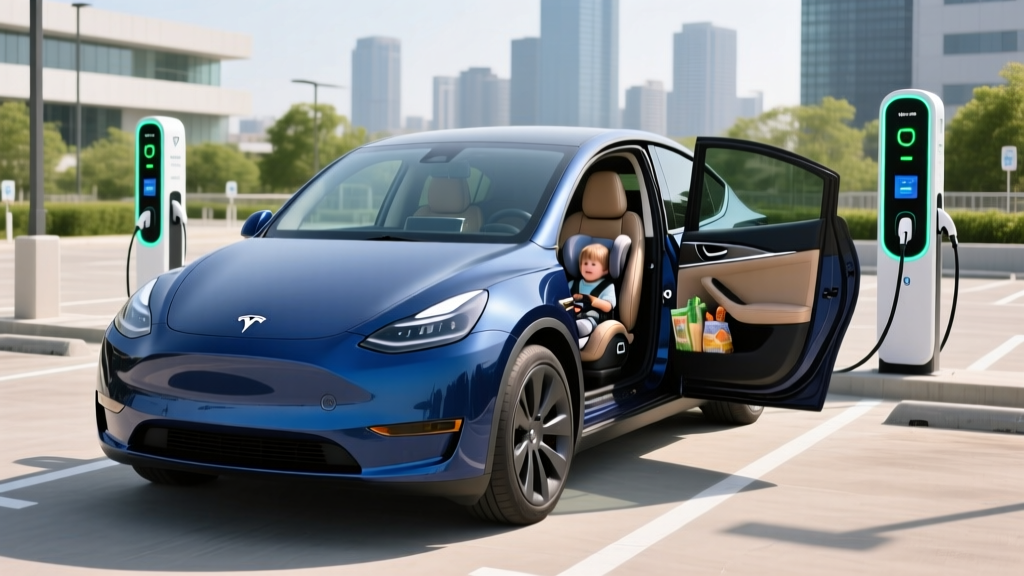
This is where the "Tesla car seat" question gets specific. The Model Y's rear bench offers 41.6 inches of legroom (front-seat-adjusted for a 5'10" driver) and 38.4 inches of headroom. In practice:
- Rear-facing infant seats (e.g., Chicco KeyFit, Graco SnugRide): Fit behind a front passenger of average height, but the front seat must move forward roughly 1–2 inches from ideal position. Tight for drivers over 6'0".
- Convertible car seats rear-facing (e.g., Graco Extend2Fit, Clek Foonf): The bulkier shells compress front legroom noticeably. Drivers 5'8" and under report acceptable compromise; taller drivers may find it restrictive.
- Forward-facing convertibles and boosters: Excellent fit with generous side-bolster clearance. LATCH anchors are accessible but recessed into the seat bight — expect to dig with fingers to locate them.
- Three-across configuration: Not viable with car seats. The rear bench width (~54 in) and contouring accommodate two car seats comfortably but not three.
Cargo space behind the second row measures 30.2 cubic feet, expanding to 72.1 cu ft with the 60/40 split rear seats folded. The front trunk (frunk) adds 4.1 cu ft — enough for a charging cable kit and a soft-sided diaper bag. For a family of four on a week-long trip, the cargo area handles two large suitcases, a stroller, and miscellaneous bags without folding seats.
Notable family drawbacks: the panoramic glass roof offers no shade option from factory (aftermarket shades are a common $40–$80 add-on), rear door pockets are shallow, and there are no rear-seat USB-C ports on the base trim — only the front console has charging ports. Rear-seat entertainment is limited to the 8-inch rear screen on higher trims.
Performance, Tech, and Driver Assistance
The Long Range AWD delivers 384 horsepower from its dual-motor setup, hitting 0–60 mph in 4.8 seconds. That's brisk for a family crossover and makes highway merging effortless. The RWD model at 295 hp and 6.6 seconds is adequate for commuting but noticeably less confident when loaded with passengers and cargo on uphill on-ramps.
Ride quality has improved with the Juniper refresh — revised damper tuning reduces the crashy low-speed impacts that plagued pre-2025 models, though it's still firmer than a Ford Mach-E or Ioniq 5 over broken pavement. Road noise is lower but still present at highway speeds; tire choice matters significantly (the stock Michelin Primacy tires prioritize efficiency over noise).
Tech highlights:
- 15.4-inch center touchscreen running Tesla's proprietary OS — responsive, feature-rich, but no Apple CarPlay or Android Auto
- Over-the-air updates add features regularly (recent: improved trip planner, battery preconditioning visualization)
- Sentry Mode dashcam recording with USB storage
- Dog Mode and Camp Mode for climate control while parked
- Heat pump standard — critical for cold-climate range preservation
Tesla's Autopilot (standard) and Full Self-Driving Supervised ($8,000 option) are SAE Level 2 driver-assistance systems. They require continuous driver supervision — hands on or near the wheel, eyes on the road. FSD Supervised handles highway lane changes, some city intersections, and parking, but it makes errors and requires intervention. It does not make the Model Y autonomous. Only Level 4 services like Waymo operate without a human driver.
Pricing, Tax Credits, and Total Cost
The 2026 Model Y lineup:
| Trim | Base MSRP | As-Tested (typical options) | §30D Credit Eligibility | Effective Price (if eligible) |
|---|---|---|---|---|
| Rear-Wheel Drive | $44,990 | $45,990 | Up to $7,500 (see rules) | ~$37,490–$38,490 |
| Long Range AWD | $47,990 | $49,990 | Up to $7,500 (see rules) | ~$40,490–$42,490 |
| Performance AWD | $52,490 | $54,990 | Up to $7,500 (see rules) | ~$44,990–$47,490 |
- MSRP cap: SUVs/crossovers must be under $80,000 — all Model Y trims qualify
- Buyer income cap: AGI ≤ $150,000 (single), ≤ $300,000 (married filing jointly)
- Battery sourcing: Critical minerals and battery components must meet phased-in percentages from US or FTA-partner countries — check IRS.gov for current Model Y compliance status, as sourcing requirements tighten annually
- Point-of-sale transfer: Eligible buyers can apply the credit at purchase to reduce down payment, rather than waiting for tax filing
- Non-transferable: Credit is per-vehicle, not per-buyer; leasing routes through lessor may differ
For a family comparing the Long Range AWD at ~$42,490 after credit to a loaded Hyundai Ioniq 5 SEL AWD (~$50,000 MSRP, ~$42,500 after credit), the purchase price is nearly identical. The differentiator becomes charging network preference (Tesla Superchargers vs. CCS networks), software ecosystem, and rear-seat car seat fit.
5-year ownership cost (estimated for Long Range AWD, 15,000 mi/yr, national average electricity at $0.16/kWh):
- Electricity: ~$3,360 total (vs. ~$9,000 gasoline for a 25 MPG equivalent SUV)
- Insurance: ~$9,500 (Tesla premiums run 15–25% higher than segment average — get quotes before purchase)
- Maintenance: ~$1,200 (no oil changes, brake pad life extended by regen, cabin air filter replacements)
- Estimated 5-year depreciation: ~$18,000–$22,000
Pros, Cons, and Who Should Buy
- Supercharger network reliability — still the most dependable DC fast-charging ecosystem in the US
- Class-leading cargo versatility (30.2 cu ft + frunk)
- Heat pump standard for cold-climate efficiency
- LFP option allows daily 100% charging without degradation worry
- Over-the-air updates continuously improve the vehicle
- Strong resale value relative to EV segment
- Rear-facing car seats compromise front legroom for taller drivers
- No Apple CarPlay or Android Auto — Tesla's OS only
- FSD is expensive ($8,000) and still requires supervision
- Insurance premiums above segment average
- Ride quality firm over rough pavement
- No three-across car seat capability
- Choose the Model Y if: You rely on road-trip charging infrastructure (Superchargers), need maximum cargo space in a compact EV footprint, value software integration, and your family uses one or two car seats (not three-across).
- Look at competitors if: You need three-across seating (Kia EV9), prioritize ride comfort (Ioniq 5, Mach-E), want Apple CarPlay (nearly everyone else), or your budget caps below $40K after credit (Chevrolet Equinox EV).
Frequently Asked Questions
What is the real-world range of the 2026 Tesla Model Y?
The EPA rates the Long Range AWD at 320 miles, but real-world highway driving at 70+ mph yields approximately 260–280 miles. In freezing temperatures with cabin heat, expect 220–240 miles. The RWD LFD model delivers roughly 230 miles highway. Plan charging stops conservatively — arriving at 15–20% state of charge is safer than gambling on 5%.
How fast does the Model Y charge at home and on the road?
At home on a Level 2 (240V, 48A) charger, the Model Y adds about 44 miles of range per hour, fully recharging overnight in 7–8 hours. On DC fast chargers, the Long Range peaks at 250 kW and reaches 10–80% in about 25 minutes. The RWD model peaks at 170 kW with a 10–80% time around 30 minutes. Above 80% SoC, charging slows dramatically — don't plan road-trip stops beyond 80%.
Does the 2026 Model Y qualify for the $7,500 federal EV tax credit?
All Model Y trims fall under the $80,000 MSRP cap for SUVs. However, eligibility depends on your adjusted gross income (≤$150K single / ≤$300K joint) and whether the battery's critical minerals and components meet the 2026 sourcing thresholds, which tighten annually. Check the current compliance list at IRS.gov before purchase. Eligible buyers can transfer the credit to the dealer at point of sale to reduce the purchase price.
How well do car seats fit in the Tesla Model Y?
Rear-facing infant and convertible car seats fit behind average-height drivers but compress front legroom for anyone over 6 feet tall. Forward-facing seats and boosters fit well with good LATCH access (though anchors are recessed). Three-across car seat installation is not practical due to bench width and contouring. If you need three-across, consider the Kia EV9 or a three-row SUV.
Is the Model Y worth buying vs. the Hyundai Ioniq 5 or Ford Mach-E?
At similar after-credit prices (~$42K for AWD Long Range vs. Ioniq 5 SEL AWD), the choice hinges on priorities. The Model Y wins on Supercharger access, cargo space, and software. The Ioniq 5 wins on ride comfort, CarPlay/Android Auto, and slightly faster 10–80% charging on 350 kW-capable stations (18 min vs. 25 min). The Mach-E offers a more traditional crossover feel with better rear-seat comfort. Test-drive all three with your car seats installed before deciding.
What's the battery warranty on the 2026 Model Y?
Tesla covers the Long Range AWD battery for 8 years or 120,000 miles (whichever comes first), with a capacity retention threshold of 70%. The RWD model's warranty is 8 years or 100,000 miles at the same 70% threshold. In practice, Tesla NMC and LFP packs have shown modest degradation — most owners report 90%+ capacity at 50,000 miles based on fleet data, though individual results vary with charging habits and climate exposure.
Sources: EPA Fuel Economy, IRS §30D Clean Vehicle Credit, Tesla Model Y Specifications