Tesla Model 3 Trunk Space: What You Actually Get
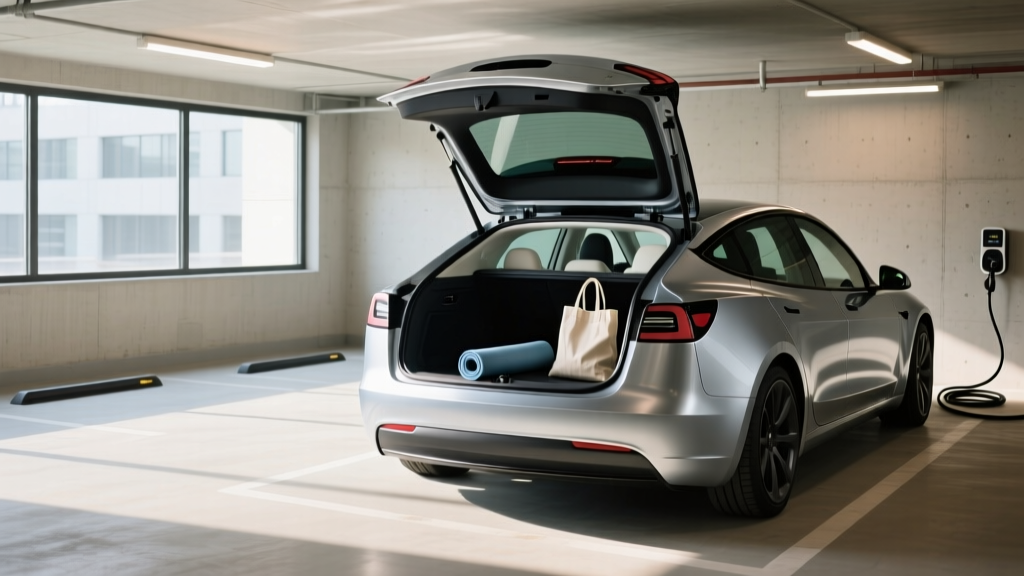
The Tesla Model 3 remains one of the most popular electric sedans on the road, but buyers shopping for practicality often ask one pointed question: how much can it actually carry? The short answer is that the Model 3 offers solid sedan-class cargo volume with a clever split between its rear trunk and front trunk (frunk), but the shape of that space — and the absence of a hatchback or liftgate — defines what fits and what doesn't.
For the 2026 model year, the refreshed "Highland" body style continues with the same cargo architecture Tesla introduced for the 2024 redesign. Rear trunk volume measures 23 cubic feet (per SAE measurement standards), while the front trunk (frunk) adds approximately 3.1 cubic feet. Combined, that gives you roughly 26 cubic feet of enclosed storage — competitive with many compact luxury sedans, though less than a hatchback like the Model Y or Hyundai Ioniq 5.
| Measurement | Value |
|---|---|
| Rear Trunk Volume | 23.0 cu ft |
| Frunk (Front Trunk) | ~3.1 cu ft |
| Total Cargo Volume | ~26.1 cu ft |
| Rear Seat Fold-Down | 60/40 split, near-flat |
| Trunk Opening Width | ~40 in (narrower than hatchback) |
| Front Headroom | 40.3 in |
| Rear Headroom | 37.8 in |
| Front Legroom | 42.7 in |
| Rear Legroom | 35.2 in |
The 60/40 split-folding rear seats expand usable length significantly — you can slide skis, long boxes, or flat-pack furniture through from the trunk into the cabin. However, the sedan's traditional trunk opening (rather than a full liftback) limits vertical clearance. A large dog crate, a tall appliance box, or a full-size bicycle with the front wheel removed will require more maneuvering than in a hatchback or crossover. If you regularly haul bulky items, the Model Y (with its 30+ cu ft hatchback area) is the more pragmatic choice.
The frunk, while modest, earns its keep for charging cables, a soft bag, groceries you want to keep separate from the cabin, or a small cooler. It's a sealed, drainable compartment — useful for wet items. One note: unlike the Model S, the Model 3 frunk does not offer powered latching, so you'll close it manually.
Range, Battery & Real-World Efficiency
Cargo space only matters if the car gets you where you're going. The 2026 Model 3 lineup offers three main trims with distinct battery chemistries and range profiles.
- Model 3 RWD: EPA 272 mi (57.5 kWh LFP) — expect ~230-245 mi highway at 70 mph; ~190-210 mi in sub-30°F cold
- Model 3 Long Range AWD: EPA 341 mi (79 kWh NMC) — expect ~290-310 mi highway; ~240-265 mi in deep cold
- Model 3 Performance: EPA 315 mi (79 kWh NMC) — expect ~265-285 mi highway; ~220-245 mi in deep cold
Real-world range depends heavily on speed, temperature, and terrain. The Long Range AWD remains the sweet spot for road-trippers who want buffer against cold-weather loss and highway driving inefficiency.
The RWD trim uses a lithium iron phosphate (LFP) battery pack. LFP chemistry is notable for its long cycle life, thermal stability, and the ability to charge regularly to 100% without accelerated degradation — a big practical advantage for daily commuters. The trade-off is lower energy density (hence the smaller pack and lower range) and somewhat reduced cold-weather performance compared to NMC.
The Long Range and Performance trims use nickel manganese cobalt (NMC) chemistry, which offers higher energy density and better cold-weather resilience. Tesla recommends daily charging to 80% for NMC packs, reserving 100% for trips — a minor behavioral adjustment that preserves long-term battery health.
Efficiency, per fueleconomy.gov, lands at approximately 132 MPGe combined for the Long Range AWD and 142 MPGe for the RWD — making the Model 3 one of the most energy-efficient EVs in its class. In kWh/100mi terms, the Long Range consumes roughly 25 kWh/100mi, which translates directly to lower charging costs on road trips.
Charging Speed: DC Fast, Level 2 & Home Setup
The Model 3's charging architecture is one of its strongest practical advantages, particularly because of seamless access to Tesla's Supercharger network — now the largest and most reliable DC fast-charging system in North America.
| Charging Level | Power / Rate | Speed | Notes |
|---|---|---|---|
| Level 1 (120V) | ~1.4 kW | ~3-4 mi/hr | Emergency / trickle only |
| Level 2 (240V, 48A) | 11.5 kW | ~44 mi/hr | Home Wall Connector; full charge in ~6-8 hrs |
| DC Fast (Supercharger V3/V4) | Peak 250 kW | 10-80% in ~25 min (LR AWD) | Curve tapers significantly above 80% |
| CCS Adapter (non-Tesla DCFC) | Up to 250 kW | Varies by station | Tesla CCS adapter included or available |
A critical nuance for buyers: the Model 3 uses the NACS (North American Charging Standard) connector natively. Tesla opened the Supercharger network to other EVs using a Magic Dock adapter, but Tesla owners plug in directly — no adapter needed at Superchargers. For non-Tesla DC fast chargers (Electrify America, EVgo, etc.), you'll use Tesla's CCS adapter.
The DC fast-charging curve on the Long Range AWD peaks near 250 kW at low state-of-charge (SoC) but tapers progressively: by 60% SoC, you're typically seeing 120-150 kW; above 80%, it drops to 50-70 kW or less. This means charging from 10-80% takes roughly 25 minutes, but 80-100% can add another 20-30 minutes. On road trips, the practical strategy is to charge to 80% and move on — the time penalty for that last 20% rarely justifies the added miles.
For home charging, the Tesla Wall Connector (or any quality 48A Level 2 unit on a 60A circuit) delivers about 44 miles of range per hour of charging. Most owners who plug in overnight easily replenish a full day's driving in 1-2 hours. Installation costs for a Level 2 home setup typically run $800-$2,500 depending on panel capacity and run length from your electrical panel to the garage — a licensed electrician should evaluate your 200A panel headroom before committing.
Performance & Drivetrain
The Model 3's driving dynamics have improved noticeably with the Highland refresh. Suspension tuning is firmer and more controlled, cabin noise is substantially reduced (acoustic glass and added insulation), and steering feel — while still electrically assisted and somewhat detached — is more precise than in pre-2024 models.
| Trim | Drivetrain | Horsepower | 0-60 mph | Top Speed |
|---|---|---|---|---|
| RWD | Rear-Wheel Drive | ~271 hp | 5.8 sec | 125 mph |
| Long Range AWD | Dual Motor AWD | ~346 hp | 4.2 sec | 125 mph |
| Performance | Dual Motor AWD | ~510 hp | 2.9 sec | 163 mph |
The Long Range AWD hits the best balance for most buyers: confident acceleration for highway merging, all-weather traction from the dual-motor system, and enough performance to feel genuinely quick without the ride harshness of the Performance trim. The Performance model adds adaptive dampers, track mode, and sticky summer tires — excellent for enthusiasts, but the ride quality trade-off is noticeable on rough roads.
Regenerative braking on the Model 3 is strong enough for near one-pedal driving in most conditions, though Tesla removed the adjustable regen setting several years ago. You get one level of regen, and it's aggressive — most owners adapt within a week, but if you're coming from a gas car, expect a brief adjustment period.
Pricing, Trims & Federal Tax Credit Eligibility
The 2026 Model 3 lineup is straightforward, though pricing shifts periodically as Tesla adjusts MSRPs throughout the year. Below are approximate base prices as of early 2026.
| Trim | Base MSRP | Federal Credit (§30D) | Est. Net Price |
|---|---|---|---|
| RWD | ~$38,990 | Up to $7,500* | ~$31,490 |
| Long Range AWD | ~$45,740 | Up to $7,500* | ~$38,240 |
| Performance | ~$52,990 | Up to $7,500* | ~$45,490 |
*Federal EV tax credit eligibility under IRS §30D depends on buyer income, battery component and critical mineral sourcing, and MSRP caps. See IRS.gov for current-year rules. Point-of-sale transfer available at participating dealers.
The federal EV tax credit (IRS §30D) remains available for qualifying Model 3 buyers, but eligibility is not automatic or universal. Key constraints for 2026:
- Income caps: Modified AGI must not exceed $150,000 (single), $225,000 (head of household), or $300,000 (joint filers).
- MSRP cap: Sedans must have an MSRP at or below $55,000. The RWD and Long Range trims qualify; the Performance trim may exceed the cap depending on options.
- Battery sourcing: Increasingly strict critical-mineral and battery-component sourcing requirements phase in annually. The full $7,500 credit requires meeting both thresholds; partial credit ($3,750) may apply if only one is met. Tesla's supply chain has adapted substantially, but confirm current-year compliance on the IRS qualified vehicle list before purchasing.
- Point-of-sale transfer: Since 2024, buyers can transfer the credit to the dealer at purchase, reducing the upfront price rather than waiting for a tax refund. This is available on Tesla's checkout flow.
Always verify eligibility with a tax professional and the latest IRS guidance before finalizing your order — rules evolve, and your personal tax situation determines the actual benefit.
Tech, Driver Assistance & Interior
The Model 3's interior is minimalist by design — or sparse, depending on your perspective. The 15.4-inch center touchscreen handles virtually every vehicle function: climate, navigation, media, vehicle settings, and even the glovebox release. There is no instrument cluster behind the steering wheel; speed and navigation info appear in the upper-left corner of the main screen. Most drivers adapt to this within days, but it remains a point of contention for buyers accustomed to a traditional gauge cluster or heads-up display.
The Highland refresh added rear-seat ventilation controls on a small rear touchscreen, ambient lighting, ventilated front seats, and significantly improved sound insulation. Material quality has moved upmarket — soft-touch surfaces, better stitching, and a more premium feel than pre-2024 models.
On the driver-assistance front, every Model 3 comes with Basic Autopilot (adaptive cruise control and lane centering). The optional Enhanced Autopilot ($6,000) adds auto lane change, autosteer on navigation routes, and smart summon. Full Self-Driving (Supervised) ($8,000 or $99/month subscription) adds traffic light/stop sign recognition and city street autosteering.
All current Tesla driver-assistance features, including FSD (Supervised), are SAE Level 2 systems. The driver must remain fully engaged, hands on or near the wheel, eyes on the road, and ready to take over instantly. These systems assist with steering and speed but do not replace the driver. Only Level 4 robotaxi services (Waymo, Zoox) operate without a human driver in geofenced areas.
The infotainment system is fast, responsive, and includes native Spotify, Apple Music, YouTube, Netflix (while parked), and a surprisingly capable web browser. There is no Apple CarPlay or Android Auto — Tesla's ecosystem is self-contained. For most owners, the native system works well; for those deeply invested in Apple or Google ecosystems, the lack of phone projection is a genuine drawback.
Ownership: Warranty, Costs & Who It's For
Tesla's warranty coverage is competitive but not class-leading:
- Basic Vehicle: 4 years / 50,000 miles
- Battery & Drive Unit (RWD): 8 years / 100,000 miles (minimum 70% capacity retention)
- Battery & Drive Unit (Long Range / Performance): 8 years / 120,000 miles (minimum 70% capacity retention)
The 70% capacity retention threshold is the warranty trigger — if your battery degrades below 70% of original capacity within the warranty period, Tesla will repair or replace it. In practice, Tesla's battery degradation data (aggregated from fleet telemetry) shows most Model 3 packs retain 85-90% capacity at 100,000 miles, with the curve flattening significantly after the initial 10-15% drop in the first 20,000-30,000 miles.
Insurance costs for the Model 3 tend to run 15-30% higher than comparable gas sedans, reflecting higher repair costs and Tesla's integrated parts ecosystem. Get quotes before ordering — premiums vary dramatically by state, age, and driving record. Tesla Insurance is available in many states and uses real-time driving data, which can benefit safe drivers.
Who the Model 3 suits best:
- Daily commuters (20-60 miles round trip) who can charge at home — the RWD trim handles this easily and benefits from LFP's 100% daily charging tolerance.
- Road-trippers who value Supercharger network access — the Long Range AWD's 341-mile EPA range and 25-minute DC fast-charge stops make cross-country driving practical.
- Tech-forward buyers who want over-the-air updates, a strong app experience, and a minimalist interior.
- NOT ideal for: Families needing easy car-seat access (the sedan roofline is lower than a crossover), buyers who regularly haul bulky cargo (choose the Model Y), or those in areas with limited home-charging options and no nearby Superchargers.
Model 3 vs. Key Competitors
The Model 3's competitive set has expanded significantly. Here's how it stacks up on the metrics that matter:
| Spec | Tesla Model 3 LR AWD | Hyundai Ioniq 6 SE | BMW i4 eDrive40 |
|---|---|---|---|
| EPA Range | 341 mi | 361 mi | 301 mi |
| Battery | 79 kWh NMC | 77.4 kWh NMC | 81.5 kWh NMC |
| DC Fast Charge (peak) | 250 kW | 233 kW | 200 kW |
| 10-80% DCFC Time | ~25 min | ~18 min | ~31 min |
| 0-60 mph | 4.2 sec | 5.1 sec | 5.5 sec |
| Cargo Volume | 23 cu ft (trunk) | 12.3 cu ft (trunk) | 16.6 cu ft (liftback) |
| Base MSRP | ~$45,740 | ~$42,750 | ~$57,900 |
The Ioniq 6 beats the Model 3 on EPA range and DC fast-charge speed (thanks to its 800V architecture), but its trunk is significantly smaller (12.3 cu ft) and rear visibility is compromised by the aerodynamic roofline. The BMW i4 offers a more traditional luxury interior and a practical liftback, but at a substantial price premium and without Supercharger access. For trunk space specifically, the Model 3's 23 cu ft trunk outpaces both rivals — though none of these sedans match a crossover's versatility.
- 23 cu ft trunk + frunk — best-in-class sedan cargo
- 341 mi EPA range (LR AWD) with strong real-world efficiency
- Supercharger network — the most reliable DC fast-charging ecosystem
- LFP option (RWD) allows daily 100% charging without degradation worry
- Strong OTA updates, app integration, and resale value
- Highland refresh: quieter cabin, better ride, improved materials
- Sedan trunk opening limits bulky cargo (no liftback/hatch)
- No Apple CarPlay or Android Auto
- No instrument cluster or HUD — all info on center screen
- Insurance costs above segment average
- FSD (Supervised) remains Level 2 — not autonomous despite the name
- Rear legroom (35.2 in) is tighter than some midsize competitors
Frequently Asked Questions
What is the real-world range of the Tesla Model 3?
The EPA rates the 2026 Model 3 Long Range AWD at 341 miles, the RWD at 272 miles, and the Performance at 315 miles. In real-world highway driving at 70 mph, expect roughly 85-90% of the EPA figure in mild weather. In sub-30°F temperatures, range drops 20-30% depending on cabin heating use and whether you precondition the battery. The RWD's LFP pack is slightly more susceptible to cold-weather range loss than the NMC packs in the Long Range and Performance trims.
How fast does the Model 3 charge at home and on the road?
At home on a 240V Level 2 charger (48A / 11.5 kW), the Model 3 adds about 44 miles of range per hour — a full overnight charge easily covers most daily needs. On DC fast charging, the Long Range AWD peaks at 250 kW at a Tesla Supercharger V3/V4, reaching 10-80% in approximately 25 minutes. The charge curve tapers significantly above 80%, so plan road-trip stops around charging to 80% and moving on rather than waiting for a full charge.
How much does the Model 3 cost after tax credits?
The 2026 Model 3 RWD starts around $38,990, the Long Range AWD at ~$45,740, and the Performance at ~$52,990. If you qualify for the full $7,500 federal EV tax credit under IRS §30D (meeting income caps, MSRP limits, and battery sourcing requirements), the effective price drops to approximately $31,490 for the RWD and $38,240 for the Long Range. The Performance trim may exceed the $55,000 MSRP cap for sedans depending on options, which would reduce or eliminate credit eligibility. Always verify on IRS.gov and consult a tax professional.
Does the Tesla Model 3 qualify for the federal EV tax credit?
Yes, but with conditions. The Model 3 RWD and Long Range AWD generally fall within the $55,000 MSRP cap for sedans. Eligibility also depends on your modified adjusted gross income (not exceeding $150K single / $300K joint), and the vehicle's battery must meet critical-mineral and component-sourcing thresholds that tighten annually. Tesla has worked to qualify for the full $7,500, but always check the current IRS qualified vehicle list before ordering, as sourcing changes can shift eligibility mid-year.
Is the Model 3 worth buying vs. competitors like the Ioniq 6 or BMW i4?
The Model 3 Long Range AWD offers the best combination of cargo space (23 cu ft trunk), Supercharger network access, real-world efficiency, and pricing in the EV sedan segment. The Hyundai Ioniq 6 edges it out on EPA range (361 mi) and DC fast-charge speed (800V architecture, ~18 min 10-80%), but has a much smaller trunk and less mature charging network access. The BMW i4 offers a more premium interior and practical liftback design but costs significantly more. If trunk space and road-trip charging infrastructure are priorities, the Model 3 remains the strongest all-around pick in 2026.
Can I fit a full-size bicycle in the Model 3 trunk?
With the 60/40 rear seats folded and the front wheel removed from the bicycle, yes — but it requires maneuvering through the sedan trunk opening, which is narrower and shorter than a hatchback or crossover liftgate. A road bike or hybrid bike fits more easily than a mountain bike with wide handlebars. If you regularly transport bicycles, a roof rack or hitch-mounted carrier is a more practical solution, and the Model 3 supports both (Tesla offers a hitch accessory for bike racks on the Highland model).