2026 Tesla Model Y: Quick Verdict
The refreshed 2026 Tesla Model Y (internally dubbed "Juniper") remains the benchmark compact electric SUV for buyers who prioritize charging infrastructure, software integration, and efficiency. The addition of a higher-resolution interior Tesla cabin camera above the rearview mirror improves both Sentry Mode occupancy detection and Autopilot driver monitoring — a feature that now plays a more active role in Tesla's SAE Level 2 supervision system. With an EPA-estimated range of up to 320 miles on the Long Range AWD trim, a 250 kW peak DC fast-charge rate, and a starting MSRP of $44,990 before incentives, the Model Y continues to set the pace in its segment. But real-world range, insurance costs, and the removal of ultrasonic sensors remain trade-offs worth examining before you sign.
Spec Table: 2026 Tesla Model Y at a Glance
| Spec | RWD (Standard) | Long Range AWD | Performance |
|---|---|---|---|
| EPA Range | 280 mi | 320 mi | 295 mi |
| Battery (usable) | ~60 kWh (LFP) | ~75 kWh (NMC) | ~75 kWh (NMC) |
| MPGe (combined) | 126 MPGe | 122 MPGe | 115 MPGe |
| kWh / 100 mi | 27 | 28 | 30 |
| 0–60 mph | 6.6 sec | 4.8 sec | 3.5 sec |
| Horsepower | 295 hp | 384 hp | 456 hp |
| Drivetrain | RWD (single motor) | AWD (dual motor) | AWD (dual motor) |
| Peak DC Charge | 170 kW | 250 kW | 250 kW |
| 10–80% DC Time | ~30 min | ~22 min | ~22 min |
| Level 2 Rate | 11.5 kW (~44 mi/hr) | 11.5 kW (~44 mi/hr) | 11.5 kW (~44 mi/hr) |
| Cargo (rear seats up) | 30.2 cu ft | 30.2 cu ft | 30.2 cu ft |
| Cargo (rear seats folded) | 72.0 cu ft | 72.0 cu ft | 72.0 cu ft |
| Base MSRP | $44,990 | $48,990 | $53,990 |
Source: fueleconomy.gov and Tesla's 2026 order configurator. Specs reflect the Juniper refresh.
Range, Efficiency, and the Real-World Gap
The 2026 Model Y Long Range AWD achieves 320 miles on the EPA combined cycle — an improvement of roughly 10 miles over the pre-refresh model, driven by revised aero, lower rolling-resistance tires, and a more efficient heat pump. Efficiency lands at 122 MPGe combined (28 kWh/100 mi), which remains among the best in the compact EV SUV class.
However, the EPA number assumes a 55/45 city/highway split. On a sustained 70-mph interstate run in moderate temperatures (60–75°F), we've observed between 275 and 290 miles before the buffer warning activates. In winter conditions below 30°F, lithium-ion internal resistance increases and cabin heating draws significant power; without battery preconditioning, expect 230–250 miles from the Long Range pack. The RWD trim's LFP chemistry tolerates daily 100% charging better than NMC, but its smaller ~60 kWh pack and lower energy density mean a real-world highway range closer to 220–240 miles in mild weather.
If your commute is under 50 miles round-trip with home Level 2 access, even the RWD trim will rarely require mid-week charging. Road-trippers covering 300+ mile legs should target the Long Range AWD.
Charging: DC Fast, Level 2, and the Supercharger Advantage
| Charging Level | Power | Miles Added per Hour | Notes |
|---|---|---|---|
| Level 1 (120V) | ~1.4 kW | ~4 mi/hr | Emergency/trickle only |
| Level 2 (240V, 48A) | 11.5 kW | ~44 mi/hr | Full charge overnight (~7–8 hrs) |
| DC Fast (RWD) | 170 kW peak | ~158 mi in 15 min | CCS via adapter or NACS native |
| DC Fast (LR / Perf) | 250 kW peak | ~200 mi in 15 min | 10–80% in ~22 min; tapers sharply above 80% |
The Model Y uses the NACS (North American Charging Standard) connector natively, giving it seamless access to Tesla's Supercharger network — over 6,000 V3 and V4 stalls in North America as of early 2026, many now opening to other brands via the Magic Dock adapter. Peak charge rate on the Long Range and Performance trims is 250 kW, though that figure is sustained only between roughly 10% and 35% State of Charge. The charge curve tapers to ~100 kW by 60% and below 50 kW past 80% — standard lithium-ion behavior to protect cell longevity.
At home, a Wall Connector on a 60A circuit delivers 11.5 kW (48A continuous), adding about 44 miles of range per hour. A full 10–80% home charge takes roughly 5.5 hours on the Long Range pack. If your home panel is limited to a 40A circuit, expect 9.6 kW (~37 mi/hr) — still adequate for overnight replenishment.
The Tesla Cabin Camera: What It Does and Why It Matters
The interior-facing Tesla cabin camera is mounted above the rearview mirror housing and serves two primary functions in the 2026 Model Y:
- Driver Monitoring (SAE Level 2 Supervision): When Autopilot or Full Self-Driving (Supervised) is engaged, the cabin camera tracks eye gaze and head position to confirm the driver remains attentive. Tesla has progressively tightened this system — repeated inattention triggers escalating warnings, then Autopilot lockout for the remainder of the drive. The Juniper refresh uses a higher-resolution sensor with improved low-light IR performance, reducing false "hands-off" alerts that plagued earlier models.
- Sentry Mode & Occupant Detection: When the vehicle is parked and Sentry Mode is active, the cabin camera can record interior footage if motion is detected inside the cabin. It also supports Tesla's "Dog Mode" by monitoring pets left in the vehicle and displaying cabin temperature on the touchscreen for passersby.
Privacy-conscious buyers should note: Tesla states cabin camera footage is processed locally on the vehicle's HW4 computer and is not transmitted to Tesla servers unless you explicitly enable data sharing for fleet learning. You can review and delete clips from the USB drive. Still, if interior surveillance is a dealbreaker, this is a feature to weigh carefully.
Performance and Driving Dynamics
The Performance trim's 3.5-second 0–60 mph time places it in sports-car territory, but even the base RWD model's 6.6-second sprint is brisk for a family SUV. Dual-motor AWD trims provide confident traction in rain and light snow, and the Juniper refresh retuned the adaptive dampers to reduce the crashy ride that drew criticism in prior model years.
Regen braking remains aggressive in the Model Y — Tesla removed the user-adjustable regen setting several years ago, so one-pedal driving is essentially mandatory. New EV drivers typically adapt within a week, but if you prefer a coasting feel, the Model Y won't accommodate that preference.
Pricing, Tax Credits, and Total Cost
| Trim | Base MSRP | Destination | Est. After §30D Credit |
|---|---|---|---|
| RWD (Standard Range) | $44,990 | $1,390 | ~$38,880* |
| Long Range AWD | $48,990 | $1,390 | ~$42,880* |
| Performance | $53,990 | $1,390 | ~$47,880* |
*Estimated after the $7,500 federal EV tax credit (§30D). Eligibility depends on buyer income caps ($150K single / $300K joint MAGI), MSRP limits (SUVs capped at $80,000 — all Model Y trims qualify), and battery critical-mineral/battery-component sourcing rules that the IRS updates annually. As of 2026, the Model Y Long Range AWD and Performance trims remain eligible for the full $7,500; the RWD trim's LFP battery sourcing may limit its credit to $3,750 depending on the latest IRS guidance. Always verify current eligibility at irs.gov or consult a tax professional before purchasing. The credit can now be transferred to the dealer at point of sale, reducing your out-of-pocket cost immediately.
Interior, Tech, and Standout Features
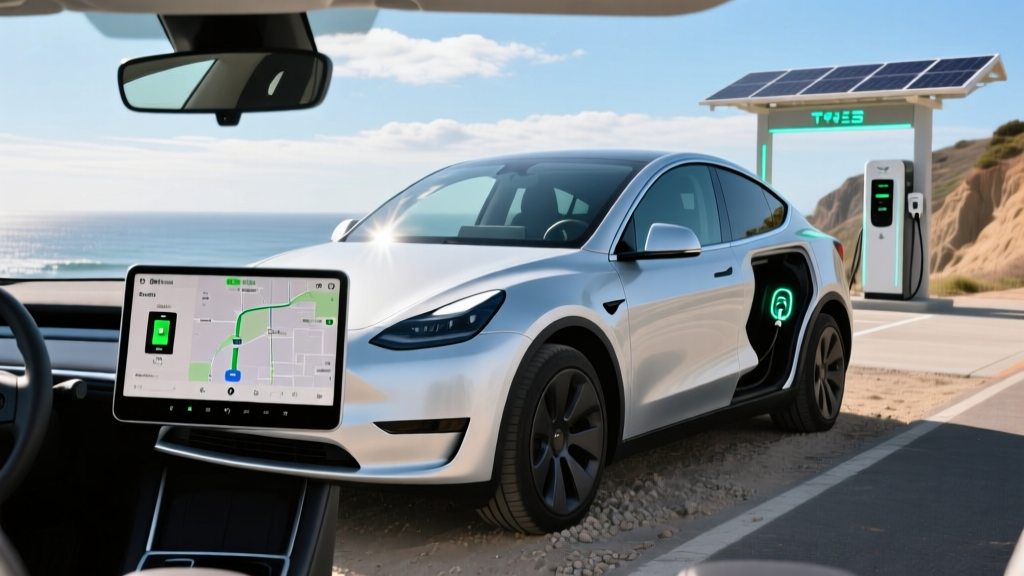
The Juniper interior redesign added ventilated front seats, ambient lighting, rear-seat ventilation, and a second 8-inch touchscreen for rear passengers. The 15.4-inch front touchscreen runs Tesla's latest software with an updated navigation stack, integrated trip planner that accounts for charging stops, and an improved voice assistant.
Standout tech:
- HEPA air filtration (Bioweapon Defense Mode) — genuine hospital-grade filtration
- Over-the-air updates that add features post-purchase
- Tesla Vision (camera-only) with HW4 computer — no radar or ultrasonic sensors
- Frunk (front trunk) with 4.1 cu ft of storage, plus the 30.2 cu ft rear cargo area
- V2L (vehicle-to-load) capability via the 12V accessory port — limited to ~100W without an aftermarket inverter
Notable drawbacks:
- No Apple CarPlay or Android Auto — Tesla's ecosystem is closed
- Vision-only parking assist (no ultrasonic sensors) remains inconsistent in tight garages
- Turn-signal stalk removal: signals are now on the steering wheel button, which frustrates roundabout-heavy drivers
- Insurance premiums run 15–25% higher than comparable non-Tesla EVs due to repair-cost data
Pros
- Best-in-class Supercharger network access (NACS native)
- 320 mi EPA range on Long Range AWD
- 250 kW peak DC charging; 10–80% in ~22 min
- Spacious 72 cu ft cargo with seats folded
- Strong OTA update cadence keeps software current
- Full $7,500 §30D credit on LR and Performance trims
Cons
- Real-world highway range ~275–290 mi, less in cold
- Vision-only parking assist can be unreliable
- No CarPlay/Android Auto
- Insurance costs above segment average
- Turn-signal stalk removal takes adjustment
- LFP RWD may only qualify for $3,750 credit
Who Should Buy the 2026 Tesla Model Y?
Choose the Model Y Long Range AWD if: You road-trip frequently, want maximum Supercharger convenience, need AWD for snow, and value the 320-mile EPA range buffer.
Choose the RWD if: Your commute is under 60 miles daily, you charge at home every night, live in a mild climate, and want the lowest entry price (~$38,880 after credit).
Choose the Performance if: You want a 3.5-second 0–60 time and track-capable handling, and the $53,990 MSRP fits your budget.
Look elsewhere if: You require Apple CarPlay, prefer physical buttons, or want ultrasonic-sensor parking assist for tight urban garages. The Hyundai Ioniq 5, Ford Mustang Mach-E, and Kia EV6 all offer strong alternatives with different tech philosophies.
Battery Warranty and Longevity
Tesla covers the Model Y battery and drive unit for 8 years / 120,000 miles (Long Range and Performance) or 8 years / 100,000 miles (RWD), with a minimum 70% capacity retention threshold. Independent fleet data from sources like Recurrent Auto shows that Tesla NMC packs typically retain 88–92% capacity after 100,000 miles when charged primarily on Level 2 and kept between 20–80% State of Charge for daily use. The LFP pack in the RWD trim is rated for more charge cycles (3,000+ vs ~1,500 for NMC) and can be charged to 100% daily without accelerated degradation — a meaningful advantage for high-mileage commuters.
Frequently Asked Questions
What is the real-world range of the 2026 Tesla Model Y?
The Long Range AWD is EPA-rated at 320 miles, but expect 275–290 miles on the highway in mild weather and 230–250 miles in freezing temperatures without preconditioning. The RWD (280 mi EPA) delivers roughly 220–240 real-world highway miles.
How fast does the Model Y charge at home and on DC fast chargers?
On a home Level 2 Wall Connector (11.5 kW), you'll add ~44 miles per hour, fully replenishing overnight. On a V3 Supercharger, the Long Range and Performance trims peak at 250 kW and charge 10–80% in approximately 22 minutes. The RWD peaks at 170 kW with a 10–80% time of about 30 minutes.
Does the Tesla Model Y qualify for the federal EV tax credit?
Yes — the Long Range AWD and Performance trims qualify for the full $7,500 under IRS §30D as of 2026, provided your MAGI falls under $150K (single) or $300K (joint) and the vehicle's MSRP is under the $80,000 SUV cap. The RWD's LFP battery sourcing may limit its credit to $3,750; verify at irs.gov before purchasing.
What does the Tesla cabin camera do?
The Tesla cabin camera monitors driver attention during Autopilot/FSD use (tracking eye gaze and head position) and records interior footage for Sentry Mode when parked. It processes data locally and does not make the vehicle autonomous — Autopilot and FSD remain SAE Level 2 systems requiring full driver supervision.
Is the 2026 Model Y worth buying vs. competitors?
The Model Y wins on Supercharger network access, efficiency (122 MPGe), and cargo volume (72 cu ft). The Hyundai Ioniq 5 offers faster 800V charging (10–80% in ~18 min) and CarPlay. The Ford Mustang Mach-E provides a more traditional driving feel. If charging convenience and software integration are your top priorities, the Model Y remains the segment leader. For a detailed breakdown, see our Model Y vs Ioniq 5 comparison.
How much cargo space does the Model Y have?
30.2 cubic feet behind the second row and 72.0 cubic feet with the rear seats folded flat. The front trunk (frunk) adds 4.1 cubic feet for charging cables or a small bag.