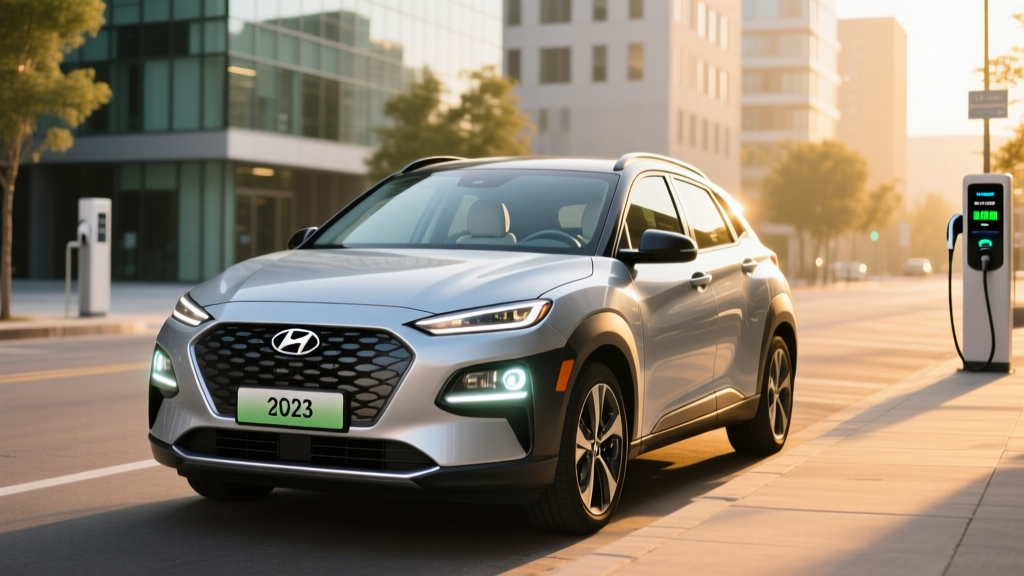
The Bottom Line on the 2023 Hyundai Kona EV
The 2023 Hyundai Kona Electric delivers an EPA-estimated 258 miles of range from a 64 kWh lithium-ion polymer battery, with DC fast charging that peaks at roughly 75 kW (10–80% in about 47 minutes). Base MSRP started at $33,550 before destination. As a used EV in 2026, it qualifies for the federal used-clean-vehicle credit of up to $4,000 (income caps and dealer-registration requirements apply). It's a practical subcompact crossover for buyers who can charge at home and mostly drive under 200 miles daily, though its modest fast-charging speed and limited rear-seat space are real trade-offs versus newer rivals like the redesigned 2024+ Kona Electric or the Chevrolet Bolt EUV.
Range, Battery, and Real-World Efficiency
The 2023 Kona Electric uses a 64 kWh usable lithium-ion polymer (NMC chemistry) battery pack paired with a single front-mounted permanent-magnet synchronous motor producing 201 horsepower and 290 lb-ft of torque. The EPA rates it at 120 MPGe combined (134 city / 106 highway), translating to roughly 28 kWh per 100 miles of driving — one of the more efficient subcompact crossovers in its class.
EPA Range vs. What You'll Actually See
EPA sticker: 258 miles
Real-world highway (70 mph, 75°F): ~220–235 miles
Real-world cold weather (30°F, mixed driving): ~180–200 miles
Why the drop? The 2023 Kona EV lacks a heat pump in US-market trims (a resistance heater is standard), which draws significant energy in cold conditions. Highway driving at sustained speeds also reduces efficiency versus the EPA's mixed-cycle test. Expect 15–30% range loss depending on temperature and driving style.
For context, fueleconomy.gov lists the 2023 Kona Electric's combined range at 258 miles with a consumption rate of 28 kWh/100mi. This efficiency figure is competitive — the Chevrolet Bolt EUV achieves 247 miles from a 65 kWh pack (slightly less efficient at 29 kWh/100mi), while the Kia Niro EV (a platform sibling) matches at 239 miles from an identical battery.
Charging Speeds: Home and Public
Understanding the distinction between kW (charging power, or how fast energy flows) and kWh (battery energy capacity) is critical for EV ownership. The Kona Electric's 64 kWh battery determines how much energy it stores; the kW rating of your charger determines how quickly you refill it.
| Charging Level | Power (kW) | Miles Added Per Hour | Full Charge Time (0–100%) |
|---|---|---|---|
| Level 1 (120V household outlet) | ~1.2 kW | ~5 miles | ~53 hours |
| Level 2 (240V home/public AC) | 7.2 kW (onboard charger limit) | ~28 miles | ~9.5 hours |
| DC Fast Charging (CCS) | Up to ~75 kW peak | ~180 miles/hr (at peak) | 10–80% in ~47 min |
The 2023 Kona Electric's DC fast-charging capability is its most notable limitation by modern standards. While it uses the standard CCS1 connector, its peak rate of approximately 75 kW means a 10–80% session takes roughly 47 minutes — noticeably slower than rivals like the Hyundai Ioniq 5 (which peaks at 235 kW on 800V architecture) or the newer 2024+ Kona Electric. The charge curve also tapers significantly above 60% state of charge, so highway road trips require more patience and planning.
For home charging, a Level 2 wallbox on a 240V/40A circuit will fully replenish the battery overnight in about 9–10 hours. A licensed electrician typically charges $500–$2,000 for a Level 2 installation depending on panel capacity and wiring distance — a one-time cost that dramatically improves daily usability.
2023 Hyundai Kona EV vs. Gas and Hybrid Alternatives
To put the ownership economics in perspective, here's how the 2023 Kona Electric stacks up against its gas-powered counterpart, the 2023 Hyundai Kona 1.6T (gasoline), and a plug-in hybrid alternative like the 2023 Kia Niro PHEV:
| Metric | 2023 Kona Electric (EV) | 2023 Kona 1.6T (Gas) | 2023 Kia Niro PHEV |
|---|---|---|---|
| EPA Range / Fuel Economy | 258 mi / 120 MPGe | ~32 MPG combined | 105 MPGe (EV) / 48 MPG (gas) |
| Energy/Fuel Cost Per Mile | ~$0.04–$0.06 (home charging) | ~$0.11–$0.13 ($3.50/gal) | ~$0.05–$0.10 (varies) |
| Annual Fuel/Energy Cost (12,000 mi) | ~$540–$720 | ~$1,320–$1,560 | ~$600–$1,000 |
| 0–60 mph | 6.4 seconds | 6.6 seconds | 7.2 seconds |
| Base MSRP (2023) | $33,550 | $22,590 | $34,090 |
| Maintenance Cost (Annual) | ~$100–$200 | ~$500–$800 | ~$400–$600 |
The Kona Electric's per-mile energy cost is roughly half that of the gasoline Kona when charging at home at the US average electricity rate of ~$0.16/kWh (source: EIA). Over five years and 60,000 miles, that translates to approximately $3,500–$4,500 in fuel savings. Maintenance savings add another $1,500–$2,500 over the same period, since EVs eliminate oil changes, spark plugs, transmission fluid, and exhaust system repairs.
However, the gas Kona's lower upfront price ($11,000 less at MSRP) means the EV doesn't break even on purchase price alone — the savings come from lower running costs over time and potential tax credits.
Real Ownership Costs: 5-Year Breakdown
| Cost Category | 2023 Kona Electric | 2023 Kona Gas 1.6T |
|---|---|---|
| Purchase Price (base MSRP) | $33,550 | $22,590 |
| Federal Tax Credit (used EV, 2026) | Up to -$4,000* | $0 |
| Home Charger Installation | +$1,200 | $0 |
| Energy/Fuel (5 yr, 60k miles) | $3,000–$3,600 | $6,600–$7,800 |
| Maintenance (5 yr) | $600–$1,000 | $2,500–$4,000 |
| Insurance (5 yr avg) | $7,500–$9,500 | $6,000–$8,000 |
| Estimated 5-Year Total | $41,850–$43,850 | $37,690–$42,390 |
*The federal used-clean-vehicle credit (§25E) provides up to $4,000 or 30% of the sale price (whichever is less) for qualifying used EVs purchased through a registered dealer. Buyer income caps apply: $75,000 single / $150,000 joint filers. Verify current eligibility at IRS.gov.
Insurance premiums for EVs typically run 15–25% higher than equivalent gas vehicles due to higher repair costs for battery and structural components. The Kona Electric is on the lower end of this premium given its modest MSRP, but factor in an extra $300–$500 annually versus the gas Kona.
What First-Time EV Buyers Should Know
Common Kona EV Misconceptions — Corrected
| Myth | Fact |
|---|---|
| "258 miles means I can drive 258 miles before stopping." | Real-world highway range is ~220–235 miles in mild weather, ~180–200 in cold. Plan for 70–80% of EPA for long trips. |
| "I can fast-charge in 20 minutes like other EVs." | The Kona's 75 kW peak charge rate means 10–80% takes ~47 minutes. Budget nearly an hour at DC fast chargers on road trips. |
| "The battery will need replacing in a few years." | Hyundai covers the battery with a 10-year/100,000-mile warranty against capacity loss below 70%. Real-world degradation data from 2019–2023 Kona EVs shows approximately 8–12% loss over 5 years / 60,000 miles under normal use. |
| "I don't need home charging — public chargers are fine." | Public DC charging costs $0.30–$0.48/kWh (vs. $0.12–$0.16 at home), roughly tripling your per-mile cost. Without home charging, the Kona's economics erode significantly. Daily Level 1 (120V) charging adds only ~5 miles/hour — insufficient for most drivers. |
| "It qualifies for the $7,500 new-EV tax credit." | Not in 2026 as a new purchase — the 2023 model is no longer sold new. As a used EV, it may qualify for up to $4,000 under §25E if purchased from a registered dealer and income limits are met. |
Home Charging Access: The Make-or-Break Factor
If you have access to a garage, driveway, or dedicated parking spot where a 240V Level 2 charger can be installed, the Kona Electric is a genuinely convenient daily driver — plug in at night, wake up to a full battery every morning. If you rely exclusively on street parking or apartment complexes without charging infrastructure, the Kona's 75 kW DC charging speed becomes a real burden. You'll spend 45+ minutes at public chargers 1–2 times per week, and public charging rates can erase most of the fuel-cost advantage.
Climate Considerations
The 2023 Kona Electric's lack of a heat pump means cold-weather range loss is more pronounced than in EVs equipped with one (like the Ioniq 5 or Tesla Model Y). Owners in northern climates (Minnesota, Michigan, New England) should expect 25–35% range reduction in sustained sub-freezing temperatures. If your daily commute exceeds 150 miles round-trip in winter, this vehicle may not provide adequate buffer.
Spec Summary: 2023 Hyundai Kona Electric
| Specification | Value |
|---|---|
| EPA Range | 258 miles |
| Battery Capacity | 64 kWh usable (NMC lithium-ion polymer) |
| Motor | 201 hp / 290 lb-ft (front-wheel drive) |
| 0–60 mph | 6.4 seconds |
| EPA Efficiency | 120 MPGe combined (28 kWh/100mi) |
| Level 2 Charging | 7.2 kW onboard (~9.5 hours 0–100%) |
| DC Fast Charging | ~75 kW peak (CCS1) — 10–80% in ~47 min |
| Cargo Volume | 25.8 cu ft (rear seats up) / 54.5 cu ft (folded) |
| Base MSRP (2023) | $33,550 (SEL) / $41,550 (Limited) |
| Battery Warranty | 10 years / 100,000 miles (70% capacity retention) |
| Vehicle Warranty | 5 years / 60,000 miles bumper-to-bumper |
Decision Framework: Is the 2023 Kona EV Right for You?
Choose the 2023 Kona Electric If:
- You can install a Level 2 home charger — this unlocks the lowest per-mile cost and daily convenience.
- Your daily driving is under 150 miles round-trip — leaving adequate range buffer even in cold weather.
- You want a subcompact crossover with low running costs — the Kona EV is one of the most efficient vehicles in its segment.
- You're buying used and qualify for the $4,000 federal credit — bringing effective cost well under $25,000 from a registered dealer.
- You rarely take road trips exceeding 200 miles — or don't mind a 47-minute charging stop.
Look Elsewhere If:
- You lack home charging access — public-only charging negates most cost savings and the slow DC rate becomes frustrating.
- You regularly drive 300+ miles in a single day — the Kona's charging speed makes multi-stop road trips tedious.
- You need substantial rear-seat or cargo space — the Kona's 25.8 cu ft cargo area is tight; consider the Ioniq 5 or Bolt EUV.
- You live in extreme cold and commute 100+ miles daily — winter range loss may leave inadequate margin; a PHEV like the Niro PHEV eliminates range risk.
- You want the latest fast-charging tech — the redesigned 2024+ Kona Electric (with NACS port and faster charging) is a meaningfully better vehicle, though pricier on the used market.
Frequently Asked Questions
What is the real-world range of the 2023 Hyundai Kona EV?
The EPA rates it at 258 miles combined. In real-world testing at highway speeds (70 mph) in mild weather, expect 220–235 miles. In cold weather (below 35°F), range drops to approximately 180–200 miles due to the resistance cabin heater and battery thermal demands. City driving with regenerative braking can match or slightly exceed the EPA figure.
How long does it take to charge the 2023 Kona EV?
On a Level 2 home charger (240V, 7.2 kW), a full charge takes approximately 9.5 hours — easily done overnight. On a DC fast charger (CCS1 connector), a 10–80% session takes about 47 minutes at the ~75 kW peak rate. Charging slows substantially above 80% state of charge to protect battery health.
Does the 2023 Kona EV qualify for any tax credits in 2026?
As a used vehicle in 2026, it may qualify for the federal used-clean-vehicle credit (§25E) of up to $4,000 or 30% of the sale price, whichever is less. Requirements include: purchase from a registered dealer, buyer income under $75,000 (single) or $150,000 (joint), and the sale price must not exceed $25,000. State incentives vary — check your state's energy office or IRS.gov for current rules. Consult a tax professional for personal eligibility.
How does the 2023 Kona EV compare to the 2024 redesigned Kona Electric?
The 2024+ Kona Electric is a substantially redesigned, larger vehicle with an available NACS charging port, longer range (up to 261 miles EPA on Long Range trims), and faster DC charging capability. It also offers more interior and cargo space. If budget allows, the newer generation is a meaningfully better vehicle — but the 2023 model remains compelling at used-EV prices, especially with the $4,000 federal credit applied.
What is the battery replacement cost for the Kona EV?
Out-of-warranty battery replacement for the 64 kWh pack typically ranges from $10,000 to $15,000 including parts and labor, though prices vary by dealer and region. However, Hyundai's 10-year/100,000-mile battery warranty covers capacity loss below 70%, and real-world data from early Kona EVs (2019–2020 models) shows most packs retain 88–92% capacity after 60,000 miles — suggesting full replacement is rarely needed within the first decade of ownership.
Is the 2023 Kona EV good for road trips?
It's adequate but not ideal. The 258-mile EPA range covers most legs between charging stops, but the ~75 kW DC fast-charging speed means each stop takes roughly 45 minutes (10–80%). On a 600-mile trip, plan for 2–3 charging stops adding 1.5–2.5 hours total. If road trips are frequent, a faster-charging EV (Ioniq 5, Tesla Model Y) will significantly reduce downtime.