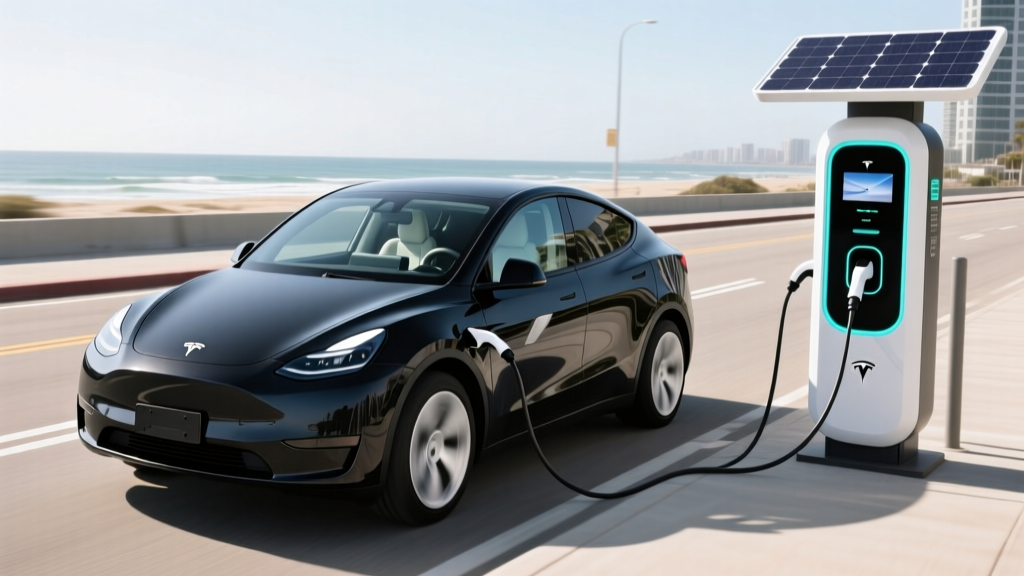
The Tesla Model Y remains the best-selling electric vehicle in the United States for good reason: it blends crossover utility, access to the Supercharger network, and continuous software updates into a package that undercuts many competitors on price-per-mile of range. For 2026, Tesla has streamlined the lineup and introduced a refreshed interior that prominently features an upgraded cabin camera system for driver monitoring and security. This review covers the Model Y Long Range AWD and Performance trims with exact specs, real-world ownership data, and a clear-eyed look at where it excels — and where it falls short.
2026 Tesla Model Y: Quick Verdict
The Model Y Long Range AWD delivers an EPA-estimated 320 miles of range, peaks at 250 kW on DC fast chargers, and starts at $44,990 before incentives. It is the default choice for buyers who want a spacious electric crossover with reliable fast-charging infrastructure. The cabin camera, now standard across all trims, enables Sentry Mode interior recording, driver-attention monitoring during Autopilot/FSD use, and upcoming cabin-aware climate features. If you need maximum range and proven road-trip charging, the Model Y is hard to beat. If you prioritize ride comfort, physical controls, or cutting-edge interior materials, competitors like the Hyundai Ioniq 5 or Ford Mustang Mach-E deserve a look.
| Spec | Long Range AWD | Performance |
|---|---|---|
| EPA Range | 320 miles | 295 miles |
| Battery (usable) | ~75 kWh (LFP) | ~75 kWh (NMC) |
| MPGe (combined) | 117 MPGe | 111 MPGe |
| kWh/100 mi | 29 kWh | 30 kWh |
| 0–60 mph | 4.8 seconds | 3.5 seconds |
| Horsepower | 384 hp | 456 hp |
| Drivetrain | Dual-Motor AWD | Dual-Motor AWD |
| Max DC Fast Charge | 250 kW | 250 kW |
| 10–80% DC Time | ~25 minutes | ~25 minutes |
| Level 2 Home Rate | 11.5 kW (~44 mi/hr) | 11.5 kW (~44 mi/hr) |
| Cargo (rear up / folded) | 30.2 / 72.0 cu ft | 30.2 / 72.0 cu ft |
| Base MSRP | $44,990 | $48,990 |
| Battery Warranty | 8 yr / 120,000 mi | 8 yr / 120,000 mi |
Range and Efficiency: EPA vs. Real World
EPA Estimated Range: 320 miles (Long Range AWD) / 295 miles (Performance)
Real-World Expectation: Expect 260–290 miles on sustained highway driving at 70–75 mph. In freezing temperatures (below 32°F), range can drop 20–30%, bringing effective highway range to approximately 200–230 miles. City driving with regenerative braking recovers energy and often matches or slightly exceeds the EPA sticker. Source: fueleconomy.gov
The Long Range AWD's 117 MPGe combined translates to roughly 29 kWh per 100 miles — competitive for a dual-motor crossover of this size. The heat pump, standard on all 2026 Model Y trims, significantly reduces cold-weather energy drain compared to older resistive-heater EVs. On a 300-mile road trip in moderate temperatures (55–75°F), you can expect to arrive with approximately 30–40 miles of buffer if you start at 100% State of Charge (SoC). In winter, plan an additional charging stop or precondition the battery aggressively before departure.
The Performance trim sacrifices 25 miles of range for its more aggressive motor tuning and stickier tires. If range is your priority, the Long Range is the clear pick.
Charging Speed: DC Fast, Level 2, and the Cabin Camera Connection
| Charging Level | Power (kW) | Speed (miles/hr) | Notes |
|---|---|---|---|
| Level 1 (120V household) | ~1.4 kW | ~4–5 mi/hr | Emergency/trickle only |
| Level 2 (240V home, 48A) | 11.5 kW | ~44 mi/hr | Full charge in ~7 hours |
| DC Fast (Tesla Supercharger V3) | Peak 250 kW | ~1,000 mi/hr at peak | 10–80% in ~25 min |
| DC Fast (CCS adapter, 350 kW station) | Peak 250 kW | ~1,000 mi/hr at peak | Same curve; car-limited |
The Model Y peaks at 250 kW on V3 Superchargers and sustains that rate from roughly 10% to 35% SoC. Beyond 50%, the charge curve tapers progressively — expect 150 kW around 60% and under 50 kW above 85%. This is why Tesla's navigation system targets 80% at Superchargers by default; charging from 80–100% can add 20+ minutes for only ~60 miles of range.
At home on a Level 2 Wall Connector (48 amps, 240V), the Model Y adds approximately 44 miles of range per hour, meaning a full overnight charge from 20% to 100% takes about 6–7 hours. A standard NEMA 14-50 outlet (32 amps) delivers roughly 30 miles per hour — adequate for daily commuters who plug in nightly.
Where the cabin camera connects: Tesla's cabin camera, mounted above the rearview mirror, monitors driver attentiveness when Autopilot or FSD (Supervised) is engaged. If the system detects you are not watching the road, it issues escalating visual and audible warnings — and can disengage Autosteer for the remainder of the trip. The cabin camera also powers Sentry Mode's interior recording feature, which captures video inside the cabin when the vehicle is parked and detects motion or break-in attempts. In 2026, Tesla has added cabin-aware climate controls that adjust airflow based on occupant detection, though this feature is still rolling out via over-the-air updates.
Performance, Drivetrain, and Ride Quality
The Long Range AWD uses a dual-motor setup producing 384 combined horsepower, reaching 0–60 mph in 4.8 seconds — quick by any measure and more than sufficient for highway merging and passing. The Performance trim bumps output to 456 hp with a 3.5-second 0–60 time, aided by a lowered suspension, larger brakes, and 21-inch Überturbine wheels.
Ride quality is where the Model Y shows its age relative to newer competitors. The suspension is firm, especially on the Performance trim with its low-profile tires. Road noise is noticeable at highway speeds, and the regenerative braking system is aggressive — Tesla does not offer adjustable regen levels or a true one-pedal driving mode that brings the car to a complete stop without brake input. Most owners adapt within a week, but it's worth testing on a drive before committing.
Interior, Tech, and the Upgraded Cabin Camera System
The 2026 Model Y interior follows Tesla's minimalist philosophy: a single 15.4-inch touchscreen controls virtually every function, from climate to mirror adjustment to glovebox release. There are no physical buttons on the dashboard, and turn signals are now stalkless (activated via steering-wheel buttons and a touchscreen slider). Opinions on this design are deeply divided — some owners find it clean and intuitive, others consider it a safety distraction.
The cabin camera hardware has been upgraded for 2026 with improved low-light sensitivity and a wider field of view. Its primary functions include:
- Driver monitoring: Required for Autopilot/FSD engagement — ensures eyes-on-road compliance per SAE Level 2 requirements
- Sentry Mode interior recording: Captures cabin video during parking events when triggered by motion or glass-break sensors
- Cabin-aware climate: Detects occupied seats and directs HVAC airflow accordingly (OTA-dependent)
- Video calls and entertainment: Supports in-cabin video conferencing while parked and Netflix/YouTube streaming
Important — Autopilot and FSD (Supervised) are SAE Level 2 systems. The driver must remain fully engaged, hands on or near the wheel, and eyes on the road at all times. These systems do not make the Model Y a self-driving vehicle. Only Level 4 services like Waymo operate without a human driver. The cabin camera enforces attentiveness but does not replace driver responsibility.
Cargo space measures 30.2 cubic feet behind the second row and 72.0 cubic feet with the 60/40 split rear seats folded — competitive with mid-size gas crossovers. The front trunk (frunk) adds 4.1 cubic feet for charging cables or a small bag. Rear legroom is 41.6 inches, adequate for adults on longer trips.
Pricing, Trims, and Federal Tax Credit Eligibility
| Trim | Base MSRP | As-Tested (common config) | Est. After §30D Credit |
|---|---|---|---|
| Long Range AWD | $44,990 | $47,490 (w/ FSD, paint) | ~$37,490 – $39,990* |
| Performance | $48,990 | $52,990 (w/ FSD, wheels) | ~$41,490 – $45,490* |
*Estimated after-tax-credit pricing assumes full §30D eligibility. Actual credit amount depends on battery sourcing, buyer income, and MSRP cap compliance. Always verify current rules at irs.gov and consult a tax professional.
IRS §30D Federal EV Tax Credit Requirements (2026):
- Vehicle MSRP must not exceed $80,000 for SUVs/crossovers (Model Y qualifies)
- Buyer adjusted gross income (AGI): ≤ $150,000 single / ≤ $300,000 joint
- Battery critical minerals and components must meet escalating domestic-sourcing thresholds (Tesla has worked to qualify, but verify VIN-specific eligibility at purchase)
- Credit can be transferred to the dealer at point of sale as a purchase-price reduction (effective since Jan 2024)
- Used EV credit (§25E) of up to $4,000 may apply to certified pre-owned Model Y purchases under separate income and price caps
FSD (Supervised) adds $8,000 to the purchase price or $99/month as a subscription. Most buyers should try the subscription first — FSD's capabilities vary significantly by geography, and many owners find Basic Autopilot (included standard) sufficient for highway driving.
Warranty, Ownership Costs, and Long-Term Outlook
Tesla covers the Model Y's battery and drive units for 8 years or 120,000 miles (whichever comes first), with a minimum 70% capacity retention guarantee. The limited vehicle warranty is 4 years / 50,000 miles. Real-world LFP battery degradation data from high-mileage owners suggests approximately 5–8% capacity loss over the first 100,000 miles — well within the warranty threshold.
Insurance costs for the Model Y tend to run 15–25% higher than comparable gas crossovers, driven by Tesla's integrated repair ecosystem and high parts costs. Shop quotes before ordering — some insurers offer EV-specific discounts. Maintenance is minimal: no oil changes, no transmission fluid, cabin air filter replacement every 2–3 years, and tire rotation every 6,250 miles. Tesla recommends brake fluid checks every 3 years, though regenerative braking significantly extends pad life.
Pros, Cons, and Who Should Buy the Model Y
Pros
- 320-mile EPA range with strong real-world highway efficiency
- 250 kW DC fast charging with access to 6,000+ Tesla Superchargers
- Spacious cargo area (72 cu ft max) and frunk
- Over-the-air updates add features post-purchase
- Cabin camera enables robust Sentry Mode and driver monitoring
- Heat pump standard for cold-weather efficiency
Cons
- Firm ride quality, especially on Performance trim
- No physical buttons — all controls via touchscreen
- Stalkless turn signals require adaptation
- Insurance premiums above segment average
- FSD costs $8,000 extra and remains SAE Level 2
- Regen braking not adjustable; no creep mode to full stop
Choose the Tesla Model Y if: You want maximum Supercharger access for road trips, value cargo versatility, prefer over-the-air feature updates, and are comfortable with a touchscreen-first interior.
Look at competitors (Ioniq 5, Mach-E, EV6) if: You want a softer ride, physical climate controls, faster peak charging (Ioniq 5 at 350 kW on 800V), or a more conventional driving experience with adjustable regen.
Frequently Asked Questions
What does the Tesla cabin camera actually do?
The cabin camera monitors driver attentiveness during Autopilot/FSD use, records interior video for Sentry Mode when parked, enables cabin-aware climate features, and supports video calls and entertainment while parked. It does not record audio continuously and footage is stored locally on the vehicle's USB drive unless you enable cloud upload for Sentry events.
What is the real-world range of the 2026 Model Y?
EPA estimates 320 miles for the Long Range AWD. In real-world highway driving at 70–75 mph, expect 260–290 miles. In freezing weather, plan for 200–230 miles of effective range. The heat pump helps, but cold temperatures still reduce battery chemistry efficiency.
How fast does the Model Y charge at home and on road trips?
On a Level 2 home charger (11.5 kW), the Model Y adds ~44 miles of range per hour, fully charging overnight in about 7 hours. On a V3 Supercharger (250 kW peak), it charges from 10–80% in approximately 25 minutes. Charging above 80% slows dramatically — plan to leave Superchargers at 80% for optimal trip efficiency.
Does the 2026 Model Y qualify for the $7,500 federal tax credit?
The Model Y qualifies for up to $7,500 under IRS §30D, provided the buyer's AGI is within limits ($150K single / $300K joint), the MSRP is under $80K (it is), and the battery meets critical-mineral and component sourcing thresholds. Tesla has worked to qualify its US-built vehicles, but eligibility can change based on supply chain shifts. Verify VIN-specific eligibility at the point of sale and consult IRS guidance.
Is the Model Y worth buying over the Hyundai Ioniq 5 or Ford Mach-E?
The Model Y wins on Supercharger network access, cargo space, and software ecosystem. The Ioniq 5 charges faster on 800V infrastructure (350 kW peak, 10–80% in ~18 min) and offers a more comfortable ride. The Mach-E provides a more traditional interior with physical controls. Test-drive all three — the best choice depends on your priorities around charging speed, ride comfort, and interface preference.
How long will the Model Y battery last?
Tesla warranties the battery for 8 years / 120,000 miles with a minimum 70% capacity retention. LFP chemistry (used in the Long Range) is known for excellent cycle life, with real-world data showing ~5–8% degradation over 100,000 miles. Many Model Y batteries are projected to retain 85%+ capacity at 150,000 miles under normal use patterns.