Search for "Tesla bumper stickers" online and you'll find a cottage industry of decals — from "My Tesla Runs on Sunshine" to ironic EV-skeptic quips. The Tesla Model Y has become the most meme-ified, sticker-bombed, and polarizing vehicle on American roads, largely because it's also the best-selling EV in the United States and, by many measures, the best-selling car globally. But strip away the decals, the Twitter discourse, and the brand tribalism, and what remains is a midsize electric crossover that has to stand on its engineering merits.
This review evaluates the 2026 Tesla Model Y Long Range AWD and Performance trims against the metrics that actually matter to buyers: real-world range, charging speed, ownership cost, and how it stacks up against increasingly credible rivals like the Hyundai Ioniq 5, Ford Mustang Mach-E, and Chevrolet Equinox EV. No hype, no FSD promises — just data.
2026 Tesla Model Y: Core Specifications at a Glance
| Spec | Long Range AWD | Performance |
|---|---|---|
| EPA Range | 320 miles | 295 miles |
| Battery (usable) | ~78 kWh, NMC | ~78 kWh, NMC |
| Drivetrain | Dual-Motor AWD | Dual-Motor AWD |
| Horsepower | 384 hp | 456 hp |
| 0–60 mph | 4.8 sec | 3.5 sec |
| Peak DC Fast Charge | 250 kW | 250 kW |
| 10–80% DCFC Time | ~27 min | ~27 min |
| Level 2 Home Charge | 11.5 kW (~44 mi/hr) | 11.5 kW (~44 mi/hr) |
| Efficiency (EPA) | 122 MPGe / 28 kWh/100mi | 111 MPGe / 30 kWh/100mi |
| Cargo (rear seats up) | 30.2 cu ft | 30.2 cu ft |
| Cargo (rear seats folded) | 72.1 cu ft | 72.1 cu ft |
| Rear Legroom | 38.4 in | 38.4 in |
| Base MSRP | $44,990 | $52,490 |
| Battery Warranty | 8 yr / 120,000 mi | 8 yr / 120,000 mi |
Source: fueleconomy.gov and Tesla's official 2026 specifications. Specs reflect the Juniper-refreshed Model Y introduced in early 2025.
Real-World Range: What the EPA Sticker Doesn't Tell You
Real-World Expectation: 270–300 miles highway (70–80 mph); 250–280 miles in cold weather (below 32°F); 310+ miles in moderate city/suburban driving with regen.
Why the gap: Highway speeds above 65 mph increase aerodynamic drag significantly. Cold temperatures reduce battery chemical efficiency and increase cabin-heating load, even with the Model Y's standard heat pump.
The Model Y Long Range's 320-mile EPA figure is competitive for the segment, but as with every EV, the sticker is a laboratory composite. In sustained highway driving at 75 mph in 60°F weather, expect roughly 280–300 miles before you're hunting for a charger. Drop the temperature to 20°F and that number falls to around 250–270 miles — a 15–20% reduction typical of NMC chemistry without preconditioning.
Tesla's heat pump (standard since the 2021 refresh) significantly mitigates cold-weather losses compared to resistive-heater EVs, but physics still wins. If your commute is 60 miles round-trip in a Minnesota winter, you'll still have ample buffer. If you're planning a 300-mile winter road trip, plan a charging stop.
One practical advantage: Tesla's navigation system automatically preconditions the battery when routing to a Supercharger, which preserves range and improves charging speed upon arrival. Many competitors still require manual preconditioning toggles.
Charging Speed: Supercharger Network vs. the Competition
| Charging Method | Power / Rate | Miles Added per Hour | Notes |
|---|---|---|---|
| Level 1 (120V outlet) | ~1.4 kW | ~4–5 mi/hr | Emergency/trickle only |
| Level 2 (240V, 48A Wall Connector) | 11.5 kW | ~44 mi/hr | Full charge in ~7.5 hours |
| DC Fast Charge (Supercharger V3/V4) | Peak 250 kW | ~1,000 mi/hr (peak) | 10–80% in ~27 min; tapers above 80% |
| DC Fast Charge (CCS adapter, third-party) | Up to 250 kW | Varies by station | Requires NACS-to-CCS adapter for non-Tesla networks |
The Model Y's 250 kW peak DC fast-charge rate is no longer class-leading — the Hyundai Ioniq 5 and Kia EV6 hit 350 kW on 800V architectures, and the Porsche Macan Electric exceeds 270 kW. However, peak kW is only part of the story. Tesla's charge curve is well-managed: the Model Y sustains roughly 200+ kW from 10% to about 40% State of Charge before gradually tapering. The 10–80% time of approximately 27 minutes is still competitive.
The bigger advantage remains the Supercharger network itself. As of 2026, Tesla operates over 6,500 Supercharger stalls in North America, and the network's uptime and plug-and-charge reliability consistently outperform Electrify America, EVgo, and other third-party networks in owner surveys. With the industry's shift to NACS (North American Charging Standard), competitors are now gaining access to Superchargers via adapters — which actually reduces Tesla's exclusivity advantage going forward.
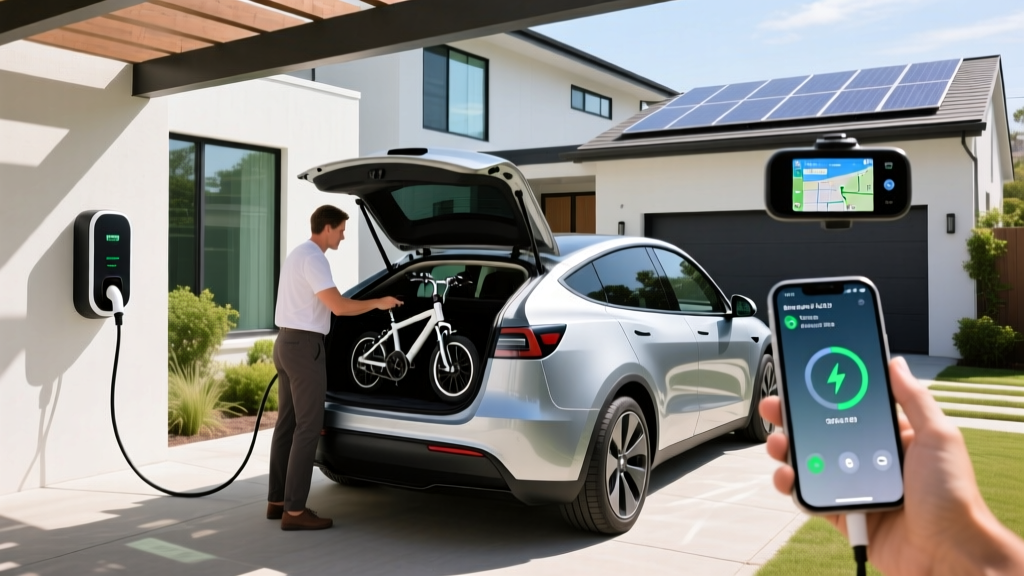
For home charging, Tesla's Wall Connector at $425 is a solid Level 2 unit delivering 11.5 kW on a 60A circuit (48A continuous). Most owners report waking up to a full battery every morning, which is the entire point of home charging. Budget $800–$2,000 for professional installation depending on your panel capacity and run distance — and confirm with a licensed electrician whether your 200A service panel needs an upgrade.
Performance and Driving Dynamics
The Long Range AWD's 4.8-second 0–60 time is genuinely quick for a family crossover, and the dual-motor all-wheel-drive system provides confident traction in rain and light snow. The Performance trim's 3.5-second sprint is supercar-adjacent, though it costs $7,500 more and sacrifices 25 miles of EPA range.
Ride quality has improved meaningfully with the Juniper refresh — earlier Model Ys were widely criticized for harsh, underdamped suspension over broken pavement. The 2025–2026 models use revised damper tuning and additional sound deadening, and the difference is noticeable on highway expansion joints and potholed city streets. It's not luxury-car quiet, but it's no longer a common complaint.
Regenerative braking remains one-pedal-driving capable, though Tesla removed the user-adjustable regen setting in 2023 (it was restored via software update in late 2023 after significant owner pushback). In 2026 models, regen strength is adjustable again, which is important for drivers transitioning from ICE vehicles who prefer a coasting feel.
Interior, Cargo, and Daily Practicality
The Juniper interior is cleaner and more material-forward than pre-2025 Model Ys. Ambient lighting, ventilated front seats, power-folding second row, and a rear-seat touchscreen are now standard or widely available. The minimalist single-screen dashboard remains divisive — there are no physical buttons, and climate controls live in the touchscreen, which is a genuine ergonomic drawback for some drivers.
Cargo space is a strength: 30.2 cubic feet behind the second row and 72.1 cubic feet with seats folded. The front trunk (frunk) adds useful sealed storage for charging cables or groceries. Rear legroom at 38.4 inches is adequate for adults on longer trips, though the sloping roofline cuts into headroom for passengers over 6 feet tall.
For families: two rear-facing child seats fit, but three-across is tight. The panoramic glass roof creates an airy cabin but offers no shade — Tesla does not include a retractable sunshade, and aftermarket solutions are a common first purchase among new owners.
Pricing, Tax Credits, and Total Cost
| Trim | Base MSRP | Est. After §30D Credit* | Notes |
|---|---|---|---|
| Long Range AWD | $44,990 | $37,490 | Below $55,000 SUV MSRP cap |
| Performance | $52,490 | $44,990 | Below $55,000 SUV MSRP cap |
*Federal §30D credit eligibility depends on buyer income (≤$150,000 single / ≤$300,000 joint MAGI), battery critical-mineral and component sourcing requirements, and MSRP caps. The credit can now be transferred to the dealer at point of sale as an instant discount. Rules are subject to change — verify current eligibility at IRS.gov before purchase.
As of early 2026, the Model Y Long Range AWD qualifies for the full $7,500 federal tax credit for most buyers who meet income requirements, because its MSRP falls under the $55,000 SUV cap and Tesla's battery sourcing has met the evolving critical-mineral thresholds. However, the sourcing requirements tighten annually, and eligibility is not guaranteed for every buyer in every tax year. Always confirm before signing.
On total cost of ownership: electricity costs vary enormously by region, but charging at home at a national average of $0.16/kWh yields roughly $0.045 per mile — compared to $0.12–$0.15 per mile for a comparable gas-powered SUV at $3.50/gallon. Over five years and 75,000 miles, that's $5,600–$7,900 in fuel savings. Insurance, however, is typically 15–25% higher for a Model Y than for a Toyota RAV4 Hybrid, and Tesla collision-repair costs remain above average due to structural battery-pack integration.
Autopilot, FSD, and Driver Assistance — What It Actually Does
Tesla's basic Autopilot (standard) includes adaptive cruise control and lane-centering, which is competent for highway use. Full Self-Driving (Supervised) — a $8,000 option or $99/month subscription in 2026 — adds automated lane changes, traffic-light and stop-sign recognition, and city-street navigation assistance. It has improved substantially since 2023, but it still requires active supervision and occasionally makes puzzling decisions in construction zones or complex intersections.
Compared to GM's Super Cruise (hands-free on mapped highways) or Ford's BlueCruise, Tesla's system covers more road types but allows fewer hands-off scenarios. If your priority is relaxed highway cruising, Super Cruise on a Cadillac Lyriq is arguably more polished. If you want the broadest feature set and accept the supervision requirement, FSD is the most ambitious option available.
Model Y vs. the Competition: Is It Still the Default Choice?
- Supercharger network reliability remains best-in-class
- Class-leading cargo volume and frunk storage
- Strong efficiency (28 kWh/100mi) keeps charging costs low
- Over-the-air updates continuously add features
- Strong resale value relative to most EVs
- 250 kW peak charge rate trails 800V competitors (Ioniq 5, EV6, Macan Electric)
- Touchscreen-only climate controls are an ergonomic compromise
- No native CCS port — adapter required for non-Tesla DCFC networks
- FSD remains an expensive, supervised beta — not autonomous
- Rear headroom limited by coupe-like roofline
The Model Y's closest rival is the Hyundai Ioniq 5, which charges faster (350 kW peak, 10–80% in 18 minutes), offers a more conventional interior with physical controls, and undercuts on price. The Ford Mustang Mach-E is sportier to drive. The Chevrolet Equinox EV offers 315+ miles of range starting near $33,000. None of these, however, match Tesla's charging network seamlessness or the Model Y's cargo-versus-efficiency balance.
If your daily life involves regular road trips on corridors with strong Supercharger coverage, the Model Y remains the path of least resistance. If you primarily drive locally and want the fastest possible DC charging for occasional trips, the Ioniq 5's 800V architecture is the stronger technical choice.
Frequently Asked Questions
What is the real-world range of the 2026 Tesla Model Y?
The EPA rates the Long Range AWD at 320 miles. In real-world highway driving at 70–80 mph in moderate temperatures, expect 270–300 miles. In sub-freezing conditions, plan for 250–280 miles. City driving with regenerative braking can approach or slightly exceed the EPA figure.
How fast does the Model Y charge at home and on the road?
On a Level 2 home charger (11.5 kW), the Model Y adds roughly 44 miles of range per hour, fully charging overnight in about 7.5 hours. On a 250 kW Supercharger, it charges from 10% to 80% in approximately 27 minutes. Charging slows significantly above 80% to protect battery health — plan to unplug at 80% on road trips unless you need the full battery.
Does the 2026 Model Y qualify for the $7,500 federal EV tax credit?
It can, subject to IRS §30D rules. The Model Y's MSRP is below the $55,000 SUV cap, and Tesla's battery sourcing has met critical-mineral thresholds as of early 2026. However, buyer income must not exceed $150,000 (single) or $300,000 (joint). The credit can be applied as a point-of-sale discount. Verify current eligibility at IRS.gov, as sourcing rules tighten annually.
Is the Model Y worth buying over the Hyundai Ioniq 5 or Ford Mach-E?
Choose the Model Y if you prioritize Supercharger network access, maximum cargo space, and proven over-the-air software updates. Choose the Ioniq 5 if you want faster DC charging (350 kW), a more conventional interior, and lower starting price. Choose the Mach-E if driving dynamics and styling matter more than cargo volume.
Is Tesla's Full Self-Driving worth the $8,000 cost?
For most buyers, no. FSD (Supervised) is a Level 2 driver-assist system that requires constant attention. Basic Autopilot handles highway cruising competently at no extra cost. The $99/month subscription is a lower-risk way to try FSD before committing $8,000. Do not purchase FSD expecting autonomous capability — it does not provide that.
How long will the Model Y battery last, and what does replacement cost?
Tesla warranties the battery for 8 years or 120,000 miles (whichever comes first), guaranteeing at least 70% capacity retention. Real-world data from high-mileage owners suggests NMC packs in Model Ys typically retain 85–90% capacity at 100,000 miles when charged primarily on Level 2 and kept between 20–80% SoC. Out-of-warranty battery replacement currently costs $12,000–$16,000 depending on the service center.
Additional sources: NHTSA safety ratings, IIHS crash-test data.