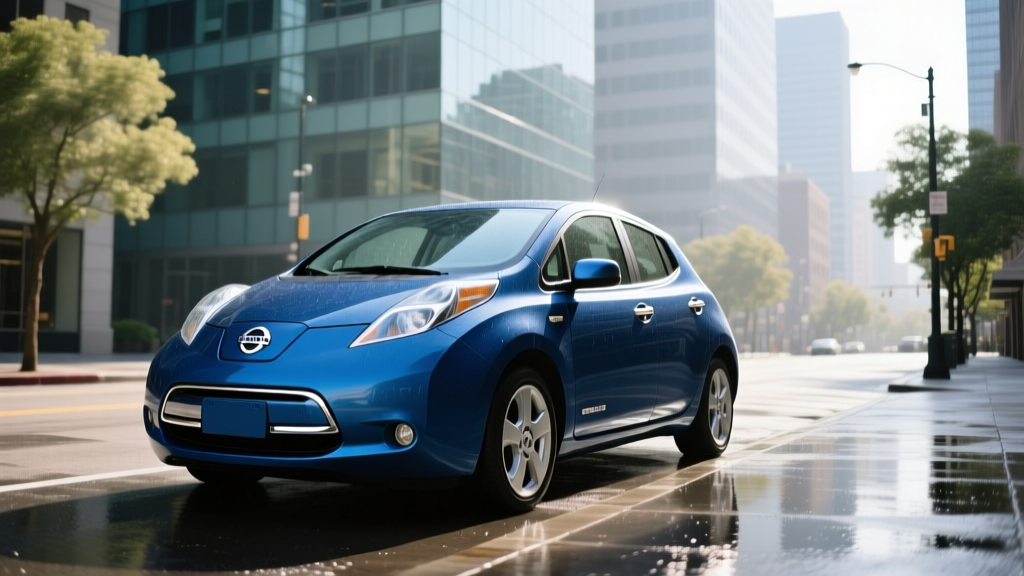
Before the Tesla Model 3 normalized electric commuting and before Hyundai and Kia flooded the market with 800V fast-chargers, there was the Nissan Leaf. Launched for the 2011 model year (not 2005 — a common search confusion we'll clear up below), the first-generation Leaf was the world's first mass-market, purpose-built battery-electric vehicle. Over 500,000 units sold globally before Nissan retired the nameplate, and thousands still populate American driveways and used-car lots in 2026.
If you've landed here searching for a "2005 Nissan Leaf," you're likely researching early EV history or evaluating a cheap used Leaf as a second car, commuter, or teen driver vehicle. This profile covers every generation of the Leaf with exact specs, real-world range expectations, charging realities, battery degradation data, and whether the Leaf still holds up against modern sub-$30K EVs and hybrids.
Clarifying the "2005 Nissan Leaf" Search
There was no 2005 Nissan Leaf. Nissan began developing the Leaf concept around 2009, unveiled it in 2010, and delivered the first US-market cars in December 2010 as 2011 models. In 2005, Nissan was selling the Altima, Sentra, Maxima, and the gasoline-powered Murano — all internal-combustion vehicles. The Leaf nameplate simply did not exist.
What you'll find on the used market spans two distinct generations:
- Generation 1 (ZE0): 2011–2017 model years, 24 kWh or 30 kWh battery, CHAdeMO DC charging
- Generation 2 (ZE1): 2018–2023 model years, 40 kWh or 62 kWh battery, CHAdeMO DC charging (with CCS adapter availability varying by market)
Nissan discontinued the Leaf after the 2023 model year in the US, replacing it indirectly with the Ariya crossover. Every Leaf on the road in 2026 is a used vehicle.
Leaf Specs at a Glance: All Generations
| Spec | Gen 1 (2011–2017) 24 kWh | Gen 1 (2016–2017) 30 kWh | Gen 2 (2018–2023) 40 kWh | Gen 2 Plus (2019–2023) 62 kWh |
|---|---|---|---|---|
| EPA Range (new) | 73–84 mi | 107 mi | 149–151 mi | 212–226 mi |
| Battery (usable) | ~21.6 kWh | ~27.5 kWh | ~38 kWh | ~59 kWh |
| Chemistry | NMC (laminated pouch) | NMC (laminated pouch) | NMC (laminated pouch) | NMC (laminated pouch) |
| Motor Output | 80 kW (107 hp) | 80 kW (107 hp) | 110 kW (147 hp) | 160 kW (214 hp) |
| 0–60 mph | ~9.9 sec | ~9.9 sec | ~7.9 sec | ~6.5 sec |
| Max DC Fast Charge | ~43 kW (CHAdeMO) | ~43 kW (CHAdeMO) | ~46 kW (CHAdeMO) | ~100 kW (CHAdeMO) |
| Level 2 Charge Rate | 3.3 kW (6.6 kW opt.) | 3.3 kW (6.6 kW opt.) | 6.6 kW | 6.6 kW |
| EPA Efficiency | 99–106 MPGe | 112 MPGe | 111–112 MPGe | 104–108 MPGe |
| Drivetrain | FWD | FWD | FWD | FWD |
| Original MSRP (base) | $32,780 (2011) | $34,200 (2016) | $29,990 (2018) | $36,550 (2019) |
Sources: EPA fueleconomy.gov, Nissan USA historical press kits.
Real-World Range: What the EPA Sticker Doesn't Tell You
The Leaf Plus (62 kWh) carries an EPA rating of 212–226 miles depending on model year and wheel size. In real-world mixed driving, expect 180–200 miles. On sustained highway travel at 70–75 mph, plan for 155–175 miles. In freezing temperatures (below 32°F / 0°C), range drops to 120–150 miles due to cabin heating load and reduced battery chemistry efficiency.
The base 40 kWh Leaf (EPA 149 mi) delivers roughly 120–135 miles in temperate mixed driving and as little as 85–100 miles in winter highway conditions.
The Leaf uses passive air cooling for its battery pack rather than the active liquid thermal management found in Teslas, Hyundais, and most modern EVs. This design choice has two consequences:
- Heat-related degradation: In hot climates (Arizona, Texas, Southern California), Gen 1 Leafs experienced accelerated battery capacity loss. Nissan's own data and owner reports on forums like MyNissanLeaf.com documented 20–30% capacity loss within 5 years for vehicles frequently fast-charged in high ambient temperatures.
- Charging throttling ("Rapidgate"): The Gen 2 Leaf, particularly the 40 kWh model, became infamous for drastically reducing DC fast-charge speeds after repeated same-day fast charges or in hot weather. Where the car might initially accept 46 kW, subsequent charges could throttle to 20–30 kW to protect the passively-cooled pack.
If you're evaluating a used Leaf in 2026, the battery State of Health (SoH) matters far more than the model year. Nissan's dashboard displays battery capacity bars (out of 12). A 2015 Leaf showing 10/12 bars may have more usable range than a 2013 Leaf at 8/12 bars. Request a LeafSpy diagnostic report from any seller — this third-party OBD tool reads actual battery degradation percentage, far more precise than the dash bars.
Charging Speed: The Leaf's Biggest 2026 Limitation
| Charging Level | Gen 1 (24/30 kWh) | Gen 2 (40 kWh) | Gen 2 Plus (62 kWh) |
|---|---|---|---|
| Level 1 (120V, 12A) | ~1.2 kW / ~5 mi/hr | ~1.2 kW / ~5 mi/hr | ~1.2 kW / ~4 mi/hr |
| Level 2 (240V, 3.3 kW) | 3.3 kW / ~14 mi/hr | N/A | N/A |
| Level 2 (240V, 6.6 kW) | 6.6 kW / ~27 mi/hr (opt.) | 6.6 kW / ~25 mi/hr | 6.6 kW / ~22 mi/hr |
| DC Fast (CHAdeMO) | ~43 kW peak / 30 min (0–80%) | ~46 kW peak / ~40 min (0–80%) | ~100 kW peak / ~45 min (0–80%) |
The Leaf's CHAdeMO connector is the single biggest ownership friction point in 2026. The North American charging industry has standardized on NACS (Tesla's connector, now adopted by Ford, GM, Hyundai, Rivian, and others) and CCS1. Electrify America, the largest US DC fast-charging network, has committed to NACS for future deployments. While many existing CHAdeMO stations still operate, the connector is effectively legacy — new public charger installations rarely include CHAdeMO cables.
Practical charging implications for a 2026 Leaf owner:
- Home charging is fine: Level 2 at 6.6 kW fully replenishes any Leaf overnight. A 240V/30A circuit with a J1772 Level 2 unit (such as a used ChargePoint Home Flex or Emporia Level 2) costs $400–$700 for equipment plus $500–$1,500 for electrician installation, depending on panel proximity.
- Public DC fast charging is shrinking: You'll rely on CHAdeMO-equipped stations, which are increasingly sparse. CHAdeMO-to-CCS adapters exist but are expensive ($200–$400) and not universally compatible. CHAdeMO-to-NACS adapters are rarer still.
- The Leaf Plus 100 kW peak rate is misleading: The 62 kWh model can peak near 100 kW but sustains it only briefly. Expect an average of 50–65 kW over a 10–80% session, and less if the battery is warm from prior driving or charging (thermal throttling).
Performance and Driving Impressions
The Leaf was never a performance EV, and that's by design. It's a comfortable, quiet, front-wheel-drive commuter with adequate acceleration for merging and city driving.
The Gen 1 (107 hp) feels sprightly from 0–30 mph thanks to instant electric torque, but runs out of breath above 65 mph. The Gen 2 Plus (214 hp, 250 lb-ft) is genuinely quick — its 6.5-second 0–60 time matches a Volkswagen GTI and makes highway passing effortless.
All Leafs feature regenerative braking, but only the Gen 2 models offer Nissan's "e-Pedal" mode, which increases regen aggressiveness enough to enable one-pedal driving in most city conditions. It's not as strong as a Tesla or Chevy Bolt's max-regen mode, but it reduces brake wear significantly.
Ride quality is a Leaf strength. The battery pack's low floor position gives it a planted feel, and the suspension tuning prioritizes comfort over sportiness. Road noise is well-managed at city speeds but becomes noticeable above 70 mph — a consequence of the efficiency-focused low-rolling-resistance tires.
Interior, Cargo, and Technology
Passenger space: The Leaf is a midsize hatchback with generous interior volume. Front legroom is 42.1 inches; rear legroom is 33.5 inches — adequate for adults on shorter trips but tighter than a Model Y or Ioniq 5. Headroom is excellent front and rear thanks to the tall roofline.
Cargo volume: 23.6 cubic feet behind the rear seats, expanding to 30.0 cubic feet with seats folded (Gen 2). Gen 1 models offer slightly less at 24.0 cu ft total. The cargo floor is high because the battery pack sits beneath it, and there is no frunk (front trunk) — the space is occupied by the charge electronics and 12V battery.
Infotainment: Gen 1 Leafs originally shipped with a basic 4.3-inch or 7-inch touchscreen with navigation. Gen 2 models (2018+) received an 8-inch display with Apple CarPlay and Android Auto — a meaningful upgrade. Neither generation offers wireless phone integration; a USB cable is required.
Driver assistance: Gen 2 models equipped with the Technology Package include Nissan ProPILOT Assist — a Level 2 (SAE) lane-centering and adaptive cruise system. It works well on marked highways but requires hands on the wheel and does not support automatic lane changes. Gen 1 Leafs offer no lane-centering capability.
Nissan ProPILOT Assist is an SAE Level 2 driver-assistance system. The driver must remain fully engaged, monitor the road, and keep hands on the steering wheel at all times. It is not autonomous or "self-driving." Only Level 4 services like Waymo One operate without driver supervision.
Battery Degradation, Warranty, and Replacement Costs
Every Leaf uses NMC (nickel-manganese-cobalt) lithium-ion chemistry in a laminated pouch cell format supplied by AESC (Automotive Energy Supply Corporation, a Nissan/NEC joint venture, later acquired by Envision). Unlike the cylindrical cells in Teslas or the prismatic LFP packs in some modern EVs, the Leaf's pouch cells are more susceptible to heat-related degradation without active thermal management.
Battery warranty (when new): Nissan provided an 8-year/100,000-mile battery capacity warranty, guaranteeing the pack would retain at least 66.25% of original capacity (9 out of 12 dashboard bars) for Gen 1 models, and 70% for Gen 2 models. By 2026, most Gen 1 Leafs have aged out of this warranty. Some 2018–2019 Gen 2 models may still have residual coverage.
Degradation data: Based on aggregated owner data from Recurrent Auto and LeafSpy community reports:
- Gen 1 (24 kWh) in moderate climates: ~75–85% SoH at 8–10 years
- Gen 1 (24 kWh) in hot climates with frequent DCFC: ~60–70% SoH at 8–10 years
- Gen 2 (40 kWh): ~85–92% SoH at 5–6 years
- Gen 2 Plus (62 kWh): ~88–94% SoH at 4–5 years (limited long-term data)
Battery replacement cost: A refurbished 24 kWh Gen 1 pack from Nissan runs $6,500–$8,500 installed at a dealer. Third-party shops and used pack swaps can reduce this to $3,500–$5,500. The 40 kWh and 62 kWh packs are more expensive — $9,000–$14,000 at dealer rates. Given that a 2013 Leaf's total market value in 2026 is roughly $5,000–$8,000, a dealer battery replacement often exceeds the car's worth.
Pricing in 2026 and Federal Tax Credit Eligibility
The Leaf is exclusively a used-car purchase in 2026. Prices vary dramatically by generation, battery health, and mileage:
| Model | Typical Price Range | Used EV Tax Credit (§25E) | Net Cost After Credit |
|---|---|---|---|
| 2011–2015 Leaf (24 kWh) | $4,000–$7,000 | Up to $4,000 (30% of sale price) | $3,000–$5,800 |
| 2016–2017 Leaf (30 kWh) | $6,500–$10,000 | Up to $4,000 | $5,300–$8,800 |
| 2018–2020 Leaf (40 kWh) | $9,000–$15,000 | Up to $4,000 | $7,800–$13,800 |
| 2019–2023 Leaf Plus (62 kWh) | $13,000–$22,000 | Up to $4,000 | $11,800–$20,800 |
Used EV tax credit (§25E) rules: Unlike the new-vehicle §30D credit, the used-EV credit (Internal Revenue Code §25E) offers 30% of the sale price, capped at $4,000, for qualifying used EVs purchased from a licensed dealer. Key requirements per IRS guidelines:
- Sale price must be $25,000 or less (all Leafs qualify)
- Buyer income caps: $75,000 single / $112,500 head of household / $150,000 joint (modified AGI)
- Vehicle must be at least 2 model years old (all Leafs qualify)
- Must purchase from a licensed dealer — private-party sales do not qualify
- Credit is non-refundable and cannot be transferred to the dealer as a point-of-sale reduction (unlike §30D)
- You can only claim this credit once every 3 years
The Leaf does not qualify for the new-vehicle §30D credit because it is no longer in production. The §30D credit applies only to new vehicles with current battery-sourcing and critical-minerals compliance — moot for a discontinued model.
Pros and Cons: The Honest Verdict
- Extremely affordable entry into EV ownership ($3K–$8K after credit for Gen 1)
- Comfortable ride quality and practical hatchback cargo space
- Low operating cost: ~$0.04–$0.06/mile on home electricity vs. $0.12–$0.18/mile for gas
- Simple mechanics — no oil changes, minimal brake wear, no transmission
- Gen 2 Plus offers legitimate 180+ real-world miles and 214 hp
- Eligible for up to $4,000 used EV tax credit
- CHAdeMO connector is legacy — public fast-charging access is shrinking rapidly
- Passive battery cooling causes accelerated degradation in hot climates
- Gen 1 range (50–80 real-world miles for aged packs) limits utility severely
- "Rapidgate" thermal throttling cripples DC fast-charge speeds on road trips
- No frunk; cargo floor is high due to battery placement
- Battery replacement cost can exceed vehicle value on Gen 1 models
- Outdated infotainment in Gen 1; no wireless CarPlay in any generation
Who Should Buy a Used Leaf in 2026?
Choose the Leaf if:
- You need a sub-$10K commuter for a sub-40-mile daily round trip and can charge at home
- You live in a moderate climate (not extreme heat) to preserve battery health
- You want the cheapest possible EV to learn on, hand down to a teen driver, or use as a second car
- Your area still has functional CHAdeMO public chargers, or you won't need DC fast charging
- You need road-trip capability — the CHAdeMO connector and thermal throttling make this painful
- You live in Phoenix, Las Vegas, Houston, or similar hot climates where passive cooling accelerates degradation
- You need more than 100 miles of reliable daily range — look at a used Chevy Bolt EV (238 mi EPA, CCS connector, liquid-cooled battery, similar used pricing)
- You want modern ADAS features — the Bolt, Model 3, and Ioniq 5 offer superior driver-assist suites
Frequently Asked Questions
Was there a 2005 Nissan Leaf?
No. The Nissan Leaf was first sold in the US as a 2011 model year vehicle, with deliveries beginning in December 2010. In 2005, Nissan did not manufacture any electric vehicles for the consumer market.
What is the real-world range of a used Leaf today?
It depends entirely on the generation, battery size, and State of Health. A 2013 Leaf 24 kWh with 80% SoH delivers roughly 55–65 real-world miles. A 2020 Leaf Plus 62 kWh with 90% SoH delivers 180–200 miles. Always check the battery capacity bars or, better yet, get a LeafSpy report before purchasing.
Can I charge a Leaf at Tesla Superchargers?
Not directly. The Leaf uses a CHAdeMO DC connector and a J1772 Level 2 connector. Tesla Superchargers use NACS. While J1772-to-Tesla-destination adapters exist for Level 2, there is no widely available, reliable CHAdeMO-to-NACS adapter for DC fast charging as of 2026.
Does the Leaf qualify for any federal tax credit?
It does not qualify for the new-vehicle §30D credit (the car is discontinued). However, a used Leaf purchased from a licensed dealer for $25,000 or less may qualify for the §25E used clean vehicle credit — 30% of the sale price, up to $4,000, subject to buyer income limits. Consult a tax professional for eligibility. See IRS §25E guidelines.
How long will a used Leaf battery last?
Nissan Leaf batteries are lasting 10–15 years on average before degradation makes the vehicle impractical for daily use. In moderate climates with primarily Level 2 home charging, Gen 2 packs are retaining 85%+ capacity at 6 years. In hot climates with frequent DC fast charging, Gen 1 packs can drop below 70% capacity in 8 years.
Is a used Leaf better than a used Chevy Bolt EV?
For most buyers in 2026, the Chevy Bolt EV is the stronger used-EV pick. The Bolt offers 238 miles EPA range (vs. 149 for the 40 kWh Leaf), a CCS1 connector compatible with modern charging networks, liquid-cooled battery thermal management (superior longevity in hot climates), and similar used pricing ($10K–$16K). The Leaf's only advantages are slightly lower entry pricing on Gen 1 models and a more comfortable ride quality.