Why Tesla Driving in Snow Deserves a Closer Look
Search forums and owner groups in January and you'll see the same question repeat: How does a Tesla actually handle in snow? The short answer for the 2026 Model Y Long Range AWD is that its dual-motor traction, low center of gravity, and sophisticated thermal management make it one of the more capable electric crossovers in winter conditions — but cold weather exacts a measurable toll on range, charging speed, and efficiency that every prospective buyer should understand before signing the paperwork.
This review focuses on the 2026 Tesla Model Y Long Range AWD, the trim most buyers consider in snow-belt states. We'll cover its EPA range versus what you'll actually see at 20°F, how the heat pump and battery preconditioning affect DC fast charging in winter, and whether the $30,000–$40,000 price bracket makes it a smarter winter daily driver than AWD hybrids like the Toyota RAV4 Hybrid or Subaru Outback.
Spec Snapshot: 2026 Model Y Long Range AWD
| Attribute | 2026 Model Y Long Range AWD |
|---|---|
| EPA Range | 320 miles |
| Battery (usable) | ~78.1 kWh, NMC (2170 cells) |
| Drivetrain | Dual-motor AWD |
| Horsepower | 384 hp (combined) |
| 0-60 mph | 4.8 seconds |
| EPA Efficiency | 117 MPGe / 29 kWh/100 mi |
| Max DC Fast Charge | 250 kW peak (V3 Supercharger) |
| 10-80% DC Time | ~27 minutes (preconditioned) |
| Level 2 Home Charge | 11.5 kW (~44 mi/hr) |
| Cargo Volume | 30.2 cu ft (rear seats up), 72.1 cu ft (folded) |
| Rear Legroom | 37.5 inches |
| Battery Warranty | 8 years / 120,000 miles (70% retention) |
| Base MSRP | $48,990 (incl. destination) |
Real-World Winter Range: The Cold Truth
EPA Sticker: 320 miles
Real-World Highway (65-75 mph, 45°F): ~265-280 miles
Real-World Winter (20-30°F, mixed driving): ~210-240 miles
Worst Case (10°F, 75 mph, cabin heat max): ~185-200 miles
According to fueleconomy.gov, the 2026 Model Y Long Range AWD carries a 320-mile EPA rating. That number assumes moderate temperatures and a mix of city/highway driving. In practice, lithium-ion cells lose efficiency in the cold because internal resistance rises and energy is diverted to heating both the battery pack and the cabin.
Tesla's octovalve heat pump — introduced on the refreshed Model Y — recovers waste heat from the drive motors and power electronics to warm the cabin, which is significantly more efficient than a resistive PTC heater. Owners in the upper Midwest and New England consistently report 25-35% range reduction in sustained sub-freezing temperatures, depending on trip length. Short trips (under 10 miles) in single-digit temperatures hit hardest because the pack and cabin must be heated from cold every time. Longer highway drives stabilize once the thermal system reaches operating temperature.
For a commuter with a 40-mile round trip and home Level 2 charging, this reduction is manageable. For a 300-mile winter road trip through Wyoming or upstate New York, it means planning one extra Supercharger stop compared to summer.
Winter Charging: What Cold Does to the Curve
| Charging Method | Power | Speed (approx.) | Winter Notes |
|---|---|---|---|
| Level 1 (120V) | 1.4 kW | ~4-5 mi/hr | Too slow for winter battery warming |
| Level 2 (240V, 48A) | 11.5 kW | ~44 mi/hr | Full charge in ~7 hrs; preconditions pack |
| DC Fast (V3 Supercharger) | 250 kW peak | 10-80% in ~27 min | Requires nav-routed preconditioning in cold |
| DC Fast (unpreconditioned, 20°F) | ~60-90 kW | 10-80% in ~50-60 min | Cold cells limit charge rate severely |
The single biggest winter-ownership lesson for Tesla drivers: always navigate to a Supercharger using the car's built-in routing. This triggers battery preconditioning — the car uses energy to warm the pack to optimal charging temperature before you arrive. Skip this step and a cold 20°F pack may accept only 60-90 kW at a 250 kW stall, more than doubling your stop time.
Tesla's NMC (nickel manganese cobalt) chemistry offers higher energy density than LFP but is more sensitive to cold-charge limitations. Never fast-charge an ice-cold NMC pack without preconditioning — it accelerates lithium plating and long-term degradation. The car's software largely prevents this, but understanding the physics helps explain why your first Supercharger stop on a road trip may be slower than the return trip's.
At home, a 240V / 48A Tesla Wall Connector delivers 11.5 kW, replenishing roughly 44 miles of range per hour. A full overnight charge is realistic even after the most brutal winter driving day. Installation typically runs $800-$2,000 depending on panel proximity and local permit costs.
Snow Traction, Handling, and Driver Assists
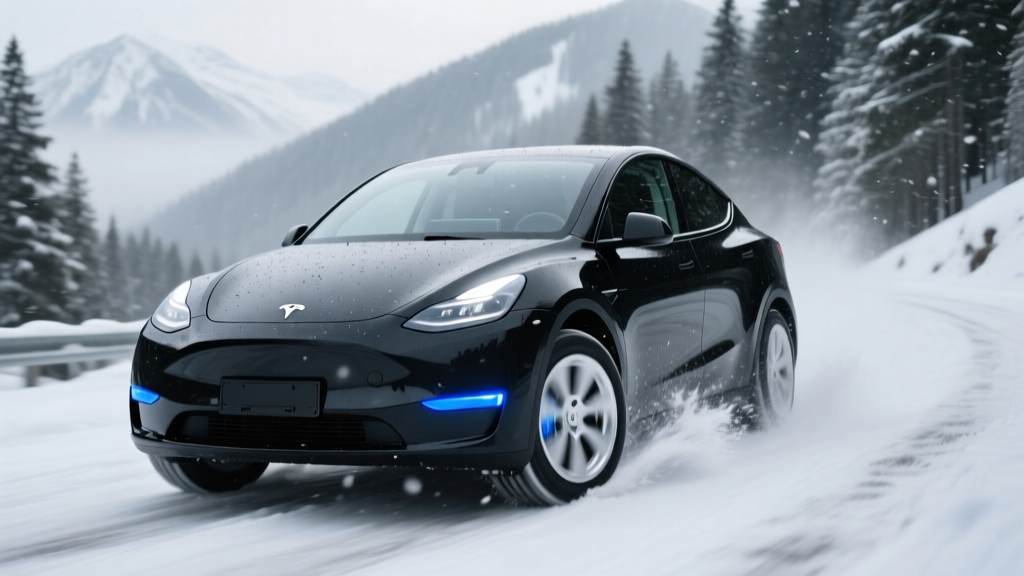
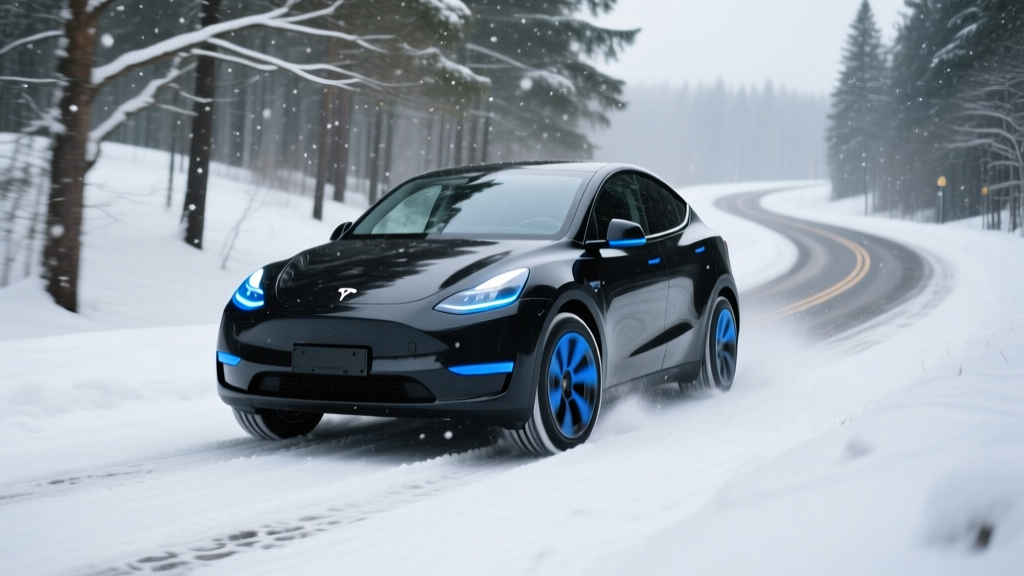
The dual-motor AWD system in the Model Y Long Range uses independent front and rear motors with millisecond torque-vectoring. Unlike mechanical AWD systems with a center differential, there is no drivetrain lag — traction control adjusts torque to each axle faster than any human could react. On packed snow and icy intersections, this translates to confident launches with minimal wheelspin.
That said, ground clearance is 6.6 inches — adequate for plowed roads and moderate accumulation but a limitation in deep unplowed drifts compared to a Subaru Outback (8.7 inches) or a RAV4 Hybrid (8.1-8.6 inches). Owners in heavy-snow regions strongly recommend dedicated winter tires (such as the Nokian Hakkapeliitta R5 or Michelin X-Ice Snow) on 19-inch Gemini wheels. The stock all-season tires are competent in light snow but lose grip significantly below freezing on ice.
Tesla's Autopilot and FSD (Supervised) are SAE Level 2 driver-assist systems — the driver must remain fully engaged with hands on the wheel and eyes on the road. In winter, lane markings obscured by snow and salt spray on cameras can cause Autopilot to disengage or refuse to engage. Tesla's camera-only vision approach (no lidar or radar) means heavy snowfall, fog, and road-salt glare degrade system confidence. Expect to drive manually more often in winter than you would in clear conditions.
Winter ADAS Limitation: Autopilot and FSD (Supervised) are SAE Level 2 systems that require active driver supervision at all times. Snow-covered lane markings, camera obstruction from salt spray, and reduced visibility will cause frequent disengagements. Never rely on these systems as a substitute for attentive winter driving.
Pricing, Tax Credits, and What You'll Actually Pay
| Trim | MSRP | §30D Credit Eligibility | Effective Price (if eligible) |
|---|---|---|---|
| Model Y Long Range AWD | $48,990 | Up to $7,500 (point-of-sale) | ~$41,490 |
| Model Y Performance AWD | $53,490 | Up to $7,500 (point-of-sale) | ~$45,990 |
Under IRS §30D rules, the Model Y qualifies for the federal clean vehicle credit because it is assembled in North America (Fremont, CA and Austin, TX) and meets the MSRP cap of $80,000 for SUVs. However, eligibility is not automatic. Buyers must meet income caps ($150,000 single / $300,000 joint modified AGI), and the vehicle must satisfy critical-mineral and battery-component sourcing thresholds that phase up annually. As of 2026, both thresholds are at 100% compliance requirements, which Tesla's vertically integrated supply chain has largely met for US-built vehicles.
The credit can be transferred to the dealer at point of sale, reducing your out-of-pocket cost immediately rather than waiting for a tax refund. Always verify current eligibility on the IRS website and consult a tax professional — rules shift and individual circumstances vary.
Pros and Cons for Snow-Belt Owners
Pros
- Dual-motor AWD with instant torque vectoring — excellent traction on snow and ice
- Heat pump preserves range better than resistive heating in cold
- Supercharger network reliability — 20,000+ stalls across North America
- Battery preconditioning for faster DC charging when routed via nav
- Low running cost: ~$0.04-$0.06/mile on home electricity vs $0.14+/mile on gas
- Over-the-air updates continuously improve thermal management algorithms
- 30.2 cu ft cargo space accommodates winter gear, skis (with rack)
Cons
- 25-35% range loss in sustained sub-freezing temperatures
- Camera-only Autopilot struggles with snow-covered lanes and salt spray
- 6.6 inches ground clearance limits deep-snow capability
- Stock all-season tires are inadequate for serious ice — winter tire investment required
- DC fast charging severely limited without preconditioning in cold
- No Apple CarPlay or Android Auto — Tesla-only infotainment
- Insurance premiums run 15-25% higher than comparable AWD crossovers
Model Y AWD vs. Key Winter Competitors
For buyers cross-shopping a winter-capable vehicle in the $40,000-$50,000 effective range, the main alternatives are:
- Toyota RAV4 Hybrid AWD ($34,000-$42,000): 39-41 MPG combined, no range loss in cold, 8.1 inches ground clearance. Loses on running cost, acceleration (7.4s 0-60), and tech — but wins on winter practicality, dealer service access, and no charging dependency.
- Hyundai Ioniq 5 AWD ($50,590 MSRP): 290-mile EPA range, 800V architecture for faster DC charging (10-80% in ~18 min), but slightly less cargo space (27.2 cu ft) and a less mature charging network. Better cold-charge speed; worse real-world range.
- Ford Mustang Mach-E AWD ($45,995 MSRP): 320-mile EPA range with extended-range battery, comparable snow traction, more traditional interior controls. Ford's BlueCruise (also Level 2) performs similarly to Autopilot in winter conditions.
The Model Y's advantage is the integrated Supercharger ecosystem — on long winter road trips, knowing you'll have a reliable, fast, well-maintained charging stop every 150-200 miles reduces planning stress. Its disadvantage is ground clearance and tire selection compared to body-on-frame or raised-wagon alternatives.
Who Should Buy the Model Y AWD for Snow Driving?
Choose the Model Y Long Range AWD if: You have home Level 2 charging, your daily commute is under 100 miles round trip, you value low running costs and fast acceleration, and you're willing to invest in winter tires and plan road trips around Supercharger stops.
Look elsewhere if: You lack reliable home charging, you regularly drive unplowed roads with 8+ inches of accumulation, you need maximum ground clearance, or you prefer physical buttons and Apple CarPlay integration.
Frequently Asked Questions
What is the real-world range of the Tesla Model Y in winter?
Expect 210-240 miles in mixed driving at 20-30°F, down from the 320-mile EPA rating. Short trips in single-digit temperatures may yield as little as 185 miles. Preconditioning the cabin and battery while still plugged in at home recovers significant range.
How fast does the Model Y charge at home and on the road in winter?
At home on a 240V Level 2 charger, the Model Y adds about 44 miles of range per hour (11.5 kW), fully recharging overnight. On DC fast chargers, preconditioned winter charging peaks at 250 kW with a 10-80% time of roughly 27 minutes. Without preconditioning in cold weather, expect 50-60 minutes for the same session.
Does the Tesla Model Y qualify for the federal EV tax credit?
Yes, the 2026 Model Y qualifies for up to $7,500 under IRS §30D, provided the buyer meets income caps ($150K single / $300K joint) and the vehicle satisfies 2026 critical-mineral and battery-component sourcing requirements. The credit can be applied at point of sale. Verify current rules at irs.gov and consult a tax professional.
Do I need winter tires on a Tesla Model Y for snow?
Strongly recommended. The stock all-season tires provide acceptable light-snow grip but are significantly outperformed by dedicated winter tires on ice and packed snow. A set of four winter tires on 19-inch wheels typically costs $800-$1,200 and transforms the car's winter safety profile.
Is Autopilot usable in snowy conditions?
Autopilot and FSD (Supervised) are SAE Level 2 driver-assist systems that require full driver engagement. In snow, camera obstruction from salt spray and hidden lane markings cause frequent disengagements. Plan to drive manually in significant winter weather.
How does Tesla's battery warranty cover winter degradation?
Tesla covers the Model Y battery for 8 years or 120,000 miles, whichever comes first, guaranteeing a minimum of 70% capacity retention. Normal winter range loss due to temperature is not degradation — it reverses when temperatures rise. Actual long-term degradation (typically 10-15% over 100,000 miles for NMC chemistry) is covered if it falls below the threshold.