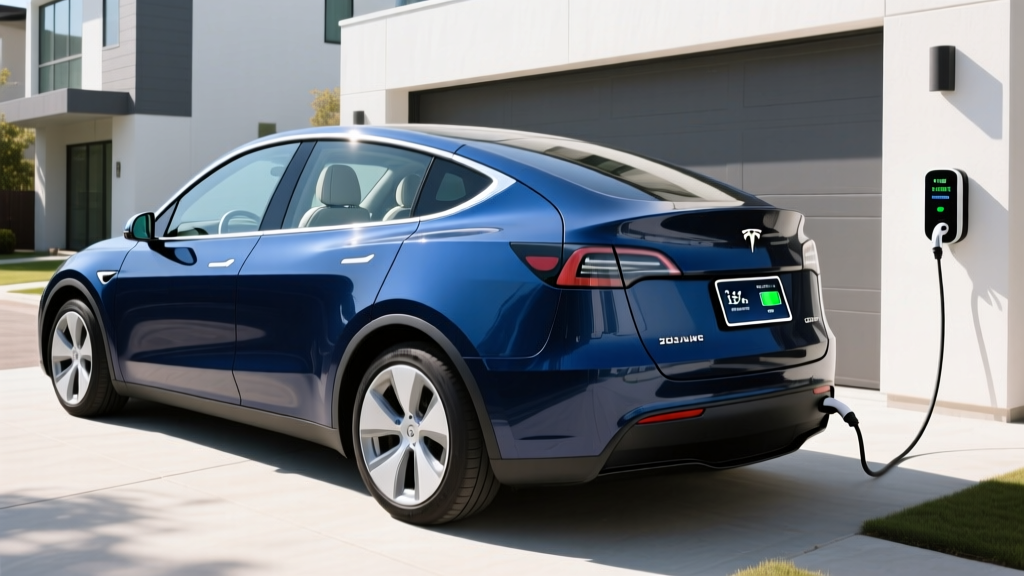
The Tesla Model Y has been America's best-selling electric vehicle for years, but the optional third row has always been its most debated feature. For 2026, the refreshed Model Y (internally dubbed "Juniper") carries over the 7-seat layout with meaningful improvements to ride quality, cabin insulation, and charging architecture. If you're searching for a Tesla Model Y 7 seater, you're likely weighing whether that tiny third row is genuinely useful or simply a marketing checkbox. This review breaks down every spec that matters — from real-world highway range to the exact cost after federal tax credits — so you can decide if this is the right family EV for your garage.
2026 Tesla Model Y 7 Seater: Core Specifications
| Specification | Long Range AWD (7-Seat) | Performance (7-Seat N/A) |
|---|---|---|
| Base MSRP | $47,990 (+$2,000 third-row option) | $52,490 (5-seat only) |
| EPA Range | 300 miles | 280 miles |
| Battery (Usable) | ~75 kWh, NMC chemistry | ~75 kWh, NMC |
| Drivetrain | Dual-Motor AWD | Dual-Motor AWD |
| Horsepower | 384 hp combined | 510 hp combined |
| 0–60 mph | 4.8 seconds | 3.5 seconds |
| Peak DC Fast Charge | 250 kW | 250 kW |
| 10–80% DC Time | ~25 minutes | ~25 minutes |
| Level 2 Home Charge | 11.5 kW (~36 mi/hr) | 11.5 kW (~36 mi/hr) |
| MPGe (Combined) | 111 MPGe | 102 MPGe |
| Battery Warranty | 8 yr / 120,000 mi | 8 yr / 120,000 mi |
Note: The third-row seat is available exclusively on the Long Range AWD trim for 2026. The Performance trim and the base RWD model remain 5-seat configurations. Pricing reflects Tesla's current order page as of early 2026, before destination fees.
Real-World Range: What the EPA Number Doesn't Tell You
Real-World Expectation: 260–280 miles on mixed highway driving at 70 mph; 220–250 miles in sub-freezing winter conditions (32°F and below) with cabin heat active.
The 300-mile EPA figure for the 2026 Model Y Long Range AWD with the 7-seat option is a solid benchmark, but EPA testing uses low-speed cycles that don't fully capture highway energy consumption. In independent real-world highway testing at sustained 70 mph speeds in moderate temperatures (65–75°F), the Model Y typically delivers between 260 and 280 miles before reaching a 10% state of charge. That's a 7–13% reduction from the sticker — consistent with most dual-motor crossover EVs.
Cold weather is the bigger variable. Tesla's inclusion of a standard heat pump (since the 2021 refresh, improved for Juniper) mitigates battery conditioning losses, but at 20°F, expect usable range to drop to roughly 220–250 miles. The 7-seat model carries approximately 80–100 lbs of additional seat hardware and structural reinforcement, which imposes a minor efficiency penalty of roughly 1–2% compared to the 5-seat Long Range — negligible on paper but measurable over a full charge cycle.
Efficiency lands at approximately 28 kWh per 100 miles (combined), which translates to 111 MPGe per fueleconomy.gov. That's slightly less efficient than the RWD Model Y (117 MPGe) but competitive with the Ford Mustang Mach-E Extended Range AWD (101 MPGe) and the Hyundai Ioniq 5 AWD (110 MPGe).
Charging Speed: DC Fast, Level 2, and the NACS Advantage
| Charging Level | Power (kW) | Speed (Miles per Hour) | Notes |
|---|---|---|---|
| Level 1 (120V household) | ~1.4 kW | ~4–5 mi/hr | Emergency/trickle only |
| Level 2 (240V home, 48A) | 11.5 kW | ~36 mi/hr | Full charge in ~7.5 hours |
| DC Fast (Supercharger V3) | Up to 250 kW peak | ~160 mi in 15 min | 10–80% in ~25 min |
| DC Fast (Supercharger V4) | Up to 250 kW (vehicle-limited) | Similar to V3 | Model Y cannot exceed 250 kW |
The 2026 Model Y uses a nickel-manganese-cobalt (NMC) battery pack, which supports Tesla's proven 250 kW peak DC fast-charge rate on the native NACS connector. A 10–80% session takes approximately 25 minutes at a V3 or V4 Supercharger, though real-world charging curves tell a more nuanced story.
The Model Y sustains its peak rate (around 240–250 kW) only between roughly 10% and 35% state of charge. From 35–60%, power tapers to approximately 150–180 kW. Above 80%, the curve drops sharply to under 50 kW to protect battery longevity — a characteristic of NMC chemistry managed by Tesla's thermal preconditioning system. If you navigate to a Supercharger using the built-in route planner, the car will precondition the battery to optimize the curve, shaving 3–5 minutes off your session compared to arriving cold.
At home on a Level 2 Wall Connector (48 amps / 240V), you'll add roughly 36 miles of range per hour of charging. A full 10–100% session takes about 7.5 hours, making overnight charging practical for daily use. Installation of a 240V/60A circuit typically runs $800–$2,000 depending on panel proximity and whether your home's electrical panel needs an upgrade to 200A service.
The native NACS port gives the Model Y direct access to over 20,000 Tesla Superchargers nationwide without an adapter. Starting in 2024, Tesla opened many Supercharger stalls to non-Tesla EVs via the Magic Dock adapter, but Tesla owners still benefit from the most seamless plug-and-charge experience in the industry.
Third-Row Space: Who Actually Fits Back There?
This is the question that defines the 7-seat Model Y purchase. The third row adds two seats, bringing total capacity to seven, but the dimensions tell a clear story about intended use:
- Third-row legroom: 26.5 inches — tight for adults beyond short trips
- Third-row headroom: 35.8 inches — adequate for children and teens
- Cargo behind third row: 12.4 cu ft (groceries, a couple of backpacks)
- Cargo with third row folded: 34.3 cu ft
- Cargo with both rear rows folded: 72.1 cu ft
- Second-row legroom: 37.7 inches (unaffected by third-row option)
In practice, the third row is best suited for children aged roughly 4–12, or very short adults on sub-20-minute rides. The seat cushions are low to the floor (a consequence of the battery pack beneath), which creates a "knees-up" seating position that adults find fatiguing. However, for school runs, carpool duty, or occasional family visits, it eliminates the need for a larger, more expensive 3-row SUV like the Rivian R1S or Kia EV9.
One practical advantage: the third row folds completely flat with a 50/50 split, so you can carry five passengers plus substantial cargo, or drop one side for a mix of passengers and long items like skis or lumber. The frunk (front trunk) adds 4.1 cu ft of secure, weatherproof storage — useful for charging cables or a gym bag.
Performance, Ride Quality, and the Juniper Refresh
The 2026 Model Y Long Range AWD delivers 384 combined horsepower from its dual-motor setup, reaching 60 mph in 4.8 seconds. That's brisk by any measure and comfortably quicker than the Mach-E Premium AWD (5.1 seconds) or the Ioniq 5 AWD (5.2 seconds). The dual-motor system provides confident all-weather traction, with torque vectoring that feels neutral rather than nose-heavy in corners.
The Juniper refresh brought substantive ride improvements: revised damper tuning, thicker acoustic glass, and additional sound deadening that noticeably reduces road noise at highway speeds compared to the 2024 model. The suspension still leans firm — Tesla prioritizes handling over plushness — but the 2026 version absorbs sharp impacts more gracefully, especially on the standard 19-inch wheels. The 20-inch Induction wheels look sharper but transmit more road imperfections and reduce range by approximately 5–8 miles.
Tesla's Autopilot comes standard and includes adaptive cruise control, lane-centering, and automatic emergency braking. Full Self-Driving (Supervised) remains a $8,000 add-on (or $99/month subscription) and operates at SAE Level 2 — meaning the driver must remain fully attentive with hands on the wheel at all times. Despite the name, FSD is not autonomous driving; it's an advanced driver-assistance system that handles highway interchanges and city streets with varying reliability.
Tesla Autopilot and FSD (Supervised) require continuous driver supervision. The vehicle does not drive itself. You are legally and operationally responsible for all driving decisions. True driverless capability (Level 4) exists only in geofenced robotaxi services like Waymo.
Pricing, Tax Credits, and Total Cost
| Cost Factor | Amount |
|---|---|
| Base MSRP (Long Range AWD) | $47,990 |
| Third-Row Seat Option | +$2,000 |
| Destination Fee | +$1,390 |
| Total Before Incentives (7-seat) | $51,380 |
| Federal Tax Credit (§30D, if eligible) | Up to $7,500 |
| Effective Price After Max Credit | ~$43,880 |
| Point-of-Sale Transfer (2026 rule) | Available at participating dealers |
The 2026 Model Y 7-seater prices at $51,380 out the door (MSRP + third row + destination). Under current IRS §30D rules, it may qualify for up to $7,500 in federal tax credits, but eligibility is far from automatic. Here's what you need to know:
- MSRP Cap: The Model Y qualifies as an SUV under IRS rules, which carries an $80,000 MSRP cap — well above the ~$51,000 as-tested price. (Sedans are capped at $55,000.)
- Buyer Income Limits: Adjusted gross income must not exceed $300,000 (joint filers), $225,000 (head of household), or $150,000 (single filers).
- Battery Sourcing: The $7,500 credit splits into two halves — $3,750 for critical-mineral sourcing and $3,750 for battery-component assembly. As of 2026, the Model Y qualifies for both halves, but the rules tighten annually. Verify current eligibility at irs.gov before purchasing.
- Point-of-Sale Transfer: Since 2024, you can transfer the credit to the dealer at purchase, reducing your out-of-pocket cost immediately rather than waiting for a tax refund. This effectively lowers the purchase price to ~$43,880 if you qualify for the full $7,500.
- Foreign Entity of Concern (FEOC): Battery components and critical minerals from China and other FEOC nations can disqualify vehicles. Tesla has shifted significant supply chain sourcing, but always confirm the specific VIN's eligibility.
Tax credit rules are subject to change. Consult a tax professional and verify your specific eligibility before finalizing a purchase.
How It Compares: 7-Seat EV Alternatives
The Model Y 7-seater occupies a narrow niche. Most 3-row electric SUVs are significantly larger and more expensive. Here's how the closest alternatives stack up:
| Spec | Tesla Model Y 7-Seat | Kia EV9 (3-Row) | Rivian R1S (3-Row) |
|---|---|---|---|
| Starting Price | $49,990 | $54,900 | $75,900 |
| EPA Range | 300 mi | 304 mi (LR RWD) | 352 mi (Max Pack) |
| 3rd-Row Legroom | 26.5 in | 32.0 in | 32.4 in |
| DC Fast Charge | 250 kW | 236 kW | 220 kW |
| 10–80% Time | ~25 min | ~24 min | ~30 min |
| Federal Credit | Up to $7,500 | Up to $7,500 | Up to $7,500 |
The EV9 offers meaningfully more third-row space (32 inches of legroom) and a usable third row for adults, but starts $5,000 higher and is physically much larger — a factor in tight garages and urban parking. The Rivian R1S is a premium off-road-capable SUV with genuine adult-sized third-row space, but at $75,900, it's a different vehicle class entirely. The Model Y 7-seater remains the most affordable path to a third-row EV, provided you accept the space limitations.
- Lowest entry price for a 7-seat EV in the US market
- Access to 20,000+ Supercharger stalls natively (NACS)
- 300-mile EPA range covers most daily and road-trip needs
- Strong efficiency (111 MPGe) keeps charging costs low
- Excellent over-the-air update track record
- Heat pump standard for cold-weather efficiency
- Third row is children-only for practical use
- Minimal cargo space (12.4 cu ft) when all 7 seats are occupied
- No Apple CarPlay or Android Auto — Tesla's screen-only ecosystem
- FSD (Supervised) remains Level 2 despite its name and $8,000 price
- Firm ride quality on rough pavement
- Service center wait times remain a pain point in many metro areas
Who Should Buy the Tesla Model Y 7 Seater?
- You need a third row occasionally for children (school carpool, visiting nieces/nephews) but don't want to drive a full-size SUV daily
- You prioritize charging infrastructure — the Supercharger network is still the most reliable long-distance charging ecosystem
- Your budget caps around $45,000–$52,000 and you want to maximize federal incentives
- You value efficiency and low per-mile charging cost over maximum interior volume
- You regularly carry more than five adults — the EV9 or R1S offer genuinely usable third rows
- You need substantial cargo space with all seats in use (consider a minivan PHEV like the Chrysler Pacifica Hybrid)
- You want Apple CarPlay/Android Auto integration — Tesla does not support either
- You require a soft, luxury ride — the Model Y's suspension is tuned for sportiness, not comfort
Battery Longevity and Warranty Coverage
Tesla warranties the Model Y's battery pack and drive units for 8 years or 120,000 miles (whichever comes first), with a guaranteed minimum 70% capacity retention over that period. This is competitive with Hyundai's 10-year/100,000-mile battery warranty and Ford's 8-year/100,000-mile coverage.
The NMC chemistry in the Model Y has demonstrated strong long-term durability in fleet data. Tesla's 2025 Impact Report indicated that Model Y vehicles retain approximately 92% of original battery capacity at 100,000 miles — well above the 70% warranty floor. Real-world degradation is front-loaded: expect roughly 3–5% loss in the first year as the battery stabilizes, then approximately 1% per year thereafter under normal use.
To maximize battery longevity, Tesla recommends daily charging to 80–90% for NMC packs (not 100%) and reserving full charges for road trips. The vehicle's built-in charge-limit slider makes this easy to manage. Avoid frequent DC fast-charging to 100% and try not to let the battery sit at very low state of charge (below 10%) for extended periods, especially in extreme heat.
Frequently Asked Questions
What is the real-world range of the Tesla Model Y 7-seater?
The EPA rates it at 300 miles, but expect 260–280 miles on real highway drives at 70 mph and 220–250 miles in freezing weather. The added weight of the third row reduces range by roughly 1–2% versus the 5-seat model.
How fast does it charge at home and on the road?
On a DC Supercharger, the Model Y peaks at 250 kW and charges from 10–80% in about 25 minutes. At home on a Level 2 Wall Connector (11.5 kW), you'll gain about 36 miles of range per hour, fully recharging overnight in roughly 7.5 hours.
Does the Tesla Model Y 7-seater qualify for the federal EV tax credit?
It can qualify for up to $7,500 under IRS §30D, subject to buyer income limits ($300K joint / $150K single), the $80K SUV MSRP cap, and battery sourcing requirements. The credit can be transferred at point of sale to reduce your purchase price immediately. Always verify eligibility at irs.gov for your specific VIN and tax situation.
Is the third row worth it?
If your primary need is occasional child transport (ages 4–12) for short trips, yes — it's the cheapest way to get a third-row EV. If you need regular adult seating for six or seven, the Kia EV9 or Rivian R1S provide far more usable space, at higher cost.
How does the Model Y compare to the Kia EV9 for families?
The EV9 offers 32 inches of third-row legroom versus the Model Y's 26.5 inches — a significant difference for comfort. The EV9 is also larger externally, has more cargo space behind the third row, and starts about $5,000 higher. Choose the Model Y for value and charging infrastructure; choose the EV9 for genuine 7-adult seating.
What does it cost to charge a Model Y at home versus gas?
At the US average electricity rate of ~$0.16/kWh, a full charge costs about $12 (75 kWh × $0.16), yielding roughly $0.045 per mile. A comparable gas SUV at 25 MPG and $3.40/gallon costs ~$0.136 per mile — roughly three times more per mile driven.
Sources: fueleconomy.gov, IRS §30D Clean Vehicle Credit, Tesla Model Y Design Studio, NHTSA Safety Ratings.