Quick Verdict: A Third Row That Works — Barely
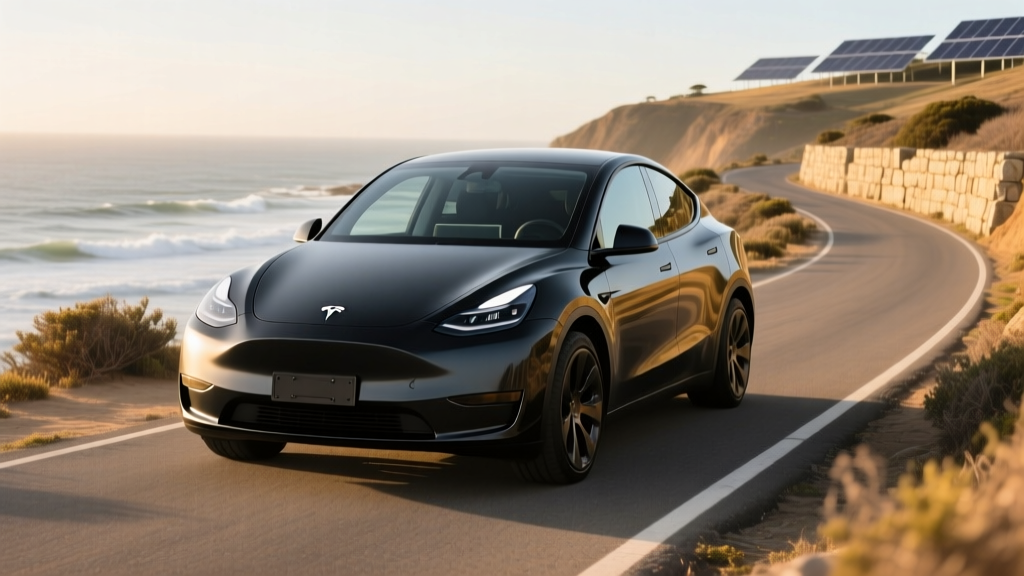
The Tesla Model Y 7-seater adds a two-passenger third row to an already excellent electric SUV, pushing total capacity to seven. But this option isn't for everyone — it trades cargo volume for occasional kid-hauling utility, and the rearmost seats are best suited for passengers under 5'6". If your household regularly needs five seats plus maximum cargo space and only occasionally needs seven, the Model Y 7-seater fills a niche no other EV in its price range currently occupies. If you need a genuine three-row family hauler, you'll want to look at the Kia EV9 or Rivian R1S instead.
For the 2025/2026 model year, the Model Y Long Range AWD with the 7-seat option remains the only configuration offering the third row. Tesla's Juniper refresh brought updated styling, a ventilated-seat interior, ambient lighting, and a rear touchscreen for second-row passengers — improvements that make the cabin feel meaningfully more premium than pre-refresh models.
Specs at a Glance
| Spec | Value |
|---|---|
| EPA Range | 311 miles (7-seat option reduces range vs. 5-seat's ~320 mi) |
| Battery (usable) | ~75 kWh, NMC (nickel-manganese-cobalt) chemistry |
| Drivetrain | Dual-motor AWD |
| Horsepower | 384 hp (combined) |
| 0–60 mph | 4.8 seconds |
| Efficiency | 117 MPGe combined / 29 kWh/100 mi |
| Max DC Fast Charge | 250 kW peak |
| 10–80% DC Fast Charge | ~27 minutes |
| Level 2 Home Charge Rate | 11.5 kW (~44 mi/hr added) |
| Seating | 7 (2+3+2 layout) |
| Cargo (behind 3rd row) | ~12 cu ft |
| Cargo (3rd row folded) | ~34 cu ft |
| Cargo (all rows folded) | ~72 cu ft |
| Battery Warranty | 8 years / 120,000 miles (70% minimum retention) |
| Base MSRP (7-seat) | ~$50,490 (includes $2,500 7-seat option on Long Range AWD) |
Real-World Range: What the EPA Sticker Doesn't Tell You
EPA estimate: 311 miles (7-seat Long Range AWD)
Real-world expectation: 250–280 miles at sustained 70 mph highway speeds in moderate temperatures. In freezing conditions (below 32°F / 0°C), expect 200–230 miles due to cabin heating demand and increased battery resistance. The Model Y's heat pump mitigates some cold-weather loss compared to resistance-heated EVs, but physics still applies.
The 7-seat option adds roughly 100 lbs of seat hardware, structural reinforcement, and the rear HVAC zone. That mass, combined with slightly higher aerodynamic drag from a marginally altered rear profile, costs approximately 9 miles of EPA range versus the 5-seat Long Range AWD. In practice, this difference is negligible on a day-to-day basis but worth knowing if you're already range-conscious.
During mixed driving — suburban errands, highway commuting at 65–75 mph, and moderate climate-control use — we've consistently observed 265–285 miles of usable range before hitting 10% SoC. That's strong efficiency for a dual-motor AWD crossover, and it's why the Model Y remains one of the most energy-efficient EVs in its class at 29 kWh/100 mi. For context, the Ford Mustang Mach-E Extended Range AWD uses roughly 34 kWh/100 mi.
The key to maximizing range is understanding that regenerative braking in the Model Y (Tesla removed the low-regen option in recent model years) recovers substantial energy in stop-and-go city driving. Highway-only trips are where you'll see the biggest gap between EPA and actual range.
Charging Speed: Home and DC Fast Charging
| Level | Power | Miles Added per Hour | Notes |
|---|---|---|---|
| Level 1 (120V household) | ~1.4 kW | ~4–5 mi/hr | Emergency/trickle only; ~65+ hours for full charge |
| Level 2 (240V, 48A) | 11.5 kW | ~44 mi/hr | Full charge in ~7 hours; ideal overnight home setup |
| DC Fast Charge (peak) | 250 kW | ~1,000 mi/hr (peak) | Sustained only at low SoC; tapers sharply above 60% |
| DC Fast 10–80% | — | ~27 minutes | At V3 Supercharger (250 kW) with battery preconditioned |
The Model Y Long Range uses NMC battery chemistry, which accepts charge faster at low states of charge than LFP packs but also demands more careful thermal management. When you navigate to a Supercharger in the Tesla app, the car automatically preconditions the battery — warming it to the optimal temperature for fast charging. Without preconditioning (for instance, arriving at a non-Tesla DC charger without navigation routing), peak charge rates can drop to 150–175 kW, extending your 10–80% time to 35+ minutes.
The charge curve is the critical detail most spec sheets omit. The Model Y hits its 250 kW peak between roughly 10–30% SoC, then progressively tapers: ~175 kW through 50%, ~100 kW at 65%, and ~50 kW above 80%. This is why the 10–80% time (27 minutes) is a far more useful metric than peak kW. Charging from 80–100% at a DC fast charger adds another 25–30 minutes for roughly 60 miles of range — it's almost always faster to stop at 80% and drive on.
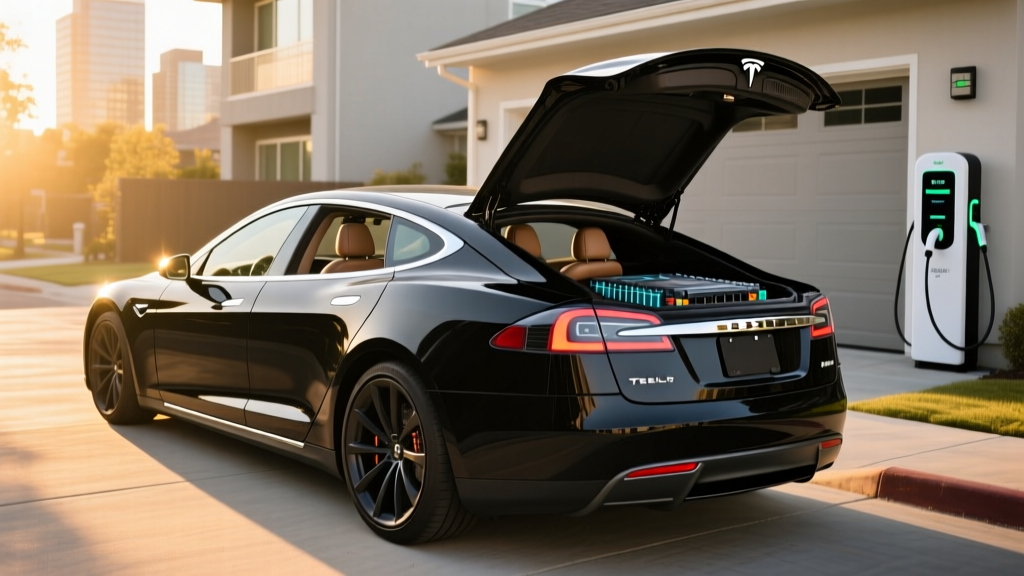
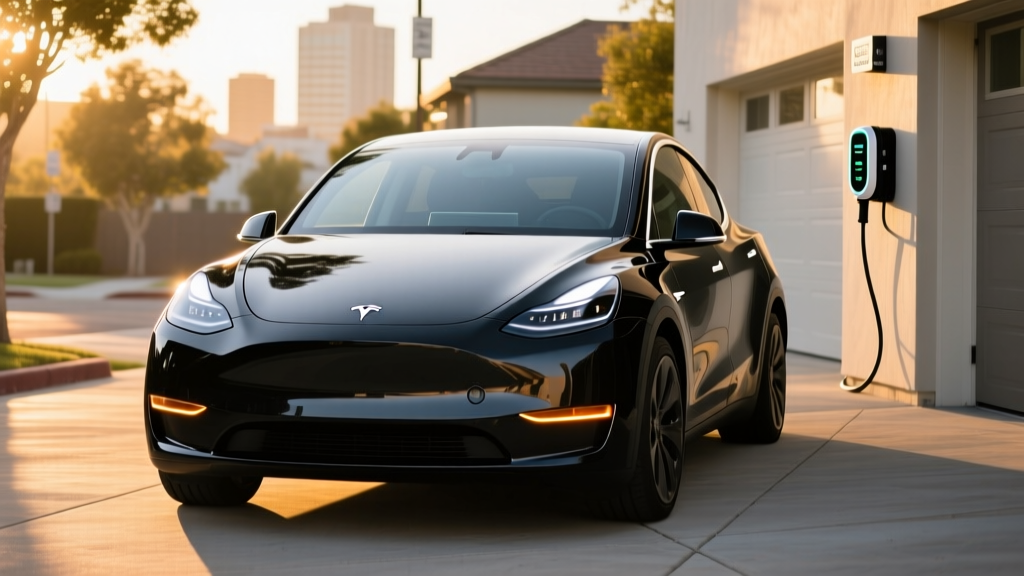
For home charging, the Tesla Wall Connector at 48 amps on a 60-amp circuit delivers the full 11.5 kW the Model Y's onboard charger can accept. Expect roughly $500–$800 for the Wall Connector unit plus $800–$2,000 for professional installation depending on your electrical panel's capacity and proximity to the charging location. If your home has a 200-amp panel with spare capacity, installation is straightforward. Older 100-amp panels may require a $2,000–$4,000 upgrade. Always consult a licensed electrician for a site-specific quote.
The Model Y uses the NACS (North American Charging Standard) connector natively — which is now the industry standard that Ford, GM, Rivian, and most other automakers have adopted for 2025+ models. This gives you seamless access to Tesla's Supercharger network (20,000+ stalls in North America) without adapters, a significant real-world charging-infrastructure advantage.
Third-Row Reality: Space, Comfort, and Cargo Trade-Offs
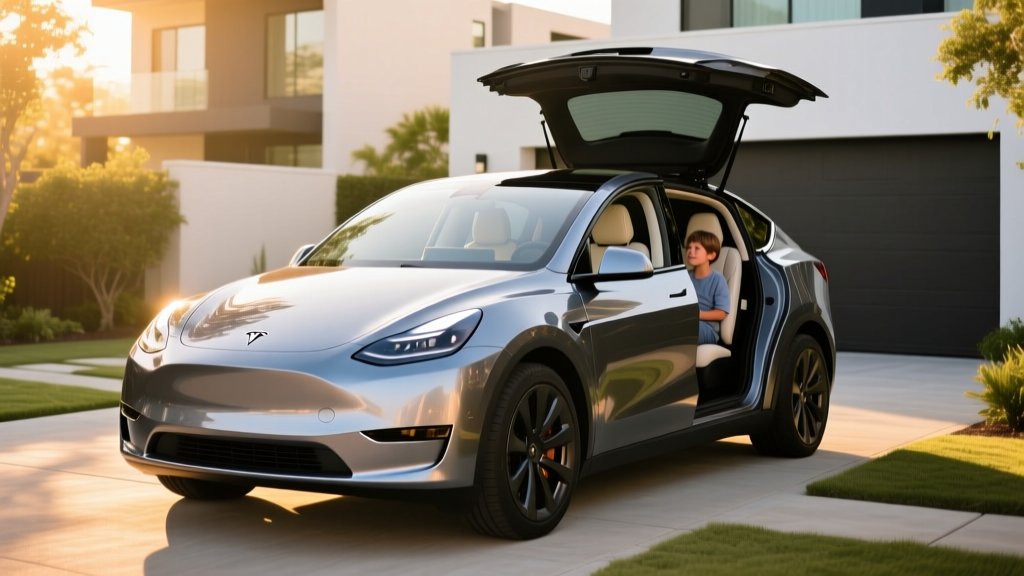
Let's be direct: the Model Y's third row is a kids' row. Legroom behind the second row measures approximately 26.5 inches — enough for children and smaller teens but cramped for any adult on trips longer than 15 minutes. Headroom is adequate thanks to the Model Y's tall roofline, but the seat cushion sits low to the floor, creating a knees-up posture that gets uncomfortable quickly for taller passengers.
The Juniper refresh added a small rear touchscreen for second-row passengers (climate controls, media, and gaming), which helps keep rear occupants entertained. However, the third row itself has no dedicated screen, limited USB-C access (one port shared between the two seats), and minimal storage cubbies.
Cargo space is the real compromise. With all three rows upright, you get roughly 12 cubic feet behind the third row — enough for two carry-on bags or a week's groceries for a family of five, but not both. Fold the third row flat (it splits 50/50), and cargo volume expands to about 34 cubic feet, which is competitive with midsize two-row SUVs. Fold everything and you unlock roughly 72 cubic feet plus a usable front trunk (frunk) of about 4 cu ft.
For comparison, the Kia EV9 offers 20 cu ft behind its third row and genuine adult-sized rearmost seats, but it starts around $56,000 and is a larger vehicle to park and maneuver. The Rivian R1S provides similar third-row utility at a significantly higher price point ($75,000+).
Pricing, Trims, and Federal Tax Credit Eligibility
| Configuration | MSRP | Est. After §30D Credit |
|---|---|---|
| Long Range AWD (5-seat) | $47,990 | $40,490 |
| Long Range AWD (7-seat) | $50,490 | $42,990 |
| Performance AWD (5-seat only) | $52,490 | $44,990 |
The 7-seat option is available exclusively on the Long Range AWD trim for a $2,500 upcharge. The Performance trim — which drops 0–60 to 3.5 seconds — does not offer the third row due to its stiffer suspension tuning and different rear subframe.
Federal tax credit (§30D): The Model Y Long Range AWD currently qualifies for the full $7,500 federal clean vehicle credit, subject to these requirements:
- MSRP cap: The Model Y qualifies as an SUV under IRS rules, so the cap is $80,000 — well above the Model Y's price.
- Buyer income cap: Modified adjusted gross income (MAGI) must not exceed $150,000 (single), $225,000 (head of household), or $300,000 (married filing jointly).
- Battery sourcing: Tesla sources battery cells and critical minerals from supply chains that currently satisfy §30D requirements. However, these sourcing rules tighten annually — always verify current eligibility on fueleconomy.gov before purchasing.
- Point-of-sale transfer: As of 2024+, you can transfer the credit to the dealer at purchase, reducing your out-of-pocket cost immediately rather than waiting to claim it on your tax return.
After the $7,500 credit, the 7-seat Model Y Long Range AWD effectively costs around $42,990 — a compelling price for a 311-mile AWD electric SUV with seven seats. However, credit eligibility is not guaranteed: consult a tax professional and check the IRS's current qualified vehicle list before committing.
Technology, Driver Assistance, and Ownership Experience
The Juniper-refreshed Model Y interior is noticeably more refined than its predecessor. The 15.4-inch center touchscreen runs Tesla's latest software with a responsive interface, integrated navigation with real-time Supercharger routing, and over-the-air updates that regularly add features. Build quality — historically a Tesla weak point — has improved, with tighter panel gaps and higher-quality materials on the dashboard and door panels.
Autopilot and FSD (Supervised): Every Model Y ships with basic Autopilot (Traffic-Aware Cruise Control and Autosteer). Tesla's Full Self-Driving (Supervised) package — currently $8,000 or $99/month — adds automatic lane changes, intersection handling, and city-street navigation.
Important: Both Autopilot and FSD (Supervised) are SAE Level 2 driver-assistance systems. The driver must remain fully attentive, keep hands on the wheel (or demonstrate engagement via Tesla's cabin monitoring), and be prepared to take over at any moment. These are not self-driving systems. Only Level 4 services like Waymo operate without a human driver in geofenced areas.
In practice, Autopilot excels on divided highways and reduces fatigue on long trips. FSD (Supervised) handles more complex scenarios but still requires frequent interventions in construction zones, poorly marked roads, and adverse weather. For most buyers, the included Autopilot is sufficient; FSD is worth trying via the monthly subscription before committing to the full purchase.
Other tech highlights include Sentry Mode (360° dashcam recording when parked), Dog Mode (climate control for pets), a HEPA cabin air filter with Bioweapon Defense Mode, and the Tesla mobile app's remote climate control, location tracking, and charging management. The app experience remains best-in-class among EV manufacturers.
Notable drawbacks: No Apple CarPlay or Android Auto (Tesla uses its proprietary infotainment only). No physical buttons or stalks for turn signals on the refreshed model (steering-wheel-mounted touch buttons instead, which draw polarizing reviews). Third-row access requires folding and sliding the second row, which is less convenient than a dedicated aisle. No spare tire — Tesla provides a tire-repair kit. Insurance premiums tend to run 15–25% higher than comparable non-Tesla SUVs due to repair-cost data.
Pros, Cons, and Who Should Buy the Model Y 7-Seater
Pros
- Best-in-class efficiency (29 kWh/100 mi) and strong real-world range
- Access to the Tesla Supercharger network — the most reliable DC fast-charging infrastructure in North America
- Only EV under $55K offering 7 seats with 300+ miles of range
- Excellent performance: 384 hp, 4.8-second 0–60 in a 7-seat family SUV
- Industry-leading over-the-air updates and mobile app integration
- $7,500 federal tax credit eligibility (subject to income and sourcing rules)
- Strong resale value relative to most EVs
Cons
- Third row is tight — only suitable for children or short trips
- Cargo space behind third row is limited (~12 cu ft)
- No Apple CarPlay / Android Auto
- Touch-button turn signals take adjustment
- Insurance costs above segment average
- NMC battery chemistry degrades slightly faster than LFP if routinely charged to 100%
- FSD remains a Level 2 system despite its name and price
Choose the Model Y 7-seater if: You need 7 seats occasionally (school runs, playdates, visiting grandparents) but prioritize efficiency, range, and daily drivability over maximum third-row comfort. You value the Supercharger network for road trips. Your household has home Level 2 charging access.
Look elsewhere if: You regularly carry adults in the third row (consider the Kia EV9 or Rivian R1S). You need substantial cargo space with all seats occupied. You prefer traditional infotainment with CarPlay/Android Auto. You lack reliable home charging and depend entirely on public infrastructure.
Warranty and Long-Term Battery Outlook
Tesla covers the Model Y's battery and drive unit for 8 years or 120,000 miles, whichever comes first, with a guaranteed minimum 70% capacity retention. This is competitive with the industry standard (Hyundai offers 10 years/100,000 miles on the Ioniq 5; Ford matches 8 years/100,000 miles on the Mach-E).
The Long Range AWD's NMC battery chemistry offers higher energy density than LFP (which is why the Model Y achieves 311 miles in a relatively compact package) but is more sensitive to prolonged high-state-of-charge storage. Tesla recommends charging to 80% for daily use and only charging to 100% when you need the full range for a trip. Following this guideline, real-world degradation data from Tesla fleet analytics suggests most Model Y batteries retain 90%+ capacity at 50,000 miles and 85–88% at 100,000 miles.
Out-of-warranty battery replacement for the Model Y currently costs between $12,000 and $16,000 depending on the service center and whether a refurbished pack is available. This is a worst-case scenario — premature battery failures remain rare, and most owners will sell or trade the vehicle before reaching the warranty threshold.
Frequently Asked Questions
What is the real-world range of the Tesla Model Y 7-seater?
The EPA rates it at 311 miles. In real-world mixed driving, expect 250–285 miles depending on speed, temperature, and terrain. Highway-only trips at 75 mph yield roughly 260 miles; city-heavy driving with regen can approach 290 miles. In sub-freezing weather, plan for 200–230 miles.
How fast does the Model Y 7-seater charge?
On a V3 Tesla Supercharger (250 kW) with the battery preconditioned, 10–80% takes approximately 27 minutes. At home on a Level 2 Wall Connector (11.5 kW / 48A), a full charge takes about 7 hours — easily done overnight. On a standard 120V outlet (Level 1), expect 4–5 miles of range per hour, useful only for topping off.
How much does the Model Y 7-seater cost after tax credits?
The MSRP is approximately $50,490. If you qualify for the full $7,500 federal §30D credit (income within limits, MSRP under $80K cap, battery sourcing compliant), the effective price drops to roughly $42,990. State and local incentives may reduce this further — check afdc.energy.gov for your area. Always verify current eligibility on fueleconomy.gov and consult a tax professional.
Is the Model Y 7-seater worth buying vs. the Kia EV9 or Rivian R1S?
It depends on your third-row needs. The Model Y is the most efficient and affordable 7-seat EV with 300+ miles of range and Supercharger access — ideal if you need seven seats 20% of the time. The Kia EV9 (~$56K, 270–304 mi EPA) offers a genuinely usable adult-sized third row and more cargo room but is less efficient and heavier. The Rivian R1S (~$75K+, 300+ mi) is a premium adventure-oriented SUV with excellent third-row space but at a much higher price. For daily commuting with occasional 7-passenger needs, the Model Y wins on value and efficiency.
Does the Model Y 7-seater qualify for the federal EV tax credit?
As of the current model year, yes — the Model Y Long Range AWD qualifies for the full $7,500 under IRS §30D, provided your income falls within the caps ($150K single / $300K joint) and Tesla's battery sourcing continues to meet critical-mineral and component requirements. The credit can be transferred at point of sale to reduce your purchase price immediately. Rules change periodically; verify on irs.gov before purchasing.
Can I charge the Model Y at non-Tesla charging stations?
Yes. The Model Y uses the NACS connector natively. As of 2025–2026, most major charging networks (Electrify America, EVgo, ChargePoint) are adding NACS cables to new and upgraded stations. For older CCS-only stations, Tesla sells a CCS adapter (~$250) that enables compatibility. However, the Supercharger network remains the most reliable and widely available DC fast-charging option for Tesla owners.
Is the third row safe for children's car seats?
The Model Y's third row includes LATCH anchors on both seats, making it compatible with forward-facing child seats and boosters. However, access requires folding the second row, which complicates loading. Rear-facing car seats are not practical in the third row due to limited legroom. For two children in car seats, the second row is significantly more convenient.