The Tesla Model Y has been one of the best-selling electric vehicles in the world for years, but for families with more than two kids — or those who regularly carpool — five seats simply aren't enough. Enter the 7-seat Model Y, a $2,000 option that adds a small third row to Tesla's midsize electric crossover. It's a configuration that turns the Model Y into a compact family hauler, but it comes with real trade-offs in cargo space, third-row comfort, and highway range.
For 2026, the Model Y receives a significant refresh — dubbed "Juniper" internally — with a redesigned interior, updated suspension tuning, a new front-end light bar, ventilated front seats, and ambient cabin lighting. The 7-seat option remains available exclusively on the Long Range AWD trim. Here's everything you need to know about the 2026 7-seat Model Y, from real-world range to third-row practicality.
2026 Model Y 7-Seat: Core Specifications at a Glance
| Spec | Value |
|---|---|
| EPA Range | 320 miles (est. ~310 mi with 7-seat/20" wheels) |
| Battery (usable) | ~78 kWh, NMC (Nickel Manganese Cobalt) |
| Drivetrain | Dual-motor AWD |
| Horsepower | 384 hp combined |
| 0–60 mph | 4.8 seconds |
| Efficiency | 122 MPGe combined / 27 kWh/100mi |
| Max DC Fast Charge | 250 kW (V3 Supercharger) |
| 10–80% DC Charge Time | ~25 minutes |
| Level 2 Home Charge Rate | 11.5 kW (~44 mi/hr) |
| Seating | 7 (2+3+2 configuration) |
| Cargo (behind 3rd row) | ~12 cu ft |
| Cargo (3rd row folded) | ~30 cu ft |
| Cargo (all rear rows folded) | ~72 cu ft |
| Battery Warranty | 8 years / 120,000 miles (min 70% retention) |
| Base MSRP (LR AWD) | $47,990 |
| 7-Seat Option | +$2,000 |
| As-Tested (7-seat, 20" wheels) | ~$51,990 (incl. destination) |
Real-World Range: What the EPA Number Doesn't Tell You
EPA Estimate: 320 miles (Long Range AWD, 19" wheels, 5-seat)
7-Seat / 20" Wheel Config: ~310 miles EPA
Real-World Highway (70–80 mph): ~255–275 miles
Real-World Cold Weather (below 32°F): ~220–245 miles
Best-Case City/Mixed (mild weather): ~295–310 miles
The EPA's 320-mile figure for the Long Range AWD is measured on a mixed driving cycle at moderate speeds. In practice, the 7-seat Model Y carries additional weight from the third-row hardware, and most buyers opt for the larger 20" wheels, which reduce the sticker to roughly 310 miles.
Highway driving at sustained 70–80 mph speeds is where EVs lose the most efficiency compared to the EPA test cycle. Expect 255 to 275 miles of usable range on a road trip in fair weather. In winter conditions — particularly below freezing — the lithium-ion NMC battery loses capacity and the cabin heating system draws significant power. Plan for 220 to 245 miles of range in cold climates unless you precondition the battery while plugged in.
The Model Y's heat pump (standard since the 2021 refresh) helps mitigate cold-weather losses compared to resistive heating systems, but physics still wins. If you live in the northern tier of the U.S. and regularly drive in winter, a 7-seat Model Y with 310 EPA miles will functionally deliver about 230 miles of winter highway range — enough for most commutes, but something to plan around on road trips.
Charging Speed: DC Fast Charging and Home Level 2
| Charging Level | Power / Rate | Speed (mi/hr added) | Notes |
|---|---|---|---|
| Level 1 (120V outlet) | ~1.4 kW | ~4–5 mi/hr | Emergency/trickle only |
| Level 2 (240V, 48A) | 11.5 kW | ~44 mi/hr | Full charge in ~7–8 hours |
| DC Fast (V3 Supercharger) | Peak 250 kW | ~1,000+ mi/hr at peak | 10–80% in ~25 min |
| DC Fast (V4 Supercharger) | Peak 250 kW* | Similar to V3 | *Model Y limited to 250 kW architecture |
| DC Fast (CCS adapter, 3rd-party) | Up to 150–175 kW | Varies | Electrify America, EVgo, etc. |
The 2026 Model Y uses Tesla's NACS (North American Charging Standard) connector natively, which means full compatibility with the Tesla Supercharger network — widely regarded as the most reliable DC fast-charging network in the U.S. At a V3 Supercharger (250 kW capable), the Model Y peaks at approximately 250 kW when the battery is preconditioned and at a low state of charge (around 5–10%).
Charging curve reality: The 250 kW peak is not sustained. The curve tapers significantly above 50% state of charge, and drops sharply above 80%. A 10–80% session takes roughly 25 minutes under ideal conditions (warm battery, V3 stall). Charging from 80–100% can add another 20+ minutes, which is why Tesla's navigation system typically recommends charging to 80% on road trips and moving on.
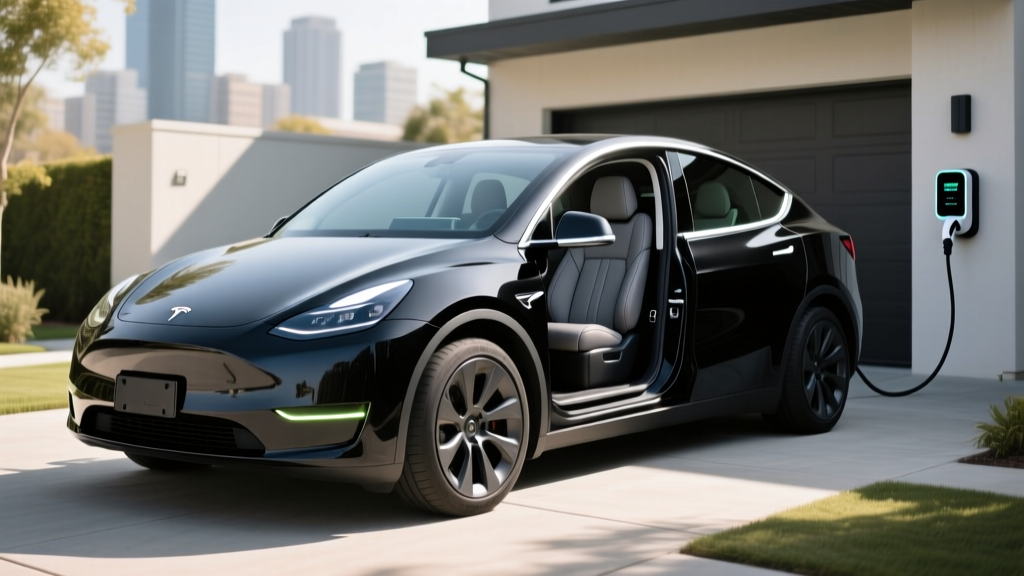
For home charging, a Wall Connector on a 60-amp circuit delivers 11.5 kW (48 amps), adding about 44 miles of range per hour. A full overnight charge from 10% to 100% takes roughly 7–8 hours. Most owners who charge nightly at home never need to visit a public charger for daily driving. Installation of a 240V/60A circuit typically runs $800–$2,500 depending on panel proximity and local permit costs — budget for a potential panel upgrade if your home has a 100-amp service.
Since early 2024, Tesla has opened select Supercharger stalls to non-Tesla EVs via a Magic Dock adapter. For Model Y owners, this means the Supercharger network is only getting more crowded at popular corridors. However, the Model Y also works with third-party CCS networks (Electrify America, EVgo) using a Tesla CCS adapter ($175 from Tesla), though charge speeds on those networks typically cap at 150–175 kW for this vehicle.
Third-Row Space and Cargo: The Practical Reality
The 7-seat Model Y uses a 2+3+2 seating configuration. The third row is best understood as a children-only space. Adults over about 5'4" will find the knee room severely limited and the seat cushion essentially at floor level, creating an uncomfortable knees-up posture. Legroom in the third row measures approximately 26.5 inches — adequate for kids aged roughly 4–12, but not viable for teenagers or adults on anything beyond a short trip across town.
Access to the third row requires folding and sliding the second-row bench forward. It's manageable but not as convenient as the one-touch tumble mechanisms found in larger SUVs like the Kia EV9 or the Rivian R1S. Installing a child seat in the third row is possible but tight — the LATCH anchors are present, but the space makes maneuvering a bulky rear-facing seat challenging.
Cargo space is the biggest trade-off. With all three rows upright, you get roughly 12 cubic feet behind the third row — enough for a couple of grocery bags or a small stroller, but not much else. Fold the third row flat (a 50/50 split) and cargo capacity expands to about 30 cubic feet, which is competitive with compact crossovers. Fold both rear rows and you unlock roughly 72 cubic feet, approaching the volume of a midsize wagon.
For context, the 5-seat Model Y offers 30 cu ft behind the second row and 72 cu ft total. The 7-seat option essentially trades flexible cargo space for occasional kid-hauling capability. If you need genuine 7-adult seating and cargo room, the Kia EV9 (3 rows, ~290 mi range, from ~$54,900) is a more spacious alternative, though it costs more and is a larger vehicle to park.
Performance, Ride Quality, and Daily Driving
The Long Range AWD powertrain produces 384 horsepower from its dual-motor setup — an induction motor up front and a permanent-magnet motor in the rear. The 0–60 mph sprint takes 4.8 seconds, which is genuinely quick for a family crossover. The instant torque delivery makes highway merging and passing effortless, and the low center of gravity (battery pack under the floor) keeps body roll well-controlled through corners.
The 2026 Juniper refresh brings revised suspension damping and new bushings that noticeably improve ride comfort over the pre-refresh Model Y, which was widely criticized for its firm, crashy ride over broken pavement. The updated Model Y absorbs small bumps more gracefully, though it still leans sporty compared to a Hyundai Ioniq 5 or Ford Mustang Mach-E. Road noise is also reduced thanks to additional sound deadening and acoustic glass.
Regenerative braking remains strong and predictable. Tesla's one-pedal driving mode allows you to drive almost exclusively with the accelerator in most conditions, though the creep mode and stop-mode behaviors have been refined in recent software updates. The steering is precise but heavy at higher speeds — a characteristic Tesla owners tend to appreciate.
Tax Credit, Pricing, and Total Cost of Ownership
- Maximum credit: $7,500 for new qualifying EVs
- MSRP cap: SUVs/crossovers must be ≤ $80,000 (Model Y qualifies)
- Income cap: AGI ≤ $150,000 single / $225,000 HOH / $300,000 joint
- Battery sourcing: Critical minerals + battery component rules phase in annually — check current-year IRS guidance
- Point-of-sale transfer: Eligible buyers can transfer the credit to the dealer for an upfront price reduction (effective Jan 2024)
- Tax liability: Credit is non-refundable — you must owe at least $7,500 in federal tax to claim the full amount
| Item | Cost |
|---|---|
| Long Range AWD base MSRP | $47,990 |
| 7-Seat Interior option | +$2,000 |
| 20" Induction Wheels (common upgrade) | +$2,000 |
| Destination fee | ~$1,390 |
| Paint (Solid Black, no upcharge in 2026) | $0 |
| As-Tested MSRP | ~$53,380 |
| Estimated federal tax credit (§30D)* | -$7,500 |
| Effective Price After Credit* | ~$45,880 |
*Tax credit eligibility depends on buyer income, battery sourcing compliance for the current model year, and federal tax liability. Always verify current rules at irs.gov and consult a tax professional before purchasing.
On a 5-year total cost of ownership basis, the Model Y benefits from low electricity costs (~$0.13/kWh national average = ~$0.035/mile), minimal maintenance (no oil changes, brake pad life extended by regen), and strong resale value. Insurance premiums, however, tend to run 15–25% higher than comparable gas crossovers — budget roughly $2,200–$3,000/year depending on your state and driving record.
Tech, Autopilot, and Interior Features
The 2026 Model Y continues with Tesla's minimalist interior approach, but the Juniper refresh meaningfully upgrades the experience. A rear-seat 8" touchscreen now controls rear climate, entertainment, and ventilation — a welcome addition for family duty. Front seats gain ventilation (previously heated-only), and ambient lighting strips run along the dash and door panels.
The 15.4" center touchscreen handles virtually all vehicle controls — there are still no physical buttons for climate or mirrors. This remains polarizing: some owners love the clean aesthetic, while others find it distracting to adjust fan speed through a touchscreen while driving.
Autopilot comes standard and includes adaptive cruise control, lane-keeping assist, and automatic emergency braking. Full Self-Driving (Supervised) is a $8,000 option (or $99/month subscription) that adds automatic lane changes, navigation-on-autopilot, traffic light recognition, and city-street driving assist.
Both Autopilot and FSD (Supervised) are SAE Level 2 driver-assistance systems. They are NOT self-driving. The driver must remain fully attentive, keep hands on the steering wheel (or demonstrate engagement via Tesla's cabin monitoring), and be prepared to take over instantly. FSD (Supervised) can handle many driving scenarios, but it makes errors — it may misread construction zones, struggle with unprotected left turns, or fail to detect certain obstacles. You are the driver at all times.
Other notable tech: the Tesla app enables remote climate preconditioning, Sentry Mode dashcam surveillance, software update scheduling, and vehicle location tracking. Over-the-air updates continue to add features post-purchase — a genuine differentiator in the EV space.
How It Compares: 7-Seat Model Y vs. the Alternatives
The 7-seat Model Y occupies a narrow niche. Very few electric vehicles offer three rows at a sub-$60,000 price point. Here's how it stacks up:
- Kia EV9 (3-row, from ~$54,900): Significantly more interior space, genuine adult-capable third row, 230–304 mi EPA range, 236 kW max DC charge. Larger, heavier, and more expensive — but a true 7-passenger SUV. Qualifies for $7,500 credit.
- Rivian R1S (3-row, from ~$75,900): Premium 3-row electric SUV with off-road capability, 352–410 mi range, excellent build quality. Far more expensive and may exceed the §30D MSRP cap for SUVs ($80,000).
- Model Y 5-seat: If you don't truly need the third row, the 5-seat Long Range offers identical range, better cargo flexibility, and a lower price. The 7-seat option only makes sense if you regularly transport 5+ passengers.
✅ Pros
- Access to Tesla Supercharger network (most reliable in U.S.)
- Quick 0–60 (4.8 sec) with dual-motor AWD
- Strong efficiency (122 MPGe / 27 kWh/100mi)
- OTA software updates add features over time
- Low running costs (~$0.035/mile on electricity)
- 7-seat option at just $2,000 — cheapest 3-row EV available
- Improved ride quality with Juniper refresh
❌ Cons
- Third row fits children only — not viable for adults
- Cargo space severely limited with all 3 rows up (~12 cu ft)
- Highway range drops to ~255–275 mi at speed
- No physical buttons — all controls via touchscreen
- Insurance costs 15–25% above segment average
- FSD ($8,000) remains a Level 2 assist, not autonomous
- Charging tapers significantly above 80% SoC
Who Should Buy the 7-Seat Model Y?
- You have 2–3 small children and occasionally need to bring a friend or grandparent
- You want the Supercharger network for family road trips
- Your daily commute is under 100 miles round-trip
- You can charge at home (Level 2) and don't rely on public charging
- You value performance and tech over maximum cargo volume
- You regularly transport 6–7 adults or teenagers
- You need serious cargo space with all seats in use (sports gear, strollers, luggage)
- You live in an apartment without home charging access
- You tow — the Model Y is rated for 3,500 lbs, but the range hit while towing is severe (~50% reduction)
Frequently Asked Questions
What is the real-world range of the 7-seat Model Y?
With 20" wheels and the 7-seat option, expect about 310 miles EPA. In real-world highway driving at 70–80 mph, plan for 255–275 miles. In freezing temperatures, that drops to roughly 220–245 miles. Preconditioning the battery while plugged in helps recover some cold-weather range.
How fast does the 7-seat Model Y charge at home and on the road?
On a home Level 2 charger (240V, 48A), the Model Y charges at 11.5 kW, adding about 44 miles of range per hour — a full overnight charge. At a Tesla V3 Supercharger, it peaks at 250 kW and charges from 10–80% in approximately 25 minutes with a preconditioned battery.
Does the 2026 Model Y qualify for the $7,500 federal EV tax credit?
The Model Y Long Range AWD (MSRP under $80,000) generally qualifies for the full $7,500 §30D credit, provided the buyer meets income caps ($150K single / $300K joint AGI), the battery sourcing requirements are met for the model year, and the buyer has sufficient federal tax liability. The credit can be transferred to the dealer at point of sale for an upfront discount. Always check current IRS rules before purchasing.
Is the Model Y 7-seat worth it vs. the Kia EV9?
It depends on your third-row needs. If you only need to seat small children occasionally and prioritize efficiency, charging infrastructure, and a lower price, the Model Y 7-seat is the better buy. If you need a genuine adult-capable third row and more cargo space, the Kia EV9 is the superior family vehicle — it just costs more and is larger to maneuver.
How long will the Model Y battery last?
Tesla warranties the Long Range battery for 8 years or 120,000 miles, whichever comes first, with a minimum 70% capacity retention guarantee. Real-world data from Tesla's fleet suggests NMC batteries in the Model Y degrade approximately 10–12% over the first 100,000 miles, with the curve flattening significantly afterward. Many high-mileage Teslas retain 85%+ capacity at 150,000 miles.
Can I install a home charger for the Model Y myself?
The Tesla Wall Connector or any J1772/NACS Level 2 charger requires a dedicated 240V circuit (typically 60A for maximum speed). This work must be done by a licensed electrician and will likely require a permit. Budget $800–$2,500 for the installation, plus $400–$600 for the Wall Connector itself. If your home has a 100-amp electrical panel, you may need a panel upgrade ($1,500–$3,000+) to support the additional load.