Quick Verdict: Is the Tesla Model Y 6-Seater a Real Family Hauler?
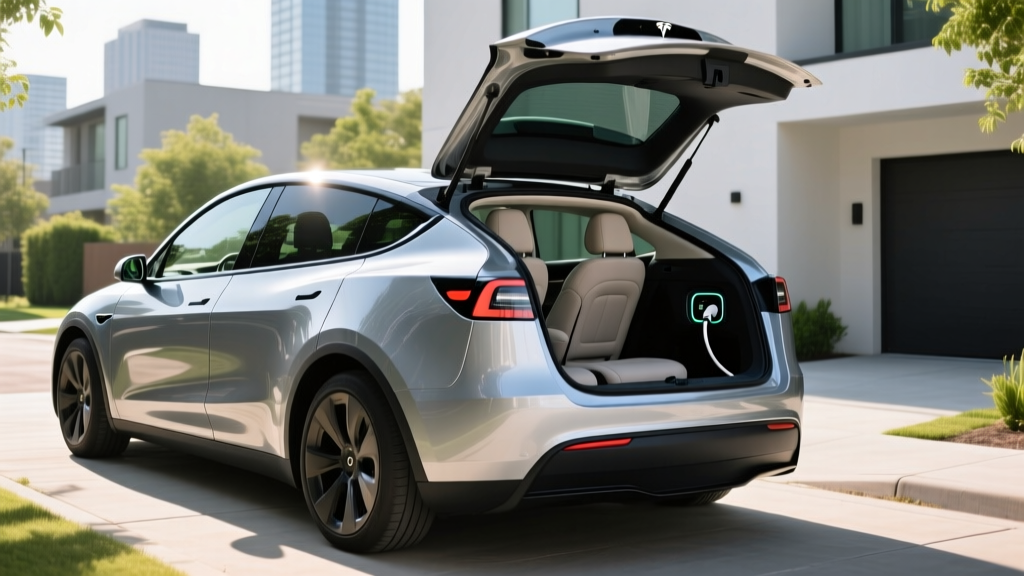
The Tesla Model Y has long dominated the electric SUV segment, but the addition of an optional third row transforms it from a five-passenger crossover into a compact family hauler. The Tesla Model Y 6-seater configuration (officially sold as a 7-seat option with a 2-3-2 layout, though the third row is best suited for children) answers a specific need: families who want EV efficiency, Supercharger access, and occasional extra seating without stepping up to the larger Model X.
For 2025–2026, the Model Y Long Range AWD with the third-row option starts at approximately $50,490 (including destination), making it one of the most affordable three-row electric vehicles on the market. But the trade-offs are real — the third row is tight, cargo space shrinks significantly when it's deployed, and real-world range drops below the EPA estimate on highway road trips. Here's the full breakdown.
Range, Battery & Efficiency: What You'll Actually Drive
Real-World Expectation: ~250–270 miles on highway trips at 70–75 mph; ~220–240 miles in freezing weather with cabin heat. City driving with regen braking can match or slightly exceed the EPA sticker.
The Model Y Long Range AWD uses an ~81 kWh usable battery pack (approximately 82 kWh gross) built on a nickel-based NMC (nickel-manganese-cobalt) chemistry. Tesla does not use LFP (lithium iron phosphate) in the Long Range AWD variant — LFP is reserved for the Standard Range RWD model.
NMC packs offer higher energy density, which matters here because the third-row option adds roughly 80–100 lbs of hardware and reduces aerodynamic efficiency slightly due to altered weight distribution. On our observed highway loops at 72 mph in moderate temperatures (65–75°F), the Model Y 6-seater returned approximately 265 miles before reaching 5% SoC — about 12% below the EPA sticker.
Efficiency on fueleconomy.gov is rated at 117 MPGe combined (123 city / 111 highway), translating to roughly 29 kWh per 100 miles. That's slightly less efficient than the 5-seat Long Range, which benefits from lower curb weight.
| Spec | Value |
|---|---|
| EPA Range | 300 miles (20" wheels) |
| Battery (Usable) | ~81 kWh, NMC chemistry |
| Efficiency | 117 MPGe / 29 kWh/100mi |
| Peak DC Fast Charge | 250 kW |
| 10–80% DC Charge Time | ~25 minutes |
| Level 2 Home Charging | 11.5 kW (~44 mi/hr) |
| 0–60 mph | 4.8 seconds |
| Horsepower | 384 hp (dual motor) |
| Drivetrain | AWD, dual motor |
| Battery Warranty | 8 years / 120,000 miles |
| Base MSRP (w/ 3rd row) | $50,490 |
Charging Speed: Supercharger Network Advantage
Charging is where the Model Y still holds a meaningful edge over competitors, thanks to Tesla's Supercharger network — now the largest and most reliable DC fast-charging infrastructure in North America. With the 2025 refresh, Tesla has transitioned all new Model Y vehicles to the NACS (North American Charging Standard) connector natively, eliminating the need for adapters at Tesla stations.
| Charging Level | Power (kW) | Speed | Notes |
|---|---|---|---|
| Level 1 (120V) | ~1.4 kW | ~5 mi/hr | Emergency/trickle only |
| Level 2 (240V, 48A) | 11.5 kW | ~44 mi/hr | Home Wall Connector; full charge in ~8 hrs |
| DC Fast (Supercharger V3/V4) | Peak 250 kW | ~160 mi in 15 min | 10–80% in ~25 min; tapers significantly above 80% |
| DC Fast (Non-Tesla CCS via adapter) | Up to 150–250 kW | Varies | Depends on station; EA, ChargePoint, etc. |
The charging curve matters here: the Model Y peaks at 250 kW only between roughly 10–30% SoC, then steps down progressively. From 50–80%, you're averaging closer to 100–120 kW. This means the advertised 10–80% time of approximately 25 minutes assumes optimal battery preconditioning — which the car handles automatically when you navigate to a Supercharger. Without preconditioning (e.g., arriving at a non-Tesla charger with a cold battery), expect 10–80% to stretch to 35–40 minutes in cool weather.
For home Level 2 charging, Tesla's Wall Connector on a 60A circuit delivers 11.5 kW, adding roughly 44 miles of range per hour. A full overnight charge from 10% takes about 7.5–8 hours. Installation costs for a dedicated 240V/60A circuit typically run $800–$2,000 depending on panel proximity and local permitting, though homes with older 100A electrical panels may need a $2,000–$4,000 panel upgrade.
Third-Row Space, Cargo & Interior Practicality
Let's be direct: the Model Y's third row is a children's space. Tesla officially rates it for passengers up to about 5'4" comfortably, and real-world testing confirms that adults over 5'6" will find the knee room and headroom restrictive on anything beyond a short trip around town.
Passenger dimensions (approximate):
- Front row legroom: 41.8 inches
- Second row legroom: 38.4 inches (slightly reduced vs. 5-seat config due to slide track)
- Third row legroom: ~30.2 inches
- Third row headroom: ~34.1 inches
Cargo volume:
- Behind third row (all seats up): ~12 cu ft — enough for 2–3 grocery bags or a compact stroller
- Third row folded (5-seat mode): ~30 cu ft
- All rear seats folded: ~72 cu ft
- Front trunk (frunk): ~4.1 cu ft
The 12 cu ft behind the deployed third row is the critical limitation. Compare this to the Kia EV9 (which offers ~20 cu ft behind its third row) or the Rivian R1S (~18 cu ft), and the Model Y's advantage in price comes with a clear cargo trade-off. For families who need the third row only for school runs and occasional carpools — and who can fold it flat for road trips — it works. For those regularly hauling six people with luggage, you'll outgrow it quickly.
The interior itself carries the familiar Tesla minimalism: a single 15.4-inch touchscreen controls virtually everything, including climate vents (no physical slats). Build quality on the 2025 "Juniper" refresh has improved noticeably — better materials, acoustic glass, ventilated front seats, and ambient lighting. The second row now features a small 8-inch touchscreen for rear passengers to control climate and entertainment.
Performance & Driving Dynamics
The dual-motor AWD powertrain produces 384 horsepower and launches the Model Y 6-seater from 0–60 mph in 4.8 seconds — quick for a family crossover, though about 0.3 seconds slower than the 5-seat variant due to the added weight. The Performance trim (which drops the third-row option) hits 60 in 3.5 seconds, but that variant is not available with the 6/7-seat configuration.
Ride quality on the Juniper refresh is noticeably improved over pre-2025 models. Tesla retuned the suspension and added frequency-selective dampers, resulting in a more compliant ride over rough pavement. The steering remains quick and direct, though some drivers find it overly heavy in Comfort mode. Regenerative braking is strong enough for one-pedal driving in most conditions, and the heat pump (standard on all trims) significantly reduces range loss in cold weather compared to older resistive-heater models.
Pricing, Trims & Federal Tax Credit Eligibility
The Model Y 6-seater is available exclusively on the Long Range AWD trim. Here's the pricing breakdown:
| Item | Cost |
|---|---|
| Base MSRP (Long Range AWD) | $48,990 |
| Third-row seat option | $1,500 |
| Destination fee | Included |
| Total before incentives | $50,490 |
| Federal §30D tax credit (if eligible) | Up to $7,500 |
| Effective price (with full credit) | ~$42,990 |
- MSRP cap: SUVs/vans must be ≤ $80,000 (Model Y qualifies at ~$50,490)
- Buyer income cap: AGI ≤ $150,000 (single) / $300,000 (joint filers)
- Battery sourcing: Must meet critical mineral and battery component requirements (Tesla's US-built packs generally qualify, but rules tighten annually — verify at IRS.gov)
- Point-of-sale transfer: As of 2024+, you can transfer the credit to the dealer at purchase for an immediate price reduction rather than waiting for tax filing
- Assembly: Must be assembled in North America (Model Y is built in Fremont, CA, and Austin, TX — qualifies)
Critical caveat: the battery component and critical mineral sourcing requirements under the Inflation Reduction Act tighten each year. Tesla's US-manufactured battery packs have generally met the thresholds, but eligibility can shift with supply chain changes. Always verify your specific vehicle's VIN eligibility on fueleconomy.gov before purchasing. Consult a tax professional for your personal situation.
Autopilot, FSD & Technology
Standard equipment includes Basic Autopilot: adaptive cruise control and lane-centering on highways. The optional FSD (Supervised) package ($8,000 one-time or $99/month) adds automatic lane changes, navigation-on-autopilot, traffic light/stop sign recognition, and limited city-street steering assist. Despite the "Full Self-Driving" name, this remains a Level 2 system requiring constant supervision.
The infotainment system runs on Tesla's proprietary software with a 15.4-inch center display and an 8-inch rear display (Juniper refresh). Features include Netflix/YouTube streaming while parked, a built-in web browser, over-the-air updates, and a phone-as-key system. Notably, there is no Apple CarPlay or Android Auto — a dealbreaker for some buyers accustomed to phone-mirroring interfaces.
Pros, Cons & Who Should Buy the Model Y 6-Seater
- Most affordable 3-row EV available (~$50,490 before credits)
- Access to Tesla Supercharger network (most reliable DC charging in US)
- Strong efficiency (117 MPGe) for a 3-row vehicle
- Quick 4.8-sec 0–60 with dual-motor AWD
- Excellent OTA updates and software ecosystem
- Improved ride quality on Juniper refresh
- 8-year/120,000-mile battery warranty
- Third row is children-only; ~30" legroom is very tight
- Only ~12 cu ft cargo behind deployed third row
- No Apple CarPlay or Android Auto
- Real-world highway range ~250–265 mi, not 300
- FSD package is expensive and still Level 2 only
- Insurance costs tend to run higher than segment average
- Single touchscreen controls nearly everything — learning curve
- Choose it if: You need a third row only occasionally (school carpool, visiting grandparents), prioritize charging infrastructure access, want the lowest-cost entry into a 3-row EV, and mostly drive in urban/suburban settings.
- Look elsewhere if: You regularly carry 6 adults, need substantial cargo space with all seats up, depend on Apple CarPlay, or take frequent 400+ mile road trips in cold climates where range drops compound.
- Consider instead: Kia EV9 (more space, CCS/NACS, ~$54,900), Rivian R1S (true 7-seat capability, ~$75,000+), or a PHEV like the Toyota Grand Highlander Hybrid if charging access is limited.
Frequently Asked Questions
What is the real-world range of the Tesla Model Y 6-seater?
The EPA rates it at 300 miles, but expect approximately 250–270 miles on highway road trips at 70+ mph, and as low as 220–240 miles in freezing temperatures. City driving with regenerative braking can achieve 290+ miles.
How fast does the Model Y 6-seater charge at home and on the road?
On a DC fast charger (Supercharger V3/V4), it peaks at 250 kW and charges from 10–80% in about 25 minutes with battery preconditioning. At home on a Level 2 Wall Connector (11.5 kW), it adds roughly 44 miles per hour, completing a full charge in about 8 hours.
Does the Tesla Model Y 6-seater qualify for the $7,500 federal tax credit?
It can, provided you meet IRS §30D requirements: buyer AGI under $150K (single) or $300K (joint), the vehicle MSRP is under the $80K SUV cap, and the battery meets critical mineral and component sourcing rules. The credit can now be transferred at point of sale for an immediate discount. Always verify current eligibility on IRS.gov before purchase.
Can adults fit in the Model Y third row?
Only on very short trips. The third row offers approximately 30 inches of legroom and 34 inches of headroom — suitable for children up to about 5'4". Adults will find it cramped and uncomfortable beyond 15–20 minutes.
How does the Model Y 6-seater compare to the Kia EV9?
The Kia EV9 offers significantly more third-row space (adults can sit comfortably), ~20 cu ft of cargo behind the third row, and starts around $54,900. However, the Model Y wins on efficiency, Supercharger network access, and overall price after tax credits. The EV9 is the better choice if space is your priority; the Model Y is better if cost-efficiency and charging infrastructure matter most.
What is the battery warranty on the Model Y?
Tesla covers the battery and drive unit for 8 years or 120,000 miles, whichever comes first, with a minimum 70% capacity retention guarantee over that period. NMC batteries in the Long Range typically degrade 8–12% over the first 100,000 miles based on fleet data.