Quick Verdict: Is the 6-Seater Tesla Model Y Worth It?
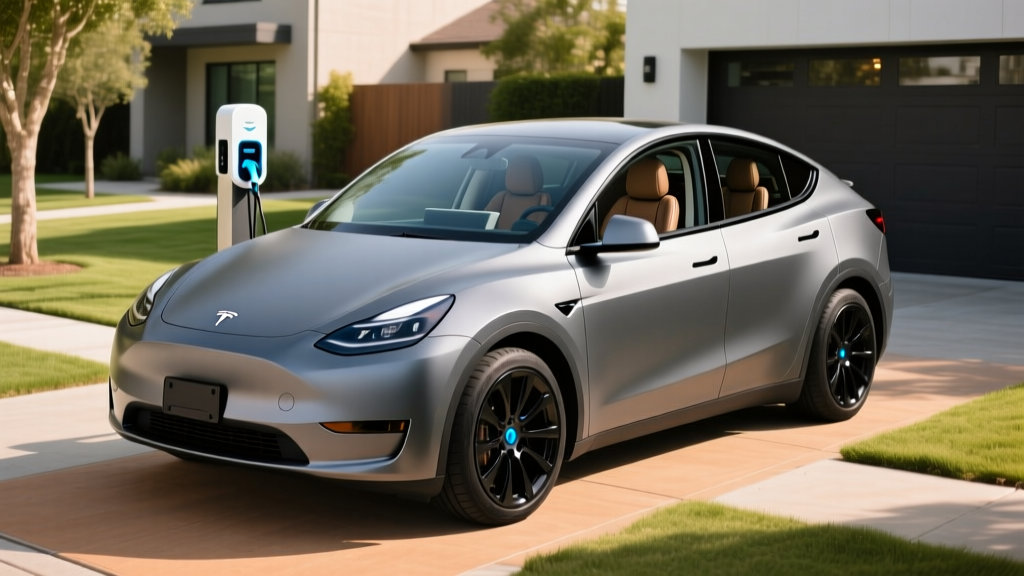
The Tesla Model Y has long dominated the electric crossover segment, but the addition of a third row transforms it into a legitimate family hauler. For 2026, the 6-seater Tesla Model Y offers two captain's chairs in the second row plus a compact third-row bench, seating up to six passengers. It's not a minivan replacement — that third row is best suited for children or short-trip adults — but it fills a critical gap between the five-seat Model Y and the far pricier Model X. With an EPA-estimated 310 miles of range on the Long Range AWD trim, access to the Tesla Supercharger network, and a starting price around $47,990 (including destination), the 6-seater Model Y remains one of the most compelling electric family vehicles on the market.
Real-World Range Expectations
EPA Estimate: 310 miles (Long Range AWD)
Highway driving (70-75 mph): Expect ~265-280 miles. Aerodynamic drag and higher speeds reduce efficiency noticeably.
Cold weather (below 32°F): Plan for 220-250 miles. Battery resistance and cabin heating draw significant energy.
City/commuter driving: You may exceed the EPA figure, reaching 320+ miles thanks to regenerative braking and lower speeds.
Bottom line: Budget for 270 miles of usable range on mixed road trips, and precondition the battery before DC fast charging to maximize speed.
Specs at a Glance: 2026 Tesla Model Y 6-Seater
| Attribute | Long Range AWD | Performance (if available) |
|---|---|---|
| EPA Range | 310 miles | ~285 miles |
| Battery Capacity | ~78.1 kWh usable (NMC) | ~78.1 kWh usable (NMC) |
| Drivetrain | Dual-Motor AWD | Dual-Motor AWD |
| Horsepower | 384 hp | ~456 hp |
| 0-60 mph | 4.8 seconds | 3.5 seconds |
| Max DC Fast Charge | 250 kW | 250 kW |
| 10-80% DC Charge Time | ~25 minutes | ~25 minutes |
| Level 2 Home Charge Rate | 11.5 kW (~44 mi/hr) | 11.5 kW (~44 mi/hr) |
| MPGe (combined) | 117 MPGe | ~111 MPGe |
| Energy Consumption | 28 kWh/100 mi | ~30 kWh/100 mi |
| Towing Capacity | 3,500 lbs | 3,500 lbs |
| Cargo (behind 3rd row) | 12.2 cu ft | 12.2 cu ft |
| Cargo (3rd row folded) | 34.3 cu ft | 34.3 cu ft |
| Cargo (all rows folded) | 72.1 cu ft | 72.1 cu ft |
| Base MSRP | $47,990 | ~$54,990 |
Sources: EPA / fueleconomy.gov, Tesla.com official specifications.
Battery, Charging & Efficiency
The 2026 Model Y Long Range uses a nickel-manganese-cobalt (NMC) lithium-ion battery pack with approximately 78.1 kWh of usable capacity. NMC chemistry provides high energy density — essential for fitting enough range into a crossover footprint — but it trades some cycle-life longevity compared to LFP (lithium iron phosphate) packs found in the base RWD Model Y. Tesla recommends daily charging to 80% for NMC batteries to minimize long-term degradation, reserving 100% charges for road trips.
DC Fast Charging
At a V3 Tesla Supercharger or compatible CCS/NACS DC fast charger, the Model Y peaks at 250 kW. However, as with all EVs, peak rate is not sustained rate. The charge curve tapers significantly after 50% state of charge (SoC). In real-world testing with a preconditioned battery:
- 10-50%: Sustains near 200-250 kW — adds roughly 150 miles in 12 minutes
- 50-80%: Tapers to 100-150 kW — adds another ~100 miles in 13 minutes
- 80-100%: Drops below 50 kW — not recommended for road-trip stops
Total 10-80% time averages about 25 minutes under optimal thermal conditions. In cold weather without adequate preconditioning, add 5-10 minutes to that figure.
Home Level 2 Charging
Using a Tesla Wall Connector on a 48-amp circuit (60-amp breaker), the Model Y charges at up to 11.5 kW, adding roughly 44 miles of range per hour. A full overnight charge from 20% to 80% takes about 4 hours — more than sufficient for daily driving. Installation typically costs $800-$2,000 depending on panel proximity and local permitting, assuming your home's electrical panel has capacity for a 60-amp circuit.
Efficiency
At 117 MPGe combined (28 kWh per 100 miles), the Model Y Long Range AWD is one of the most efficient all-wheel-drive electric crossovers available. For context, the Hyundai Ioniq 5 AWD achieves 113 MPGe combined, and the Ford Mustang Mach-E Extended Range AWD rates at 101 MPGe. Tesla's thermal management system — including a heat pump standard on all trims — contributes significantly to this efficiency, especially in moderate climates.
Interior, Space & the Third-Row Reality
The 6-seat configuration replaces the standard second-row bench with two individual captain's chairs separated by a small center console, then adds a two-seat third row behind. This layout improves second-row comfort and access to the third row, but it's essential to understand the spatial constraints.
Passenger Dimensions
- Front row headroom: 41.0 inches
- Front row legroom: 41.8 inches
- Second row headroom: 39.4 inches
- Second row legroom: 38.4 inches (with seat slide)
- Third row headroom: 36.1 inches
- Third row legroom: 26.5 inches
That 26.5 inches of third-row legroom is the critical number. It works for children aged roughly 4-12 in booster seats, or for adults on trips under 30 minutes. For comparison, the Kia EV9 (a dedicated three-row EV) offers 32.0 inches of third-row legroom, and the Chrysler Pacifica minivan offers 36.5 inches. The Model Y's third row is a solution for occasional use, not daily carpooling with teenagers.
Cargo Trade-Offs
With all three rows upright, you get 12.2 cubic feet behind the third row — enough for a few grocery bags or a compact stroller, but not a week's luggage for six. Fold the third row and cargo space opens to 34.3 cubic feet. Fold everything and you access 72.1 cubic feet, competitive with midsize SUVs. The front trunk (frunk) adds another 4.1 cubic feet for charging cables or a small bag.
Pricing, Trims & Federal Tax Credit Eligibility
The 2026 Tesla Model Y 6-seater is available as a $3,000 option on the Long Range AWD trim and the Performance trim. Here's how pricing breaks down:
| Trim | Base MSRP | 6-Seat Option | Destination | Total Before Credit | Est. After §30D Credit |
|---|---|---|---|---|---|
| Long Range AWD | $44,990 | +$3,000 | $1,990 | $49,980 | ~$42,480* |
| Performance | $51,990 | +$3,000 | $1,990 | $56,980 | ~$49,480* |
*Tax credit estimates assume full $7,500 eligibility. Actual credit varies based on buyer income, battery sourcing, and point-of-sale transfer rules.
Federal Tax Credit: IRS §30D Rules for 2026
The Model Y may qualify for up to $7,500 under the federal §30D Clean Vehicle Credit, but eligibility is not automatic. Key requirements include:
- MSRP cap: SUVs/crossovers must be priced at or below $80,000 (the Model Y qualifies)
- Buyer income cap: Modified AGI must not exceed $150,000 (single), $225,000 (head of household), or $300,000 (joint filers)
- Battery sourcing: Increasing percentages of critical minerals and battery components must be sourced from the US or FTA partners — Tesla has largely met these thresholds for the Model Y, but verify current-year compliance at IRS.gov
- Point-of-sale transfer: As of 2024, buyers can transfer the credit to the dealer at purchase, reducing the upfront price rather than waiting for a tax refund
Consult a tax professional and verify your specific eligibility before purchase. Rules can shift annually.
Performance, Ride & Driving Dynamics
The Long Range AWD Model Y pairs dual electric motors producing a combined 384 horsepower. The 0-60 mph sprint takes 4.8 seconds — quick enough to merge confidently onto any freeway and genuinely sporty for a six-passenger vehicle. The Performance trim drops that to 3.5 seconds with 456 hp, though the stiffer suspension tuning trades some ride comfort for cornering composure.
Ride quality on the Long Range is firm but well-damped. Tesla revised the suspension tuning in recent model years to better absorb sharp pavement impacts, though the Model Y still communicates more road texture than competitors like the Hyundai Ioniq 5 or Volkswagen ID.4. Noise insulation has also improved, with acoustic glass and additional sound-deadening reducing tire and wind noise at highway speeds.
Driver Assistance: Autopilot and FSD
Every Model Y includes Tesla's Basic Autopilot — adaptive cruise control and lane centering that functions as a solid SAE Level 2 driver-assistance system. The optional Full Self-Driving (Supervised) package ($8,000 one-time or $99/month) adds automatic lane changes, traffic light and stop sign recognition, and more assertive navigation-based driving.
⚠️ FSD Is Not Self-Driving
Tesla's Full Self-Driving (Supervised) is an SAE Level 2 system. You must keep your hands on the wheel and eyes on the road at all times. The system can make errors — missed construction zones, phantom braking, misread lane markings — and the driver is legally responsible for the vehicle's operation. True driverless operation (SAE Level 4) is only available in limited robotaxi services like Waymo, not in any consumer Tesla.
Tech, Software & Standout Features
Tesla's 15.4-inch center touchscreen runs the company's proprietary infotainment OS — responsive, visually clean, and tightly integrated with vehicle controls. There are no physical buttons for climate, mirrors, or glovebox; everything routes through the screen. Whether this is a pro or con depends on your tolerance for menu-diving while driving.
Notable Features
- Over-the-air updates: Tesla routinely pushes software improvements — new features, efficiency tweaks, UI refinements — without dealer visits
- Sentry Mode: 360-degree camera recording when parked, triggered by proximity or impact
- Dog Mode / Camp Mode: Maintains cabin climate for pets or keeps HVAC running for overnight camping
- Tesla app: Remote preconditioning, charge monitoring, location tracking, and Summon (low-speed parking lot movement)
- Supercharger network: 60,000+ fast chargers globally, with industry-leading reliability and seamless plug-and-charge billing
Notable Drawbacks
- No Apple CarPlay / Android Auto: Tesla's ecosystem is closed — if you rely on phone projection, this is a dealbreaker
- Turn signal stalk removal: The refreshed Model Y uses steering-wheel-mounted touch buttons for turn signals, which many drivers find unintuitive, especially in roundabouts
- Minimal physical controls: Adjusting mirrors, climate fan speed, or even the glovebox requires screen taps
- Third-row access: While the captain's chairs improve access, climbing into the third row still requires agility — not ideal for elderly passengers
Warranty & Ownership Costs
Tesla's warranty coverage is competitive but not class-leading:
- Basic vehicle: 4 years / 50,000 miles
- Battery & drive unit: 8 years / 120,000 miles (Long Range & Performance)
- Battery degradation threshold: Tesla warrants that the battery will retain at least 70% of its original capacity during the warranty period
For context, Hyundai covers the Ioniq 5's battery for 10 years / 100,000 miles, and Kia covers the EV9's for 10 years / 100,000 miles. Tesla's 8-year coverage is adequate but shorter than Korean competitors.
Insurance & Maintenance
Insurance premiums for the Model Y tend to run 15-25% higher than comparable gas crossovers, reflecting Tesla's higher repair costs and collision frequency data. Expect annual premiums of $1,800-$2,800 depending on your location, age, and driving record. Maintenance is minimal — no oil changes, no transmission fluid, and regenerative braking extends pad life significantly. Budget for cabin air filter replacement (~$100 every 2 years), tire rotation, and eventual tire replacement (EV-specific tires wear faster due to instant torque and vehicle weight).
Pros & Cons
✅ Pros
- 310-mile EPA range with best-in-class efficiency (117 MPGe)
- Supercharger network — the most reliable public charging infrastructure in North America
- 250 kW DC fast charging delivers ~200 miles in 15 minutes
- Strong performance: 4.8-second 0-60 even in the non-Performance trim
- Over-the-air updates continuously improve the vehicle
- Competitive pricing for a 6-seat electric SUV after tax credit
- Heat pump standard — better cold-weather range retention
❌ Cons
- Third row is cramped — 26.5" legroom limits use to children
- Only 12.2 cu ft of cargo with all rows up
- No Apple CarPlay or Android Auto
- Turn signal buttons on the steering wheel are divisive
- FSD requires constant supervision — it's not autonomous driving
- Insurance costs are above segment average
- Battery warranty shorter than Hyundai/Kia competitors
Who Should Buy the 6-Seater Tesla Model Y?
Choose the 6-Seat Model Y If:
- You have 1-2 young children who can use the third row occasionally, but don't need a full-size three-row SUV daily
- You prioritize charging speed and Supercharger network access for road trips
- You want an electric vehicle that can handle a 300-mile day with a single 20-minute stop
- Performance matters to you — 4.8-second 0-60 in a family crossover is genuinely quick
- You value OTA updates and a tech-forward ownership experience
Look Elsewhere If:
- You regularly carry 5-6 adults — the Kia EV9 or a used Model X offers more third-row space
- You need maximum cargo capacity with all seats occupied (consider the Rivian R1S or EV9)
- You depend on Apple CarPlay or Android Auto for navigation and media
- You want the longest battery warranty available (Hyundai/Kia offer 10 years)
- Your budget is under $40,000 — the 6-seat option pushes the Model Y above the entry-level EV price bracket
Frequently Asked Questions
What is the real-world range of the 6-seater Tesla Model Y?
The EPA rates the Long Range AWD at 310 miles. In real-world mixed driving at highway speeds, expect 265-280 miles. In cold weather (below freezing), range drops to roughly 220-250 miles due to battery resistance and cabin heating demands. Preconditioning the battery and using seat heaters instead of cabin heat can recover some of that loss.
How fast does the Model Y 6-seater charge?
On a V3 Supercharger or equivalent 250 kW DC fast charger, the Model Y charges from 10% to 80% in approximately 25 minutes with a preconditioned battery. At home on a Level 2 Tesla Wall Connector (11.5 kW / 48 amps), you'll add about 44 miles per hour, meaning a typical overnight session from 30% to 80% takes roughly 3.5 hours.
Does the 2026 Tesla Model Y qualify for the federal EV tax credit?
The Model Y Long Range AWD and Performance are generally eligible for up to $7,500 under IRS §30D, subject to buyer income caps ($300,000 joint / $150,000 single), the $80,000 SUV MSRP cap, and battery critical-mineral sourcing requirements. Tesla has largely met sourcing thresholds, but confirm current-year eligibility at IRS.gov before purchasing. The credit can be transferred at point of sale to reduce your purchase price directly.
How does the Model Y 6-seater compare to the Kia EV9?
The Kia EV9 offers significantly more third-row space (32.0" vs 26.5" legroom), more cargo room with all rows up, and a longer battery warranty (10 years vs 8 years). However, the Model Y offers better range (310 vs ~270 miles for EV9 AWD), faster DC charging, access to the Supercharger network, and a lower starting price. If third-row comfort for older children or adults is your priority, the EV9 wins. If range, charging speed, and value matter more, the Model Y holds the edge.
Is the Model Y third row safe for car seats?
Tesla provides LATCH anchors on the third-row seats, and the space accommodates forward-facing car seats and boosters for children roughly ages 4-10. Rear-facing infant seats are a tight fit and may require the second-row seats to be pushed uncomfortably forward. Always verify car seat compatibility with Tesla's owner manual and your specific seat model.
What's the biggest complaint from 6-seat Model Y owners?
The most consistent feedback centers on the limited cargo space when all three rows are in use (12.2 cu ft) and the tight third-row legroom for anyone over about 5'4". Owners who expected minivan-level space are often disappointed, while those who treat the third row as occasional overflow for kids tend to be satisfied.
For the latest EPA ratings and safety data, consult fueleconomy.gov and NHTSA.gov. Tax credit rules are subject to change — verify eligibility with a tax professional and the IRS before purchase.