The Quick Verdict: A 7-Seat EV With Caveats
The Tesla Model Y has offered an optional third row since its launch, but the 2026 refresh — built on the Juniper platform introduced in early 2025 — brings meaningful improvements in ride quality, cabin insulation, and efficiency that make the seven-seat configuration more livable than before. However, the third row remains best suited for children or occasional use, and adding it costs you both cargo flexibility and a small slice of range.
If you need a true three-row family hauler, the Kia EV9 or Rivian R1S will serve you better. But if your household needs occasional extra seating in a compact, efficient crossover footprint — and you want access to the Supercharger network — the Model Y with seven seats occupies a niche no other EV fills at its price point.
| EPA Range | 305 miles (est. w/ 3rd-row option) |
| Battery | ~78 kWh usable, NMC (nickel-manganese-cobalt) |
| Drivetrain | Dual-motor AWD |
| Horsepower | 384 hp (combined) |
| 0–60 mph | 4.8 seconds |
| Efficiency | 122 MPGe combined / 27 kWh/100 mi |
| Max DC Fast Charge | 250 kW (peak) |
| 10–80% DC Charge | ~25 minutes |
| Level 2 Home Charging | 11.5 kW (~44 mi/hr) |
| Base MSRP (5-seat LR AWD) | $48,990 |
| 3rd-Row Option | +$3,000 |
| As-Tested (7-seat, w/ FSD) | ~$59,990 |
| Battery Warranty | 8 years / 120,000 miles |
| Vehicle Warranty | 4 years / 50,000 miles |
EPA Range vs. Real-World: What Seven Seats Actually Costs You
EPA Estimate: 305 miles (Long Range AWD, 7-seat)
Real-World Expectation: Plan for ~255–275 miles on highway-heavy trips at 70–75 mph. In cold weather (below 30°F), expect a 15–25% reduction — roughly 230–250 miles with a full cabin of passengers and cargo.
The 2026 Model Y Long Range AWD carries a ~78 kWh usable NMC battery pack. Tesla's Juniper refresh improved thermal management and aerodynamic drag, yielding a modest efficiency bump over the pre-2025 model. On fueleconomy.gov, the five-seat Long Range AWD is rated at 315 miles; the seven-seat option adds approximately 60–80 pounds (the seat structure, belts, and hardware) and slightly alters rear airflow, trimming range by roughly 10 miles on the EPA cycle.
In practice, the bigger range enemy is passenger and cargo load. A full cabin of seven with luggage on a highway road trip will push consumption closer to 30–32 kWh/100 mi, yielding an effective range of 245–260 miles before you'd want to stop. For daily commuting with one or two passengers, hitting 280+ miles is realistic in mild weather with moderate speeds.
The Model Y's heat pump — standard on all 2026 trims — helps mitigate cold-weather cabin heating losses, but battery chemistry itself (NMC) is more cold-sensitive than LFP. Preconditioning the battery before fast charging or departure is essential in winter to preserve range and charging speed.
Charging Speed: DC Fast, Level 2, and the Supercharger Advantage
| Charging Level | Power | Speed (Miles Added/Hour) | Notes |
|---|---|---|---|
| Level 1 (120V) | ~1.4 kW | ~5 mi/hr | Emergency/trickle only |
| Level 2 (240V, 48A) | 11.5 kW | ~44 mi/hr | Full charge in ~7 hours |
| DC Fast (Tesla Supercharger V3/V4) | 250 kW peak | ~180 mi in 15 min (10–50%) | Tapers above 60% |
| DC Fast (CCS via adapter) | ~150 kW typical | Varies | Non-Tesla networks |
The Model Y's peak 250 kW DC fast-charging rate is competitive but no longer class-leading — the Hyundai Ioniq 5 and Kia EV6 can peak above 300 kW on 800V architectures. However, Tesla's advantage is the charging curve shape and the Supercharger network's reliability. The Model Y sustains strong charge rates through the 10–50% state-of-charge window, then tapers progressively. The 10–80% charge takes approximately 25 minutes under ideal conditions (warm battery, V3 or V4 Supercharger).
At home, the Model Y's onboard charger accepts up to 11.5 kW on a 240V/48A circuit. That translates to roughly 44 miles of range per hour of charging — enough to fully replenish the battery overnight in about 7 hours. Installation of a Tesla Wall Connector or equivalent Level 2 station typically costs $800–$2,000 including electrical work, depending on panel proximity and whether a 200-amp service upgrade is needed.
Since 2024, Tesla has opened the Supercharger network to non-Tesla EVs via the NACS connector standard, but Tesla owners still benefit from seamless plug-and-charge integration, automatic routing, and generally superior station uptime. For CCS-based public charging (Electrify America, EVgo), Tesla includes a CCS adapter, though charge speeds on non-Tesla hardware are typically capped around 150 kW.
Third-Row Space, Cargo Trade-Offs, and Interior Reality
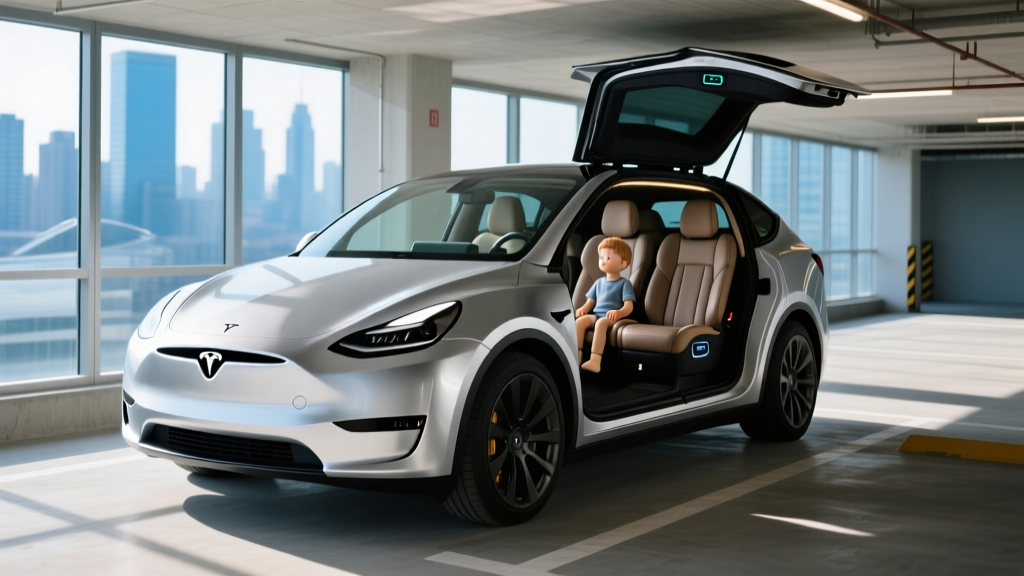
Let's address the central question directly: the Model Y's third row is not a minivan third row. It's a compact, rear-facing bench best described as suitable for children under about 5'4" or for adults on short trips of 20 minutes or less.
Third-row dimensions (approximate):
- Legroom: ~26.5 inches
- Headroom: ~33.5 inches
- Shoulder room: ~47 inches (shared bench)
Cargo volume:
- Behind third row: ~12 cu ft (enough for a couple of grocery bags or a stroller frame)
- Third row folded (5-seat mode): ~34 cu ft
- All rear rows folded: ~72 cu ft
- Front trunk (frunk): ~4.1 cu ft
With all seven seats occupied, you'll struggle to fit more than soft duffel bags or backpacks in the rear cargo area. This is the fundamental trade-off: the Model Y was designed as a midsize crossover, and shoehorning a third row into that footprint inevitably compromises cargo when all seats are in use. Families who regularly need seven seats and cargo space should look at the three-row Kia EV9 (up to 300 miles, genuinely spacious third row) or the Rivian R1S (up to 410 miles with the Max Pack, but $80,000+).
Where the Model Y seven-seat shines is the flexibility use case: a family of four that occasionally carpools two extra kids to soccer practice, or a couple who hosts visiting family a few times a year and needs temporary extra seating without stepping up to a larger, less efficient vehicle day-to-day.
The 2026 Juniper interior refresh adds improved materials, ventilated front seats, a rear-seat entertainment screen (8" display for second-row passengers), ambient lighting, and significantly better sound insulation — all of which make the cabin feel more premium and reduce the fatigue associated with a compact third-row experience.
Performance, Efficiency, and Driving Dynamics
The Long Range AWD powertrain pairs dual permanent-magnet motors producing a combined 384 horsepower. The 0–60 mph time of 4.8 seconds is brisk for a family crossover and more than adequate for highway merging and passing. The Performance trim (5-seat only) drops that to 3.5 seconds with 456 hp, but sacrifices the seven-seat option entirely.
Efficiency is where the Model Y continues to excel. At 122 MPGe combined (27 kWh/100 mi), it remains one of the most efficient all-wheel-drive electric crossovers on the market — a Tesla hallmark rooted in the company's motor, inverter, and thermal management engineering. For context, the Ford Mustang Mach-E Extended Range AWD achieves 101 MPGe combined, and the Hyundai Ioniq 5 AWD lands at 110 MPGe.
The Juniper suspension retuning yields a noticeably more compliant ride over the pre-2025 Model Y, which was often criticized for being overly firm. Body control remains composed, steering is precise if artificially weighted, and regenerative braking offers a strong one-pedal driving experience with two adjustable levels.
Pricing, Tax Credits, and Total Cost
| Base MSRP (5-seat LR AWD) | $48,990 |
| 3rd-Row Option | +$3,000 |
| 7-Seat LR AWD Base | $51,990 |
| FSD (Supervised) Add-On | +$8,000 (or $99/mo subscription) |
| Premium Interior / Paint Upgrades | +$0–$3,000 |
| As-Tested (7-seat, FSD, metallic paint) | ~$59,990 |
| Federal Tax Credit (§30D) | Up to $7,500 (see eligibility below) |
| Effective Price After Max Credit | From ~$44,490 |
The Model Y qualifies for the full $7,500 federal EV tax credit under IRS §30D for the 2026 tax year, provided the buyer meets all eligibility requirements. Since 2024, this credit can be transferred to the dealer at point of sale, effectively reducing the purchase price upfront rather than requiring you to wait for a tax refund.
Key §30D eligibility requirements for the Model Y:
- MSRP Cap: The vehicle must have an MSRP at or below $80,000 for SUVs — the Model Y 7-seat clears this easily at ~$51,990 base.
- Buyer Income Caps: Modified adjusted gross income must not exceed $300,000 (joint filers), $225,000 (head of household), or $150,000 (individual). See IRS.gov Clean Vehicle Credit for current rules.
- Battery Sourcing: A percentage of critical minerals and battery components must be sourced from the U.S. or FTA-partner countries. Tesla has progressively shifted Model Y battery supply chains, but verify current-year compliance on the IRS qualified vehicles list before purchasing.
- Final Assembly: Must occur in North America. The Model Y is assembled in Fremont, CA and Austin, TX — both qualifying.
Important: Tax credit eligibility can change mid-year as battery sourcing requirements tighten annually. Always confirm your specific vehicle's VIN qualifies on irs.gov or with your tax professional before finalizing a purchase.
Technology, Driver Assistance, and Safety
The Model Y runs Tesla's latest software on a 15.4-inch center touchscreen with no physical buttons. The Juniper refresh adds a rear-seat display, ventilated seats, power-folding second-row seats (helpful for third-row access), and improved Bluetooth/UWB phone-as-key reliability.
Autopilot is standard and includes adaptive cruise control, lane centering, and automatic emergency braking. Full Self-Driving (Supervised) — a $8,000 option or $99/month subscription — adds city-street navigation, traffic light/stop sign recognition, and automated lane changes. Critically, both systems are SAE Level 2 driver-assistance features: you must remain attentive, keep your hands available, and supervise at all times. Tesla's camera-based "Tesla Vision" system has no radar or lidar redundancy.
⚠️ SAE Level 2 — Not Self-Driving: Tesla Autopilot and FSD (Supervised) require continuous driver engagement. You are responsible for the vehicle at all times. Level 4 autonomy (no driver needed) currently exists only in geofenced robotaxi services like Waymo.
The Model Y earns a 5-star overall safety rating from NHTSA and has historically scored Top Safety Pick+ from IIHS, though buyers should verify the 2026 model year's specific test results as IIHS protocols evolve.
Pros, Cons, and Who Should Buy
✅ Pros
- Most efficient 7-seat electric crossover in its price range (122 MPGe)
- Access to Tesla Supercharger network — best public charging reliability
- Low price of entry for 7-seat EV: ~$44,490 after federal credit
- Strong real-world charging infrastructure (seamless plug-and-charge)
- Excellent software, OTA updates, and infotainment ecosystem
- Improved Juniper ride comfort and cabin quietness
❌ Cons
- Third row is child-sized — not viable for adults on longer trips
- Cargo space behind third row is minimal (~12 cu ft)
- Peak DC charge rate (250 kW) trails 800V competitors (300+ kW)
- No Apple CarPlay / Android Auto — Tesla-native infotainment only
- Tesla Vision (camera-only) can struggle in heavy rain, fog, or sun glare
- FSD remains a Level 2 system despite its name — value is debatable
Who Is the 7-Seat Model Y For?
Buy it if: You need occasional extra seating (carpool, visiting family) in a compact, efficient EV footprint; you value Supercharger access for road trips; your budget is $45K–$55K after credits; and your third-row passengers will mostly be children.
Look elsewhere if: You regularly carry six or seven adults; you need substantial cargo space with all seats in use; or you prefer physical controls and Apple CarPlay. Consider the Kia EV9 for a genuine three-row experience or the Rivian R1S for adventure-oriented families.
How It Compares: Model Y 7-Seat vs. the Alternatives
| Spec | Tesla Model Y LR AWD (7-seat) | Kia EV9 GT-Line AWD | Rivian R1S Dual-Motor |
|---|---|---|---|
| EPA Range | ~305 mi | ~280 mi | ~340 mi (Standard) / 410 mi (Max) |
| 3rd-Row Legroom | ~26.5 in | ~32.0 in | ~32.5 in |
| Cargo (behind 3rd row) | ~12 cu ft | ~20 cu ft | ~18 cu ft |
| 0–60 mph | 4.8 sec | 5.0 sec | 4.5 sec |
| DC Fast Charge (peak) | 250 kW | 210 kW (350 kW capable) | 220 kW |
| Base MSRP (7-seat) | ~$51,990 | ~$65,900 | ~$79,900 |
| After $7,500 Credit | ~$44,490 | ~$58,400 | ~$72,400 |
| Efficiency | 122 MPGe | 97 MPGe | ~105 MPGe |
The Model Y wins on price, efficiency, and charging network access. The EV9 wins on genuine three-row comfort and cargo. The R1S wins on range (with the Max Pack), off-road capability, and interior quality — but at nearly double the Model Y's effective price.
Frequently Asked Questions
What is the real-world range of the 7-seat Tesla Model Y?
The EPA rates the 2026 Model Y Long Range AWD with the 7-seat option at approximately 305 miles. In real-world highway driving at 70–75 mph with passengers, expect 255–275 miles. In cold weather below 30°F, plan for 230–250 miles. Preconditioning and moderate speeds help maximize range.
How fast does the Model Y charge at home and on the road?
On a home Level 2 charger (240V, 48A), the Model Y charges at 11.5 kW, adding about 44 miles of range per hour — a full charge takes roughly 7 hours. On a Tesla V3/V4 Supercharger, it peaks at 250 kW and charges from 10–80% in about 25 minutes, though the rate tapers significantly above 60% state of charge.
Does the 7-seat Model Y qualify for the $7,500 federal tax credit?
Yes, the Model Y qualifies for up to $7,500 under IRS §30D for eligible buyers in 2026, with the credit available as a point-of-sale transfer. Eligibility depends on buyer income (≤$300K joint), the vehicle's MSRP (must be ≤$80K for SUVs — the Model Y qualifies), and battery component/critical-mineral sourcing requirements. Confirm your specific vehicle's eligibility on irs.gov before purchase.
Is the third row practical for adults?
Not for trips longer than about 20 minutes. With ~26.5 inches of legroom and limited headroom, the third row is realistically designed for children or very short adult rides. Adults over 5'4" will find it cramped. If you need regular adult-capable third-row seating, the Kia EV9 or Rivian R1S are substantially more comfortable.
How much cargo space do you lose with the third row up?
With all seven seats occupied, you have approximately 12 cubic feet behind the third row — enough for a few soft bags or groceries but not luggage for a family trip. Fold the third row flat and you regain ~34 cu ft, which is competitive with five-seat crossovers. Fold all rear rows and you get ~72 cu ft plus a 4.1 cu ft frunk.
Is the Model Y 7-seat worth buying over competitors?
It depends on your use case. If you need an occasional 7-seat EV at the lowest price point with the best efficiency and charging network, the Model Y is unmatched. If you need a primary 7-seat family vehicle with real cargo space and adult-friendly third-row comfort, the Kia EV9 or Rivian R1S are better choices — at higher prices.