Verdict: The Family Hauler Tesla Buyers Have Been Asking For
The Tesla Model Y has dominated EV sales charts since its launch, but one persistent criticism followed it: no third row for growing families. The refreshed Model Y (internally dubbed the "Juniper" update) introduced an optional third-row seat in select markets, transforming it from a five-passenger crossover into a compact three-row SUV. For buyers searching for a Tesla 3-row SUV, this configuration finally answers the question — though with important trade-offs in cargo space, third-row comfort, and range that every prospective buyer needs to understand before ordering.
This review covers the Model Y Long Range AWD with the optional third-row seating package, examining real-world range, charging performance, family practicality, and whether it holds up against rivals like the Kia EV9, Hyundai Ioniq 9, and Rivian R1S.
Range, Battery, and Real-World Efficiency
Real-World Expectation: Plan for ~250–270 miles on highway road trips at 70+ mph. In freezing temperatures (below 32°F), expect a 20–30% reduction, bringing usable range down to ~200–220 miles without preconditioning. City driving with regenerative braking recovers closer to the EPA sticker.
| Spec | Value |
|---|---|
| EPA Range | 290 mi (3-row config) |
| Battery Capacity | ~82 kWh usable (NMC chemistry) |
| Efficiency | 122 MPGe combined / 28 kWh/100mi |
| Max DC Fast Charge | 250 kW (peak) |
| 10–80% DCFC Time | ~25 minutes |
| Level 2 Home Charging | 11.5 kW / ~36 mi/hr |
| Drivetrain | Dual-motor AWD |
| 0–60 mph | 4.8 seconds |
| Horsepower | 384 hp (combined) |
| Seating | 7 passengers (2+3+2) |
| Cargo (behind 3rd row) | ~12 cu ft |
| Cargo (3rd row folded) | ~34 cu ft |
| Cargo (all rear rows folded) | ~72 cu ft |
| Battery/Powertrain Warranty | 8 years / 120,000 miles |
| Base MSRP | $50,490 (Long Range AWD) + $2,500 (3-row option) |
The 82 kWh NMC (nickel manganese cobalt) battery pack provides solid energy density for the Model Y's weight class. Tesla's thermal management system remains one of the best in the industry, enabling consistent charging speeds and reducing degradation over time. However, NMC chemistry is more sensitive to sustained 100% state-of-charge than LFP — Tesla recommends daily charging to 80–90% for battery longevity, reserving 100% for road trips.
Efficiency drops slightly with the third-row option due to approximately 100 lbs of added weight from the extra seats, seatbelts, and structural reinforcement. At 28 kWh/100mi combined, the Model Y Long Range AWD remains competitive with the class, though the lighter 5-seat version achieves a marginally better 27 kWh/100mi.
Charging Performance: DC Fast Charging and Home Setup
Charging speed is where Tesla's Supercharger network advantage becomes tangible. The Model Y Long Range peaks at 250 kW on V3 Superchargers, though it doesn't sustain that rate for the entire session. Here's what the charging curve actually looks like:
| Charging Level | Power (kW) | Speed | Notes |
|---|---|---|---|
| Level 1 (120V) | ~1.4 kW | ~4 mi/hr | Emergency/trickle only |
| Level 2 (240V, 48A) | 11.5 kW | ~36 mi/hr | Home Wall Connector, 8–9 hr full charge |
| DC Fast (V3 Supercharger) | 250 kW peak | 10–80% in ~25 min | Tapers above 60%; precondition battery via nav |
| DC Fast (CCS adapter, 3rd-party) | Up to 150–250 kW | Varies by station | Tesla CCS adapter included; speeds depend on station |
Charging curve reality check: The 250 kW peak occurs between roughly 10–30% state of charge. From 30–60%, expect ~170–200 kW. Above 60%, the rate tapers significantly to protect battery health — 60–80% takes nearly as long as 10–60%. This is standard for NMC packs, but it means a 10–80% session takes ~25 minutes, not the "15 minutes" you'd get if peak rate were sustained.
Preconditioning matters. When you navigate to a Supercharger using the car's built-in navigation, the battery preheats to optimal temperature before arrival. Without preconditioning (e.g., arriving at a charger without nav routing), peak charge rates can drop by 30–50% in cold weather. Always route through the car's nav for fastest charging.
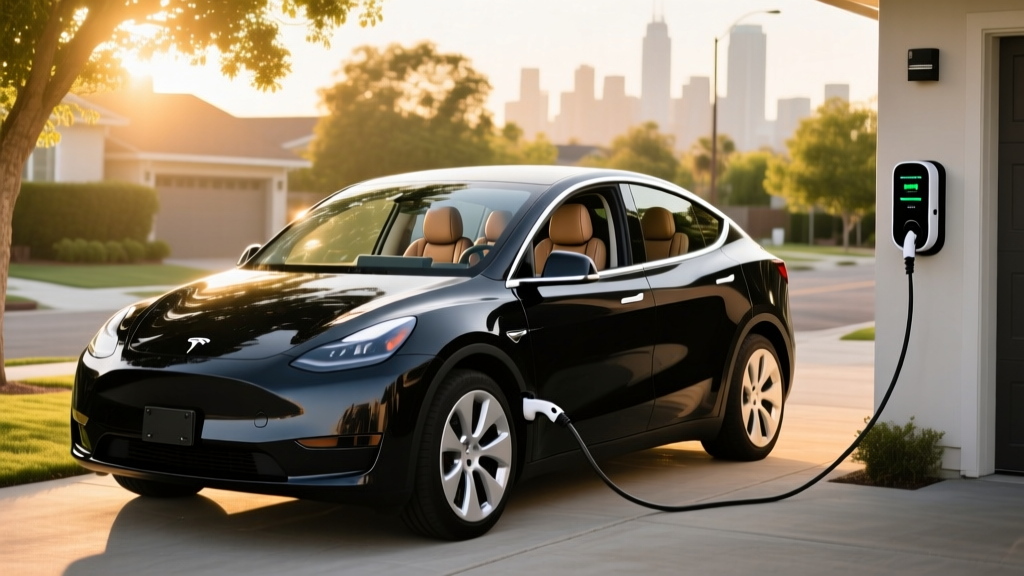
For home charging, Tesla's Wall Connector at 48 amps on a 60-amp circuit delivers 11.5 kW — enough to fully recharge overnight. Most 3-row SUV buyers with daily commutes under 60 miles will rarely need public charging. Budget $500–$1,500 for professional Level 2 installation (electrician + permit), or more if your panel needs a 200-amp upgrade.
Performance and Driving Dynamics
The dual-motor AWD powertrain produces 384 combined horsepower and rockets the Model Y to 60 mph in 4.8 seconds — quick for any SUV, let alone a three-row family hauler. Instant torque delivery makes highway merging and city driving feel effortless, and the low center of gravity (battery pack under the floor) keeps body roll surprisingly controlled for a crossover this tall.
Ride quality improved significantly with the Juniper refresh: revised dampers, acoustic glass, and additional sound deadening reduce road noise and harshness. The 3-row variant carries slightly more weight over the rear axle, which marginally improves rear-end composure over bumps but slightly increases stopping distances.
Towing: The Model Y Long Range AWD is rated for 3,500 lbs of towing capacity — adequate for a small camping trailer or a pair of jet skis, but well below the Rivian R1S (7,700 lbs) or Kia EV9 (5,000 lbs). If you need serious towing, the Model Y is not the right tool.
Interior, Third-Row Practicality, and Tech
This is where the 3-row Model Y demands honest scrutiny. The third row is best described as occasional use — suitable for children or shorter adults on trips under 30 minutes. Legroom in the third row measures approximately 26 inches, compared to 38+ inches in the second row and 41 inches up front. Headroom is adequate for passengers under 5'8", but the sloping roofline (a Model Y design signature) cuts into space for taller riders.
Cargo trade-off: With all three rows upright, you get roughly 12 cubic feet behind the third row — enough for a couple of grocery bags or a small stroller, but not much else. Fold the third row and you reclaim ~34 cu ft, which is practical for weekly family logistics. Fold both rear rows flat and you access ~72 cu ft, competitive with midsize SUVs.
Tech highlights:
- 15.4-inch center touchscreen running Tesla's latest software (fast, responsive, frequent OTA updates)
- 8-inch rear touchscreen for second-row passengers (climate, media, entertainment)
- Tesla Autopilot standard (SAE Level 2 driver assistance — lane centering, adaptive cruise, traffic-aware)
- Full Self-Driving (Supervised) available as a $8,000 add-on — still Level 2, requires active driver supervision at all times
- Sentry Mode dashcam recording, HEPA air filtration (Bioweapon Defense Mode), and phone-as-key
- No Apple CarPlay or Android Auto — Tesla's native interface is the only option
Pricing, Trim Levels, and Federal Tax Credit
| Configuration | MSRP | Est. After §30D Credit |
|---|---|---|
| Long Range AWD (5-seat) | $50,490 | ~$42,990* |
| Long Range AWD (3-row option) | $52,990 | ~$45,490* |
| Performance AWD (5-seat only) | $54,490 | ~$46,990* |
*Tax credit estimates assume full eligibility. See requirements below.
The Model Y Long Range AWD with the 3-row option prices at $52,990 before any incentives. As an SUV, it falls under the IRS §30D MSRP cap of $80,000, so it clears the price threshold. However, eligibility for the full $7,500 federal tax credit depends on several factors that change periodically:
- Buyer income caps: Modified AGI must not exceed $150,000 (single), $225,000 (head of household), or $300,000 (joint filing)
- MSRP cap: SUVs/vans/pickups capped at $80,000 — Model Y qualifies
- Battery sourcing requirements: Critical minerals and battery components must meet phased-in domestic/free-trade sourcing thresholds. Tesla's US-built batteries have largely met these requirements, but verify current-year compliance at IRS.gov before purchasing
- Point-of-sale transfer: Eligible buyers can transfer the credit to the dealer at purchase, reducing the upfront price rather than waiting for tax filing
Always confirm eligibility with a tax professional and check the latest IRS guidance, as battery-sourcing rules tighten annually and can shift mid-year based on supply chain changes.
How It Compares: Model Y 3-Row vs. the Competition
The 3-row electric SUV segment has grown considerably. Here's how the Model Y stacks up against key rivals:
| Metric | Tesla Model Y (3-row) | Kia EV9 LR AWD | Rivian R1S Dual-Motor |
|---|---|---|---|
| EPA Range | 290 mi | 280 mi | 340 mi (Max Pack) |
| Battery | 82 kWh NMC | 99.8 kWh NMC | 149 kWh (Max) NMC |
| 3rd-Row Legroom | ~26 in | ~32 in | ~30 in |
| Max DCFC | 250 kW | 236 kW | 200 kW |
| Towing | 3,500 lbs | 5,000 lbs | 7,700 lbs |
| Base MSRP (3-row) | $52,990 | $60,400 | $82,700 |
| Charging Network | Supercharger (native) | NACS (Supercharger access) | NACS (Supercharger access) |
- Choose the Model Y 3-row if: You want the lowest price of entry, best charging network access, over-the-air updates, and your third-row passengers are primarily children. Ideal for daily family commuting with occasional carpools.
- Choose the Kia EV9 if: You need a genuinely usable third row for adults, more cargo space with all seats up, and don't mind paying ~$7,000 more. Better for families who regularly carry 6–7 passengers.
- Choose the Rivian R1S if: You need serious towing capacity, off-road capability, maximum range, and have the budget for a premium adventure SUV. Overkill for school runs; ideal for outdoor families.
Pros, Cons, and Who Should Buy
- Lowest-priced 3-row EV on the market
- Supercharger network access (most reliable DCFC in the US)
- Strong efficiency for its size (28 kWh/100mi)
- Quick acceleration (4.8s 0–60) with dual-motor AWD
- Continuous OTA software improvements
- Excellent safety ratings (NHTSA 5-star, IIHS Top Safety Pick+)
- Strong resale value relative to EV segment average
- Third row is tight — children only for anything beyond short trips
- Minimal cargo space with all three rows upright (~12 cu ft)
- No Apple CarPlay or Android Auto
- Touchscreen-only controls (no physical buttons for climate, etc.)
- 3,500-lb towing limit trails competitors
- Insurance costs run 15–25% above segment average
- Visibility rearward is compromised with 3rd-row seats up
Who this EV suits best: The 3-row Model Y is ideal for families with younger children (under 12) who need occasional extra seating for carpools, grandparents, or playdate shuttles — but whose daily reality is 4–5 passengers. If your third row will be in constant use with teenagers or adults, look at the larger Kia EV9 or wait for the Tesla Model Y refresh with a stretched wheelbase. For two-adult households who want the option "just in case," it's a smart, efficient choice at a competitive price.
Frequently Asked Questions
What is the real-world range of the Tesla Model Y 3-row?
The EPA rates the 3-row Model Y Long Range AWD at 290 miles. In real-world highway driving at 70–75 mph, expect 250–270 miles. In cold weather (below freezing), range can drop to 200–220 miles without battery preconditioning. For road trip planning, budget 220–240 miles between charging stops to maintain a comfort margin.
How fast does the Model Y charge at home and on the road?
At home on a Level 2 Tesla Wall Connector (48A/240V), the Model Y charges at 11.5 kW, adding roughly 36 miles of range per hour — a full charge takes about 8–9 hours. On DC fast chargers, it peaks at 250 kW on V3 Superchargers, reaching 10–80% in approximately 25 minutes with battery preconditioning. Third-party CCS stations (using Tesla's included adapter) deliver similar speeds at compatible stations.
Does the Tesla Model Y 3-row qualify for the $7,500 federal tax credit?
It can, but eligibility depends on your income (under $300K joint / $150K single), the vehicle's battery-sourcing compliance with current-year critical-mineral rules, and the $80K SUV MSRP cap (which the Model Y clears). The credit can be transferred at point of sale to reduce your purchase price directly. Verify current eligibility at IRS.gov and consult a tax professional before finalizing your order.
Is the third row practical for adults?
For short trips under 20–30 minutes, adults under 5'8" can manage. For anything longer, the ~26 inches of legroom and sloping roofline make it uncomfortable. This third row is designed primarily for children, and Tesla markets it accordingly. If you regularly transport six or seven adults, the Kia EV9 or a used Rivian R1S will serve you better.
How does the Supercharger network compare to other charging networks?
Tesla's Supercharger network remains the most reliable DC fast-charging network in the US, with higher uptime rates and simpler plug-and-charge billing than Electrify America, EVgo, or ChargePoint. As of 2025–2026, Kia, Ford, Rivian, and others have gained Supercharger access via NACS adapters — which increases station congestion but also validates the network's superiority. Model Y owners still enjoy seamless native integration with no adapters required.
What's the battery warranty, and how long will it last?
Tesla covers the Model Y battery and drive unit for 8 years or 120,000 miles, whichever comes first, with a minimum 70% capacity retention guarantee. Real-world data from high-mileage Model Y owners suggests NMC packs typically retain 85–90% capacity at 100,000 miles when following Tesla's recommended charging practices (daily limit of 80–90%, occasional 100% for trips). Full battery replacement, if needed out of warranty, currently runs $12,000–$16,000 at Tesla service centers.
Is it worth buying vs. the competition?
At $52,990 before incentives, the 3-row Model Y Long Range is the most affordable 3-row EV available, backed by the best charging infrastructure and strong efficiency. If the third row is for kids and carpools, it's the value leader. If you need a real third row for adults, the extra $7,000–$10,000 for a Kia EV9 is justified by significantly better space and comfort. For towing or off-road needs, the Rivian R1S is in a different class entirely.