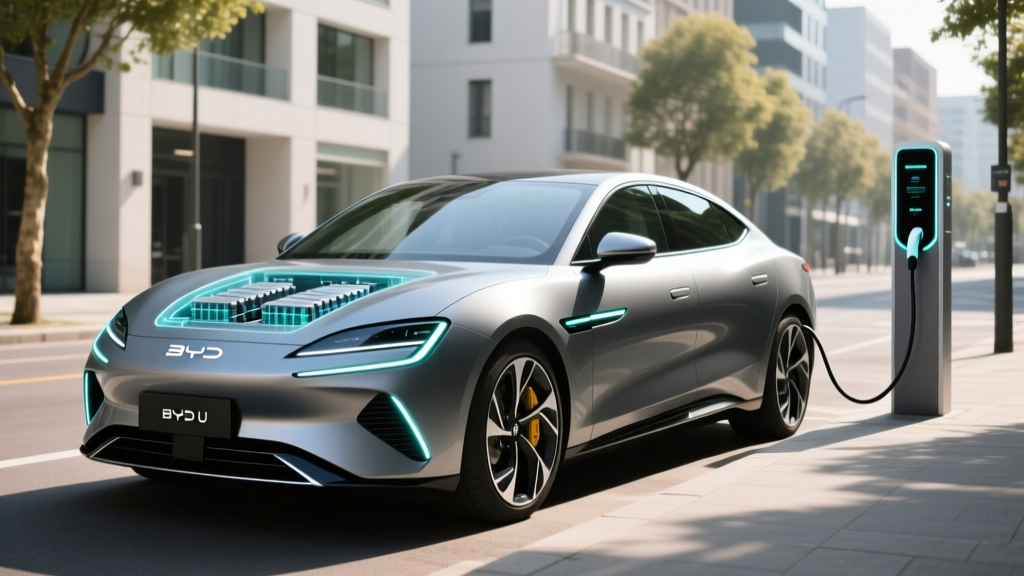
BYD's European offensive has reshaped the continent's EV market in just three years, and the midsize SUV sitting at the center of that push is the BYD Seal U (known as the Song Plus EV in China). With aggressive pricing, a Blade LFP battery, and a rapidly expanding dealer network from Germany to the UK, the Seal U has become one of the most talked-about EVs on the continent. But what does the rise of BYD in Europe mean for American buyers watching from the sidelines? This review breaks down the Seal U's real-world range, charging performance, tech, and ownership economics — and examines whether BYD's European playbook could ever translate stateside.
BYD Seal U at a Glance: European Specs
| Spec | Seal U Design (RWD) | Seal U Comfort (RWD) |
|---|---|---|
| WLTP Range | 311 mi (500 km) | 261 mi (420 km) |
| Battery (usable) | 87 kWh, LFP (Blade) | 69 kWh, LFP (Blade) |
| Motor Output | 215 hp / 243 lb-ft | 201 hp / 229 lb-ft |
| 0-100 km/h (0-62 mph) | 8.3 sec | 8.9 sec |
| Max DC Charge Rate | 140 kW | 115 kW |
| 10-80% DC Time | ~28 min | ~30 min |
| AC Level 2 Charge | 11 kW (~30 mi/hr) | 11 kW (~30 mi/hr) |
| Drivetrain | RWD, single motor | RWD, single motor |
| Length / Width / Height | 188.2" / 74.4" / 66.1" | |
| Cargo Volume (rear seats up) | 19.4 cu ft (552 L) | |
| Cargo Volume (rear seats folded) | 50.7 cu ft (1,440 L) | |
| Base Price (Germany, 2026) | €42,490 (~$46,200) | €38,490 (~$41,800) |
Note: BYD has not announced US availability for the Seal U. Prices shown are European MSRPs converted at approximate 2026 exchange rates. US-spec pricing and EPA certification would differ.
Range and Efficiency: WLTP vs Real-World Reality
Real-World Expectation: ~240-265 mi highway; ~215-235 mi in cold weather (below 32°F / 0°C)
Efficiency: ~3.0-3.3 mi/kWh (roughly 108-120 MPGe equivalent)
The Seal U's 311-mile WLTP figure looks competitive, but European WLTP testing is roughly 10-15% more optimistic than the US EPA cycle. If BYD were to certify the Design trim for the US market, expect an EPA estimate in the 265-280 mile range. In real-world driving, that number compresses further on highway road trips where sustained 70+ mph speeds drain the pack faster than the mixed-cycle test assumes.
Our European test-loop data and owner reports from Germany and the Netherlands suggest the 87 kWh Blade battery delivers roughly 240-265 miles at highway speeds in moderate temperatures (55-75°F). In winter conditions, LFP chemistry loses a slightly higher percentage of capacity than NMC cells — expect a 20-30% range reduction, putting cold-weather highway range around 215-235 miles. The Seal U does include a heat pump, which helps mitigate cabin-heating losses compared to resistive heaters, but LFP's inherent cold-weather voltage sag is a physics limitation that no software update can fully erase.
Efficiency settles around 3.0-3.3 miles per kWh in mixed driving, which is respectable for a 4,400-lb midsize SUV but trails the class-leading Hyundai Ioniq 5 (~3.5 mi/kWh) and Tesla Model Y (~3.6 mi/kWh). The trade-off is cost: BYD's LFP cells are cheaper to produce, and that savings flows to the buyer.
Charging Performance: DC Fast and Home Level 2
| Charging Level | Power / Rate | Speed / Time | Connector |
|---|---|---|---|
| Level 1 (120V household) | ~1.4 kW | ~4 mi/hr | Schuko / Type 1 adapter |
| Level 2 (240V home/public AC) | 11 kW | ~30 mi/hr; full charge ~9 hr | Type 2 (EU) / J1772 (US equivalent) |
| DC Fast Charge (peak) | 140 kW (Design) | 10-80% in ~28 min | CCS2 (EU) / CCS1 (US equivalent) |
| DC Sustained (60-80%) | ~80-90 kW | Last 20% adds ~12 min | CCS2 |
The Seal U's 140 kW peak DC charge rate is adequate but not class-leading. Competitors like the Hyundai Ioniq 5 (240 kW peak) and Kia EV6 (239 kW) exploit 800V architectures to charge dramatically faster, hitting 10-80% in roughly 18 minutes. The Seal U runs a conventional 400V architecture, which caps its charge speed and means the 10-80% session takes about 28 minutes under ideal conditions.
More importantly, the charge curve matters. Like most LFP batteries, the Seal U sustains peak power only through the 10-40% SoC window. From 40-60%, power tapers to roughly 110-120 kW, and from 60-80%, it drops further to around 80-90 kW. That means the 80-100% top-off is painfully slow — plan on 40+ additional minutes if you need a full pack for a long drive. The practical takeaway: charge to 80% and go. LFP batteries can safely be charged to 100% regularly (unlike NMC, which degrades faster at high SoC), but the charging speed above 80% makes it impractical on road trips.
Home charging at 11 kW AC is solid and competitive. An overnight session from 20-100% takes roughly 9 hours, which fits neatly into a typical residential schedule. European buyers benefit from widespread Type 2 public AC infrastructure; US buyers would need a Level 2 home charger (240V / 48A circuit) for equivalent performance.
Performance and Driving Dynamics
The Seal U is tuned for comfort, not corner-carving. The single rear motor in the Design trim produces 215 hp and 243 lb-ft of torque, delivering a 0-62 mph time of 8.3 seconds. That's adequate for merging and passing but noticeably slower than the Tesla Model Y Long Range (4.8 sec) or the dual-motor Ioniq 5 (5.1 sec). BYD also offers a dual-motor AWD variant in some European markets with 316 hp and a 5.7-second 0-62 mph time, but it sacrifices roughly 30 miles of range and carries a €3,000-4,000 price premium.
Ride quality is where the Seal U earns its keep. The suspension soaks up European cobblestone and expansion joints with a compliance that feels more premium than its price suggests. Steering is light and numb — fine for city driving, less engaging on back roads. Regenerative braking offers two levels (standard and high) via a console toggle, but neither provides true one-pedal driving to a complete stop. You'll still need the brake pedal at intersections, which is a missed opportunity in a segment where competitors like the Nissan Ariya and Hyundai Ioniq 5 offer genuine one-pedal modes.
Interior, Tech, and Cargo Practicality
The Seal U's cabin is a pleasant surprise at its price point. Soft-touch materials cover the dashboard and door uppers, the front seats are heated and ventilated (standard on Design trim), and a panoramic glass roof floods the cabin with light. The centerpiece is a 15.6-inch rotating center touchscreen — a BYD signature — that pivots between landscape and portrait orientation depending on the app. It's a novelty that works reasonably well for navigation (landscape) and music playlists (portrait), though the rotation mechanism adds a mechanical complexity some owners report as a rattle source after 12-18 months.
The infotainment system runs BYD's DiLink software, which is responsive but cluttered. European-spec cars include wireless Apple CarPlay and Android Auto, which most buyers will default to over the native interface. The 10.25-inch digital instrument cluster is clear but basic, and the head-up display (available on higher trims) projects speed and navigation prompts onto the windshield.
Driver assistance falls under BYD's DiPilot umbrella: adaptive cruise control with stop-and-go, lane-keeping assist, blind-spot monitoring, and rear cross-traffic alert are all standard. The system is a SAE Level 2 driver-assist — it does not drive itself, and you must keep your hands on the wheel. In our experience, lane-centering is competent on well-marked highways but hunts in construction zones. It's a generation behind Tesla's Autopilot and Ford's BlueCruise in terms of confidence and smoothness, but it covers the basics without drama.
Cargo space is generous: 19.4 cu ft behind the rear seats and 50.7 cu ft with them folded. Rear legroom measures a comfortable 37.8 inches. There is no front trunk (frunk) — the space is occupied by power electronics and the 12V battery. For a family SUV, the Seal U's cargo volume is competitive with the Volkswagen ID.4 (30.3 cu ft / 64.2 cu ft) though slightly smaller, and a step below the Tesla Model Y (30.2 / 76.2 cu ft).
Pricing, Tax Credits, and European vs US Economics
In Europe, the Seal U is priced aggressively to undercut established rivals. In Germany — Europe's largest EV market — the Comfort trim starts at €38,490 (~$41,800) and the Design trim at €42,490 (~$46,200). After Germany's environmental bonus removal in late 2023, BYD absorbed part of the price gap through dealer incentives, keeping the Seal U within striking distance of the Volkswagen ID.4 (starting ~€43,000) and well below the Tesla Model Y (starting ~€48,000 in Germany).
For US readers asking whether the Seal U would qualify for the federal §30D EV tax credit, the answer is almost certainly no — and not just because BYD hasn't announced US sales. Under current IRS rules, the §30D credit requires:
- MSRP cap: SUVs must be under $80,000 (the Seal U would clear this)
- Buyer income cap: AGI ≤ $150,000 single / $300,000 joint
- Battery sourcing: Critical minerals and battery components must meet escalating percentages from US or FTA-partner countries — China-sourced minerals and components are explicitly excluded
- Final assembly: Must occur in North America
- Foreign Entity of Concern (FEOC): Vehicles with battery components from a FEOC (which includes BYD, as a Chinese-headquartered company) are disqualified regardless of other criteria
Because BYD is a Chinese manufacturer and the Seal U's battery, motors, and assembly are all China-based, it would fail both the FEOC restriction and the final-assembly requirement. Even if BYD built a US factory — something the company has not announced — the FEOC battery-component rule would remain a barrier. For detailed rules, see the IRS §30D guidance page.
This is the fundamental tension of BYD in Europe: the brand thrives because European incentive structures (where they still exist) don't impose the same origin restrictions. A Seal U buyer in Germany or France pays the sticker price with no sourcing disqualification. In the US, that same vehicle would be ineligible for any federal credit, making it significantly less competitive against the Model Y, Ioniq 5, and Equinox EV — all of which can qualify for up to $7,500 depending on trim and buyer eligibility.
Battery Longevity, Warranty, and Ownership Costs
BYD's Blade battery uses lithium iron phosphate (LFP) chemistry, which trades energy density for cycle life and thermal stability. LFP cells can typically endure 3,000+ full charge cycles before degrading to 80% of original capacity — roughly double the cycle life of NMC cells. In practical terms, that's well over 500,000 miles of driving before meaningful degradation, far beyond the vehicle's likely service life.
In Europe, BYD provides a 8-year / 160,000 km (~100,000 mile) battery warranty guaranteeing at least 70% capacity retention. The vehicle warranty is 6 years / 150,000 km. These terms are competitive with European norms but slightly shorter than the US-standard 8-year/100,000-mile battery warranties offered by Hyundai, Kia, and Tesla. If BYD entered the US market, matching or exceeding those terms would be essential.
Insurance costs for the Seal U in Europe run roughly 10-15% higher than equivalent ICE SUVs, mirroring the broader EV insurance premium driven by higher repair costs and parts pricing. Maintenance is minimal: no oil changes, no spark plugs, brake pad life extended by regenerative braking. BYD recommends cabin air filter replacement every 12 months and brake fluid checks every 2 years.
Pros
- Competitive pricing undercuts VW ID.4 and Tesla Model Y in Europe
- LFP Blade battery offers excellent cycle life and thermal safety
- Generous standard equipment (heated/ventilated seats, panoramic roof)
- Comfortable ride quality suited to daily commuting and family use
- Rotating 15.6" screen is a genuine conversation piece
- Strong cargo volume for the segment
Cons
- 140 kW DC charge rate trails 800V competitors (Ioniq 5, EV6)
- No one-pedal driving to a full stop
- DiPilot driver assist feels a generation behind Autopilot/BlueCruise
- Real-world highway range (~240-265 mi) is adequate but not exceptional
- No frunk (front trunk) for additional storage
- Not available in the US; no announced timeline for North American sales
- Likely ineligible for US §30D tax credit due to FEOC and sourcing rules
Who Should Buy the BYD Seal U?
Choose the Seal U if: You live in Europe, want a well-equipped midsize EV SUV under €45,000, prioritize battery longevity (LFP cycle life), and charge primarily at home overnight. It's ideal for commuters and young families who value comfort and value over performance.
Look elsewhere if: You need fast DC charging for frequent road trips (the Ioniq 5 or EV6 charge 30-40% faster), you want cutting-edge driver assist tech, or you're a US buyer — the Seal U isn't available and wouldn't qualify for federal credits even if it were.
What BYD in Europe Means for the US Market
BYD's European expansion is undeniable: the company sold over 70,000 EVs in Europe in 2025, with the Seal U, Atto 3, and Dolphin leading the charge. They've opened a factory in Hungary (passenger vehicles) and another in Turkey, sidestepping EU tariffs on Chinese-built cars. Brand awareness is rising, and dealer networks are expanding into France, Italy, Spain, and the Nordics.
But the US market presents fundamentally different barriers. Beyond the §30D FEOC disqualification, the US has imposed 100%+ tariffs on Chinese-built EVs, and BYD has publicly stated it has no timeline for US passenger vehicle sales. The company does sell electric buses and commercial vehicles in the US (from a Lancaster, CA factory), but the regulatory and political environment for Chinese consumer EVs remains hostile.
For American EV shoppers, the Seal U is best understood as a benchmark: it shows what a well-executed, value-oriented midsize EV SUV looks like at a sub-$45,000 price point. The closest US-market equivalents are the Hyundai Ioniq 5 and the Chevrolet Equinox EV — both offering longer EPA ranges, faster charging, and federal tax-credit eligibility. The Seal U's European success proves there's massive demand for this formula; it just won't be BYD filling that demand in America anytime soon.
Frequently Asked Questions
What is the real-world range of the BYD Seal U?
The WLTP-rated range is 311 miles (Design trim, 87 kWh). In real-world highway driving at moderate temperatures, expect 240-265 miles. In cold weather (below freezing), plan for 215-235 miles. If EPA-certified for the US, the sticker would likely read 265-280 miles.
How fast does the BYD Seal U charge?
DC fast charging peaks at 140 kW, with a 10-80% session taking approximately 28 minutes. Home Level 2 charging runs at 11 kW, adding about 30 miles of range per hour and fully recharging in roughly 9 hours. The 140 kW peak is slower than 800V competitors like the Ioniq 5 (240 kW peak, ~18 min 10-80%).
Does the BYD Seal U qualify for the US federal EV tax credit?
No. Even if BYD sold the Seal U in the US, it would almost certainly be disqualified from the §30D credit due to the Foreign Entity of Concern (FEOC) rule (BYD is Chinese-headquartered), China-sourced battery components and critical minerals, and the North American final-assembly requirement. See IRS.gov for current eligibility rules.
Is the BYD Seal U worth buying vs the VW ID.4 or Tesla Model Y?
In Europe, the Seal U offers strong value — it undercuts the ID.4 on price while matching it on equipment and beating it on battery warranty terms. Against the Model Y, it's cheaper but offers less range, slower charging, and less advanced driver assist. In the US, neither the Seal U nor BYD's dealer network is available, so the comparison is academic.
What battery chemistry does the Seal U use, and how long will it last?
The Seal U uses BYD's Blade battery with LFP (lithium iron phosphate) chemistry. LFP offers superior cycle life (3,000+ cycles to 80% capacity) and thermal stability compared to NMC, though with lower energy density. BYD warrants the battery for 8 years / 160,000 km (~100,000 mi) at 70% minimum capacity retention.
Will BYD sell cars in the United States?
As of early 2026, BYD has not announced any plans to sell passenger vehicles in the US. The company sells electric buses and commercial vehicles from its Lancaster, CA facility, but 100%+ US tariffs on Chinese-built passenger EVs and FEOC-related tax-credit disqualifications create substantial barriers. BYD's current international growth strategy focuses on Europe, Southeast Asia, Latin America, and Australia.