The Tesla Model Y has dominated the EV sales charts for years, and for 2026, it remains the default compact electric SUV for families. But for households with more than two kids—or those who regularly carpool—the five-seat layout leaves a gap. That's where the optional third row comes in. The Model Y 3-row configuration adds two rear-facing seats in the cargo area, transforming the crossover into a seven-passenger vehicle. But does a compact SUV's footprint actually support usable third-row seating, and what does the extra row do to range, cargo, and daily practicality?
We've spent time with the 2026 Model Y Long Range AWD equipped with the optional third row to answer those questions with hard data—not marketing claims. Below, you'll find exact EPA range figures, real-world highway and cold-weather expectations, DC fast-charging curves, §30D tax credit eligibility, and a candid look at who should (and shouldn't) opt for the seven-seat layout.
2026 Model Y 3-Row: Key Specs at a Glance
| Spec | Long Range AWD (7-seat) |
|---|---|
| EPA Range | 320 miles |
| Battery Capacity | ~75 kWh usable (NMC) |
| Drivetrain | Dual-Motor AWD |
| Horsepower | 384 hp (combined) |
| 0–60 mph | 4.8 seconds |
| Max DC Fast Charge | 250 kW (peak) |
| 10–80% DC Charge Time | ~25 minutes |
| Level 2 Home Charge Rate | 11.5 kW (~44 mi/hr) |
| EPA Efficiency | 122 MPGe combined / 28 kWh/100mi |
| Cargo (behind 3rd row) | 12.8 cu ft |
| Cargo (3rd row folded) | 30.2 cu ft |
| Cargo (all rear rows folded) | 72.1 cu ft |
| Base MSRP | $47,990 (incl. destination) |
| 3rd-Row Option | +$2,500 |
| Battery Warranty | 8 years / 120,000 miles |
Range, Efficiency, and Real-World Expectations
The 2026 Model Y Long Range AWD carries an EPA-estimated 320 miles of range with the standard 19-inch Gemini wheels. Opting for the 20-inch Induction wheels drops that figure to roughly 303 miles. The third-row option adds approximately 50–70 lbs of seat hardware and structural reinforcement, which Tesla accounts for in the published EPA figure—so the 320-mile sticker already reflects the seven-seat configuration.
EPA tests include a mix of city and moderate-speed driving. On a 75°F day at 70 mph on flat interstate, expect roughly 275–290 miles from the 7-seat Long Range AWD. In freezing temperatures (below 32°F), range can drop 20–30%, putting real-world winter highway range closer to 210–240 miles without preconditioning. The Model Y's heat pump helps mitigate cabin-heating losses compared to resistive heaters, but cold-soaked batteries still reduce available capacity until the pack warms up.
Efficiency lands at 122 MPGe combined (28 kWh per 100 miles) per fueleconomy.gov. That's competitive with the Hyundai Ioniq 5 (114 MPGe combined AWD) and slightly behind the BMW iX xDrive50 (86 MPGe but a larger, heavier vehicle). In mixed suburban driving with regenerative braking set to "Hold," owners typically report 25–27 kWh/100mi.
Charging Speed: DC Fast, Level 2, and the Supercharger Network
Charging remains a Tesla stronghold. The 2026 Model Y Long Range supports up to 250 kW peak on V3 Superchargers and compatible CCS/NACS DC fast chargers. Tesla has transitioned all North American Model Y vehicles to the NACS connector, granting native access to the Supercharger network without adapters.
| Charging Level | Power | Speed (Approx.) |
|---|---|---|
| Level 1 (120V outlet) | ~1.4 kW | ~5 miles per hour |
| Level 2 (240V, 48A Wall Connector) | 11.5 kW | ~44 miles per hour |
| DC Fast (V3 Supercharger) | 250 kW peak | 10–80% in ~25 min |
| DC Fast (V4 Supercharger) | Up to 325 kW* | 10–80% in ~20 min* |
*V4 Supercharger speeds depend on station hardware, ambient temperature, and battery state of charge. Not all V4 stalls deliver 325 kW to all vehicles.
The charging curve matters more than the peak number. The Model Y holds close to 250 kW from roughly 10% to 35% SoC, then tapers progressively: ~175 kW at 50%, ~100 kW at 65%, and ~50 kW above 80%. This means the advertised 25-minute 10–80% time assumes a warm battery and a V3 or better stall. In cold weather without preconditioning, add 5–10 minutes.
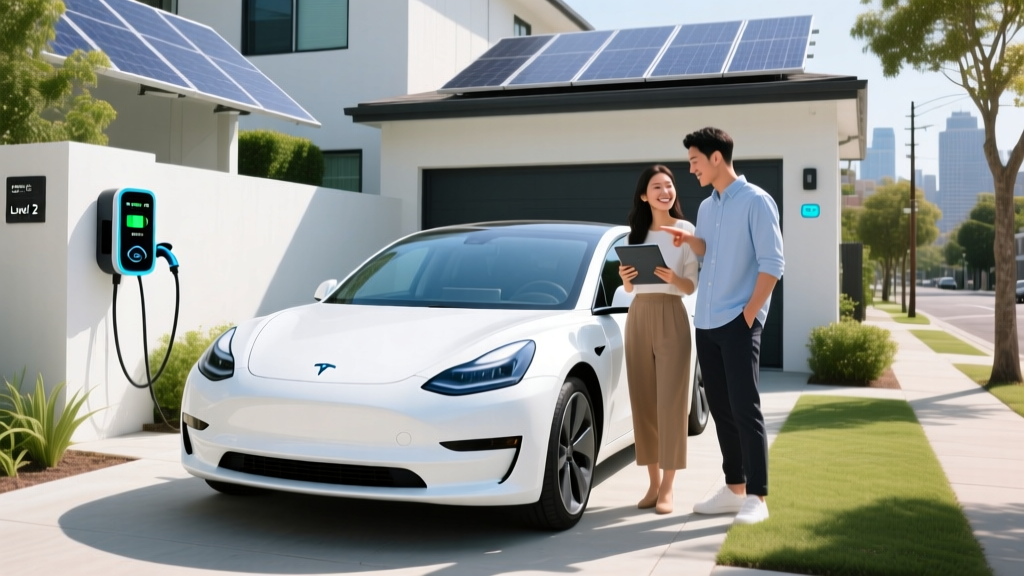
At home, Tesla's Gen 3 Wall Connector on a 60A circuit delivers 11.5 kW (48A continuous), adding roughly 44 miles of range per hour of charging. A full overnight session (8 hours) restores about 350 miles—more than the battery holds. Most owners find 30A–40A circuits sufficient for daily needs. Installation costs typically range from $500 to $2,000 depending on panel proximity and local permitting, though a 200A panel upgrade can push that to $3,000+.
Performance and Driving Dynamics
The dual-motor AWD powertrain produces 384 horsepower and rockets the 7-seat Model Y to 60 mph in 4.8 seconds. That's barely slower than the five-seat variant—the added third-row hardware contributes minimal weight penalty relative to the ~4,400-lb curb weight.
Ride quality on the refreshed Juniper-generation chassis is noticeably improved over pre-2025 models, with retuned dampers and additional sound insulation. The steering is quick but light, and the low center of gravity (battery pack under the floor) keeps body roll controlled through corners. However, the 19-inch Gemini tires prioritize efficiency over grip—drivers who push hard on canyon roads will notice early understeer.
Regenerative braking in "Hold" mode enables one-pedal driving in most scenarios, bringing the car to a near-stop without touching the brake pedal. The blended braking transition (regen to friction) is seamless—a hallmark of Tesla's powertrain calibration.
Third-Row Usability: Who Actually Fits Back There?
This is the crux of the Model Y 3-row decision. The third row consists of two individual seats that face rearward, designed primarily for children or smaller teens. Legroom in the third row measures approximately 26.5 inches—adequate for kids up to about 5'2" but cramped for adults on anything beyond a short school run.
Access requires folding and sliding the second-row seats forward. It's a one-hand operation, but the opening is narrow, and taller passengers will need to duck. Once seated, third-row occupants get USB-C ports and cup holders, but no dedicated climate vents—a notable omission for summer comfort.
With the third row upright, cargo space shrinks to 12.8 cubic feet—enough for a couple of backpacks or a week's groceries for a family of four, but tight for strollers or sports gear. Fold the third row flat, and you recover 30.2 cu ft, which handles most family logistics. Fold everything, and 72.1 cu ft is competitive with the class.
Bottom line: The third row is a legitimate solution for families who need occasional seven-passenger capacity for short trips (school drop-off, restaurant runs, carpools). For regular adult passengers or long road trips with all seven seats in use, a larger vehicle like the Kia EV9 or Rivian R1S is a better fit.
Pricing, Trims, and Federal Tax Credit Eligibility
The 2026 Model Y Long Range AWD starts at $47,990 (including the $1,390 destination fee). Adding the third-row option brings the total to $50,490. The Performance trim ($54,490 base) does not offer the third-row option—it's exclusive to the Long Range.
| Configuration | MSRP | Est. After §30D Credit |
|---|---|---|
| Long Range AWD (5-seat) | $47,990 | ~$40,490* |
| Long Range AWD (7-seat) | $50,490 | ~$42,990* |
*Federal §30D tax credit eligibility requires meeting all of the following criteria per IRS rules:
- MSRP Cap: SUVs must have an MSRP at or below $80,000 — the Model Y qualifies.
- Buyer Income Cap: Modified AGI must not exceed $150,000 (single), $225,000 (head of household), or $300,000 (joint filers).
- Battery Sourcing: Critical minerals and battery components must meet phased-in percentages from US or free-trade-agreement partners. Tesla sources LFP cells from CATL for some trims, which may affect eligibility depending on the specific battery pack installed. Verify with your dealer and a tax professional before purchase.
- Point-of-Sale Transfer: The credit can be applied at purchase as an instant rebate (reducing the financed amount) or claimed on your federal tax return.
Because battery-sourcing rules tighten annually and vary by production batch, we strongly recommend checking the specific VIN's eligibility on the IRS portal and confirming with your tax advisor. Never assume the full $7,500 applies without verification.
Tech, Safety, and Driver Assistance
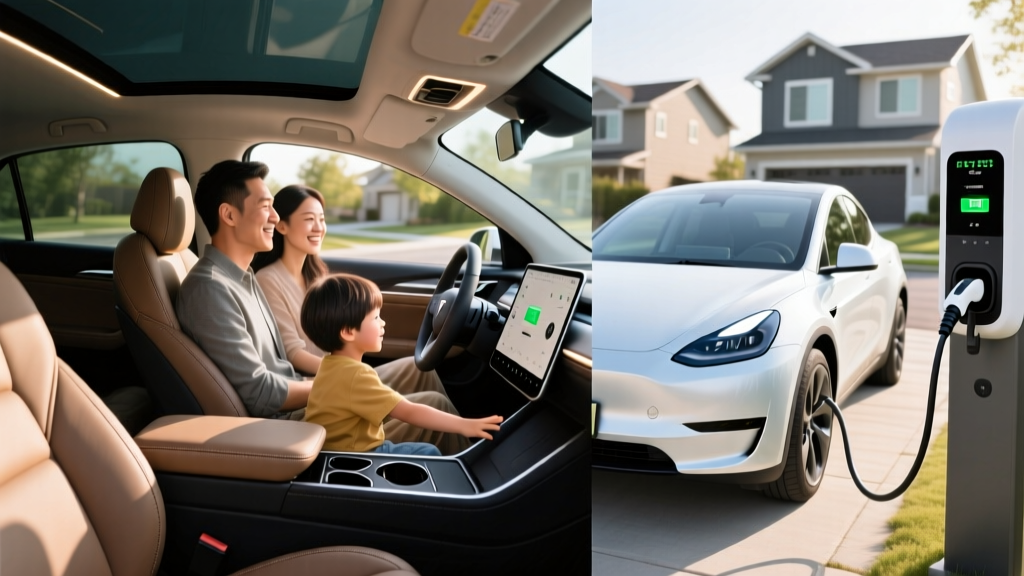
The 2026 Model Y features Tesla's current-generation infotainment system on a 15.4-inch center touchscreen, with a secondary 8-inch rear display for second-row passengers. Navigation, media, climate, and vehicle controls all route through the screen—there are minimal physical buttons. The interface is fast and responsive, though the lack of Apple CarPlay and Android Auto remains a sticking point for some buyers.
Standard driver assistance includes Tesla Autopilot (Traffic-Aware Cruise Control + Autosteer), which is a SAE Level 2 system. This means the driver must remain fully attentive with hands on the wheel at all times. The optional Full Self-Driving (Supervised) package ($8,000 or $99/month) adds automated lane changes, Navigate on Autopilot, and traffic-light recognition—but it is still Level 2 and requires active supervision. Tesla does not currently offer a hands-off, eyes-off system.
Tesla Autopilot and FSD (Supervised) are SAE Level 2 driver-assistance systems. The driver is responsible for all vehicle operation. This is fundamentally different from Level 4 robotaxi services like Waymo, which operate without a driver in defined geographic areas.
Safety ratings remain strong: the Model Y earned a 5-Star Overall Rating from NHTSA and Top Safety Pick+ recognition from IIHS in prior model years. The 2026 model continues this structural safety performance, with standard automatic emergency braking, blind-spot monitoring, and lane-departure prevention.
Pros and Cons of the 7-Seat Model Y
Pros
- Access to Tesla's Supercharger network (17,000+ stalls in North America)
- Class-leading efficiency at 28 kWh/100mi
- Strong 250 kW DC fast-charging with predictable curve
- Over-the-air updates continuously add features
- Low running costs (~$0.04–$0.08/mile on home electricity)
- Third row viable for children on short trips
Cons
- Third-row legroom (26.5") is tight — adults won't fit comfortably
- Only 12.8 cu ft cargo with third row up
- No Apple CarPlay or Android Auto
- FSD package is expensive and still requires full driver attention
- Cold-weather range loss is significant (20–30%)
- Battery sourcing may affect §30D credit — verify by VIN
Should You Buy the Model Y 3-Row?
The 2026 Tesla Model Y with the third-row option is a pragmatic solution for families who need occasional seven-seat capacity but don't want to step up to a larger, more expensive EV like the Kia EV9 (starting ~$56,000, 304-mile range) or Rivian R1S (starting ~$79,900, 352-mile range). If your third-row passengers are children under 12 and your trips are typically under 30 minutes, the Model Y's third row is genuinely useful—and you retain the efficiency, charging infrastructure, and software advantages of the Tesla ecosystem.
However, if you regularly transport adults in the third row, need substantial cargo space with all seats up, or take frequent road trips with seven passengers, the space compromise will frustrate you. In that case, the three-row Kia EV9 or the upcoming three-row electric SUVs from legacy automakers deserve a serious look.
- Your third-row passengers are primarily children
- You want the lowest cost-per-mile in a 7-seat EV
- Supercharger access is a priority for road trips
- You mostly drive under 250 miles between charges
- Adults will regularly ride in the third row
- You need maximum cargo space with all seats occupied
- You want Apple CarPlay/Android Auto integration
- You regularly tow (Model Y is rated for 3,500 lbs; the EV9 handles 5,000 lbs)
Frequently Asked Questions
What is the real-world range of the Model Y 3-row?
The EPA rates it at 320 miles. In real-world highway driving at 70 mph and moderate temperatures, expect 275–290 miles. In freezing weather, that drops to roughly 210–240 miles without preconditioning.
How fast does the Model Y 3-row charge?
On a V3 Supercharger (250 kW), it charges from 10–80% in approximately 25 minutes with a preconditioned battery. At home on a Level 2 Wall Connector (11.5 kW), it adds about 44 miles per hour.
Does the Model Y 3-row qualify for the $7,500 federal tax credit?
It can, but eligibility depends on your income, the MSRP (which is under the $80,000 SUV cap), and the battery's critical-mineral sourcing. Because Tesla uses varying cell suppliers, verify your specific VIN's eligibility on the IRS portal before purchasing.
Can adults sit in the Model Y third row?
Technically yes, but with only ~26.5 inches of legroom, it's uncomfortable for anyone over about 5'4" on anything longer than a 15-minute drive. It's best suited for children and smaller teens.
Is the Model Y 3-row worth it vs. the Kia EV9?
The Model Y is more efficient, charges faster on its native network, and costs less. The EV9 offers far more third-row space (32" legroom), more cargo room with all seats up, and a longer wheelbase. For families who prioritize passenger comfort over efficiency, the EV9 is the better seven-seater.
What is the battery warranty on the 2026 Model Y?
Tesla covers the battery and drive unit for 8 years or 120,000 miles (whichever comes first), with a minimum 70% capacity retention guarantee during that period.