Quick Verdict: The Cybertruck Cyberbeast in 2026
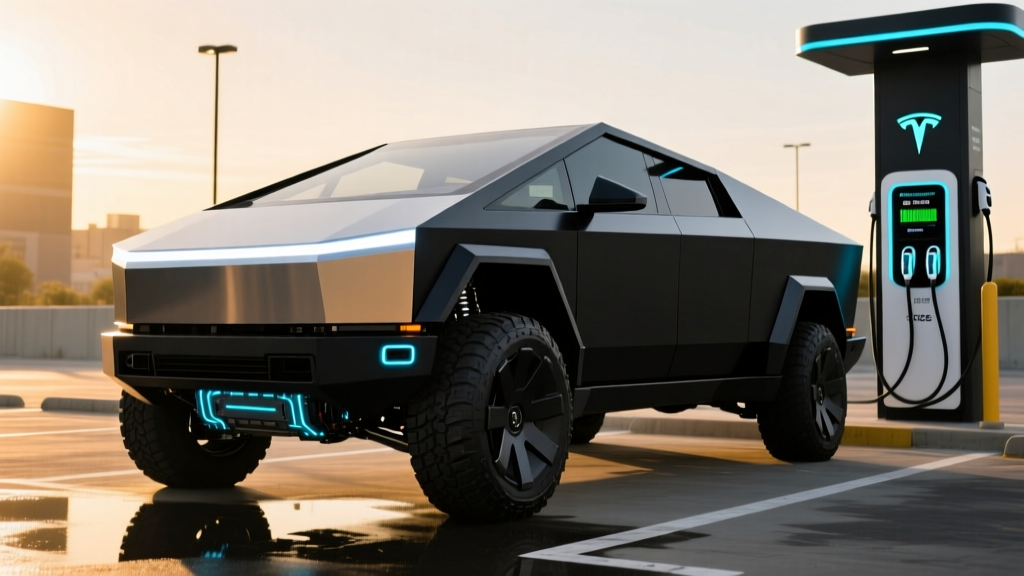
The Tesla Cybertruck Cyberbeast remains the most polarizing vehicle on the road — and the most powerful electric pickup you can buy. With a tri-motor all-wheel-drive powertrain producing 845 horsepower, a 2.6-second 0-60 mph time, and an EPA-estimated 320 miles of range, the Cyberbeast is simultaneously a supercar slayer and a 11,000-pound-capable work truck. But at a starting MSRP of $114,990, and with real-world range that can dip below 250 miles under heavy loads or cold weather, it demands a clear-eyed look before you sign the paperwork.
This review breaks down every number that matters — battery chemistry, charging curves, real-world efficiency, tax-credit eligibility, and how the Cyberbeast stacks up against the Rivian R1T Tri-Motor and GMC Hummer EV Pickup — so you can decide whether Tesla's flagship truck earns a spot in your garage.
Range & Efficiency: EPA Sticker vs. Real-World Miles
Real-World Expectation: 260–290 miles at highway speeds (70–80 mph); 220–250 miles in sub-freezing weather; up to 310 miles in mixed city/suburban driving with regenerative braking engaged.
The Cyberbeast's 320-mile EPA figure is achievable under ideal conditions: moderate temperatures, mixed driving, and speeds under 65 mph. However, the Cybertruck's angular stainless-steel exoskeleton creates a drag coefficient that penalizes highway efficiency more than sleeker EVs. In independent testing, sustained 75-mph highway loops have returned figures closer to 270 miles before the battery buffer warning engages.
Cold weather compounds the issue. Lithium-ion batteries lose efficiency in freezing temperatures, and the Cybertruck's large frontal area demands more energy for cabin and battery heating. Expect a 15–25% range reduction in sustained sub-32°F driving — meaning a winter road trip could yield as little as 240 miles of usable range. The Cyberbeast includes a heat pump for cabin climate, which mitigates some of this loss compared to resistive heating systems, but physics still wins in deep cold.
Efficiency is rated at approximately 53 MPGe combined (roughly 64 kWh/100 miles), which is competitive for a 6,800-pound tri-motor truck but significantly thirstier than a Model Y or Ioniq 5. For context, that translates to roughly $0.13–$0.18 per mile at the national average residential electricity rate of $0.16/kWh — still cheaper than gasoline at $3.50/gallon for a comparable gas truck getting 16 mpg combined, but not the penny-pinching efficiency of lighter EVs.
| Metric | Value |
|---|---|
| EPA Range | 320 miles |
| Real-World Highway (75 mph) | ~260–290 miles |
| Real-World Cold Weather (20°F) | ~240–260 miles |
| MPGe (Combined) | 53 MPGe |
| Energy Consumption | ~64 kWh/100 mi |
| Cost Per Mile (Home Charging) | ~$0.10–$0.13 |
| Cost Per Mile (DC Fast Charging) | ~$0.18–$0.25 |
Battery & Powertrain: What's Under the Exoskeleton
The Cyberbeast uses a ~123 kWh usable battery pack (gross capacity approximately 135 kWh) built with Tesla's 4680-format cells. These cells use a nickel-based chemistry (NMC variant — nickel manganese cobalt), chosen for its higher energy density compared to LFP (lithium iron phosphate). The trade-off: NMC cells are more sensitive to sustained 100% state-of-charge storage and high-temperature degradation, so Tesla recommends daily charging to 80–90% for longevity.
The tri-motor AWD layout places one motor on the front axle and two on the rear, enabling torque vectoring across the rear wheels. Combined output is 845 horsepower and an estimated 740+ lb-ft of torque at the motor shafts. This configuration also enables the Cyberbeast's signature party trick: Tank Mode, which locks inner and outer wheels at different speeds for tight-radius turns — useful on trails, less so in a grocery parking lot.
The 48-volt electrical architecture (a first for a production vehicle at this scale) reduces wiring harness weight and enables higher-power accessories, including the 240V bed outlet rated for 9.6 kW of continuous power delivery — enough to run a welder, power a job site, or feed energy back to your home via Tesla's Powerwall integration.
Charging Speed: DC Fast, Level 2, and the Supercharger Advantage
Charging speed is where Cybertruck owners need realistic expectations. Tesla quotes a peak DC fast-charge rate of 250 kW on V3 Superchargers and up to 350 kW on the newer V4 Supercharger cabinets. However, peak rate is not sustained rate.
| Charging Level | Power (kW) | Speed | Notes |
|---|---|---|---|
| Level 1 (120V household) | ~1.4 kW | ~3 miles/hour | Emergency only; 123 kWh pack takes days |
| Level 2 (240V home, 48A) | 11.5 kW | ~29 miles/hour | Full charge in ~11 hours; ideal overnight |
| Level 2 (240V, 80A Wall Connector) | 19.2 kW | ~48 miles/hour | Requires 100A circuit; ~6.5 hours full |
| DC Fast (V3 Supercharger) | Peak 250 kW | 10–80% in ~28 min | Tapers above 60%; preconditioning required |
| DC Fast (V4 Supercharger) | Peak 350 kW | 10–80% in ~22 min | Limited V4 availability as of early 2026 |
| CCS Adapter (Electrify America, etc.) | Up to 250 kW | Varies by station | NACS port native; CCS via adapter |
Critical detail on the charge curve: The Cyberbeast hits its peak 250 kW rate only between approximately 10–35% state of charge. Above 50%, the rate drops to roughly 150 kW, and above 80%, it tapers sharply to under 50 kW to protect cell health. This means a 10–80% session takes around 28 minutes on a V3 Supercharger — competitive with the Rivian R1T but slower than the Hyundai Ioniq 5's 18-minute 10–80% time, thanks to the Cybertruck's much larger battery.
For home charging, Tesla's Gen 3 Wall Connector at 48 amps (11.5 kW) adds roughly 29 miles of range per hour and will fully replenish the pack overnight in about 11 hours. If your electrical panel supports a 100-amp dedicated circuit, the 80A configuration at 19.2 kW cuts that to about 6.5 hours — worth the upgrade if you regularly deplete the battery on long hauls.
Preconditioning the battery before arriving at a Supercharger is essential. Navigate to a Supercharger using the built-in navigation, and the thermal management system will warm the pack to optimal charging temperature automatically. Skip this step, and your peak charge rate may be cut in half, especially in cold weather.
Performance: 845 HP and a 2.6-Second 0-60
The Cyberbeast's headline number is 2.6 seconds from 0 to 60 mph — verified by multiple independent testers and placing it in hypercar territory. For context, that matches a Lamborghini Huracán STO and demolishes a Ford F-150 Raptor R by over a full second. The instant torque delivery from three electric motors means there is zero turbo lag, zero gear-shift interruption — just a relentless, physics-defying shove that never gets old.
Top speed is electronically limited to 130 mph. The quarter-mile time falls in the 10.8-second range. Braking from 60 mph requires approximately 135 feet — respectable for a 6,800-pound vehicle, aided by regenerative braking that can recover up to 100+ kW of energy during deceleration.
Towing capacity is rated at 11,000 pounds (with the optional towing package), and the 6.5-foot bed includes a motorized tonneau cover, 240V and 12V power outlets, and a built-in air compressor. The adaptive air suspension provides up to 16 inches of ground clearance in Off-Road mode and can lower the truck for easier bed access and highway aerodynamics.
Interior, Tech & Driver Assistance
The Cybertruck cabin is aggressively minimalist. An 18.5-inch center touchscreen handles virtually all vehicle functions — climate, media, navigation, and vehicle settings — with no physical buttons aside from steering-wheel scroll wheels and window switches. A 9.4-inch rear touchscreen serves second-row passengers. The front "frunk" provides approximately 7 cubic feet of lockable storage, and the bed offers 67 cubic feet with the tonneau closed.
Second-row legroom measures 38.2 inches — adequate for adults on shorter trips but tighter than a full-size F-150 SuperCrew. The rear bench folds flat for expanded cargo, and the roof's angular geometry creates surprisingly generous headroom.
Driver Assistance (SAE Level 2): The Cyberbeast ships with Tesla's Autopilot (adaptive cruise control + lane centering) standard. Full Self-Driving (Supervised) is available as a $8,000 one-time purchase or $99/month subscription. FSD Supervised handles highway lane changes, on-ramp to off-ramp navigation, and city-street driving — but it remains a Level 2 system. The driver must maintain hands-on-wheel awareness and full attention at all times. This is not autonomous driving. Tesla's camera-only vision system (no lidar, no radar) has improved substantially, but complex construction zones, faded lane markings, and heavy rain still require immediate driver takeover.
Pricing, Trims & Federal Tax Credit Eligibility
| Trim | MSRP | Drivetrain | EPA Range |
|---|---|---|---|
| Long Range (AWD Dual-Motor) | $79,990 | Dual-Motor AWD | 340 miles |
| Cyberbeast (Tri-Motor) | $114,990 | Tri-Motor AWD | 320 miles |
Federal Tax Credit (§30D) — Critical Details: As of the 2026 tax year, the Cybertruck does not qualify for the $7,500 federal EV tax credit under IRS §30D. The reason: the credit applies only to vehicles with an MSRP at or below $80,000 for trucks, vans, and SUVs. The Cyberbeast at $114,990 exceeds this cap by a wide margin. Even the Long Range trim at $79,990 sits at the absolute ceiling and may be subject to additional battery-sourcing and critical-minerals requirements that can reduce or eliminate the credit depending on the specific build date and supply-chain composition. Additionally, buyer income caps apply: modified adjusted gross income (MAGI) must not exceed $300,000 for joint filers, $225,000 for heads of household, or $150,000 for single filers.
For the latest eligibility rules, always verify directly at IRS.gov §30D guidelines and consult a tax professional before relying on the credit for purchase planning. Point-of-sale transfer is available for eligible vehicles, but again, the Cyberbeast's MSRP disqualifies it.
- ✗ MSRP cap: $80,000 for trucks — Cyberbeast ($114,990) EXCEEDS cap
- ⚠ Long Range ($79,990) is AT the cap — verify with Tesla at purchase
- ✓ Buyer income cap: $300K joint / $150K single (MAGI)
- ⚠ Battery sourcing & critical minerals rules apply — varies by build date
- ✓ Must be new, purchased for personal use in the United States
- ✓ Point-of-sale transfer available if eligible
How the Cyberbeast Compares to Key Rivals
| Spec | Tesla Cyberbeast | Rivian R1T Tri-Motor | GMC Hummer EV 3X |
|---|---|---|---|
| Base MSRP | $114,990 | $105,900 | $104,995 |
| EPA Range | 320 mi | ~350 mi (Max Pack) | ~329 mi |
| 0-60 mph | 2.6 sec | ~3.0 sec | ~3.0 sec |
| Horsepower | 845 hp | ~850 hp | ~830 hp |
| Towing Capacity | 11,000 lbs | 11,000 lbs | 7,500 lbs |
| Bed Length | 6.5 ft | 4.5 ft (+ Gear Tunnel) | 5.0 ft |
| DC Fast Charge Peak | 250–350 kW | ~220 kW | ~350 kW |
| Federal Tax Credit | Not eligible (MSRP cap) | Not eligible (MSRP cap) | Not eligible (MSRP cap) |
| Supercharger Access | Native NACS | NACS adapter available | NACS adapter available |
Bottom line on competition: The Rivian R1T Tri-Motor offers a more conventional pickup experience with better rear-seat comfort, a clever Gear Tunnel for extra storage, and a slightly longer range with the Max Pack — but it costs less and charges slower. The GMC Hummer EV is the closest in sheer outrageousness but sacrifices towing capacity and feels heavier on the road. The Cyberbeast wins on raw acceleration, Supercharger network access (a genuine infrastructure advantage), and bed utility. It loses on rear-seat space, polarizing styling (love it or hate it), and panel-gap quality consistency.
Warranty & Long-Term Ownership
Tesla provides the following warranty coverage for the Cybertruck Cyberbeast:
- Basic Vehicle: 4 years / 50,000 miles
- Battery & Drive Unit: 8 years / 120,000 miles (whichever comes first), with a minimum 70% capacity retention guarantee
- Rust-Through (perforation): Not separately specified for stainless-steel body — stainless is inherently corrosion-resistant but can show surface staining
The 70% battery retention threshold over 8 years is industry-standard. Real-world data from Tesla's existing fleet (Model S/X with similar NMC chemistry) suggests most packs retain 85–90% capacity at 100,000 miles, though the 4680 cells are newer and long-term data is still accumulating. Battery replacement cost, if needed out of warranty, is estimated at $20,000–$30,000 based on current Tesla service pricing — a figure worth factoring into 10+ year ownership plans.
Insurance premiums for the Cyberbeast are notably high. Multiple insurers quote $3,500–$5,500 annually depending on zip code, driving record, and coverage level. The stainless-steel body panels are expensive to repair (they cannot be traditionally painted or bent), and Tesla's direct-repair model limits body-shop options. Get insurance quotes before purchasing.
Who Should Buy the Cybertruck Cyberbeast?
- You need a genuine work truck (11,000-lb towing, 9.6 kW bed power) that also delivers supercar acceleration
- You live within the Tesla Supercharger network and take regular road trips
- You value over-the-air updates and a tech-forward ownership experience
- The $115K+ price (with no federal tax credit) fits your budget comfortably
- You prioritize rear-seat comfort for family hauling — the R1T or F-150 Lightning serve families better
- You need proven long-term reliability data on the 4680 platform
- You're uncomfortable with camera-only driver assistance and minimal physical controls
- Your daily commute is short and a less expensive EV (Model Y, Ioniq 5) would serve you equally well
- 2.6-second 0-60 mph — fastest production pickup ever built
- 11,000-lb towing + 9.6 kW bed power outlet
- Native NACS / Supercharger network access
- Stainless-steel body is dent- and corrosion-resistant
- 48V architecture reduces weight and enables high-power accessories
- Over-the-air updates continuously add features
- $114,990 MSRP — no federal tax credit eligibility
- Real-world highway range falls 30–50 miles below EPA estimate
- Rear-seat legroom is tight for a truck at this price
- Insurance premiums are $3,500–$5,500/year
- Camera-only FSD is Level 2, not autonomous
- Panel gaps and build-quality variability reported by early owners
- 250 kW peak charge rate tapers quickly above 50% SoC
Frequently Asked Questions
What is the real-world range of the Tesla Cybertruck Cyberbeast?
The EPA rates the Cyberbeast at 320 miles. In real-world highway driving at 75 mph, expect 260–290 miles. In cold weather (below freezing), plan for 240–260 miles. City driving with regenerative braking can approach the EPA figure.
How fast does the Cyberbeast charge at home and on the road?
At home on a 48-amp Level 2 charger, it adds about 29 miles per hour (11.5 kW), fully charging in roughly 11 hours. On a Tesla V3 Supercharger, 10–80% takes approximately 28 minutes at a peak rate of 250 kW. V4 Superchargers can hit 350 kW peak, reducing 10–80% to about 22 minutes where available.
Does the Cybertruck Cyberbeast qualify for the $7,500 federal EV tax credit?
No. The §30D credit caps eligible trucks at $80,000 MSRP. The Cyberbeast starts at $114,990, well above the threshold. Even the Long Range trim at $79,990 sits at the limit and may face additional battery-sourcing restrictions. Always verify current rules at IRS.gov.
Is the Cyberbeast worth it over the Rivian R1T or Hummer EV?
If acceleration, Supercharger access, and bed power are your top priorities, the Cyberbeast is unmatched. If rear-seat comfort, a more traditional truck feel, or slightly better range matter more, the Rivian R1T Tri-Motor is a strong alternative at a lower price. The Hummer EV offers similar theatrics but trails in towing capacity.
How long will the Cybertruck battery last?
Tesla warranties the battery for 8 years / 120,000 miles with at least 70% capacity retention. Based on data from similar NMC packs in the Tesla fleet, most owners see 85–90% retention at 100,000 miles. Out-of-warranty replacement is estimated at $20,000–$30,000.
Can the Cybertruck power my home during an outage?
Yes, with Tesla's Powershare system and a compatible Powerwall or gateway setup, the Cybertruck's 123 kWh battery can serve as a backup power source via vehicle-to-home (V2H) functionality. The 9.6 kW bed outlet can also directly power tools and appliances on a job site.
Is Tesla's Full Self-Driving actually self-driving?
No. FSD (Supervised) is an SAE Level 2 driver-assistance system. It can navigate highways, handle on-ramps, and manage some city streets — but the driver must remain fully attentive with hands on the wheel at all times. It is not Level 4 autonomous driving like Waymo's robotaxi service.
Sources: EPA range and efficiency data via fueleconomy.gov; Tesla Cybertruck specifications via tesla.com/cybertruck; IRS §30D clean vehicle credit rules via irs.gov.