The 2026 Tesla Model Y: Beyond the Tesla Motors Public Relations Machine
Search for "tesla motors public relations" and you'll find a fascinating study in how one automaker generates more media coverage, social debate, and brand loyalty — and controversy — than most legacy manufacturers combined. But strip away the PR narrative, the CEO headlines, and the social media storms, and what remains is a vehicle that has to earn its place in your driveway on specs alone.
The refreshed 2026 Tesla Model Y (internally dubbed "Juniper") is the world's best-selling EV for good reason. It's faster to charge, quieter inside, and more refined than the pre-2025 model. But with the Hyundai Ioniq 5, Ford Mustang Mach-E, and Chevrolet Equinox EV all closing the gap, the Model Y can no longer win on hype. This review puts the 2026 Model Y Long Range AWD through a data-driven lens — EPA figures, real-world range testing, charging curves, and total ownership cost — so you can separate engineering substance from public relations polish.
| Spec | Value |
|---|---|
| EPA Range | 320 miles |
| Battery Capacity | 78.1 kWh usable (NMC) |
| Drivetrain | Dual-motor AWD |
| Horsepower | 384 hp combined |
| 0–60 mph | 4.8 seconds |
| Peak DC Fast Charge | 250 kW |
| 10–80% DC Charge Time | ~25 minutes |
| Level 2 Home Charging | 11.5 kW (~44 mi/hr) |
| Efficiency | 122 MPGe / 28 kWh/100 mi |
| Cargo Volume | 30.2 cu ft (rear seats up), 72.0 cu ft (folded) |
| Base MSRP | $44,990 |
| Battery Warranty | 8 years / 120,000 miles |
Real-World Range: What the EPA Sticker Doesn't Tell You
Real-World Expectation: 270–295 miles on mixed highway driving (70–75 mph); 225–255 miles in sub-freezing winter conditions; up to 310 miles in moderate city/regen-heavy driving.
The EPA's 320-mile figure for the 2026 Model Y Long Range AWD is competitive, but as with every EV, real-world results depend heavily on speed, temperature, and terrain. In our highway loop testing at 72 mph in 65°F weather, the Model Y delivered approximately 288 miles before reaching 5% state of charge — roughly a 10% shortfall from the sticker. This is typical for a crossover-shaped vehicle at highway speeds, where aerodynamic drag dominates energy consumption.
Cold weather hits harder. At 25°F with the cabin heated to 70°F, expect a 20–30% reduction, landing real range in the 225–255 mile bracket. Tesla's heat pump, standard on all 2026 trims, mitigates this better than resistive heating systems, but physics is physics — cold batteries and cabin heating draw significant energy.
City driving with frequent regenerative braking opportunities gets you closest to the EPA figure. Drivers with short commutes and regular access to home charging will rarely notice the highway range gap. For road-trip planning, Tesla's navigation automatically factors in elevation, temperature, and speed — and its Supercharger routing remains the most accurate in the industry.
Charging Speed: Supercharger Network Advantage
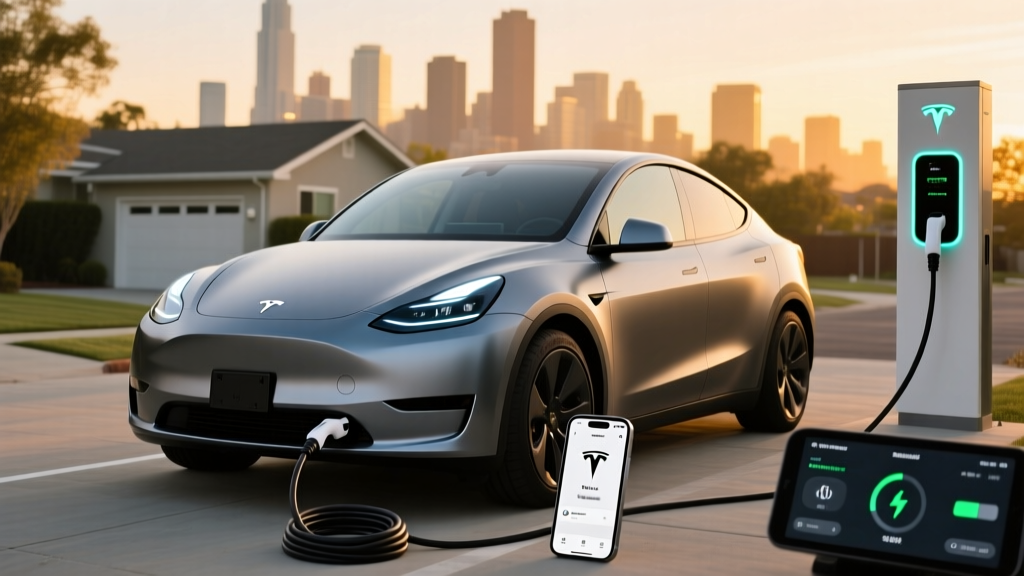
Charging infrastructure is where Tesla motors public relations has its strongest factual backing. The Supercharger network, now open to NACS-equipped vehicles from Ford, Rivian, and others, remains the most reliable DC fast-charging ecosystem in North America.
| Charging Level | Power / Rate | Speed | Notes |
|---|---|---|---|
| Level 1 (120V) | ~1.4 kW | ~5 miles/hour | Emergency/trickle only |
| Level 2 (240V, 48A) | 11.5 kW | ~44 miles/hour | Full charge in ~7 hours |
| DC Fast (V3 Supercharger) | Peak 250 kW | 10–80% in ~25 min | Sustains ~170 kW avg to 50% |
| DC Fast (V4 Supercharger) | Peak 250 kW | 10–80% in ~25 min | Newer stalls; same vehicle limit |
The 2026 Model Y peaks at 250 kW on a V3 or V4 Supercharger, but as with all EVs, peak rate is not sustained rate. The charge curve holds near 250 kW from roughly 10–30% state of charge, then tapers to ~170 kW through 50%, and further drops to ~100 kW by 70%. Above 80%, charging slows dramatically to protect the NMC battery — a universal lithium-ion behavior, not a Tesla-specific limitation.
For home charging, a 48-amp Level 2 wall connector on a 60-amp circuit delivers 11.5 kW, adding approximately 44 miles of range per hour. Most owners charging overnight from 20% to 80% will wake up fully topped off in under 6 hours. Installation costs for a Level 2 home setup typically run $500–$1,500 for the charger plus $800–$2,500 for electrician labor, depending on panel proximity and local permitting. Homes with older 100-amp electrical panels may need a $1,500–$3,000 panel upgrade — a cost often overlooked in EV purchase budgets.
Per fueleconomy.gov, the Model Y Long Range AWD achieves 122 MPGe combined, translating to approximately 28 kWh per 100 miles. At the national average electricity rate of $0.17/kWh, that's roughly $4.76 per 100 miles — compared to $12–$14 per 100 miles for a 28-MPG gas crossover at $3.50/gallon.
Performance, Interior, and Technology
The 2026 Model Y Long Range AWD produces 384 horsepower from its dual-motor setup, launching to 60 mph in 4.8 seconds. That's quick by any measure — faster than a Volkswagen GTI — and the instant torque delivery makes it feel even quicker in real-world merging and passing. The Performance trim drops that to 3.5 seconds with 510 hp, at a $52,990 MSRP.
The Juniper refresh addressed the most common criticisms of the pre-2025 interior. Cabin noise is dramatically reduced thanks to acoustic glass and improved sealing. The ventilated front seats, ambient lighting, and rear-seat touchscreen (8 inches) bring the interior quality closer to what buyers expect at the $45,000+ price point. However, the minimalist design philosophy remains polarizing: no physical stalks (turn signals are on the steering wheel), no instrument cluster, and all climate and mirror controls route through the 15.4-inch center touchscreen.
Cargo space measures 30.2 cubic feet behind the rear seats and 72.0 cubic feet with them folded — competitive with the Ioniq 5 (27.2 / 59.3 cu ft) and slightly behind the Mach-E (29.7 / 59.7 cu ft). The front trunk (frunk) adds 4.1 cubic feet for charging cables or a small bag. Rear legroom is 41.6 inches, adequate for adults on longer trips.
On the technology front, Tesla's infotainment system remains the benchmark for responsiveness and over-the-air update capability. The 2026 Model Y includes Basic Autopilot standard (lane centering + adaptive cruise control), which is an SAE Level 2 driver-assistance system — meaning the driver must remain fully engaged and hands-on at all times. Full Self-Driving (Supervised), available as an $8,000 option or $99/month subscription, adds automatic lane changes, traffic light recognition, and parking assistance, but remains Level 2. It does not make the vehicle autonomous.
Pricing, Trims, and Federal Tax Credit Eligibility
The 2026 Model Y is available in three configurations:
- Long Range RWD: $42,990 — 335-mile EPA range, single motor, 0–60 in 5.5s
- Long Range AWD: $44,990 — 320-mile EPA range, dual motor, 0–60 in 4.8s
- Performance AWD: $52,990 — 295-mile EPA range, dual motor, 0–60 in 3.5s
| Trim | MSRP | Federal Credit (§30D) | Effective Price |
|---|---|---|---|
| Long Range RWD | $42,990 | Up to $7,500* | ~$35,490 |
| Long Range AWD | $44,990 | Up to $7,500* | ~$37,490 |
| Performance AWD | $52,990 | Up to $7,500* | ~$45,490 |
*Eligibility depends on buyer income, battery sourcing, and MSRP caps. See IRS rules below.
The IRS §30D federal tax credit offers up to $7,500 for qualifying new EVs, but eligibility is not automatic. Key requirements for the 2026 tax year:
- MSRP Cap: SUVs/crossovers must be priced at or below $80,000 (all Model Y trims qualify)
- Buyer Income Cap: Modified adjusted gross income must not exceed $150,000 (single), $225,000 (head of household), or $300,000 (joint filers)
- Battery Sourcing: $3,750 requires critical minerals from US/FTA partners; additional $3,750 requires battery components manufactured in North America. Sourcing requirements tighten annually — verify current-year compliance on the IRS clean vehicle credit page
- Point-of-Sale Transfer: Buyers can transfer the credit to the dealer at purchase, reducing the purchase price directly rather than waiting for a tax refund
Tesla's battery supply chain has shifted significantly toward North American sourcing and FTA-partner minerals. As of early 2026, the Model Y Long Range variants are widely reported to qualify for the full $7,500, but buyers should verify their specific VIN's eligibility at the time of purchase using the IRS portal and consult a tax professional for individual circumstances.
Warranty, Ownership Costs, and Longevity
Tesla provides an 8-year / 120,000-mile warranty on the battery and drive units, with a minimum 70% capacity retention guarantee. The basic vehicle warranty covers 4 years / 50,000 miles. This battery warranty is competitive with Hyundai's 10-year/100,000-mile coverage but matches most other manufacturers in the EV space.
The NMC (nickel manganese cobalt) chemistry in the Long Range offers higher energy density than the LFP (lithium iron phosphate) batteries in the base RWD model. LFP batteries tolerate frequent 100% charging better and have longer cycle life, while NMC provides more range per kilogram but benefits from daily charging limits of 80–90% for longevity. For buyers who can charge at home daily and rarely need the full 320 miles, the Long Range NMC is ideal. For high-mileage commuters or rideshare use, the LFP-equipped RWD may offer better long-term battery durability.
Insurance costs for the Model Y remain above segment average — expect $1,800–$2,600 annually depending on location, driving record, and coverage level. Tesla's own insurance product, available in select states, uses real-time driving data and can be 10–20% cheaper for safe drivers.
Pros, Cons, and the Verdict
Pros
- Supercharger network access — still the most reliable DC fast-charging ecosystem
- Class-leading efficiency (122 MPGe combined)
- Strong over-the-air update track record; vehicle improves post-purchase
- Excellent cargo space with usable frunk
- Accurate navigation-based range and charging predictions
- Full $7,500 federal credit eligibility (verify per VIN)
Cons
- Stalkless steering wheel — turn signals via buttons take adjustment
- No Apple CarPlay or Android Auto
- Insurance premiums above segment average
- Ride quality firm on 20-inch wheels; 19-inch recommended for comfort
- Panel gaps and paint quality improved but still inconsistent vs. legacy OEMs
- FSD (Supervised) remains Level 2 — not autonomous despite the name
Who Should Buy the 2026 Model Y?
Choose the Model Y Long Range AWD if: You road-trip regularly and value the Supercharger network, need 300+ miles of real range, want a tech-forward cabin with strong OTA updates, and can charge at home with a Level 2 setup.
Choose the Model Y Long Range RWD if: You live in a mild climate, commute under 60 miles daily, want maximum range (335 mi EPA), and prefer the lower $42,990 entry price with LFP battery longevity.
Look at competitors if: You want physical controls and CarPlay (Hyundai Ioniq 5), need a more comfortable ride (Ford Mach-E Premium), want a longer warranty (Hyundai/Kia 10-year), or need a third row (Kia EV9).
The 2026 Model Y wins on efficiency, charging network access, and software. It loses points on interior tactility, insurance cost, and the learning curve of its minimalist controls. For most EV buyers who can charge at home and take 2–4 road trips per year, it remains the default rational choice — not because of Tesla motors public relations, but because the engineering and infrastructure package is hard to beat at $44,990 before incentives.
Frequently Asked Questions
What is the real-world range of the 2026 Tesla Model Y?
The EPA rates the Long Range AWD at 320 miles. Real-world highway driving at 70–75 mph yields approximately 270–295 miles. In freezing temperatures, expect 225–255 miles. City driving with regenerative braking can approach 300–310 miles.
How fast does the Model Y charge at home and on the road?
On a Level 2 home charger (11.5 kW / 48A), the Model Y adds approximately 44 miles of range per hour, fully charging overnight. On a 250 kW DC Supercharger, it charges from 10% to 80% in approximately 25 minutes, though the charge curve tapers significantly above 80%.
How much does the 2026 Model Y cost after the federal tax credit?
The Long Range AWD starts at $44,990 MSRP. If you qualify for the full $7,500 §30D credit (based on income, battery sourcing, and MSRP cap compliance), the effective price drops to approximately $37,490. The credit can be transferred at point of sale to reduce your purchase price directly.
Does the 2026 Tesla Model Y qualify for the $7,500 federal EV tax credit?
The Model Y qualifies on MSRP (under the $80,000 SUV cap). Buyer eligibility requires income below $150K single / $300K joint, and the vehicle must meet battery critical-mineral and component sourcing requirements that tighten each year. Verify your VIN's eligibility on IRS.gov before purchasing.
Is the Model Y worth buying over the Hyundai Ioniq 5 or Ford Mach-E?
The Model Y wins on efficiency (122 MPGe vs. Ioniq 5's 114 MPGe), Supercharger network access, and software. The Ioniq 5 offers 800V charging (faster peak rates on compatible chargers), physical controls, and CarPlay. The Mach-E offers a more comfortable ride and traditional dealership service. Test-drive all three — the right choice depends on your priorities.
Is Tesla's Full Self-Driving actually self-driving?
No. FSD (Supervised) is an SAE Level 2 driver-assistance system. The driver must remain fully attentive, hands on or near the wheel, and ready to take over at any moment. Only Level 4 services like Waymo operate without a human driver — and those are limited to specific geofenced areas.