The Towing Numbers: What Ford Claims vs. What Physics Demands
The Ford F-150 Lightning's maximum towing capacity is 10,000 pounds when equipped with the Extended Range battery and the Max Trailer Tow Package. Standard Range models with the same tow package are rated at 7,700 pounds. Without the tow package, ratings drop to 5,000 pounds across the board.
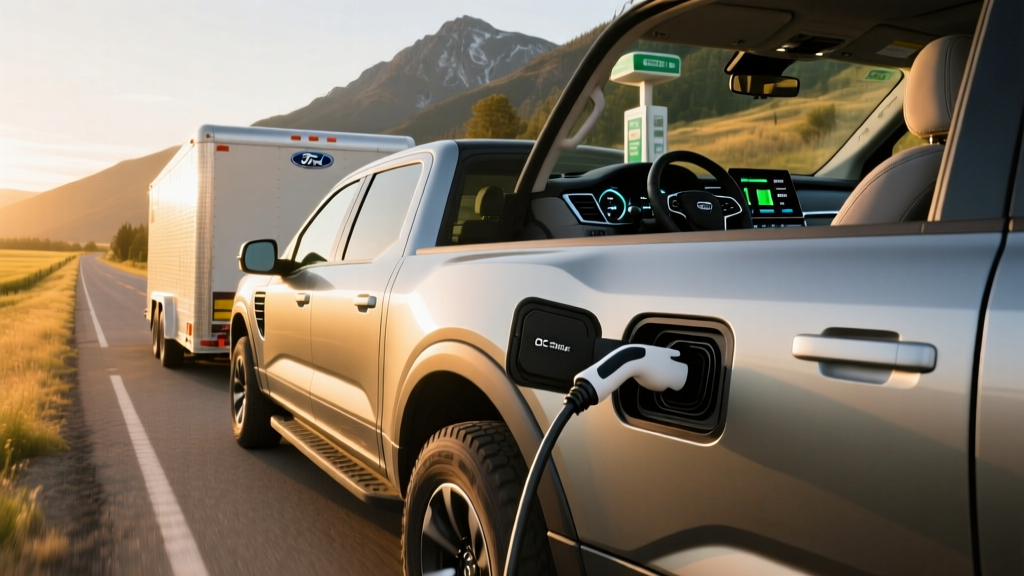
Those figures are competitive with gas-powered F-150 configurations, but the real conversation around the Lightning and towing isn't about whether it can pull the load — it's about how far it can pull it and how much energy that demands. Towing at or near max capacity cuts range by roughly 40-55%, depending on speed, terrain, and temperature. A 320-mile EPA estimate on the Extended Range model shrinks to approximately 140-180 miles of real-world towing range at highway speeds with a heavy trailer.
Full Specification Breakdown
| Specification | Standard Range | Extended Range |
|---|---|---|
| EPA Range | 240 miles | 320 miles |
| Battery Capacity (Usable) | 98 kWh | 131 kWh |
| Battery Chemistry | NMC (Nickel Manganese Cobalt) | NMC |
| Max Towing Capacity | 7,700 lbs (w/ tow pkg) | 10,000 lbs (w/ tow pkg) |
| Horsepower | 452 hp | 580 hp |
| Torque | 775 lb-ft | 775 lb-ft |
| 0-60 mph | ~3.8 sec | |
| Drivetrain | Dual-motor AWD | Dual-motor AWD |
| Max DC Fast Charge | 120 kW | 150 kW |
| 10-80% DC Charge Time | ~44 min | ~41 min |
| Level 2 Home Charging | 11.3 kW (30 mi/hr) | 11.3 kW (30 mi/hr) / 19.2 kW (50 mi/hr) w/ 80A charger |
| EPA Efficiency | 76 MPGe (combined) | 70 MPGe (combined) |
| Payload Capacity | 2,235 lbs | 1,800 lbs |
| Base MSRP (2025 MY) | ~$54,995 | ~$69,995 |
Sources: EPA Fueleconomy.gov, Ford F-150 Lightning Specs.
Charging Speeds: On the Road and at Home
The Lightning uses a CCS1 connector for DC fast charging (with a NACS adapter now available for Tesla Supercharger access). The Extended Range battery peaks at 150 kW, while the Standard Range peaks at 120 kW. Neither figure is class-leading — competitors like the Rivian R1T and Chevrolet Silverado EV accept higher peak rates — but the Lightning's large battery means sustained charging at moderate speeds still adds meaningful range.
| Charging Level | Power | Range Added Per Hour | Notes |
|---|---|---|---|
| Level 1 (120V) | 1.4 kW | ~3-4 miles | Emergency/trickle only |
| Level 2 (240V, 48A) | 11.3 kW | ~30 miles | Included Ford Mobile Charger or wall unit |
| Level 2 (240V, 80A) | 19.2 kW | ~50 miles | Requires Ford Charge Station Pro + 100A circuit |
| DC Fast (Standard Range) | 120 kW peak | ~180 miles in 44 min (10-80%) | Tapers above 80% SoC |
| DC Fast (Extended Range) | 150 kW peak | ~240 miles in 41 min (10-80%) | Peak only below ~55% SoC |
The charge curve matters here. The 150 kW peak on the Extended Range model is only sustained roughly from 10% to 55% state of charge. After that, the rate tapers progressively — dropping to around 80 kW by 70% and below 50 kW past 85%. If you're towing and need quick top-ups, plan stops from 10-70% rather than waiting until 90%+.
At home, the Ford Charge Station Pro (80A hardwired unit) requires a dedicated 100-amp circuit. Most homes will need a panel evaluation — and potentially a 200A service upgrade ($1,500-$3,000) — before installation. Budget $800-$1,500 for the charger unit itself and $500-$2,000 for electrician labor depending on your panel's proximity to the garage.
Real-World Range: Beyond the EPA Sticker
The EPA rates the Extended Range Lightning at 320 miles and the Standard Range at 240 miles. In mixed driving without a trailer, owners consistently report achieving 90-95% of those figures — roughly 290-305 miles for the Extended Range and 220-230 for Standard Range in moderate temperatures.
Highway-heavy driving at 75+ mph reduces efficiency by about 10-15%, bringing Extended Range down to approximately 270-285 miles. Cold weather (below 30°F) introduces a further 20-30% reduction due to battery resistance and cabin heating demands. In sub-freezing winter conditions, expect 220-250 miles from the Extended Range pack without a trailer.
With a trailer attached, the math changes drastically. Aerodynamic drag is the dominant energy consumer at highway speeds, and a boxy travel trailer or car-hauler creates enormous drag compared to the truck alone. Ford's onboard range estimation system — which factors in trailer weight via the Pro Trailer Hitch Assist and historical driving data — is one of the Lightning's strongest towing features. It provides far more accurate range projections than the standard guess-o-meter.
Technology, Interior, and Towing-Specific Features
The Lightning's tech suite includes several features purpose-built for towing:
- Pro Trailer Hitch Assist: Automatically steers the truck to align with the trailer coupler. Reduces the frustration of solo hookups significantly.
- Trailer Reverse Guidance: Multi-camera system showing trailer angle and path during backing maneuvers.
- Onboard Scales: Estimates payload weight and displays it on the center screen and via taillight indicators.
- Intelligent Range Estimation: Factors in trailer weight, terrain, weather, and driving habits for more accurate range predictions while towing.
- Pro Power Onboard: Up to 9.6 kW of exportable power through bed outlets (240V and 120V). Powers tools at a job site, appliances during an outage, or campsite equipment. This is a genuine differentiator.
The interior uses a massive 15.5-inch portrait touchscreen (SYNC 4A) on Lariat and above trims. The Platinum trim adds a 12-inch instrument cluster, leather, and upgraded audio. Crew cab configuration provides 43.6 inches of rear legroom and a 5.5-foot bed with 52.8 cubic feet of volume. The front trunk ("frunk") adds 14.1 cubic feet of lockable, drainable storage — useful for gear you don't want in the cab.
On the driver-assist front, Ford's BlueCruise offers hands-free highway driving on pre-mapped divided highways. This is an SAE Level 2 system — the driver must remain attentive, and a camera monitors eye gaze. It is not autonomous driving. BlueCruise is a $2,100 option or included on Platinum trims, with a subscription required after the initial trial period.
Pricing, Trims, and Federal Tax Credit Eligibility
| Trim | Battery | MSRP (approx.) | §30D Credit Eligible? |
|---|---|---|---|
| Pro | Standard Range | $54,995 | Yes (if MSRP, income, and sourcing rules met) |
| XLT | Standard / Extended | $59,995 - $74,995 | Yes (truck MSRP cap: $80,000) |
| Lariat | Extended Range | $76,995 | Yes |
| Platinum | Extended Range | $96,874 | No — exceeds $80,000 truck MSRP cap |
The F-150 Lightning qualifies as a light-duty truck under IRS §30D rules, which sets an $80,000 MSRP cap for trucks, vans, and SUVs. This means Pro, XLT, and Lariat trims are potentially eligible for up to $7,500 in federal tax credits — but the Platinum trim, at nearly $97,000, is excluded.
Eligibility also depends on:
- Buyer income caps: Modified AGI must not exceed $300,000 (joint), $225,000 (head of household), or $150,000 (single).
- Battery component sourcing: A percentage of battery components must be manufactured or assembled in North America, and critical minerals must meet sourcing thresholds. These percentages increase annually. Check the latest IRS guidance for the current year's requirements.
- Point-of-sale transfer: As of 2024, buyers can transfer the credit to the dealer at purchase, reducing the out-of-pocket price directly rather than waiting to claim it on a tax return.
The credit is not guaranteed for every buyer or every configuration. Always verify current eligibility on IRS.gov and consult a tax professional before relying on the credit in your purchase budget.
How It Compares: Lightning vs. Rivian R1T vs. Silverado EV
- Pro Power Onboard (up to 9.6 kW exportable) is unmatched for job-site and emergency use
- Lower starting price than Rivian R1T
- Traditional truck ergonomics — familiar to F-150 buyers
- Excellent towing tech (hitch assist, onboard scales, intelligent range calc)
- Frunk is the largest in the segment at 14.1 cu ft
- DC fast-charge speed (150 kW peak) trails Rivian R1T (~220 kW) and Silverado EV (~350 kW)
- Towing range is significantly reduced — plan more stops than gas equivalents
- Extended Range battery adds weight, reducing payload to 1,800 lbs
- Platinum trim exceeds the §30D tax credit MSRP cap
- Ride quality when unloaded is firm compared to independent-rear-suspension rivals
The Rivian R1T offers more adventurous off-road capability, faster DC charging, and a more refined interior — but starts around $75,000 and has a smaller bed. The Chevrolet Silverado EV (particularly the 4WT and Trail Boss trims) boasts up to 400+ miles of range on the max battery and ~350 kW DC charging, but is larger, more expensive in higher trims, and less widely available as of early 2026.
For a buyer whose priority is a familiar full-size truck experience with genuine work capability and the best power-export feature on the market, the Lightning holds its ground. For buyers who tow frequently over long distances, the Silverado EV's superior range and charging speed deserve serious consideration.
Warranty and Battery Longevity
Ford covers the Lightning's battery and electric powertrain for 8 years or 100,000 miles, whichever comes first. The warranty guarantees the battery will retain at least 70% of its original capacity during that period. The bumper-to-bumper warranty is 3 years/36,000 miles.
NMC chemistry, used in both battery packs, offers high energy density but is somewhat more susceptible to calendar and cycle degradation than LFP chemistry. Real-world data from early Lightning owners (2022-2024 models) suggests degradation in the 5-8% range after 40,000-60,000 miles — well within warranty parameters. Best practices for longevity include avoiding routine charges to 100%, minimizing DC fast-charging frequency, and using scheduled charging to reduce time spent at high state of charge.
Who Should Buy the F-150 Lightning?
- You need a full-size truck for work with Pro Power Onboard for tools and equipment
- You tow moderate distances (under 150 miles one-way) and can charge at your destination
- You want home backup power capability (Ford Intelligent Backup Power, with Home Integration System)
- You prefer traditional truck styling and ergonomics over futuristic designs
- You tow long distances regularly — the charging stops will add significant time
- You need maximum payload (Extended Range battery weight cuts it to 1,800 lbs)
- Fastest possible DC charging is a priority (consider Silverado EV or Rivian R1T)
- You want a luxury EV truck interior (Rivian R1T is more premium)
Frequently Asked Questions
What is the real-world range of the F-150 Lightning?
Without a trailer, expect 270-305 miles from the Extended Range (EPA 320) and 220-230 miles from Standard Range (EPA 240) in moderate conditions. Highway driving and cold weather reduce these figures. With a heavy trailer, plan for 120-180 miles depending on weight and conditions.
How fast does the F-150 Lightning charge?
The Extended Range model peaks at 150 kW on DC fast chargers, achieving 10-80% in about 41 minutes. Standard Range peaks at 120 kW with a 10-80% time around 44 minutes. At home on a Level 2 charger, expect 30 miles of range per hour (11.3 kW) or up to 50 miles per hour with the optional 80A Ford Charge Station Pro (19.2 kW).
How much does the F-150 Lightning cost after tax credits?
A Pro trim at $54,995 could drop to approximately $47,495 after the full $7,500 federal credit — if you meet income caps and battery-sourcing requirements. The XLT Standard Range at ~$59,995 could reach ~$52,495. Always verify current-year eligibility on IRS.gov and consult a tax professional.
Does the F-150 Lightning qualify for the federal EV tax credit?
Pro, XLT, and Lariat trims are potentially eligible for up to $7,500 under §30D, as they fall below the $80,000 truck MSRP cap. The Platinum trim exceeds the cap and does not qualify. Buyer income limits and battery component/critical mineral sourcing rules also apply and change annually.
Is the F-150 Lightning worth buying vs. competitors?
For work-truck buyers who value Pro Power Onboard, a massive frunk, and familiar F-150 ergonomics, the Lightning is compelling — especially at the Pro and XLT price points. For long-distance towing or premium interiors, the Rivian R1T and Chevrolet Silverado EV have advantages in charging speed and range, respectively.
What are the biggest pros and cons?
Top pros: Pro Power Onboard, best-in-class frunk, strong towing tech suite, competitive pricing on lower trims, home backup power capability. Top cons: 150 kW max DC charging lags rivals, towing range drops sharply, Extended Range payload is limited, Platinum trim is expensive and credit-ineligible.