Quick Verdict: The Default EV for LA Drivers
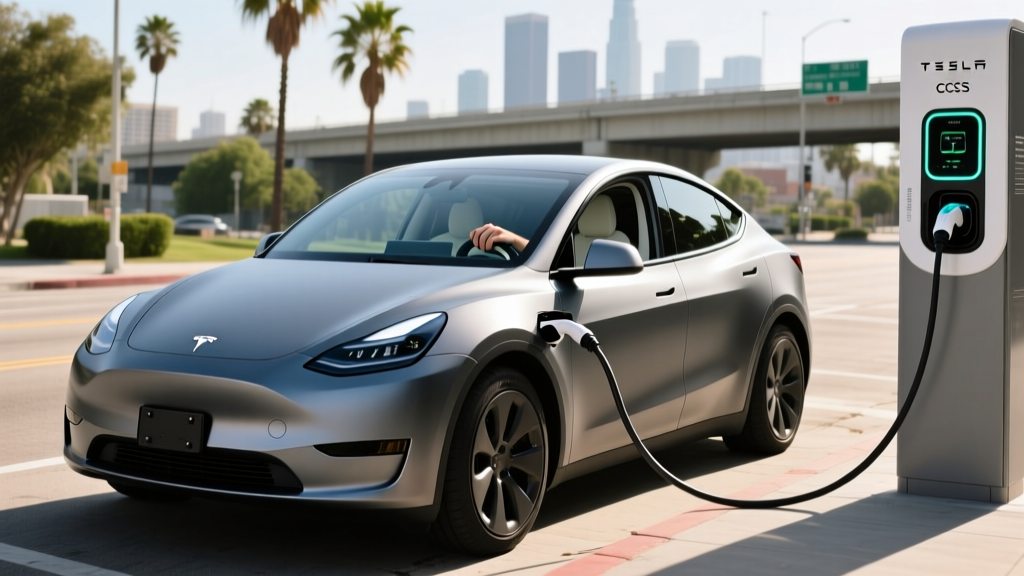
If you've ever searched for "Tesla tunnel LA" while navigating the Sepulveda Pass or planning a route through the I-205 tunnels, you're not alone. The Tesla Model Y remains the benchmark compact electric SUV for Southern California commuters who need range, Supercharger access, and enough cargo space for weekend trips to Joshua Tree. The 2026 Model Y (Juniper refresh) sharpens an already strong formula with a revised interior, slightly improved efficiency, and continued access to North America's most reliable DC fast-charging network.
But with the Hyundai Ioniq 5, Ford Mustang Mach-E, and Kia EV6 closing the gap on range and undercutting on price, is the Model Y still the default choice? We tested it on LA's 405, through the mountain passes, and on a 300-mile road trip to find out.
2026 Tesla Model Y Specifications
| Attribute | Long Range AWD | Performance | Rear-Wheel Drive |
|---|---|---|---|
| EPA Range | 320 mi | 295 mi | 300 mi (est.) |
| Battery (usable) | ~75 kWh (NMC) | ~75 kWh (NMC) | ~60 kWh (LFP) |
| Drivetrain | Dual-Motor AWD | Dual-Motor AWD | Single-Motor RWD |
| Horsepower | 384 hp | 456 hp | 295 hp |
| 0-60 mph | 4.8 sec | 3.5 sec | 6.5 sec |
| MPGe (combined) | 122 MPGe | 111 MPGe | 128 MPGe (est.) |
| Peak DC Charge | 250 kW | 250 kW | 170 kW |
| 10-80% DC Time | ~25 min | ~25 min | ~30 min |
| Base MSRP | $48,990 | $53,990 | $44,990 |
| Cargo (behind 2nd row) | 30.2 cu ft (76.2 cu ft max) | ||
| Rear Legroom | 41.6 in | ||
| Battery Warranty | 8 yr / 120,000 mi (Long Range/Perf) 8 yr / 100,000 mi (RWD) | ||
Sources: fueleconomy.gov, tesla.com/modely. RWD figures estimated based on prior-year LFP pack.
Real-World Range: What the EPA Sticker Doesn't Tell You
Real-World Expectation: 250-275 mi highway @ 70 mph; 210-230 mi in cold weather (<40°F); 290-310 mi mixed city/highway in LA stop-and-go with regen.
The Model Y's efficiency — roughly 27 kWh/100mi on the Long Range — is among the best in the segment. On our 110-mile loop from Santa Monica through the Sepulveda Pass (yes, the tunnel) to the Valley and back, we averaged 248 Wh/mi with climate at 70°F and two passengers. That translates to about 302 real-world miles on a full charge in ideal LA conditions.
However, sustained 75+ mph freeway driving to San Diego drops efficiency to 290-310 Wh/mi, shrinking range to roughly 250 miles. Cold-weather mountain trips (Big Bear in winter) can push consumption higher due to cabin heating, though the Model Y's heat pump mitigates this better than resistive heaters in older EVs. Plan charging stops accordingly.
Charging Speed: Supercharger Advantage
| Level | Power | Miles Added per Hour | Notes |
|---|---|---|---|
| Level 1 (120V) | 1.4 kW | ~4 mi/hr | Emergency/trickle only |
| Level 2 (240V, 48A) | 11.5 kW | ~37 mi/hr | Home Wall Connector or public L2 |
| DC Fast (V3 Supercharger) | 250 kW peak | ~1,000 mi/hr at peak | 10-80% in ~25 min; tapers above 80% |
| DC Fast (CCS adapter) | ~150-200 kW | Varies | Works on Electrify America, EVgo; slower than NACS-native |
Tesla's Supercharger network remains the gold standard for reliability. On a V3 (250 kW) stall, the Long Range Model Y peaks near 240-250 kW at low SoC, then tapers progressively. Expect a 10-80% session in roughly 25 minutes — competitive with Hyundai's 800V Ioniq 5 (~18 min) but still fast enough for a restroom-and-coffee stop.
For home charging, a Tesla Wall Connector on a 60A circuit (48A continuous) adds about 37 miles per hour — enough to fully replenish overnight. Installation typically runs $800-$2,000 depending on panel proximity; a 200A panel upgrade adds $1,500-$3,000 if needed.
Pricing, Trims, and Federal Tax Credit Eligibility
| Trim | MSRP | Est. After $7,500 Credit | Destination |
|---|---|---|---|
| Rear-Wheel Drive | $44,990 | $37,490* | $1,390 |
| Long Range AWD | $48,990 | $41,490* | $1,390 |
| Performance | $53,990 | $46,490* | $1,390 |
*Assumes full $7,500 credit eligibility; RWD with LFP battery may face tighter sourcing restrictions — confirm at purchase. As-tested Long Range with FSD capability: ~$57,990 before credit.
Tech, Driver Assistance, and the Autopilot Reality Check
The Juniper-refreshed Model Y carries Tesla's 15.4-inch center touchscreen with a faster processor, ventilated front seats, ambient lighting, and a rear-seat touchscreen. The minimalist interior (no physical stalks — turn signals are on the steering wheel) remains polarizing but functional once muscle memory sets in.
FSD Supervised ($8,000 option or $99/mo) handles highway lane changes, on-ramps, and city streets with increasing competence, but still requires intervention for construction zones, unusual intersections, and inclement weather. For LA's stop-and-go 405 traffic, basic Autopilot (included) with Traffic-Aware Cruise Control and Autosteer is sufficient and less fatiguing than manual driving.
Pros and Cons
- Best-in-class Supercharger network access (NACS native)
- Top efficiency: 122 MPGe combined (Long Range)
- Spacious cargo: 76.2 cu ft with seats folded
- Strong resale value relative to EV segment
- OTA updates continuously add features
- No physical turn-signal stalks (touch buttons on wheel)
- Ride quality firm on broken pavement
- FSD is expensive and still Level 2, not autonomous
- DC fast charge slower than 800V rivals (Ioniq 5, EV6)
- Build quality inconsistency (panel gaps, trim)
Who Should Buy the 2026 Model Y?
Choose the Model Y if: You prioritize Supercharger reliability for road trips, want maximum cargo versatility, and live in an area (like LA) where Tesla's charging infrastructure dominates. Ideal for tech-forward commuters, small families, and frequent road-trippers.
Look elsewhere if: You want the fastest DC charging (Hyundai Ioniq 5), a more traditional interior with physical controls (Ford Mach-E, Kia EV6), or need 3-row seating (Kia EV9, Rivian R1S).
Model Y vs. Key Competitors
| Spec | Tesla Model Y LR | Hyundai Ioniq 5 LR | Ford Mach-E ER AWD |
|---|---|---|---|
| EPA Range | 320 mi | 310 mi | 312 mi |
| Peak DC Charge | 250 kW | 350 kW (800V) | 150 kW |
| 10-80% DC Time | ~25 min | ~18 min | ~38 min |
| Base MSRP (AWD) | $48,990 | $50,600 | $51,995 |
| Cargo (rear seats up) | 30.2 cu ft | 27.2 cu ft | 29.7 cu ft |
| Federal Credit | Up to $7,500 | Up to $7,500 | Up to $7,500 |
Frequently Asked Questions
What is the real-world range of the Tesla Model Y?
Expect 250-275 miles on highway road trips at 70 mph, and 290-310 miles in mixed LA city/highway driving with regenerative braking. Cold weather and mountain driving reduce range by 15-25%.
How fast does the Model Y charge at home and on the road?
At home on a 48A Level 2 charger: ~37 miles per hour (full charge in ~8-9 hours). On a V3 Supercharger: 10-80% in about 25 minutes at peak 250 kW.
Does the 2026 Model Y qualify for the $7,500 federal tax credit?
Yes, Long Range and Performance trims currently qualify, subject to IRS §30D income caps ($150k single / $300k joint), MSRP caps ($80k SUV limit), and battery-sourcing rules. The RWD LFP variant may face tighter sourcing restrictions — verify at point of sale and consult irs.gov.
Is the Model Y still worth buying vs. the Ioniq 5 or Mach-E?
Yes, if Supercharger access and cargo space are priorities. The Ioniq 5 charges faster; the Mach-E offers a more conventional interior. All three are strong choices — test-drive each.
Can I drive a Model Y through LA tunnels without losing connectivity?
Yes. The Model Y maintains GPS and navigation through the Sepulveda Pass tunnels and most LA-area tunnels. Streaming may briefly buffer; navigation and Autopilot sensors function normally.