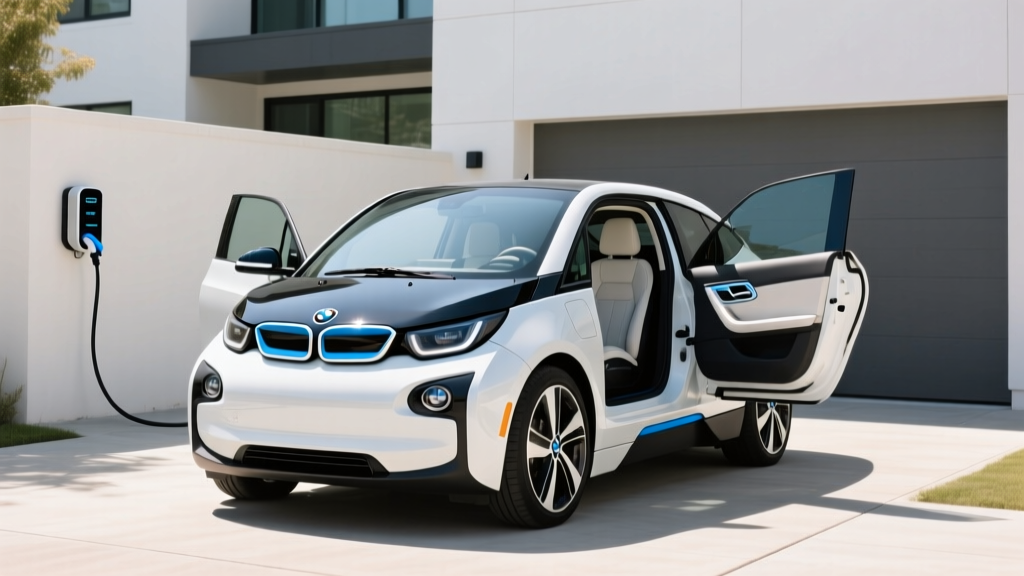
The BMW i3 launched in the United States for the 2014 model year as one of the most unconventional electric vehicles ever sold by a legacy automaker. Built on a carbon-fiber-reinforced plastic (CFRP) passenger cell with an aluminum chassis, the i3 prioritized lightweight efficiency and urban agility over long-distance touring. By 2026, the i3 is firmly a used-EV proposition — BMW ended production in July 2022 — but it remains a compelling choice for city commuters who can charge at home and need a premium-feeling runabout with genuinely interesting engineering.
This review covers the 2014 BMW i3 in detail: its real-world range, charging behavior, battery longevity, used-market pricing, and whether the federal used-EV tax credit can make it an exceptional value.
2014 BMW i3 Specifications at a Glance
| Specification | Value |
|---|---|
| EPA Range (BEV) | 81 miles |
| Battery (Gross / Usable) | 22 kWh gross / ~18.8 kWh usable |
| Battery Chemistry | NMC (Nickel Manganese Cobalt) — Samsung SDI cells |
| DC Fast Charge (CCS) | 50 kW peak |
| DC Fast Charge 0–80% | ~28–30 minutes |
| Level 2 Charge Rate | 7.4 kW (adds ~25 mi/hr) |
| Level 1 Charge Rate (120V) | ~2.5 kW (adds ~7 mi/hr) |
| Motor Output | 170 hp (125 kW) / 184 lb-ft torque |
| 0–60 mph | 7.0 seconds |
| Drivetrain | Rear-wheel drive (single motor) |
| EPA Efficiency | 124 MPGe combined / 27 kWh/100 mi |
| Cargo Volume (rear seats up / folded) | 15.1 cu ft / 36.9 cu ft |
| Curb Weight | ~2,630 lbs (BEV) |
| Battery Warranty (original) | 8 years / 100,000 miles |
| Original Base MSRP | $41,350 (BEV, before incentives) |
Real-World Range: What 81 EPA Miles Actually Means
EPA Sticker: 81 miles (BEV only)
Real-World Expectation: 65–75 miles on mixed highway driving at 70 mph; 80–90 miles in moderate-temperature city driving with frequent regenerative braking. In freezing weather (below 32°F), expect 50–60 miles due to cabin heating load and reduced battery efficiency.
The 2014 i3's 22 kWh battery pack (with roughly 18.8 kWh usable after the top and bottom buffer) was modest even at launch. BMW later upgraded to 33 kWh (2017) and 42.2 kWh (2019) packs, but the original 2014 model is locked into the smallest variant.
For context, the i3 achieves outstanding efficiency — roughly 4.0 to 4.5 miles per kWh in temperate city conditions — thanks to its carbon-fiber construction, narrow low-rolling-resistance tires (155/70 R19), and aggressive regenerative braking. But efficiency can't overcome a small battery on the highway, where aerodynamic drag and sustained speeds erode range quickly.
The REx (Range Extender) variant, which pairs the BEV powertrain with a 647cc two-cylinder BMW Motorrad gasoline engine and a 1.9-gallon fuel tank, extends total range to roughly 150 miles combined (72 electric + ~78 on gasoline). The REx adds approximately 260 lbs and reduces pure-electric EPA range to 72 miles. For 2014, the REx was a popular choice among buyers who needed occasional longer trips.
According to fueleconomy.gov, the 2014 i3 BEV achieves 124 MPGe combined (137 city / 111 highway). The REx variant is rated at 117 MPGe in charge-depleting mode and 39 MPG combined when operating on gasoline.
Charging: DC Fast, Level 2, and Level 1 Breakdown
| Charge Level | Connector | Max Power | Miles Added per Hour | Notes |
|---|---|---|---|---|
| Level 1 (120V household) | J1772 | ~2.5 kW | ~7 miles/hr | Full charge in ~8 hours; adequate for overnight top-ups under 50 miles |
| Level 2 (240V home/public) | J1772 | 7.4 kW | ~25 miles/hr | Full charge in ~3 hours; recommended for daily use |
| DC Fast Charge | CCS1 (optional on 2014) | 50 kW peak | ~120 miles/hr (at peak) | 0–80% in ~28–30 min; tapers significantly above 80% |
Critical note for used buyers: The CCS DC fast-charging port was optional on the 2014 i3. Some early examples were sold without it, meaning they can only charge on Level 1 or Level 2 AC power. Always verify the presence of a CCS port (located below the standard J1772 inlet on the driver's side rear quarter panel) before purchasing a used 2014 i3 if you plan to use public fast chargers.
At 50 kW peak, the i3's DC fast charging was competitive for 2014 but is slow by 2026 standards. The charge curve holds near peak rate from roughly 10% to 50% state of charge, then tapers progressively. The final 80–100% stretch is quite slow, so plan to disconnect at 80% for the best time efficiency at public stations.
On a home Level 2 charger (such as a 32-amp or 40-amp wall unit on a 240V circuit), the i3 charges at its onboard maximum of 7.4 kW. A nightly plug-in easily replenishes a full day's driving for any commute under 50 miles round-trip.
Battery Health, Degradation, and Longevity
The 2014 i3 uses Samsung SDI NMC (nickel manganese cobalt) lithium-ion cells arranged in 8 modules of 12 cells each (96 cells total). BMW's original battery warranty guarantees that the pack will retain at least 70% of its original capacity for 8 years or 100,000 miles, whichever comes first.
For a 2014 model in 2026, that factory battery warranty has expired or is expiring depending on mileage. This is the single most important factor when buying a used 2014 i3.
Observed degradation: Owner reports and fleet data suggest that 2014 i3 battery packs typically retain 80–90% of original capacity after 8–10 years and 60,000–80,000 miles, assuming normal use. Packs in hot climates (Arizona, Southern California, Texas) tend to degrade faster, losing up to 15–20% capacity over the same period. Cold-climate packs generally age better but may show reduced winter range due to temporary capacity loss at low temperatures.
Before purchasing, request a battery health reading from the iDrive system or use an OBD2 dongle with an app like BimmerCode or LeafSpy-equivalent for BMW to check actual State of Health (SoH). A pack reading below 75% SoH means you may see only 55–60 miles of real-world range and should negotiate the price accordingly or plan for a battery replacement.
Replacement cost: A refurbished 22 kWh i3 battery pack from BMW or an independent specialist typically costs between $8,000 and $12,000 installed as of 2026. Third-party cell-level repairs (replacing individual degraded modules) can reduce this to $3,000–$5,000 but require a qualified EV technician.
Performance, Driving Dynamics, and Efficiency
The 2014 i3's rear-mounted electric motor produces 170 horsepower and 184 lb-ft of torque, delivering instant acceleration from a standstill. The 0–60 mph time of 7.0 seconds (BEV) feels brisk in practice thanks to the linear torque curve and the i3's remarkably low curb weight of approximately 2,630 pounds — lighter than many compact gasoline cars.
The single-speed transmission and strong regenerative braking (up to 0.13g of deceleration from regen alone) enable true one-pedal driving in most city conditions. Lift off the accelerator and the i3 slows decisively, often eliminating the need for the friction brake pedal in stop-and-go traffic. This regen-heavy driving style also maximizes range in urban environments.
Handling is unusual. The tall, narrow tires (designed for low rolling resistance) provide less lateral grip than conventional EV rubber, and the steering is quick but light. The i3 is genuinely fun to drive in tight urban settings — its 32.8-foot turning circle is exceptional — but it is not a sports car. On the highway, wind noise becomes noticeable above 65 mph, and the tall ride height produces more body roll than a conventional BMW sedan.
Efficiency is the i3's ace. At 27 kWh per 100 miles (EPA combined), it is one of the most efficient EVs ever sold in the U.S. This translates to roughly $0.04–$0.06 per mile on residential electricity at $0.15/kWh — dramatically cheaper than any gasoline vehicle.
Interior, Cargo, Technology, and Daily Usability
The i3's interior was a radical departure from conventional BMW design in 2014 and still feels distinctive today. The dashboard uses eucalyptus wood trim and recycled materials, and the freestanding 6.5-inch iDrive display (upgraded to 8.8 inches in later years) controls infotainment and vehicle settings via BMW's rotary controller.
Passenger space: The i3 seats four adults. Front headroom and legroom are generous (40.5 inches front headroom, 40.5 inches front legroom). Rear seats are elevated (stadium-style) for visibility, offering 37.2 inches of rear legroom — adequate for adults on short trips but snug for long journeys. The rear-hinged "coach doors" (suicide doors) require the front doors to be open before the rears can open, which is a minor inconvenience in tight parking spots.
Cargo: With rear seats upright, cargo space is 15.1 cubic feet — comparable to a subcompact hatchback. Fold the rear seats flat and space expands to 36.9 cubic feet, enough for a week's groceries or two carry-on suitcases with room to spare. There is no front trunk (frunk); the space under the hood houses the power electronics and the REx engine (if equipped).
Technology: The 2014 i3 came with BMW iDrive, Bluetooth, USB connectivity, and available navigation with real-time range estimation. A DC fast-charging port (CCS), heated seats, LED headlights, and a sunroof were optional. Driver-assistance features were limited by 2014 standards: no adaptive cruise control or lane-keeping assist was offered. Parking sensors and a rearview camera were available.
Used Pricing, Trims, and Federal Tax Credit Eligibility
The 2014 i3 was offered in three trims: Mega World (base), Giga World (mid), and Tera World (top). Original MSRPs ranged from $41,350 to approximately $47,000 with options. The REx powertrain added $3,850 to any trim.
As of early 2026, used 2014 BMW i3 BEV models typically sell for $9,000 to $16,000 depending on mileage, condition, battery health, and trim. REx variants command a $1,000–$2,000 premium. Low-mileage Tera World examples with verified battery health above 90% SoH can approach $18,000.
| Scenario | Vehicle Price | Used EV Credit (§25E) | Net Cost |
|---|---|---|---|
| Mega World, 85k mi, 80% SoH | $10,500 | Up to $4,000 | ~$6,500 |
| Giga World, 60k mi, 88% SoH | $13,500 | Up to $4,000 | ~$9,500 |
| Tera World, 45k mi, 92% SoH | $17,000 | Up to $4,000 | ~$13,000 |
Federal used-EV tax credit (§25E): The 2014 i3 can qualify for a federal tax credit of 30% of the sale price, up to a maximum of $4,000, when purchased from a licensed dealer. Key eligibility requirements per IRS guidelines:
- Price cap: The dealer sale price must be $25,000 or less (virtually all 2014 i3s qualify).
- Buyer income cap: Adjusted gross income must not exceed $75,000 (single), $112,500 (head of household), or $150,000 (joint filers).
- Model year requirement: The vehicle must be at least two model years old (a 2014 model qualifies in 2026).
- Dealer sale required: Private-party purchases do not qualify.
- Battery capacity: Must have at least 7 kWh (the i3's 22 kWh pack qualifies).
- First transfer since Aug 16, 2022: The credit applies only to the first qualified resale after that date — confirm with the dealer that this specific VIN has not previously triggered the §25E credit.
The §25E credit is non-refundable, meaning it can only reduce your federal tax liability to zero — it will not generate a refund beyond that. However, as of 2024 and continuing into 2026, the credit can be transferred to the dealer at point of sale, reducing your purchase price directly. Consult a tax professional to confirm your personal eligibility.
2014 BMW i3 vs. Key Used-EV Competitors
In the $10,000–$16,000 used EV market, the 2014 i3 competes against several alternatives:
| Attribute | 2014 BMW i3 BEV | 2015 Nissan Leaf (30 kWh) | 2015 VW e-Golf |
|---|---|---|---|
| EPA Range | 81 mi | 107 mi | 83 mi |
| Battery Usable | 18.8 kWh | ~28 kWh | ~21.2 kWh |
| DC Fast Charge | 50 kW (CCS optional) | 50 kW (CHAdeMO) | 50 kW (CCS) |
| 0–60 mph | 7.0 sec | 9.8 sec | 9.2 sec |
| Efficiency | 124 MPGe | 114 MPGe | 116 MPGe |
| Cargo (seats up) | 15.1 cu ft | 24.0 cu ft | 22.8 cu ft |
| Build Quality | Premium (CFRP) | Economy | Solid (MQB) |
| Typical Used Price | $10K–$16K | $8K–$13K | $9K–$14K |
The i3 wins on efficiency, acceleration, build quality, and uniqueness. It loses on range, cargo space (vs. Leaf), and DC charging availability (CCS was optional). The Leaf offers more practicality; the e-Golf feels more conventional. The i3 is the enthusiast's pick in this price bracket.
Pros, Cons, and Who Should Buy
Pros
- Exceptional efficiency (124 MPGe, ~4 mi/kWh)
- Quick acceleration (7.0 sec 0–60) and one-pedal driving
- Carbon-fiber construction — lightweight and corrosion-resistant
- Premium interior materials and build quality
- Tight turning circle — ideal for city parking
- Eligible for up to $4,000 used-EV tax credit (§25E)
- Strong regenerative braking reduces brake wear
Cons
- 81-mile EPA range limits highway and long-distance use
- CCS DC fast charging was optional — not all cars have it
- Rear "coach doors" are inconvenient in tight spaces
- Battery warranty has expired on most 2014 examples
- Narrow tires limit wet-weather and lateral grip
- Small cargo area vs. Leaf or e-Golf
- No advanced driver-assistance features (ADAS)
- Replacement battery is expensive ($8K–$12K)
Who the 2014 i3 suits best: Urban commuters with reliable home charging, a round-trip commute under 50 miles, and an appreciation for distinctive engineering. It's an excellent second car for a household that has a gasoline or long-range EV for road trips. It is not suitable as a sole vehicle for families who regularly drive more than 60 miles in a day or who live in areas with sparse charging infrastructure.
Frequently Asked Questions
What is the real-world range of the 2014 BMW i3?
In moderate temperatures with city driving, expect 75–90 miles. At sustained highway speeds (70 mph), range drops to 60–70 miles. In freezing weather with cabin heat, expect 50–60 miles. The REx (range extender) variant adds a gasoline engine for a combined range of roughly 150 miles.
How fast does the 2014 i3 charge?
On a DC fast charger (CCS, if equipped), the i3 peaks at 50 kW and charges from 10% to 80% in approximately 28–30 minutes. On a 240V Level 2 home charger, it charges at 7.4 kW, adding about 25 miles of range per hour and fully recharging in roughly 3 hours. On a standard 120V outlet, expect about 7 miles of range per hour.
Does the 2014 BMW i3 qualify for any federal tax credit?
It does not qualify for the new-vehicle §30D credit (the car is no longer sold new). However, when purchased from a licensed dealer for $25,000 or less, it may qualify for the §25E used clean vehicle credit: 30% of the sale price, up to $4,000. Buyer income caps apply ($75K single / $150K joint). The vehicle must not have previously triggered the §25E credit since August 16, 2022. Verify eligibility with your dealer and a tax professional, referencing IRS §25E guidance.
Is the 2014 i3 worth buying in 2026 vs. other used EVs?
If your commute is under 50 miles round-trip and you value premium build quality, quick acceleration, and exceptional efficiency, the 2014 i3 is one of the best used EVs available under $16,000 — especially with the $4,000 tax credit bringing net cost as low as $6,500. If you need more range, cargo space, or DC fast-charging certainty, consider a 2015+ Nissan Leaf (30 kWh), a 2017+ i3 (33 kWh battery), or a used Chevrolet Bolt EV (238 miles EPA, typically $14K–$18K).
How long will the 2014 i3 battery last?
Most 2014 i3 packs retain 80–90% capacity after 8–10 years. A well-maintained pack in a moderate climate can deliver 100,000+ miles before dropping below 70% SoH. Always check SoH before purchasing. Budget $8,000–$12,000 for a full replacement if needed, or $3,000–$5,000 for module-level repair.
Can I install a home charger for the i3?
Yes. The i3 uses the standard J1772 connector for Level 1 and Level 2 AC charging. Any quality Level 2 home charger (ChargePoint Home Flex, Emporia Level 2, BMW i Wallbox) on a 240V / 40-amp circuit will charge the i3 at its maximum 7.4 kW rate. Professional installation typically costs $500–$1,500 depending on your electrical panel's capacity and the run distance from panel to garage.