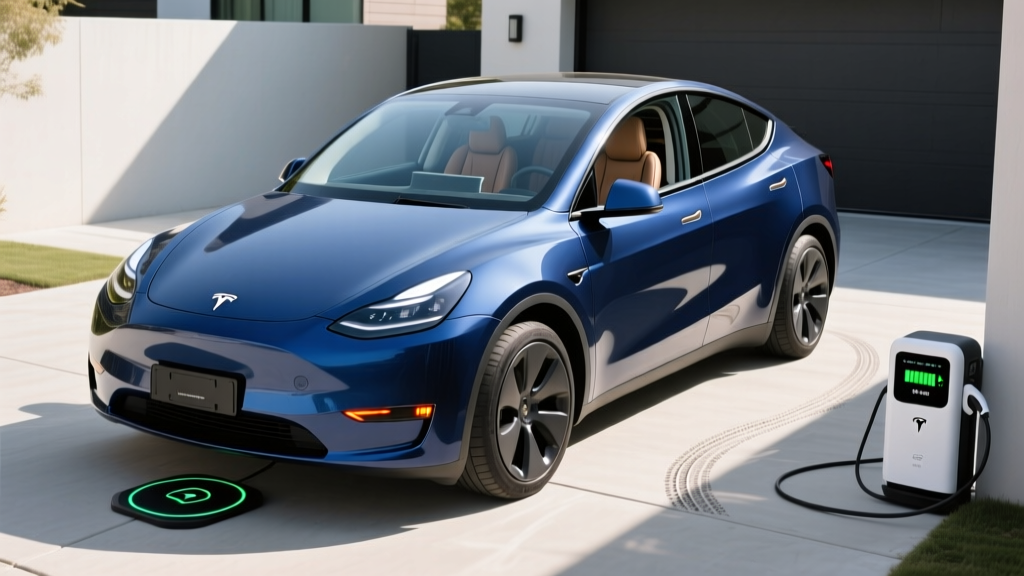
The 2026 Tesla Model Y: Still the EV Benchmark After Juniper?
The Tesla Model Y received its long-awaited "Juniper" refresh for the 2025 model year, and the 2026 version carries that redesigned platform forward with minor software and trim updates. It remains the best-selling electric vehicle in the United States and one of the best-selling cars globally — period. But with competition from the Hyundai Ioniq 5, Ford Mustang Mach-E, and a wave of new Chinese-market EVs, the Model Y can no longer coast on first-mover advantage alone.
This review breaks down every spec that matters — EPA range, charging speed, battery chemistry, real-world efficiency, interior space, and federal tax credit eligibility — and addresses a question we hear constantly from prospective buyers: what does Tesla body repair cost actually look like in 2026? Whether you're cross-shopping or ready to order, here's the data you need.
Range, Battery, and Real-World Efficiency
The 2026 Model Y is offered in three primary configurations in the US market, each with distinct range and battery profiles:
| Spec | Long Range RWD | Long Range AWD | Performance AWD |
|---|---|---|---|
| EPA Range | 320 mi | 308 mi | 285 mi |
| Battery (usable) | ~75 kWh (NMC) | ~75 kWh (NMC) | ~75 kWh (NMC) |
| MPGe (combined) | 123 MPGe | 119 MPGe | 111 MPGe |
| Efficiency | 27 kWh/100 mi | 28 kWh/100 mi | 30 kWh/100 mi |
| 0-60 mph | 5.8 sec | 4.8 sec | 3.5 sec |
| Horsepower | 346 hp | 384 hp | 456 hp |
| Drivetrain | RWD (single motor) | AWD (dual motor) | AWD (dual motor) |
| Base MSRP | $44,990 | $47,990 | $52,490 |
Tesla continues to use NMC (nickel manganese cobalt) lithium-ion chemistry in the Model Y's structural battery pack. NMC offers higher energy density than LFP (lithium iron phosphate), which is why it's used in the Long Range and Performance variants where maximizing range is the priority. The trade-off: NMC cells are more sensitive to sustained 100% state-of-charge storage, so Tesla recommends daily charging to 80-90% for battery longevity.
Real-World Range Reality Check
EPA sticker: 320 miles (Long Range RWD)
Expect in practice: ~270-290 miles on a mixed highway commute at 70 mph in moderate temperatures. On a sustained 75-80 mph road trip, plan for ~250-265 miles before needing to stop. In freezing conditions (below 32°F), range can drop 20-30%, yielding as little as ~220-240 miles. The Juniper heat pump helps mitigate cabin-heating losses, but cold battery chemistry still reduces available energy.
Efficiency, measured in kWh per 100 miles, is where the Model Y continues to lead the compact electric SUV segment. At 27 kWh/100 mi on the Long Range RWD, it converts energy to miles more effectively than the Ioniq 5 AWD (30 kWh/100 mi) or the Mach-E Extended Range AWD (~32 kWh/100 mi), per fueleconomy.gov. That efficiency advantage translates directly into lower charging costs and more miles per stop on road trips.
Charging Speed: DC Fast, Level 2, and the Supercharger Advantage
Charging speed remains one of the Model Y's strongest selling points, thanks to Tesla's mature Supercharger network and the vehicle's capable onboard charging hardware.
| Charging Level | Power (kW) | Speed / Time | Connector |
|---|---|---|---|
| Level 1 (120V outlet) | ~1.4 kW | ~4-5 miles per hour | NACS (native) |
| Level 2 (240V home/public) | 11.5 kW (max onboard) | ~44 miles per hour | NACS (native) |
| DC Fast Charge (peak) | 250 kW | 10-80% in ~25 min | NACS (native) |
A few critical notes on real-world charging:
- Peak vs. sustained: The 250 kW peak occurs only between roughly 10-30% state of charge (SoC) with a preconditioned battery. Above 50%, the charge curve tapers significantly — expect ~100-120 kW. Above 80%, it drops to ~40-60 kW. This is normal for NMC chemistry but means the last 20% takes disproportionately long.
- Preconditioning matters: Navigate to a Supercharger using the car's built-in navigation, and the battery will preheat automatically. Arriving at a charger without preconditioning — especially in cold weather — can cut peak charge rates by 40-60%.
- NACS is the standard: The Model Y uses the North American Charging Standard (NACS) connector natively. With most major automakers adopting NACS for 2025-2026 models, Tesla's connector advantage is narrowing, but the Supercharger network's reliability still leads public charging.
- Home charging cost: A full Level 2 home charge (0-100%) on the Long Range uses ~75 kWh. At the US average residential electricity rate of ~$0.16/kWh, that's roughly $12 for 320 miles of range — about 3.75 cents per mile. Compare that to a 25 MPG gas SUV at $3.50/gallon: ~14 cents per mile.
Interior, Cargo, and Everyday Practicality
The Juniper redesign brought meaningful interior improvements over the pre-2025 Model Y: ventilated front seats, ambient lighting, a rear-seat touchscreen, power-folding second row, and improved sound insulation. The minimalist dashboard remains — one 15.4-inch center touchscreen handles nearly all vehicle functions, including climate controls and the glovebox release.
Cargo volume:
- Behind second row: 30.2 cu ft
- Second row folded: 72.1 cu ft
- Front trunk (frunk): 4.1 cu ft
Passenger space:
- Front headroom: 41.0 in
- Front legroom: 41.8 in
- Rear headroom: 39.4 in
- Rear legroom: 40.5 in
The Juniper update added roughly 0.5 inches of rear legroom and improved seat cushion density, addressing one of the pre-refresh Model Y's most common complaints. The rear touchscreen (8 inches) lets passengers control climate and media — a feature borrowed from the Model S/X and now expected in this segment.
Standout tech features:
- Tesla's 15.4-inch infotainment with Netflix, YouTube, and gaming while parked
- Over-the-air (OTA) software updates that add features post-purchase
- Sentry Mode (360° camera recording while parked)
- Dog Mode, Camp Mode, and Bioweapon Defense Mode (HEPA filtration)
- Tesla app with remote climate, location, and charging control
Notable drawbacks:
- No physical buttons for climate, volume, or glovebox — everything is screen-based
- No Apple CarPlay or Android Auto
- Turn signals are on a steering wheel that yoke-option buyers find awkward for roundabouts
- Panel gap consistency has improved but still lags luxury German competitors
Pricing, Tax Credits, and Total Cost
| Trim | Base MSRP | Est. As-Tested* | §30D Credit Eligible? | Effective Price |
|---|---|---|---|---|
| Long Range RWD | $44,990 | $46,500 | Yes (up to $7,500) | ~$37,490 |
| Long Range AWD | $47,990 | $50,200 | Yes (up to $7,500) | ~$40,490 |
| Performance AWD | $52,490 | $55,000 | Yes (up to $7,500) | ~$44,990 |
*As-tested prices include typical destination fee ($1,390) and common add-ons. Your configuration will vary.
Federal tax credit eligibility (IRS §30D) — critical caveats:
- MSRP cap: SUVs must be under $80,000. All Model Y trims qualify.
- Buyer income cap: Modified AGI must not exceed $150,000 (single), $225,000 (head of household), or $300,000 (joint). Check IRS.gov §30D guidelines for current-year thresholds.
- Battery sourcing: The full $7,500 requires both critical-mineral and battery-component requirements be met. Tesla's US-built battery cells and North American mineral sourcing have generally qualified the Model Y for the full credit, but component-sourcing rules tighten annually. Verify current eligibility on Tesla's website or with your tax professional before ordering.
- Point-of-sale transfer: Since 2024, you can transfer the credit to the dealer at purchase, reducing your out-of-pocket cost immediately rather than waiting for tax filing. Tesla supports this at delivery.
Warranty Coverage
Tesla's warranty structure is straightforward:
- Basic vehicle: 4 years / 50,000 miles
- Battery & drive unit: 8 years / 120,000 miles (Long Range AWD & Performance)
- Battery & drive unit: 8 years / 100,000 miles (Long Range RWD)
- Battery capacity retention: Tesla warrants a minimum of 70% capacity retention during the warranty period
The 70% retention threshold is consistent with industry norms (Hyundai offers 70% on the Ioniq 5; Ford offers 70% on the Mach-E). Real-world degradation data from Tesla's fleet suggests most Model Y packs retain 88-92% capacity at 100,000 miles, though individual results depend on charging habits, climate, and Supercharging frequency.
Tesla Body Repair Cost: What Owners Should Know
This is the question that surfaces in every EV forum and Reddit thread: how much does Tesla body repair cost after a collision, and is it really more expensive than repairing a conventional vehicle?
The honest answer: it depends heavily on damage severity, but Tesla body repair costs tend to run higher than comparable gas vehicles for several structural and logistical reasons.
Why Tesla body repair costs can be higher:
- Giga-castings: The Juniper Model Y uses large single-piece front and rear aluminum castings (replacing dozens of welded steel parts). If a giga-casting is cracked or deformed, it cannot be section-repaired — it must be replaced as a unit, which is a labor-intensive, expensive procedure.
- Integrated sensor suite: Bumpers and fenders house cameras, ultrasonic sensors (now removed on newer Teslas in favor of Tesla Vision), and radar components (where equipped). Even minor fender damage can require sensor recalibration.
- Structural battery pack: The battery is a stressed chassis member. Any underbody impact must be inspected by a Tesla-certified technician, and pack damage can result in a total-loss determination due to the cost of replacement ($15,000-$22,000+ for the pack alone).
- Approved body shop network: Tesla controls its collision repair network tightly. Not all independent shops are Tesla-certified, which can limit your options and extend repair timelines.
- Parts availability: While improving, Tesla's parts supply chain can still mean 2-6 week waits for specific body panels, castings, or trim pieces — especially for less common colors.
Typical Tesla body repair cost ranges (2026 estimates):
- Minor bumper scuff/scratch: $500-$1,500 (paint and refinish)
- Fender bender (single panel + bumper replacement): $3,000-$7,000
- Moderate front/rear collision: $8,000-$18,000
- Major structural damage (giga-casting involvement): $15,000-$35,000+ (may trigger total loss)
Insurance implications: Tesla insurance premiums tend to run 15-30% higher than equivalent gas SUVs, largely because of these repair-cost dynamics. Tesla offers its own insurance product in many states, which uses real-time driving data (Safety Score) to adjust monthly premiums — some careful drivers report rates competitive with conventional insurers. Get quotes from multiple providers before taking delivery.
Autopilot and Driver Assistance (SAE Level 2)
SAE Automation Level: Level 2 — Driver Assistance, NOT Self-Driving
Tesla's Autopilot and Full Self-Driving (Supervised) are SAE Level 2 systems. The driver must remain fully attentive, keep hands on the wheel (or demonstrate engagement via cabin camera), and be prepared to take over at any moment. This is not autonomous driving. Only Level 4 services like Waymo operate without a human driver.
What's included standard (Basic Autopilot):
- Traffic-Aware Cruise Control
- Autosteer (lane-centering on marked highways)
Full Self-Driving (Supervised) — $8,000 one-time or $99/month:
- Auto lane change on highways
- Autopark and Summon
- Traffic light and stop sign recognition/response
- City street navigation with turn execution
FSD (Supervised) Limitations
FSD (Supervised) does not make the Model Y autonomous. It struggles with construction zones, faded lane markings, unprotected left turns in complex intersections, and adverse weather. The driver is legally and practically responsible for all vehicle operation. NHTSA continues to monitor Tesla's Autopilot/FSD crash data under its Standing General Order.
Pros and Cons at a Glance
Pros
- Class-leading efficiency (27 kWh/100 mi on LR RWD)
- Supercharger network reliability still bests third-party DC networks
- Strong real-world range (320 mi EPA on LR RWD)
- OTA updates continuously add features
- Spacious cargo area (72.1 cu ft folded)
- Qualifies for up to $7,500 federal tax credit (verify sourcing rules)
- Excellent app integration and remote features
Cons
- Tesla body repair cost runs higher than segment average
- No physical buttons — all controls via touchscreen
- No Apple CarPlay or Android Auto
- Insurance premiums 15-30% above comparable gas SUVs
- FSD (Supervised) is Level 2, not autonomous — requires constant attention
- Parts wait times for body repairs can stretch weeks
Who Should Buy the 2026 Model Y?
Choose the Model Y if:
- You want the most efficient electric SUV in its class and prioritize range per dollar
- You road-trip frequently and value the Supercharger network's coverage and reliability
- You need cargo space for a family (strollers, groceries, luggage) without stepping up to a three-row EV
- You're comfortable with screen-based controls and no CarPlay
Look at competitors if:
- You want physical buttons, CarPlay, or a more traditional interior layout (Hyundai Ioniq 5, Ford Mach-E)
- You're concerned about body repair costs and insurance premiums — mainstream brands may offer cheaper collision repair
- You need a third row (Kia EV9, Rivian R1S)
- You prefer LFP battery chemistry for its longer cycle life and 100% daily charging tolerance (base Ioniq 5 Standard Range)
Frequently Asked Questions
What is the real-world range of the 2026 Tesla Model Y?
The Long Range RWD has an EPA rating of 320 miles. In real-world mixed driving at moderate temperatures, expect 270-290 miles. Sustained highway driving at 75-80 mph drops that to ~250-265 miles, and freezing weather can reduce range by 20-30%, yielding ~220-240 miles.
How fast does the Model Y charge at home and on DC fast chargers?
At home on a 240V Level 2 charger, the Model Y accepts up to 11.5 kW, adding roughly 44 miles of range per hour. A full charge from near-empty takes about 7-8 hours overnight. On DC fast chargers, it peaks at 250 kW (with a preconditioned battery), achieving a 10-80% charge in approximately 25 minutes. Charging slows significantly above 80% SoC due to the NMC charge curve taper.
How much does the Model Y cost after the federal tax credit?
The Long Range RWD starts at $44,990. If you qualify for the full $7,500 §30D credit (subject to income caps, MSRP caps, and battery-sourcing requirements per IRS guidelines), the effective price drops to approximately $37,490. The credit can be transferred at point of sale, reducing your out-of-pocket cost at delivery.
Does the Tesla Model Y qualify for the federal EV tax credit?
As of 2026, the Model Y qualifies for up to $7,500 under IRS §30D, provided the buyer meets income limits ($150K single / $300K joint), the vehicle MSRP is under $80,000 (all trims qualify), and battery critical-mineral and component sourcing requirements are satisfied. These sourcing rules tighten annually — confirm current eligibility on Tesla's order page or with a tax professional before purchasing.
Is the Tesla Model Y worth buying vs. the Hyundai Ioniq 5 or Ford Mach-E?
The Model Y wins on efficiency, Supercharger network access, and cargo volume. The Ioniq 5 offers faster 10-80% charging on 350 kW chargers (~18 min), Apple CarPlay, physical buttons, and available LFP chemistry. The Mach-E provides a more conventional SUV driving feel and CarPlay. If charging infrastructure and efficiency are your top priorities, the Model Y leads. If interior ergonomics, repair costs, or CarPlay matter more, test-drive the Ioniq 5 and Mach-E before deciding.
Why is Tesla body repair cost higher than other vehicles?
Three primary factors: (1) large aluminum giga-castings that must be replaced as whole units rather than section-repaired; (2) an integrated structural battery pack that makes underbody damage potentially very expensive; and (3) a controlled body-shop network with parts supply chains that can delay repairs. Minor cosmetic damage costs are comparable to other vehicles, but moderate-to-severe collisions tend to be 20-40% more expensive to repair than equivalent gas SUVs.
What is the battery warranty on the 2026 Model Y?
Tesla warrants the battery and drive unit for 8 years / 120,000 miles on AWD trims and 8 years / 100,000 miles on RWD, with a minimum 70% capacity retention guarantee. Real-world fleet data suggests most packs retain 88-92% capacity at 100,000 miles under normal charging habits.