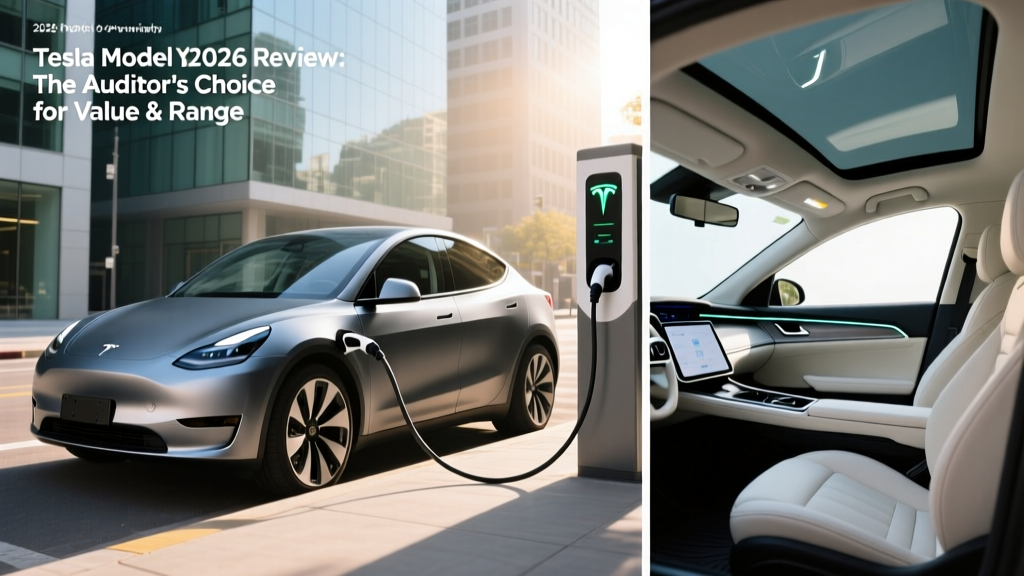
The Tesla Model Y enters 2026 with a refreshed "Juniper" design, improved efficiency, and the same market-dominating proposition that has made it the world's best-selling EV for two consecutive years. But with rivals like the Hyundai Ioniq 5, Ford Mustang Mach-E, and Chevrolet Equinox EV closing the gap, does the Model Y still pass a rigorous audit of value, range, and daily usability? We put the 2026 lineup under the microscope.
Quick Verdict: Who the Tesla Model Y Is For
The 2026 Tesla Model Y remains the default recommendation for buyers who want a midsize electric crossover with excellent efficiency, access to the Supercharger network, and strong over-the-air update cadence. It excels as a daily commuter and family hauler, though its minimalist interior and firm ride will not appeal to every buyer. If you audit your needs around range-per-dollar, charging convenience, and cargo versatility, the Model Y continues to score near the top.
Range, Efficiency & Real-World Expectations
Tesla offers the 2026 Model Y in three primary configurations. The EPA-estimated range and efficiency figures below reflect the latest Juniper powertrain refinements, which include improved aerodynamics and a standard heat pump for better cold-weather performance.
| Trim | Drivetrain | EPA Range | MPGe (Combined) | kWh/100 mi |
|---|---|---|---|---|
| Long Range RWD | Rear-Wheel Drive | 320 mi | 122 MPGe | 27 |
| Long Range AWD | Dual-Motor AWD | 302 mi | 115 MPGe | 29 |
| Performance AWD | Dual-Motor AWD | 285 mi | 108 MPGe | 31 |
The Long Range RWD's 27 kWh/100 mi efficiency figure is among the best in the midsize electric crossover segment, meaning you spend less per mile at the charger than competitors like the Mach-E Extended Range (~31 kWh/100 mi).
Battery Chemistry, Capacity & Longevity
The 2026 Model Y Long Range uses an NMC (nickel manganese cobalt) battery pack with approximately 78 kWh of usable capacity. Tesla has not published the exact cell-level chemistry shift for 2026, but the pack remains a structural battery tray contributing to chassis rigidity.
For the Standard Range variant (where available), Tesla has historically used LFP (lithium iron phosphate) chemistry, which offers superior cycle life and allows regular charging to 100% without degradation concerns—ideal for daily commuters who can charge at home nightly. The trade-off is lower energy density (heavier pack, slightly less range) and slower DC fast-charging speeds compared to NMC.
| Attribute | NMC (Long Range) | LFP (Standard Range) |
|---|---|---|
| Energy Density | Higher (more range per kg) | Lower |
| Cycle Life | ~1,000–1,500 cycles | ~3,000+ cycles |
| Recommended Daily SoC | 80% (for longevity) | 100% (weekly at minimum) |
| Cold-Weather Performance | Better at low temps | More range loss in cold |
| DC Fast-Charge Speed | Up to 250 kW | Up to ~170 kW |
Warranty: Tesla covers the battery and drive unit for 8 years / 120,000 miles on Long Range and Performance trims, with a minimum 70% capacity retention threshold. This is competitive with Hyundai's 10-year/100,000-mile battery warranty, though Hyundai's mileage cap is lower.
Charging Speed: DC Fast, Level 2 & Home Setup
Charging remains a Model Y strong suit, particularly if you live near Tesla Superchargers. The 2026 Long Range supports up to 250 kW peak DC fast charging on V3 Superchargers, while the Performance trim shares the same peak rate.
| Charging Level | Power / Rate | Time / Speed | Connector |
|---|---|---|---|
| DC Fast (V3 Supercharger) | Peak 250 kW | 10–80% in ~25 min | NACS (native) |
| DC Fast (CCS via adapter) | Up to ~150 kW (adapter-limited) | 10–80% in ~35 min | CCS1 (with adapter) |
| Level 2 (Tesla Wall Connector) | 11.5 kW (48A) | ~37 mi/hr of charging | NACS |
| Level 2 (Universal J1772) | Up to 11.5 kW (with adapter) | ~37 mi/hr | J1772 (with adapter) |
| Level 1 (120V household) | ~1.4 kW | ~3–4 mi/hr | NACS (mobile connector) |
Charge-curve reality check: The 250 kW peak only sustains from roughly 10–30% SoC. Above 50%, the rate tapers to ~100 kW, and above 80% it drops further to protect the battery. On a road trip, plan stops around the 10–80% window for optimal speed—charging from 80–100% can add 20+ minutes for only ~60 miles of range.
For home charging, a Tesla Wall Connector on a 60-amp circuit delivers 11.5 kW, replenishing the full 78 kWh battery in roughly 7–8 hours. Installation costs typically range from $800–$2,000 depending on panel proximity and local permit requirements. If your home has a 200-amp panel with capacity, expect the lower end; a panel upgrade to 200A can add $1,500–$3,000.
Performance: 0–60, Horsepower & Drivetrain
| Trim | 0–60 mph | Horsepower | Top Speed | Drivetrain |
|---|---|---|---|---|
| Long Range RWD | 5.8 sec | ~346 hp | 125 mph | Rear-Wheel Drive |
| Long Range AWD | 4.8 sec | ~384 hp | 125 mph | Dual-Motor AWD |
| Performance AWD | 3.5 sec | ~456 hp | 155 mph | Dual-Motor AWD |
The Long Range RWD provides more than adequate acceleration for merging and passing, while the Performance variant delivers sports-car territory thrust. All trims feature regenerative braking with one-pedal driving capability. The Juniper refresh added revised suspension tuning for a marginally more compliant ride, though the Model Y still leans firm compared to a Hyundai Ioniq 5 or Kia EV6.
Interior, Cargo & Technology
The 2026 Juniper interior introduces ambient lighting, ventilated front seats, a rear-seat touchscreen, and power-folding second-row seats. The minimalist dashboard centers on a 15.4-inch touchscreen that controls virtually every vehicle function—climate, mirrors, glovebox, and drive settings.
Cargo capacity:
- Behind second row: 30.2 cu ft
- Seats folded: 72.1 cu ft
- Front trunk (frunk): 4.1 cu ft
- Rear legroom: 38.0 inches
- Front headroom: 40.7 inches
These cargo figures beat the Ford Mustang Mach-E (29.7 cu ft behind rear seats) but trail the Hyundai Ioniq 5's more boxy cargo area slightly. The frunk is useful for charging cables and small bags.
Driver Assistance (SAE Level 2): Standard Autopilot includes Traffic-Aware Cruise Control and Autosteer. The optional Full Self-Driving (Supervised) package adds city-street navigation, traffic-light recognition, and autosteer on surface streets. Per NHTSA guidelines, FSD remains a Level 2 system—the driver must remain fully engaged, with hands on the wheel and eyes on the road. It is not autonomous driving.
Pricing, Trims & Federal Tax Credit Eligibility
| Trim | Base MSRP | Federal Credit (§30D) | Effective Price* |
|---|---|---|---|
| Long Range RWD | $44,990 | Up to $7,500 (if eligible) | ~$37,490 |
| Long Range AWD | $47,990 | Up to $7,500 (if eligible) | ~$40,490 |
| Performance AWD | $52,490 | Up to $7,500 (if eligible) | ~$44,990 |
*Effective price assumes full §30D credit eligibility. Destination fee ($1,390) not included. State/local incentives vary.
The federal EV tax credit under IRS §30D has strict eligibility requirements for 2026:
- MSRP cap: SUVs/crossovers must be under $80,000 — all Model Y trims qualify.
- Buyer income cap: Modified AGI must not exceed $150,000 (single), $225,000 (head of household), or $300,000 (joint).
- Battery sourcing: A percentage of critical minerals and battery components must be sourced from the U.S. or FTA partners. The full $7,500 requires meeting both thresholds ($3,750 for minerals + $3,750 for components). Tesla's U.S.-built packs generally qualify, but verify at purchase.
- Point-of-sale transfer: Eligible buyers can transfer the credit to the dealer at purchase for an immediate price reduction, rather than waiting for tax filing.
Always confirm credit eligibility with your tax professional and the dealer at point of sale. Rules can change, and individual tax situations vary.
Pros, Cons & Competitor Comparison
✅ Pros
- Best-in-class efficiency (27 kWh/100 mi on LR RWD)
- Access to 6,000+ Tesla Supercharger stalls nationwide
- Strong OTA update cadence; features improve post-purchase
- Spacious cargo area with practical frunk
- Competitive pricing after federal tax credit
- Standard heat pump for cold-weather range preservation
❌ Cons
- Minimalist interior polarizes; no physical buttons or stalks (Juniper removes turn-signal stalk)
- Firm ride quality on rough pavement
- Turn signals via steering-wheel buttons take adjustment
- Service center wait times can be lengthy in some regions
- FSD package ($8,000) remains Level 2 despite the name
vs. Hyundai Ioniq 5: The Ioniq 5 offers 800V ultra-fast charging (10–80% in ~18 min at 350 kW), a more comfortable ride, and physical controls. But it lacks Supercharger access (though Hyundai has a NACS adapter for 2026) and trails on efficiency.
vs. Ford Mustang Mach-E: The Mach-E provides a more engaging drive and conventional interior layout, but its real-world efficiency and cargo space fall short of the Model Y.
vs. Chevrolet Equinox EV: The Equinox EV 3RS starts lower (~$43,000) and offers 319 miles EPA, but its DC fast-charging peaks at ~150 kW, making road trips slower.
Ownership Costs: 5-Year Audit
Based on 15,000 miles/year, national-average electricity at $0.16/kWh, and gasoline at $3.50/gallon:
| Category | Model Y LR RWD | Gas SUV (28 MPG) |
|---|---|---|
| Purchase (after credit) | $38,880 | $35,000 |
| Fuel / Energy (5 yr) | $3,300 | $9,375 |
| Maintenance (5 yr) | $1,200 | $3,500 |
| Insurance (5 yr avg) | $9,500 | $7,000 |
| Depreciation (est.) | $16,000 | $12,000 |
| Total 5-Year | ~$68,880 | ~$66,875 |
The Model Y's higher insurance premiums and depreciation partially offset fuel and maintenance savings. Buyers who drive more than 15,000 miles/year or have access to cheap electricity (<$0.12/kWh) will see a stronger financial case. According to fueleconomy.gov, the Model Y Long Range's annual fuel cost is approximately $660 at current electricity rates.
Frequently Asked Questions
What is the real-world range of the 2026 Tesla Model Y?
The EPA rates the Long Range RWD at 320 miles. In real-world highway driving at 75 mph, expect 260–280 miles in mild weather and 210–240 miles in freezing temperatures. City driving with regenerative braking can exceed the EPA estimate.
How fast does the Model Y charge at home and on road trips?
At a V3 Supercharger (250 kW), the Long Range charges from 10–80% in approximately 25 minutes. At home on a Level 2 Tesla Wall Connector (11.5 kW), you gain about 37 miles per hour of charging, fully replenishing the battery overnight.
Does the 2026 Model Y qualify for the $7,500 federal tax credit?
Yes, all trims fall under the $80,000 MSRP cap. However, you must also meet income limits ($150K single / $300K joint) and the vehicle's battery must meet critical-mineral and component sourcing requirements. Verify at point of sale; the credit can be transferred to the dealer for an immediate discount.
Is the Model Y worth buying over the Ioniq 5 or Mach-E?
If Supercharger access, efficiency, and cargo space are your priorities, the Model Y wins. If you prefer a more comfortable ride, physical controls, and ultra-fast 800V charging (on non-Tesla networks), the Ioniq 5 is a strong alternative. The Mach-E suits drivers who want sportier handling and a conventional interior.
What are the biggest drawbacks of the 2026 Model Y?
The Juniper's stalkless turn signals require a learning curve. The ride is firm on broken pavement. Service center availability varies by region. And the FSD package, at $8,000, remains a Level 2 driver-assist system—not autonomous driving.
How long will the Model Y battery last?
Tesla warranties the battery for 8 years / 120,000 miles with at least 70% capacity retention. Real-world data from Tesla's fleet suggests NMC packs retain approximately 85–90% capacity at 100,000 miles under normal use. Avoid frequent DC fast charging and routinely charging to 100% (on NMC) to maximize longevity.
Look elsewhere if: You need physical buttons, prioritize ride comfort over sportiness, frequently drive in extreme cold without garage charging, or want the fastest possible DC charging on non-Tesla networks.