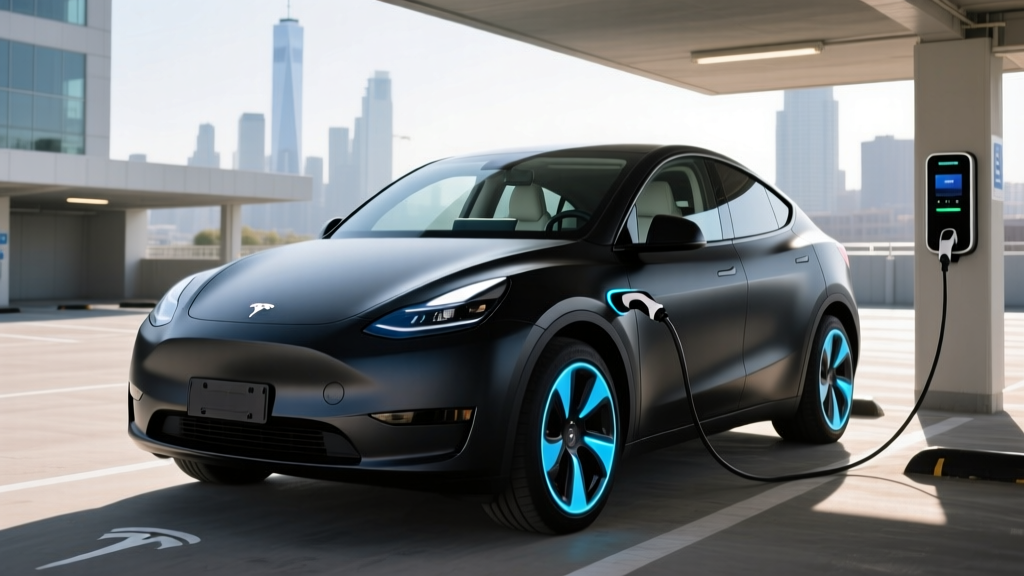
The refreshed Tesla Model Y—internally dubbed "Juniper"—arrived for the 2025 model year with a redesigned exterior, a quieter cabin, and a significantly overhauled interior. For buyers researching Tesla connectivity features 2025, the Juniper update brings a rear touchscreen, ventilated seats, ambient lighting, and continued access to Tesla's industry-leading software ecosystem. But beneath the cosmetic refresh lies the same proven 75 kWh (usable) battery architecture that has made the Model Y the best-selling EV in the world.
This review covers the 2025 Model Y Long Range AWD and Performance trims with exact EPA figures, real-world range data, DC fast-charging curves, and current federal tax credit eligibility under IRS §30D rules.
2025 Tesla Model Y: Core Specifications at a Glance
| Spec | Long Range AWD | Performance AWD |
|---|---|---|
| EPA Range | 320 miles | 298 miles |
| Battery (Usable) | ~75 kWh, NMC | ~75 kWh, NMC |
| Drivetrain | Dual-Motor AWD | Dual-Motor AWD |
| Horsepower | 384 hp | 456 hp |
| 0–60 mph | 4.8 sec | 3.5 sec |
| Peak DC Fast Charge | 250 kW | 250 kW |
| 10–80% DC Time | ~27 min | ~27 min |
| Level 2 Rate | 11.5 kW (~37 mi/hr) | 11.5 kW (~37 mi/hr) |
| MPGe (Combined) | 111 MPGe | 103 MPGe |
| Efficiency | 30 kWh/100 mi | 33 kWh/100 mi |
| Cargo Volume | 72 cu ft (rear seats folded) | 72 cu ft (rear seats folded) |
| Rear Legroom | 41.6 in | 41.6 in |
| Base MSRP | $46,630 | $51,630 |
Source: fueleconomy.gov and Tesla's official specifications page. Prices reflect the current MSRP before destination fees and incentives.
Real-World Range: What the EPA Sticker Doesn't Tell You
Real-World Highway (70–75 mph): ~255–275 miles
Cold Weather (below 32°F): ~210–240 miles
Mixed Commute (city + suburban): ~290–310 miles
The 320-mile EPA rating on the Long Range AWD is a strong number, but EPA testing cycles favor lower-speed, mixed driving with generous regeneration. On sustained highway trips at 70–75 mph—where aerodynamic drag dominates—expect to see between 255 and 275 miles before hitting 0% State of Charge. In sub-freezing temperatures, the NMC battery's internal resistance rises and cabin heating draws significant power (the Model Y uses a heat pump, which helps but doesn't eliminate the penalty). Plan for roughly 210–240 miles of usable range in deep winter conditions.
The Performance trim's stickier tires and more aggressive tuning reduce its EPA figure to 298 miles, and real-world highway range drops to approximately 235–255 miles. If your typical road trip involves 250-mile legs between charging stops, the Long Range is the more practical choice.
Charging Speed: DC Fast Charging and Home Level 2
Tesla's Supercharger network remains the most reliable public DC fast-charging infrastructure in the U.S., and the 2025 Model Y takes full advantage of it. The vehicle accepts a peak charge rate of 250 kW on V3 Superchargers.
| Charging Level | Power / Rate | Speed (Miles Added) | Notes |
|---|---|---|---|
| Level 1 (120V) | ~1.2 kW | ~3–4 mi/hr | Emergency/trickle only |
| Level 2 (240V, 48A) | 11.5 kW | ~37 mi/hr | Full charge in ~7.5 hours |
| DC Fast (V3 Supercharger) | Peak 250 kW | ~170 mi in 15 min | 10–80% in ~27 min |
| DC Fast (CCS via adapter) | Up to 250 kW | Varies by station | Requires Tesla CCS adapter |
Charging curve reality: The 250 kW peak is not sustained across the entire session. The Model Y's charge curve peaks around 15–30% SoC and begins tapering significantly above 60%. From 10% to 80%, the average sustained rate is closer to 150–170 kW, which is why the 10–80% time lands at approximately 27 minutes. Above 80%, charging slows dramatically to protect battery health—plan your road-trip stops around 80% departures rather than waiting for a full charge.
For home charging, the onboard charger accepts up to 11.5 kW on a 240V/48A circuit (NEMA 14-50 or hardwired Wall Connector). This adds roughly 37 miles of range per hour, meaning a depleted battery reaches full in about 7.5 hours—ideal for overnight replenishment.
Juniper Connectivity Features and Interior Tech
The 2025 Juniper refresh is where the keyword Tesla connectivity features 2025 becomes most relevant. Tesla overhauled the cabin with several notable upgrades:
- Front 15.4-inch touchscreen: Higher resolution than the pre-refresh unit, running Tesla's latest software with Netflix, YouTube, and Arcade streaming while parked.
- Rear 8-inch touchscreen: New for 2025, mounted on the rear console for climate control, media, and streaming—useful for families with children.
- Ambient lighting: A full cabin light strip replaces the older, minimal LED accents.
- Ventilated front seats: Finally standard, addressing one of the most common complaints about prior Model Y interiors.
- Power-folding second row: Buttons in the cargo area fold the rear seats electrically.
- Improved NVH: Additional acoustic glass and insulation significantly reduce road and wind noise—a measurable improvement over the 2024 model.
On the connectivity side, Tesla's built-in LTE provides real-time navigation with Supercharger routing, traffic-aware routing, Sentry Mode remote viewing, and over-the-air (OTA) software updates. The Tesla app allows preconditioning, location tracking, Summon, and remote climate control. Premium Connectivity ($9.99/month or $99/year) adds satellite maps, live traffic visualization, and in-car streaming.
Autopilot and FSD (Supervised): SAE Level 2
Autopilot and Full Self-Driving (Supervised) require continuous driver supervision. You must keep your hands on the wheel and eyes on the road. These are not self-driving systems. Only Level 4 services like Waymo operate without a human driver in defined zones.
Standard Autopilot includes Traffic-Aware Cruise Control and Autosteer. The optional FSD (Supervised) package ($8,000 one-time or $99/month) adds automatic lane changes, Navigate on Autopilot for highway interchanges, traffic light and stop sign recognition, and Autopark. As of early 2026, FSD remains a driver-assist system—impressive in capability but legally and functionally requiring your attention at all times.
Pricing, Trims, and Federal Tax Credit Eligibility
| Trim | Base MSRP | Destination | Total Before Credit | Est. After §30D Credit |
|---|---|---|---|---|
| Long Range AWD | $46,630 | $1,390 | $48,020 | ~$40,520* |
| Performance AWD | $51,630 | $1,390 | $53,020 | ~$45,520* |
*Tax credit amounts depend on individual eligibility. See below.
Does the 2025 Model Y Qualify for the §30D Federal Tax Credit?
The 2025 Tesla Model Y is eligible for up to $7,500 under the IRS §30D Clean Vehicle Credit, but several conditions must be met:
- MSRP cap: The vehicle must have an MSRP at or below $80,000 for SUVs. Both Model Y trims qualify.
- Buyer income cap: Modified Adjusted Gross Income (MAGI) must not exceed $150,000 (single), $225,000 (head of household), or $300,000 (joint filers).
- Battery sourcing: A portion of the credit depends on critical minerals and battery components meeting U.S. or free-trade-agreement sourcing requirements. Tesla's Fremont-built Model Y has historically met these thresholds, but exact eligibility can shift as sourcing rules tighten annually.
- Point-of-sale transfer: As of 2024, buyers can transfer the credit to the dealer at purchase, reducing the upfront price rather than waiting for a tax refund.
Important: Always verify current eligibility on IRS.gov before purchasing. Battery sourcing requirements tighten each year, and a vehicle that qualifies in January may have different status by December. Consult a tax professional for your specific situation.
Warranty, Battery Longevity, and Ownership Costs
Tesla provides the following warranty coverage for the 2025 Model Y:
- Basic Vehicle: 4 years / 50,000 miles
- Battery & Drive Unit: 8 years / 120,000 miles (whichever comes first), with a minimum 70% capacity retention guarantee
The NMC (nickel-manganese-cobalt) chemistry in the Model Y offers higher energy density than LFP, enabling the 320-mile range in a relatively compact pack. However, NMC batteries are more sensitive to sustained high SoC. Tesla recommends daily charging to 80% and reserving 100% charges for road trips. Long-term degradation data from fleets and high-mileage owners suggests approximately 10–12% capacity loss at 100,000 miles under normal use patterns—well within the 70% warranty threshold.
Insurance costs for the Model Y tend to run 15–25% higher than comparable non-electric compact SUVs, driven by repair costs for aluminum panels and sensor calibration. Expect annual premiums in the $1,800–$2,600 range depending on your state and driving record.
Pros and Cons: The Honest Assessment
Pros
- Best-in-class Supercharger network access with seamless plug-and-charge
- Class-leading efficiency at 30 kWh/100 mi (Long Range)
- Strong real-world range for road trips when planned around 80% SoC
- Juniper cabin is meaningfully quieter and more refined
- OTA updates continuously add features post-purchase
- Spacious 72 cu ft cargo area with flat load floor
- Rear touchscreen is a genuine upgrade for families
Cons
- No Apple CarPlay or Android Auto—Tesla's ecosystem is the only option
- FSD ($8,000) remains Level 2 despite the "Full Self-Driving" name
- Turn-signal stalks removed; buttons on steering wheel take adaptation
- 250 kW peak DC charge rate trails Hyundai/Kia's 350 kW E-GMP platform
- Insurance premiums above segment average
- Ride quality on 20-inch Performance wheels can be firm on rough roads
Who Should Buy the 2025 Tesla Model Y?
Choose the Model Y Long Range if: You want the most efficient electric SUV for daily commuting and road trips, value Supercharger reliability, and need practical cargo space for a family of four. It's ideal for buyers who charge at home and take 2–4 road trips per year within the Supercharger network.
Choose the Model Y Performance if: Acceleration and handling matter to you, and you're willing to sacrifice ~22 miles of EPA range for a 3.5-second 0–60 time and sport-tuned suspension. Best for enthusiasts who still need SUV practicality.
Look at competitors (Hyundai Ioniq 5, Ford Mustang Mach-E, Kia EV6) if: You want Apple CarPlay, faster 10–80% DC charging via 800V architecture, or a more traditional dealership service experience. The Ioniq 5's 350 kW peak charge capability means 10–80% in roughly 18 minutes at compatible stations—a meaningful advantage on road trips if you have access to 350 kW Electrify America chargers.
Is the 2025 Tesla Model Y Worth It vs. Competitors?
The Model Y's strongest competitive advantage in 2025 remains the Supercharger network. While CCS-compatible vehicles now access Tesla Superchargers via adapter, the native Tesla experience—automatic routing, pre-conditioning on approach, plug-and-charge with no app or RFID card—remains unmatched for frictionless road-trip charging.
Against the Hyundai Ioniq 5 (EPA 305 mi, $45,500 base), the Model Y offers more range and a more mature software ecosystem but trails on peak DC charging speed (250 kW vs. 350 kW). Against the Ford Mustang Mach-E Extended Range (EPA 320 mi, $48,995), the comparison is closer on paper, but the Mach-E's CCS charging and Ford dealer network appeal to buyers wary of Tesla's direct-sales service model.
For buyers prioritizing connectivity features, Tesla's software integration—real-time Supercharger availability, in-car trip planning with battery preconditioning, remote Sentry Mode access, and continuous OTA improvements—sets a benchmark that legacy automakers are still working to match.
Frequently Asked Questions
What is the real-world range of the 2025 Tesla Model Y?
The EPA rates the Long Range AWD at 320 miles. In real-world highway driving at 70–75 mph, expect 255–275 miles. In cold weather below freezing, plan for 210–240 miles. City driving with regenerative braking can approach or slightly exceed the EPA figure.
How fast does the 2025 Model Y charge?
On a V3 Supercharger (250 kW peak), the Model Y charges from 10% to 80% in approximately 27 minutes. At home on a 240V/48A Level 2 charger, it adds about 37 miles per hour, fully charging in roughly 7.5 hours.
Does the 2025 Model Y qualify for the $7,500 federal EV tax credit?
The Model Y is eligible for up to $7,500 under IRS §30D, provided the buyer meets income caps ($150K single / $300K joint), the MSRP is under $80,000 (it is), and battery sourcing requirements are met at the time of purchase. Always verify on IRS.gov and consult a tax professional.
Does the 2025 Model Y have Apple CarPlay or Android Auto?
No. Tesla does not support Apple CarPlay or Android Auto in any model. All infotainment, navigation, and media run through Tesla's proprietary system with built-in LTE connectivity.
Is Tesla's Full Self-Driving actually self-driving?
No. FSD (Supervised) is an SAE Level 2 driver-assist system. You must remain attentive, keep your hands on the steering wheel, and be prepared to take over at any time. It is not autonomous driving.
How does the Juniper refresh change the Model Y interior?
The 2025 Juniper update adds a rear 8-inch touchscreen, ventilated front seats, ambient cabin lighting, power-folding rear seats, improved acoustic insulation, and a redesigned front and rear exterior. The overall cabin experience is notably more refined than the pre-2025 model.
What is the battery warranty on the 2025 Model Y?
Tesla covers the battery and drive unit for 8 years or 120,000 miles, whichever comes first, with a guaranteed minimum of 70% capacity retention over that period.