The Stock Question Meets the Product Question
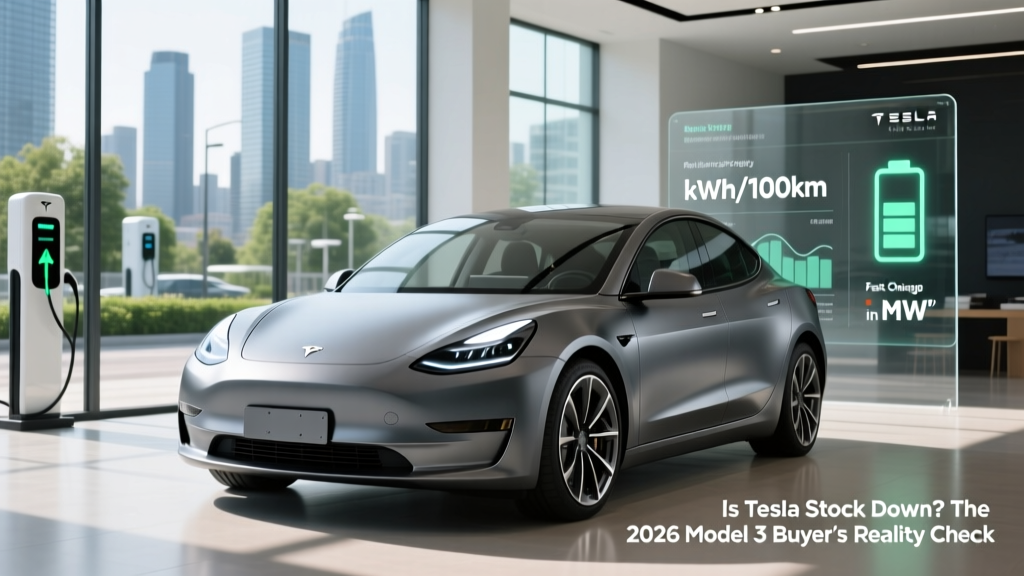
If you've searched "is Tesla stock down" lately, you've likely seen the headlines: margin pressure, increased competition from Hyundai, BYD, and legacy automakers, and Elon Musk's polarizing public persona all weighing on TSLA shares. But for EV buyers, the stock ticker matters far less than the spec sheet. A declining or volatile stock price doesn't change the engineering in the car sitting on the lot — and in 2026, the Tesla Model 3 remains one of the most efficient, best-charging electric sedans you can buy.
This review cuts through the financial noise to answer the question that actually matters if you're considering a Model 3: Is the product worth your money in 2026? We'll cover real-world range, charging speeds, tax credit eligibility under current IRS §30D rules, and how the refreshed Model 3 (often called "Highland") stacks up against rivals like the Hyundai Ioniq 6 and BMW i4.
2026 Tesla Model 3: Core Specifications
| Specification | Long Range AWD | Rear-Wheel Drive |
|---|---|---|
| EPA Range | 341 miles | 272 miles |
| Battery Capacity | ~79 kWh usable (NMC) | ~60 kWh usable (LFP) |
| Max DC Fast Charge | 250 kW | 170 kW |
| 10–80% DC Time | ~25 minutes | ~30 minutes |
| Level 2 Home Charge | 11.5 kW (~44 mi/hr) | 7.6 kW (~30 mi/hr) |
| 0–60 mph | 4.2 seconds | 5.8 seconds |
| Horsepower | 346 hp (dual motor) | 271 hp (single motor) |
| Drivetrain | AWD (dual motor) | RWD |
| Efficiency (EPA) | 132 MPGe / 25 kWh/100mi | 132 MPGe / 25 kWh/100mi |
| Cargo Volume | 23 cu ft (trunk + frunk) | 23 cu ft (trunk + frunk) |
| Rear Legroom | 35.2 inches | 35.2 inches |
| Base MSRP | $47,740 | $38,990 |
| Battery Warranty | 8 yr / 120,000 mi | 8 yr / 100,000 mi |
Source: fueleconomy.gov and Tesla's official specifications. Pricing reflects 2026 model-year MSRP before destination fees.
Real-World Range: What the EPA Sticker Doesn't Tell You
EPA Estimate: 341 miles
Real-World Highway (70 mph, mild weather): ~280–300 miles
Real-World Cold Weather (below 32°F, mixed driving): ~230–260 miles
Real-World City/Commuter (regenerative braking active): ~310–330 miles
The Model 3 Long Range's 341-mile EPA figure is legitimate for mixed driving in moderate temperatures. But EPA testing uses relatively low average speeds and includes generous regenerative braking recovery. On a 75-mph interstate run in 85°F heat with A/C blasting, expect to use about 270–290 miles of practical range before you need to stop.
Cold weather is the bigger variable. Tesla's heat pump (standard on the refreshed Model 3) significantly reduces cabin-heating energy draw compared to older resistive heaters, but lithium-ion batteries still lose effective capacity in freezing temperatures. In sub-30°F conditions, plan for a 20–30% range reduction. That 341-mile sticker becomes roughly 240–270 miles of usable range on a cold winter road trip.
The RWD model with its LFP (lithium iron phosphate) battery behaves differently. LFP chemistry tolerates regular 100% charging without the degradation concerns of NMC packs, so you can charge to full daily and actually access all 272 EPA miles — a meaningful advantage for commuters who charge at home every night.
Charging Speed: Supercharger Network Advantage
| Charging Level | Power / Rate | Miles Added per Hour | Best Use Case |
|---|---|---|---|
| Level 1 (120V household) | ~1.4 kW | ~5 miles/hr | Emergency / overnight trickle |
| Level 2 (240V home Wall Connector) | 11.5 kW (Long Range) / 7.6 kW (RWD) | 30–44 miles/hr | Daily home charging |
| DC Fast (Tesla Supercharger V3) | Peak 250 kW (LR) / 170 kW (RWD) | ~1,000+ mi/hr at peak | Road trips |
| DC Fast (CCS adapter, Electrify America) | Up to 250 kW (station-dependent) | Varies | Non-Tesla network charging |
The Model 3 Long Range peaks at 250 kW on a V3 Supercharger, but — and this is critical for buyers to understand — peak kW is not sustained kW. The charge curve tapers significantly above 50% State of Charge (SoC). You'll see 250 kW only between roughly 10–25% SoC, after which the rate progressively drops. The 10–80% time of approximately 25 minutes reflects this taper. A 10–50% sprint takes roughly 12–14 minutes, which is the more relevant metric for road-trip stop planning.
One major 2026 advantage: Tesla's North American Charging Standard (NACS) connector has been adopted by Ford, GM, Rivian, Volvo, and most major automakers. This means Supercharger stalls are getting busier, but Tesla owners still enjoy native plug-and-charge integration — no adapter needed, automatic billing, and the highest uptime rates in the industry (~97%+ station availability per Tesla's reports).
For home charging, the Tesla Wall Connector ($420) delivers up to 11.5 kW on a 60-amp circuit (48 amps continuous). Most Long Range owners will wake up to a full battery every morning with 5–6 hours of charging. Installation costs typically range from $800–$2,500 depending on your electrical panel capacity and the run distance from panel to garage. If your home has a 200-amp service panel with available capacity, expect the lower end. Older homes with 100-amp panels may need a $1,500–$3,000 panel upgrade.
Pricing, Trims, and Federal Tax Credit Eligibility
| Trim | Base MSRP | Destination | Est. Price After §30D Credit | Credit Eligibility |
|---|---|---|---|---|
| Rear-Wheel Drive | $38,990 | $1,390 | ~$32,880* | Likely eligible (≤$55K MSRP cap) |
| Long Range AWD | $47,740 | $1,390 | ~$41,630* | Likely eligible (≤$55K MSRP cap) |
| Performance AWD | $52,990 | $1,390 | ~$46,880* | Likely eligible (≤$55K MSRP cap) |
*Assumes full $7,500 §30D credit. Actual eligibility depends on buyer income, battery sourcing, and critical mineral requirements. Consult a tax professional.
Under current IRS §30D rules, the Model 3 qualifies for the federal clean vehicle credit — but eligibility is not universal. Here's the checklist:
- MSRP Cap: Sedans must be ≤$55,000. All Model 3 trims currently clear this threshold.
- Buyer Income Cap: Modified AGI must not exceed $150,000 (single), $225,000 (head of household), or $300,000 (joint filers).
- Battery Sourcing: The credit splits into two $3,750 halves — one for critical minerals, one for battery component manufacturing. Tesla's evolving supply chain means eligibility for each half can shift. Verify current-year status on the IRS clean vehicle portal before purchasing.
- Point-of-Sale Transfer: As of 2024, buyers can transfer the credit to the dealer at purchase, reducing the out-of-pocket price immediately rather than waiting for a tax refund.
Driving Experience, Tech, and Interior
The refreshed Model 3 interior is a substantial improvement over pre-2024 models. The cabin is noticeably quieter thanks to acoustic glass all around, improved suspension bushings absorb road imperfections more effectively, and the materials — ventilated front seats, ambient lighting, a rear touchscreen for passengers — feel closer to the premium segment Tesla has long claimed to occupy.
Infotainment: The 15.4-inch center touchscreen runs Tesla's proprietary OS, which remains the most responsive and feature-rich in the EV market. Navigation with real-time Supercharger routing, streaming media, and a built-in trip planner that accounts for elevation and temperature are genuinely useful daily tools. However, there is no Apple CarPlay or Android Auto — a dealbreaker for some buyers accustomed to phone projection.
Driver Assistance: Tesla's Autopilot (standard) includes adaptive cruise control and lane centering. The optional Full Self-Driving (FSD) Supervised package adds automated lane changes, traffic light recognition, and city-street navigation.
Both Autopilot and FSD (Supervised) are SAE Level 2 driver-assistance systems. The driver must remain fully engaged, hands on or near the wheel, and eyes on the road at all times. These systems do NOT make the Model 3 self-driving. Tesla's naming of "Full Self-Driving" is marketing, not a technical classification. Only Level 4 services like Waymo operate without a human driver.
Notable Drawbacks:
- No physical instrument cluster — all speed and navigation info is on the center screen, which requires glancing right.
- Turn signals are on the steering wheel (no stalks in the refresh), which some drivers find unintuitive during roundabouts.
- Visibility rearward is limited; the camera-based rearview mirror helps but takes acclimation.
- No CarPlay/Android Auto support.
- Rear seat headroom is tight for passengers over 6'2" due to the sloping roofline.
How the Model 3 Stacks Up Against Competitors
| Spec | Tesla Model 3 LR | Hyundai Ioniq 6 SE LR | BMW i4 eDrive40 |
|---|---|---|---|
| EPA Range | 341 mi | 361 mi | 307 mi |
| Battery | ~79 kWh (NMC) | 77.4 kWh (NMC) | 83.9 kWh (NMC) |
| Peak DC Charge | 250 kW | 240 kW | 200 kW |
| 10–80% Time | ~25 min | ~18 min | ~31 min |
| 0–60 mph | 4.2 sec | 5.1 sec | 5.5 sec |
| Base MSRP | $47,740 | $42,600 | $57,900 |
| Charging Network | Native NACS/Supercharger | NACS (with adapter) | NACS (with adapter) |
| CarPlay | No | Yes (wireless) | Yes (wireless) |
The Hyundai Ioniq 6 beats the Model 3 on EPA range (361 vs. 341 miles) and has a faster 10–80% charge time thanks to its 800V architecture. It also costs roughly $5,000 less and includes wireless CarPlay. The trade-off: Hyundai's charging network access requires a NACS adapter, and public CCS/EA stations still have lower uptime than Tesla's Superchargers.
The BMW i4 offers a more traditional luxury sedan experience with superior build quality and a physical instrument cluster, but its range and charging speed lag behind, and it starts nearly $10,000 higher. It suits buyers who prioritize driving refinement over maximum efficiency.
Pros, Cons, and Who Should Buy
✅ Pros
- Best-in-class Supercharger network access (native NACS)
- Top-tier efficiency: 25 kWh/100mi translates to lowest cost-per-mile
- Strong 0–60 performance across all trims
- Over-the-air updates continuously add features
- Excellent resale value relative to most EVs
- Heat pump standard for cold-climate efficiency
- Comprehensive 8-year battery warranty
❌ Cons
- No Apple CarPlay or Android Auto
- Stalkless steering wheel (turn signals, wipers on wheel) takes acclimation
- Rear headroom limited for tall passengers
- FSD subscription ($99/mo or $8,000 purchase) is expensive for Level 2
- Service center wait times can be long in some metro areas
- Insurance premiums run 15–30% above segment average
- Brand reputation polarizing for some buyers
Who the Model 3 Suits Best
Tech-forward commuters and road-trippers who value charging network reliability above all else. If you have home Level 2 charging access and take regular road trips where Supercharger coverage matters, the Model 3's ecosystem advantage is real and measurable. It's less ideal for buyers who prioritize traditional luxury finishes, need CarPlay, or want maximum rear-seat space for tall passengers.
Frequently Asked Questions
Is Tesla stock being down a reason to avoid buying a Model 3?
Stock performance reflects investor sentiment about Tesla's business trajectory — margins, robotaxi timelines, competition, and leadership. It does not affect the quality, warranty coverage, or Supercharger network reliability of a Model 3 you purchase today. Tesla's service infrastructure and charging network remain the most developed in the US. If the product meets your needs, stock volatility is not a purchase-relevant factor.
What is the real-world range of the 2026 Model 3 Long Range?
Expect 280–300 miles on a highway road trip in mild weather, 310–330 miles in city commuting with regenerative braking, and 230–260 miles in sub-freezing winter conditions. The 341-mile EPA figure assumes mixed driving at moderate speeds.
How fast does the Model 3 charge at home and on the road?
On a home Level 2 Wall Connector (11.5 kW), the Long Range adds roughly 44 miles per hour — a full overnight charge from 20–100% takes about 7 hours. On a V3 Supercharger, it peaks at 250 kW and charges 10–80% in approximately 25 minutes, though sustained rates taper significantly above 50% SoC.
Does the 2026 Model 3 qualify for the $7,500 federal EV tax credit?
The Model 3 is listed on the IRS clean vehicle credit eligible vehicles list, and all trims fall under the $55,000 sedan MSRP cap. However, your personal eligibility depends on income limits ($150K single / $300K joint), and the vehicle must meet battery sourcing and critical mineral requirements that can change throughout the year. Verify at irs.gov and consult a tax professional.
Is the Model 3 worth buying over the Hyundai Ioniq 6?
Choose the Model 3 if native Supercharger access, OTA updates, and the lowest cost-per-mile efficiency are your top priorities. Choose the Ioniq 6 if you want longer EPA range (361 mi), faster 10–80% charging (18 min on 800V), wireless CarPlay, and a lower starting price — and you're comfortable using a NACS adapter for Tesla Supercharger access.
What is the Model 3's battery warranty?
The Long Range AWD carries an 8-year/120,000-mile battery and drive unit warranty. The RWD model covers 8 years/100,000 miles. Tesla guarantees the battery will retain at least 70% of its original capacity during the warranty period. Real-world degradation data from Tesla's fleet reports suggest most Model 3 packs retain approximately 85–90% capacity at 100,000 miles.