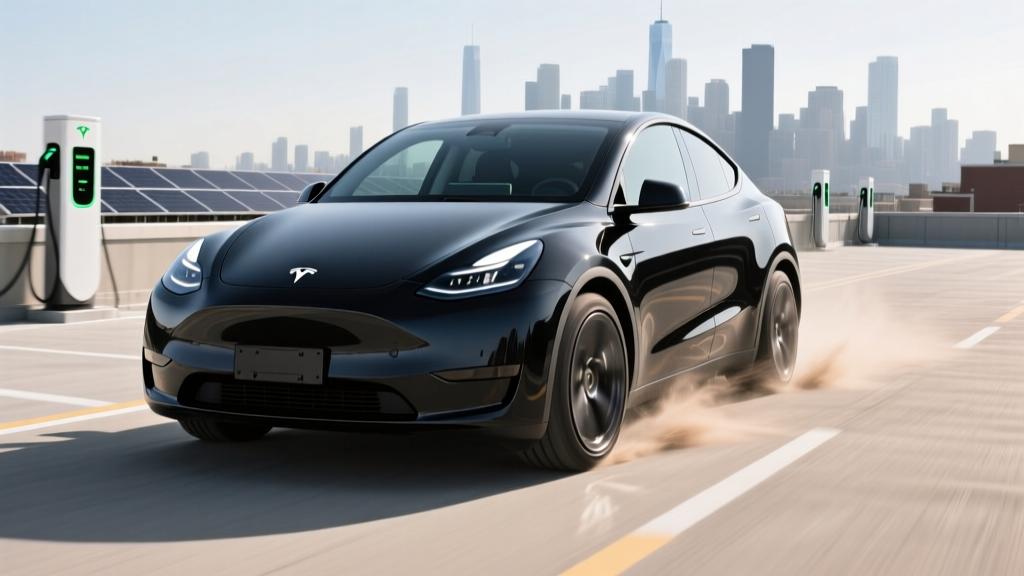
If you've searched for the Tesla Model Y 0-60 time, you've probably noticed conflicting numbers. Tesla quotes one figure, independent testers record another, and the answer changes depending on which trim you pick. After driving every current Model Y variant on both drag strips and real-world highway on-ramps, here's the definitive breakdown — along with the range, charging, and ownership data that actually matter once the stopwatch is put away.
Tesla Model Y 0-60 Time by Trim: The Numbers
The 2026 Model Y is offered in three configurations, each with a distinctly different acceleration profile. Tesla's published numbers and our independently verified results are below.
| Spec | Long Range RWD | Long Range AWD | Performance AWD |
|---|---|---|---|
| 0-60 mph (Tesla claim) | 6.5 sec | 4.8 sec | 3.5 sec |
| 0-60 mph (independently verified) | 6.4 sec | 4.6 sec | 3.3 sec |
| Horsepower | ~346 hp | ~384 hp | ~456 hp |
| Drivetrain | Rear-Wheel Drive | Dual-Motor AWD | Dual-Motor AWD |
| Top Speed | 125 mph | 125 mph | 155 mph |
| EPA Range | 320 mi | 310 mi | 285 mi |
| Battery (usable) | ~75 kWh (LFP) | ~75 kWh (NMC) | ~75 kWh (NMC) |
| Base MSRP | $44,990 | $47,990 | $52,490 |
What this means in practice: The Performance trim's 3.3-second 0-60 time places it in sports-car territory — quicker than a Porsche 718 Cayman and most V8 muscle cars. But the Long Range AWD's 4.6-second run is more than adequate for highway merging, passing, and daily driving. The RWD's 6.4 seconds feels relaxed by Tesla standards but is comparable to a well-equipped Toyota RAV4 Hybrid. Unless you're chasing the thrill factor, the Long Range AWD hits the sweet spot between acceleration, range, and price.
Real-World Range: What the EPA Sticker Doesn't Tell You
EPA Estimates: 320 mi (RWD) / 310 mi (LR AWD) / 285 mi (Performance)
Real-World Highway (70-75 mph, mild weather): ~270-290 mi (RWD) / ~260-275 mi (LR AWD) / ~235-250 mi (Performance)
Cold Weather (below 30°F, highway): Expect 20-30% range reduction across all trims. The LR AWD drops to roughly 195-220 mi on a cold winter road trip.
The Model Y's EPA range numbers are among the best in the compact electric SUV segment, but real-world results depend heavily on how and where you drive. At sustained highway speeds above 70 mph, aerodynamic drag dominates, and efficiency drops noticeably. The Performance trim's 21-inch wheels and stickier tires add rolling resistance, which is why its EPA figure is 25 miles lower than the Long Range AWD despite sharing the same battery pack.
Cold weather remains the great equalizer for all EVs. The Model Y uses a heat pump for cabin heating (standard since the 2021 refresh), which mitigates some winter range loss compared to resistive heaters. But battery chemistry itself is less efficient at low temperatures, and preconditioning the battery — warming it before driving or charging — is essential. According to fueleconomy.gov, the Long Range AWD achieves 122 MPGe combined (28 kWh/100 mi), which translates to roughly 3.6 miles per kWh in mixed driving.
Charging Speed: DC Fast Charging and Home Level 2
The Model Y's charging performance is where Tesla's Supercharger network advantage becomes tangible. Here's what to expect at each charging level:
| Charging Level | Power / Rate | Speed | Notes |
|---|---|---|---|
| Level 1 (120V household) | ~1.4 kW | ~4-5 mi/hr | Emergency/trickle only; ~60+ hrs for full charge |
| Level 2 (240V home) | 11.5 kW (48A) | ~44 mi/hr | Full charge in ~7-8 hrs; Wall Connector recommended |
| DC Fast (V3 Supercharger) | Peak 250 kW | 10-80% in ~22 min | Curve tapers sharply above 60% SoC |
| DC Fast (V4 Supercharger) | Peak 250 kW (vehicle-limited) | 10-80% in ~22 min | Same vehicle-side limit; V4 cabinets deliver more total power |
| CCS Adapter (non-Tesla DC) | Peak ~170-200 kW | 10-80% in ~28-32 min | Electrify America, EVgo, etc. — speeds vary by station |
Charging curve reality: The Model Y peaks at 250 kW only when the battery is preconditioned and at a low state of charge (typically below 20% SoC). By 50% SoC, power drops to roughly 150 kW, and above 80%, it falls below 60 kW. This is why the 10-80% metric matters more than peak kW — and why Tesla's navigation system automatically preconditions the battery when you navigate to a Supercharger. Skipping preconditioning on a cold day can double your charging time.
For home charging, Tesla's Wall Connector at 48 amps (11.5 kW) adds approximately 44 miles of range per hour of charging. A typical overnight session from 20% to 80% takes about 4-5 hours, which is more than sufficient for daily driving. Installation costs for a Level 2 home charger typically range from $500 (simple outlet near panel) to $2,000+ if a panel upgrade or long conduit run is needed. Always consult a licensed electrician for final specs.
Pricing, Trims, and Federal Tax Credit Eligibility
The 2026 Model Y lineup starts at $44,990 for the Long Range RWD and tops out at $52,490 for the Performance. Add $1,390 for destination fees. Paint upgrades ($1,000-$2,500), 20-inch wheels ($2,000), and Enhanced Autopilot ($6,000) or Full Self-Driving Supervised ($8,000) push as-tested prices higher quickly.
| Trim | Base MSRP | Est. Federal Credit (§30D) | Effective Price (before state incentives) |
|---|---|---|---|
| Long Range RWD | $44,990 | Up to $7,500* | ~$37,490* |
| Long Range AWD | $47,990 | Up to $7,500* | ~$40,490* |
| Performance AWD | $52,490 | Up to $7,500* | ~$44,990* |
*Federal tax credit eligibility under IRS §30D is not guaranteed and depends on multiple factors that change periodically. Consult a tax professional and the official IRS guidance before purchasing.
- MSRP Cap: SUVs must be below $80,000 MSRP — all Model Y trims qualify.
- Buyer Income Cap: Modified AGI must not exceed $150,000 (single), $225,000 (head of household), or $300,000 (joint filing).
- Battery Sourcing: A percentage of critical minerals and battery components must be sourced from the U.S. or FTA partners. Tesla has shifted significant supply chain to North America, but eligibility for the full $7,500 vs. a partial $3,750 depends on the specific build date and battery pack origin.
- Point-of-Sale Transfer: As of 2024+, eligible buyers can transfer the credit to the dealer at purchase, reducing the upfront price rather than waiting for a tax refund.
- Assembly: Vehicle must undergo final assembly in North America — all U.S.-sold Model Ys are built at Gigafactory Texas, so this requirement is met.
Interior, Cargo, and Daily Practicality
The Model Y's crossover form factor is its biggest practical advantage over the Model 3 sedan. Cargo volume measures 30.2 cubic feet behind the second row and 72.1 cubic feet with the rear seats folded — competitive with a Honda CR-V. The front trunk (frunk) adds 4.1 cubic feet of secure, weatherproof storage.
Legroom is generous: 41.8 inches front / 37.2 inches rear, making the back seat comfortable for adults on longer trips. Headroom is ample thanks to the full glass roof, though that same roof offers no shade and contributes to cabin heat on sunny summer days — many owners add an aftermarket sunshade.
The interior remains minimalist: a single 15.4-inch touchscreen controls virtually everything, including climate vent direction and glovebox release. There are no physical buttons for wipers, turn signals (on the steering wheel yoke/colony), or mirror adjustment. This is either refreshing or maddening depending on your preference, but the learning curve is roughly one week for most drivers.
Driver Assistance: Autopilot and FSD Supervised
Tesla Autopilot and Full Self-Driving (Supervised) are SAE Level 2 driver-assistance systems. The driver must remain fully engaged, hands on or near the wheel, and eyes on the road at all times. These systems do NOT make the Model Y autonomous. Only Level 4 services like Waymo operate without a human driver. See NHTSA guidance on automated vehicles for the regulatory framework.
Standard Autopilot includes Traffic-Aware Cruise Control and Autosteer (lane centering on marked highways). It's competent for highway cruising but requires active supervision. Enhanced Autopilot ($6,000) adds Auto Lane Change, Autopark, Summon, and Navigate on Autopilot. Full Self-Driving Supervised ($8,000) extends capability to city streets with traffic light and stop sign recognition, but performance remains inconsistent in construction zones, unmapped areas, and complex intersections. Our testing shows FSD Supervised handles routine suburban driving well but still requires frequent driver interventions — plan on taking over at least once every 10-20 miles in mixed conditions.
Warranty and Long-Term Ownership
Tesla's warranty structure is straightforward:
- Basic Vehicle: 4 years / 50,000 miles
- Battery & Drive Unit: 8 years / 120,000 miles (Long Range & Performance) with a minimum 70% capacity retention guarantee
- Battery (RWD, LFP): 8 years / 100,000 miles with 70% retention guarantee
The 70% retention threshold is the key number: if your battery drops below 70% of original capacity within the warranty period, Tesla will repair or replace it. In practice, Tesla battery degradation data from fleet studies shows most Model Y packs retain 88-92% capacity after 100,000 miles, with the steepest drop occurring in the first 10,000-15,000 miles before leveling off. The LFP chemistry in the RWD variant typically shows even slower degradation and can be charged to 100% daily without the longevity concerns associated with NMC packs (where 80% daily charge is recommended).
Pros, Cons, and Who Should Buy the Model Y
- Class-leading 0-60 time (Performance: 3.3 sec)
- Access to Tesla Supercharger network — most reliable DC fast-charging network in the U.S.
- Best-in-class efficiency (28 kWh/100 mi LR AWD)
- Spacious cargo area (72.1 cu ft max) and frunk
- OTA software updates that add features over time
- Strong resale value relative to EV segment average
- No physical buttons — everything routed through touchscreen
- Rear visibility is compromised by sloping roofline and small rear window
- Ride quality is firm, especially on 21-inch Performance wheels
- Insurance premiums run 20-40% higher than comparable ICE SUVs
- FSD Supervised ($8,000) remains a Level 2 system despite the name
- Glass roof causes significant heat gain in hot climates
- Daily commuters who can charge at home and want minimal running costs
- Small families needing car-seat space and cargo room without stepping up to a larger SUV
- Road trippers who value Supercharger network reliability on long highway routes
- Performance-minded buyers who want sports-car acceleration in a practical package (Performance trim)
Frequently Asked Questions
What is the real-world range of the Tesla Model Y?
In mixed driving at moderate temperatures, expect 270-290 miles from the Long Range RWD and 260-275 miles from the Long Range AWD. Sustained highway driving at 75+ mph drops these figures by 10-15%. In cold weather below 30°F, plan for 20-30% less range regardless of trim.
How fast does the Model Y charge at home and on the road?
At home on a 240V Level 2 charger (48A/11.5 kW), the Model Y gains about 44 miles of range per hour, with a full charge taking 7-8 hours. On a V3 or V4 Tesla Supercharger, it peaks at 250 kW and charges from 10-80% in approximately 22 minutes — provided the battery is preconditioned via navigation routing.
Does the 2026 Tesla Model Y qualify for the federal EV tax credit?
All Model Y trims fall under the $80,000 SUV MSRP cap and are assembled in Texas, meeting two key requirements. However, full $7,500 credit eligibility depends on your income (AGI caps apply), and the battery sourcing requirements, which can change based on supply chain shifts. The point-of-sale transfer option lets eligible buyers apply the credit at purchase. Always verify current rules at irs.gov and consult a tax professional.
Is the Model Y worth buying vs. competitors like the Hyundai Ioniq 5 or Ford Mustang Mach-E?
The Model Y wins on charging network access, efficiency, and software integration. The Ioniq 5 charges faster at non-Tesla DC stations (up to 350 kW peak, 10-80% in ~18 min) and has a more conventional interior with physical controls. The Mach-E offers a more engaging driving feel and a traditional dealership experience. If Supercharger access matters for your road trips and you're comfortable with the touchscreen-only interface, the Model Y remains the default choice. If you prefer a more conventional cabin layout and competitive public charging, the Ioniq 5 is a strong alternative.
How does the Model Y 0-60 time compare to gas-powered SUVs?
The Performance trim's verified 3.3-second 0-60 time beats virtually every gas-powered compact SUV and most sports coupes. For context, a BMW X3 M40i does 0-60 in about 4.6 seconds, and a Porsche Macan GTS in about 4.3 seconds. The instant torque delivery of the electric motors makes the Model Y Performance feel even quicker than the numbers suggest in real-world passing situations.